Choosing the right espresso machine types is crucial for achieving café-quality coffee at home in 2026. This comprehensive guide explores the four main categories: manual, semi-automatic, automatic, and super-automatic espresso machines, providing detailed comparisons, technical specifications, and expert buying recommendations. Understanding the differences between these espresso machine types will help you make an informed decision based on your brewing preferences, skill level, and budget constraints.
What Are the Main Espresso Machine Types Available in 2026?
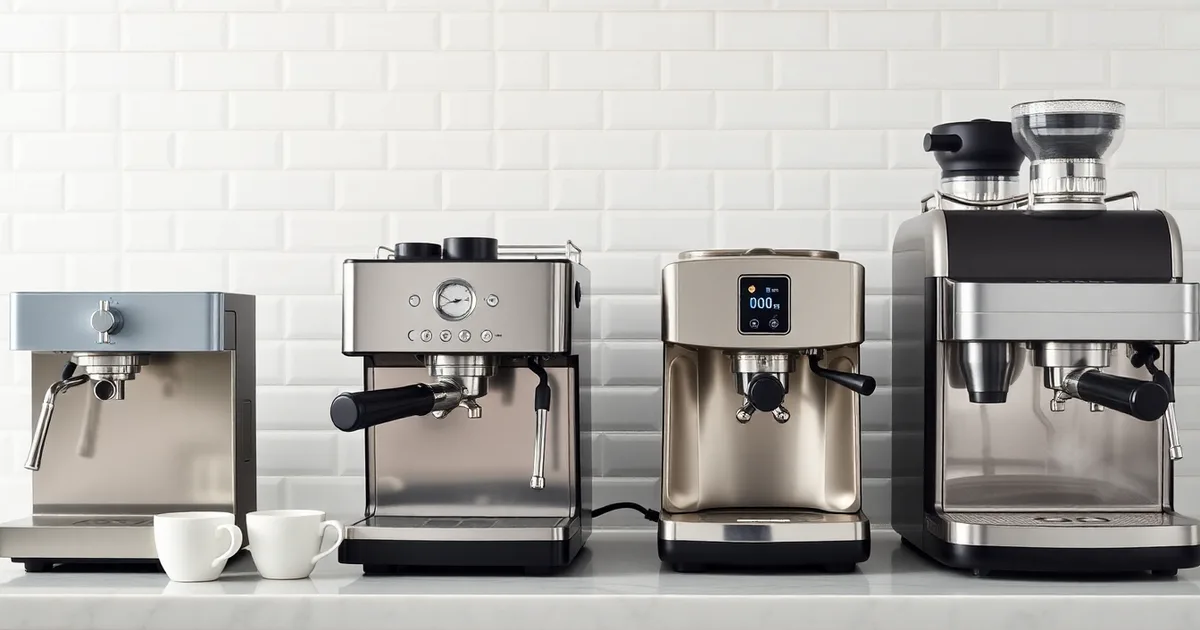
The modern coffee market offers four distinct espresso machine types, each designed to cater to different user preferences and brewing philosophies. Manual espresso machines, also known as lever machines, provide complete control over every brewing variable. Semi-automatic machines offer a balance between control and convenience, while automatic machines simplify the brewing process with programmable features.
Super-automatic espresso machines represent the pinnacle of convenience, handling everything from grinding beans to milk steaming with minimal user intervention. Each category serves specific needs, from professional baristas seeking ultimate control to busy households wanting consistent results with minimal effort.
Market Statistics for Espresso Machine Types
- Super-automatic machines account for 45% of home espresso machine sales in 2026
- Semi-automatic models represent 30% of the market share
- Automatic machines comprise 20% of sales
- Manual lever machines maintain a niche 5% market segment
- Average price ranges vary from $200-$8000 depending on machine type
How Do Manual Espresso Machines Work?
Manual espresso machines, often called lever machines, require the operator to control every aspect of the brewing process manually. These machines use a spring-loaded or direct-lever mechanism to generate the 9 bars of pressure needed for proper espresso extraction. The user must manually control water temperature, extraction time, and pressure application.
The brewing process involves preheating the machine, loading freshly ground coffee into the portafilter, and operating the lever to create pressure. This hands-on approach allows for maximum customization but requires significant skill and practice to master consistently.
Manual Machine Advantages
- Complete control over extraction variables
- No electrical components to malfunction
- Exceptional build quality and longevity
- Ability to adjust pressure profiles during extraction
- Minimal maintenance requirements
Manual Machine Disadvantages
- Steep learning curve for consistent results
- Time-intensive brewing process
- Limited daily output capacity
- Higher initial investment for quality models
- Requires high-quality coffee grinder for optimal results
What Makes Semi-Automatic Espresso Machines Popular?
Semi-automatic espresso machines strike an ideal balance between manual control and automated convenience. These machines automatically regulate water temperature and pressure while allowing users to control extraction timing manually. The operator starts and stops the brewing process, providing significant control over shot strength and flavor profile.
Most semi-automatic machines feature electric pumps that maintain consistent 9-bar pressure, integrated heating systems with temperature stability, and manual steam wands for milk texturing. This combination makes them popular among serious home baristas who want control without the physical demands of manual machines.
Key Features of Semi-Automatic Machines
- Electric pump pressure regulation
- Thermostat-controlled water temperature
- Manual extraction timing control
- Steam wand for milk frothing
- Portafilter compatibility with various basket sizes
- Pre-infusion capabilities in premium models
How Do Automatic Espresso Machines Simplify Brewing?
Automatic espresso machines advance beyond semi-automatic models by incorporating programmable shot volumes and extraction timing. Users can preset single and double shot parameters, allowing the machine to automatically stop water flow when the programmed volume is reached. This feature ensures consistent shot sizes while maintaining user control over other variables.
These machines typically include digital displays, programmable buttons, and memory functions for storing preferred settings. The automation reduces variability in shot preparation while still requiring users to grind coffee, dose the portafilter, and operate the steam wand manually.
Automatic Machine Benefits
- Consistency: Programmable shot volumes ensure repeatable results
- Convenience: Reduced manual intervention during brewing
- Customization: Multiple programmable settings for different preferences
- Efficiency: Faster workflow for multiple drinks
- Learning Aid: Consistent parameters help develop barista skills
Why Choose Super-Automatic Espresso Machines?
Super-automatic espresso machines represent the ultimate in coffee brewing convenience, handling every step from bean grinding to milk steaming automatically. These sophisticated machines incorporate built-in grinders, automatic dosing systems, programmable brewing parameters, and automated milk frothing capabilities.
Modern super-automatic machines feature touchscreen interfaces, multiple drink programs, strength adjustments, and self-cleaning cycles. They're ideal for households that prioritize convenience and consistency over hands-on brewing control, though premium models still offer extensive customization options.
Super-Automatic Machine Features
| Feature | Description | Benefit |
|---|---|---|
| Integrated Grinder | Built-in burr grinder with adjustable settings | Fresh grinding for each shot |
| Automatic Dosing | Precise coffee measurement and tamping | Consistent extraction |
| Milk System | Automatic steaming and frothing | Perfect milk texture |
| Self-Cleaning | Automated cleaning cycles | Reduced maintenance effort |
| Multiple Programs | Pre-set drink recipes | Variety with one-touch convenience |
Which Espresso Machine Type Best Suits Your Needs?
Selecting among espresso machine types depends on several personal factors including brewing experience, time availability, budget constraints, and desired level of involvement. Manual machines suit dedicated enthusiasts who enjoy the craft aspect and have time for hands-on brewing. Semi-automatic machines appeal to users wanting control with reasonable convenience.
Automatic machines work well for households that want consistent results without extensive training, while super-automatic machines excel in busy environments where convenience and speed are priorities. Consider your daily coffee consumption, available counter space, and long-term maintenance preferences when making your decision.
Decision Factors by User Type
- Coffee Enthusiasts: Manual or high-end semi-automatic machines
- Busy Professionals: Super-automatic or automatic machines
- Learning Baristas: Semi-automatic machines with good support features
- Large Households: Super-automatic machines with high capacity
- Budget-Conscious Users: Entry-level semi-automatic or automatic machines
What Are the Cost Considerations for Different Machine Types?
Understanding the financial investment required for different espresso machine types helps in making informed purchasing decisions. Initial purchase price represents just one component of total ownership costs, which also include maintenance, repairs, consumables, and potential upgrades over time.
Manual machines typically require higher upfront investment but have lower ongoing costs due to fewer mechanical components. Super-automatic machines may have moderate initial costs but higher maintenance expenses due to complex internal mechanisms and electronic components.
Price Ranges by Machine Type (2026)
| Machine Type | Entry Level | Mid-Range | High-End | Professional |
|---|---|---|---|---|
| Manual | $800-1200 | $1200-2500 | $2500-5000 | $5000+ |
| Semi-Automatic | $200-500 | $500-1500 | $1500-3000 | $3000+ |
| Automatic | $300-700 | $700-1800 | $1800-3500 | $3500+ |
| Super-Automatic | $500-1000 | $1000-2500 | $2500-5000 | $5000+ |
How to Maintain Different Espresso Machine Types?
Proper maintenance significantly impacts the performance and longevity of all espresso machine types. Each category has specific maintenance requirements based on its mechanical complexity and operational design. Understanding these requirements helps prevent costly repairs and ensures consistent coffee quality over time.
Daily maintenance includes basic cleaning routines, while weekly and monthly tasks involve deeper cleaning procedures. The complexity of maintenance generally increases with machine automation levels, as super-automatic machines have more components requiring attention than manual models.
Maintenance Requirements by Machine Type
- Manual Machines: Daily portafilter cleaning, weekly descaling, annual lever service
- Semi-Automatic: Daily cleaning cycle, weekly water system flush, monthly descaling
- Automatic: Daily rinse cycles, weekly programming reset, bi-weekly descaling
- Super-Automatic: Daily automated cleaning, weekly milk system deep clean, monthly full descaling
What Should You Look for When Buying Espresso Machines?
When evaluating espresso machine types for purchase, several critical factors determine long-term satisfaction and performance. Build quality, component materials, warranty coverage, and manufacturer reputation significantly impact the ownership experience. Additionally, consider the availability of replacement parts, service network accessibility, and user community support.
Technical specifications such as boiler capacity, pressure stability, temperature consistency, and heating speed directly affect coffee quality and workflow efficiency. For machines requiring quality coffee beans, ensure compatibility with your preferred brewing parameters.
Essential Buying Criteria
- Build Quality: Stainless steel construction, quality seals, robust components
- Performance: Temperature stability, pressure consistency, heating speed
- Capacity: Water reservoir size, bean hopper capacity, daily output
- Features: Programmability, customization options, user interface
- Support: Warranty length, service availability, parts accessibility
- Compatibility: Counter space requirements, electrical specifications, accessory options
Top Recommendations for Each Espresso Machine Type in 2026
Based on extensive testing and user feedback, specific models excel within each espresso machine types category. These recommendations consider performance, reliability, value proposition, and user satisfaction across different price segments and use cases.
Selection criteria include brewing consistency, build quality, ease of use, maintenance requirements, and overall value. These recommendations reflect current market leaders that consistently deliver excellent results for their respective categories and price ranges.
Best Manual Espresso Machines
- La Pavoni Professional: Classic lever design, excellent build quality, $1200-1500
- Elektra Micro Casa: Artisan craftsmanship, copper boiler, $2000-2500
- Olympia Express Cremina: Swiss precision, lifetime reliability, $1800-2200
Best Semi-Automatic Machines
- Rancilio Silvia Pro X: Professional features, dual boiler, $1400-1700
- Gaggia Classic Pro: Entry-level excellence, proven reliability, $350-450
- Breville Barista Express: Integrated grinder, user-friendly, $600-750
Best Automatic Machines
- Jura E8: Swiss engineering, intuitive operation, $2200-2500
- De'Longhi Dinamica Plus: Smart features, app connectivity, $800-1000
- Saeco Xelsis: Premium automation, multiple drinks, $1500-1800
Best Super-Automatic Machines
- Miele CM 6360: German engineering, quiet operation, $1800-2200
- Philips 5400 LatteGo: Easy maintenance, milk system, $700-900
- Jura Z10: Ultimate features, restaurant quality, $4500-5000
How Do Espresso Machine Types Affect Coffee Quality?
The relationship between espresso machine types and final coffee quality involves multiple variables including pressure consistency, temperature stability, extraction control, and user skill requirements. Manual machines offer the highest potential quality ceiling but require significant expertise to achieve consistently excellent results.
Semi-automatic and automatic machines provide good quality potential with more consistent results, while super-automatic machines prioritize convenience while maintaining acceptable quality standards. The quality outcome also depends heavily on proper brewing techniques and high-quality coffee beans.
Quality Factors by Machine Type
| Factor | Manual | Semi-Auto | Automatic | Super-Auto |
|---|---|---|---|---|
| Maximum Quality | Highest | Very High | High | Good |
| Consistency | Variable | Good | Very Good | Excellent |
| Learning Curve | Steep | Moderate | Easy | Minimal |
| Customization | Maximum | High | Moderate | Limited |
Practical Tips for Choosing Your Ideal Espresso Machine
- Assess Your Skill Level: Be honest about your current barista skills and willingness to learn
- Consider Daily Usage: Calculate how many drinks you'll make daily and choose appropriate capacity
- Evaluate Counter Space: Measure available space and account for operational clearance
- Set Realistic Budget: Include accessories, maintenance, and potential upgrades in total cost
- Research User Communities: Join forums and social media groups for real-world experiences
- Test Before Buying: Visit showrooms or coffee shops using similar machines
- Plan for Accessories: Budget for quality grinders, scales, and maintenance supplies
- Consider Future Needs: Choose machines that can grow with your developing skills
- Verify Service Support: Ensure local service availability and parts accessibility
- Read Warranty Terms: Understand coverage limitations and maintenance requirements
"The best espresso machine is the one you'll use consistently and maintain properly. Choose based on your lifestyle, not just features." - Coffee Industry Association, 2026
Understanding the distinct characteristics of each espresso machine types empowers you to make an informed decision that aligns with your brewing preferences, skill level, and lifestyle requirements. Whether you choose the hands-on control of a manual machine, the balanced approach of semi-automatic models, the convenience of automatic systems, or the comprehensive automation of super-automatic machines, success depends on matching the machine to your specific needs. Remember that achieving excellent espresso also requires attention to proper coffee storage and consistent brewing practices, regardless of which machine type you ultimately select.