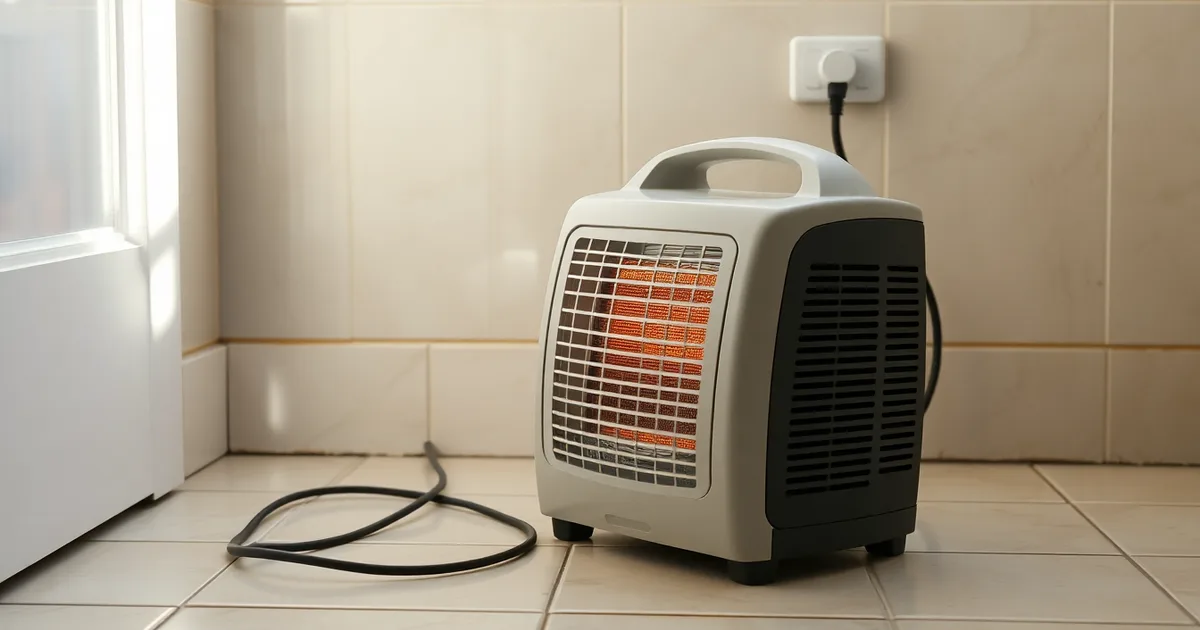
A space heater tripping a GFCI outlet means at least 5 milliamps of current is leaking to ground, usually through moisture in the heating element or a damaged cord. The outlet is doing its job, not failing. Test the heater on a non-GFCI circuit; if it trips that breaker too, replace the heater rather than bypassing the protection.
Underwriters Laboratories sets the threshold in UL 943: a GFCI must trip once leakage current hits 5 mA, give or take 1 mA. That is a tiny amount, roughly 1/200th of what a 1500-watt heater draws in normal operation. The GFCI is not measuring how hard the heater is working. It is comparing the current going out on the hot wire against the current coming back on the neutral, and a heater pushes about 12.5 amps out and back at 120 volts. If 5 mA of that goes missing to ground instead of returning, the device cuts power in under a second.
The number that surprises people is the 2.5 amps of headroom. A 1500-watt heater on a 15-amp circuit leaves only that much spare capacity, which is why running one alongside a hair dryer or a shop vac in a garage can trip a standard breaker. But that is a different failure. A breaker tripping means overload or short circuit, typically at 15 amps or more. A GFCI tripping at 5 mA is a ground-fault problem, and it happens even when nothing else is plugged in.
Moisture is the usual culprit in a bathroom or garage. Most portable heaters use a nichrome element wrapped in magnesium oxide insulation; when damp air or condensation works into that insulation, leakage climbs past the threshold. Cracked cords and degraded insulation do the same thing. You can dry a heater out and try again, and sometimes it holds for a season, but the fault tends to come back. Ground-fault protection has been required for bathroom, garage and outdoor receptacles since the 1970s, and the 2020 National Electrical Code extended it to many 125–250V outlets, so there are fewer and fewer non-GFCI places to hide a faulty heater anyway.
- UL 943 threshold: A GFCI is required to trip when leakage current reaches 5 mA (±1 mA), which is why a heater leaking just a few milliamps shuts the circuit down.
- Leakage, not load: A 1500-watt heater drawing 12.5 amps at 120 volts trips a GFCI because of current lost to ground, not because of total amperage.
- Breaker versus GFCI: A standard breaker tripping means overload or short circuit at 15 amps or more; a GFCI tripping means a ground fault at 5 mA or more.
- Common cause: Portable heaters use a nichrome element inside magnesium oxide insulation, and moisture penetrating that layer is the most frequent reason leakage rises.
- Do not bypass: Moving the heater to a non-GFCI outlet removes the protection, not the fault. If it trips any circuit, replace the heater.
What does it mean when a space heater trips a GFCI outlet?
A GFCI does not measure how much power you are pulling. It measures the difference between the current going out on the hot wire and the current coming back on the neutral. Those two numbers should match almost exactly. When they don't, some current is escaping somewhere else — through a person, through water, through a damaged conductor — and the GFCI cuts power. The trip threshold is 5 milliamps, plus or minus 1 mA, as defined in UL 943 (the standard's 2015 revision). Five milliamps is roughly the point where a shock starts interfering with your heartbeat.
That missing current is called leakage. On a space heater, the path is usually the nichrome heating element itself. The wire is wrapped in magnesium oxide insulation and sealed inside a metal sheath, and when that seal is compromised — a crack, a pinhole, years of thermal cycling, or just damp dust sitting on the element — current finds its way to the heater's metal housing and from there to ground. Industry testing in 2024 found damp elements leaking past 10 mA, double the trip threshold. Your outlet is not faulty. It is reporting a fault.
Why an overload looks different
An overloaded circuit trips the breaker, not the GFCI, and it takes minutes rather than milliseconds. A 1500-watt heater draws 12.5 amps at 120 volts, which is fine on the 15-amp circuit in a bedroom but marginal on a 20-amp garage circuit already feeding a freezer. Breaker trips are about heat and time. GFCI trips are about current going where it shouldn't, and they happen fast.
The timing tells you something. A heater that trips the GFCI within one or two seconds of power-on has severe leakage — damaged insulation, most likely, and it is done. One that runs for ten or twenty minutes and then trips is usually pulling moisture out of a humid bathroom or garage floor; the element heats, the moisture migrates, and the leakage crosses 5 mA. That second case is worth unplugging the heater, letting it dry somewhere warm for 24 hours, and testing it on a known-good GFCI. If it trips again dry, it fails. Replace it. A new heater runs $30–$100; a GFCI outlet costs $15–$25, and swapping it changes nothing about where the current is going.
Is the heater or the outlet at fault? How to tell in 5 minutes
This procedure applies when a GFCI trips only while the space heater is running and resets fine with nothing plugged in. It needs one working outlet you trust, one non-GFCI outlet on a different circuit, and about five minutes. No multimeter required. A lamp or phone charger is enough to prove the outlet itself is healthy.
- Unplug the heater. Press RESET on the GFCI. If it clicks and holds, the outlet is alive. If RESET will not stay in, stop here — the GFCI has failed and needs replacing. A new one costs $15–$25 at any hardware store. Takes two minutes with a screwdriver, ten if the box is crowded.
- Plug a known-good device into the same GFCI. A table lamp, a phone charger with an indicator light, a hair dryer on low. Confirm it runs. Press TEST, then RESET again with the lamp still plugged in. The lamp should blink off and come back. That confirms the outlet trips and resets correctly — roughly five seconds of work.
- Plug the heater back into the same GFCI. Note how fast it trips. Under two seconds from power-on points to serious leakage in the element or its wiring. Tripping after several minutes, or only on humid mornings, points to moisture creeping into the housing. Both are faults. The speed just tells you how bad.
- Do not plug the heater into a non-GFCI outlet as a fix. This is the step people botch. "It works on the other outlet" is not a diagnosis; it is the removal of a safety device that was doing exactly what UL 943 requires it to do. Every GFCI made since the 2015 revision of UL 943 trips at 5 mA ±1 mA. A non-GFCI outlet has no equivalent sensor. It cannot tell you the heater is leaking.
- If you want a second opinion, plug the heater into a non-GFCI outlet on a different circuit — a bedroom or living room circuit, not the garage or bathroom. Watch the breaker. Most space heaters draw 1500 watts, or 12.5 amps at 120 volts, against a 15-amp circuit. That leaves about 2.5 amps of headroom. If the breaker trips within a minute or two, the heater is pulling more than its rating or has a short. Either way, it is faulty.
- If the heater runs on that non-GFCI circuit without tripping the breaker, you have your answer. The heater is leaking somewhere between roughly 5 and 15 mA to ground — enough for a GFCI to catch, not enough for a 15-amp breaker to notice. Breakers trip in the 15–20 amp range. The gap between 5 mA and 15 amps is where people get shocked.
- Retire the heater. A replacement costs $30–$100 from Lasko, Vornado, De'Longhi or Dyson. Repair is not an option for a homeowner: the leakage path is usually inside the nichrome element or through degraded magnesium oxide insulation, both sealed at the factory.
What goes wrong is the obvious one. The heater "works fine" on the bedroom outlet, so it goes back into service, gets carried into the garage on a wet morning in January, and the next person to touch the metal grille and a grounded surface at the same time becomes the path to ground. A GFCI has been required in bathrooms since 1975 and in garages since 1978 under NFPA 70. Those dates are not trivia. They mark the point at which the code stopped trusting heating elements and bathroom outlets to stay dry on their own.
The outlet is not the problem. It is the only part of this system that is currently working.
Why moisture is the most common culprit (and what to do about it)
Inside a nichrome heating element, the wire that actually glows is packed in magnesium oxide — a white mineral powder that conducts heat well and electricity not at all, provided it stays dry. Magnesium oxide is hygroscopic. Leave a heater in a damp basement or an unheated garage through a wet spring and that powder pulls water out of the air. Water carries ions, ions carry current, and now a small amount of electricity has a path from the live element to the metal sheath around it, and from there to ground through whatever touches the case. That is leakage current, and a GFCI trips at 5 mA ±1 mA under UL 943. Industry testing in 2024 measured damp elements leaking past 10 mA, double the threshold.
So the first thing to try costs nothing. Plug the heater into a non-GFCI outlet somewhere dry — a bedroom or living room circuit is fine for this test only — and run it on high for 10 to 15 minutes. The element self-heats to several hundred degrees Celsius and drives the absorbed moisture back out. Let it cool, then try the GFCI again. If it holds, you have your answer: the heater is fine, the storage location is not, and a sealed plastic bin with a desiccant pack will prevent a repeat next season. If you have nowhere non-GFCI to run it, a 15-minute session on a 20-amp garage circuit that isn't GFCI-protected works too, as long as nothing else is drawing on that circuit.
When drying doesn't fix it
If the heater still trips after a full dry-out cycle, the magnesium oxide has degraded permanently. Repeated moisture cycling cracks the insulation, and once that happens the leakage path is baked in — no amount of running it will close it up. You can confirm the diagnosis by watching the timing. A unit that trips within one to two seconds of power-on has severe leakage; one that trips randomly after several minutes is usually still just accumulating moisture. The first pattern means replace it. At $30–$100 for a new Lasko, De'Longhi, or Vornado against $15–$25 for a GFCI outlet, swapping the outlet to make the symptom go away is the more expensive mistake in every sense.
Replacing the heater is not optional here, and it is not about convenience. A GFCI exists precisely to catch this failure mode before the metal grille or the cord's ground pin becomes a shock path through a wet bathroom floor. Defeating it with a non-GFCI outlet, an extension cord run to a different room, or a piece of tape over the RESET button leaves a heater leaking 10 mA sitting in the one room in the house where someone is most likely to be barefoot on a wet surface. The outlet is not malfunctioning. It is telling you something true.
How much leakage current is dangerous?
The number that matters is 5 milliamps. That is 0.005 amps, roughly one two-hundredth of what a 1500-watt space heater draws at full tilt. UL 943, the standard governing GFCI devices, requires a receptacle to trip somewhere between 4 and 6 mA of current imbalance (5 mA ±1 mA, as revised in 2015). Underwriters Laboratories did not pick that figure arbitrarily. It sits just below the level where most adults can still let go of a live conductor on their own.
Two milliamps is a faint tingle. Five is a distinct shock you feel in your hand and wrist. Between 10 and 20 mA the muscles in your forearm contract and you cannot release your grip — the current holds you to the conductor. At 30 mA, sustained across the chest, breathing stops and the heart can enter ventricular fibrillation. Above roughly 50 mA the risk of death climbs sharply. So the trip threshold is not a nuisance setting; it is a line drawn a few milliamps below the point where a healthy adult loses voluntary control of their own arm.
A heater with a damaged element does not leak 5.1 mA. Industry testing through 2024 has measured leakage above 10 mA on damp or cracked heating assemblies, and sometimes well above that — double the trip point or more. The path is the nichrome element inside its magnesium oxide insulation: if moisture reaches the element, or the insulation cracks from years of thermal cycling, current bleeds through to the metal sheath and then to the grounded chassis. The GFCI sees current going out on the hot leg that is not coming back on the neutral, and it opens the circuit. If you unplug that same heater and move it to a non-GFCI receptacle, nothing trips. The outlet has no way to sense the imbalance. The heater runs, the chassis sits at a potential above ground, and the next person who touches it and a grounded surface at the same time completes the circuit.
This is the part homeowners get backwards. The GFCI is not failing. It is the only device in the circuit that can detect the fault, and it is telling you the heater has become a shock hazard. A replacement outlet costs $15 to $25, a replacement heater $30 to $100 — which is why the trade-off resolves the way it does. For a heater with an obvious cause (stored in a damp garage, used in a bathroom where steam condenses inside the housing), drying it out for a day and retesting on a known-good GFCI is reasonable. For a heater that trips within a second or two of power-on, the element is already compromised, and the only correct action is to stop using it.
What's the difference between a tripping GFCI and a tripping breaker?
A GFCI and a circuit breaker sit on the same circuit and protect against completely different things. The breaker watches current volume — it trips when you pull more than 15 amps through a 15-amp circuit, or when a hot wire touches neutral. The GFCI watches current balance. It compares the current going out on hot to the current coming back on neutral, and if the two differ by 5 mA ±1 mA, it cuts power in under a second. The standard is UL 943, and that 5 mA threshold has been the requirement since the 2015 revision. A heater drawing a normal 12.5 amps at 120 volts can pass through a breaker without a flicker while leaking 8 mA to ground and tripping the GFCI every single time.
That asymmetry is the whole story. Your breaker does not care about 8 mA. It never will. Leakage that small is invisible to a thermal-magnetic breaker, which is why a failed heating element can trip one device and not the other.
| What tripped | Trip threshold | What it detects | Typical reset behaviour | Implication for the heater |
|---|---|---|---|---|
| GFCI outlet | 5 mA ±1 mA (UL 943) | Current leaking to ground | Reset holds until heater draws power again | Heating element or wiring is leaking; shock hazard |
| 15-amp breaker | 15 amps continuous | Overload or short circuit | Reset holds until load exceeds 15 A again | Too much load on the circuit, not a leakage fault |
| 20-amp breaker (garage, kitchen) | 20 amps continuous | Overload or short circuit | Reset holds until load exceeds 20 A again | Heater alone at 12.5 A is fine; second load is the problem |
| GFCI trips in 1–2 seconds | Leakage present at power-on | Severe, immediate leakage path | Won't hold at all | Element failure, not moisture; replace the heater |
| GFCI trips after 5–20 minutes | Leakage builds as element heats | Moisture or degraded magnesium oxide insulation | Holds briefly, then trips again | Damp element; may dry out, may not |
If your GFCI trips and the breaker does not, the heater is the problem — every row in that table points the same way, and the fix is a new heater ($30–$100 at 2026 prices) rather than a $15–$25 GFCI that keeps doing its job. The one case where it flips: if the breaker trips alongside the GFCI, or the breaker trips on its own with the heater on a shared 15-amp circuit, you have an overload problem and the GFCI is a bystander — add up the load (a 1500-watt heater plus a 1200-watt hair dryer on a 15-amp circuit is 22.5 amps) before you blame the heater.
Can a space heater be too powerful for a GFCI circuit?
No. A 1500-watt heater on a 120-volt circuit draws 12.5 amps, and that is comfortably inside what a standard 15-amp branch circuit is designed to carry — 80% of 15 amps is 12 amps continuous, and UL lists most 1500W portable heaters for exactly this reason. The GFCI is not watching that 12.5 amps at all. It compares the current going out on the hot wire with the current coming back on the neutral, and it trips when those two differ by 5 milliamps (±1 mA) or more, per UL 943. Twelve and a half amps out and 12.5 amps back is a perfectly balanced circuit. The GFCI sees nothing.
When you actually do exceed the circuit, a different device fires. A 15-amp breaker on a 14-gauge wire will trip on overload or short circuit, and a GFCI on that same circuit will typically keep working just fine because it isn't an overcurrent device. That is the distinction people get backwards. If running the heater and a hair dryer together kills the power, the breaker tripped. If the heater alone kills the power at the outlet and you have to press RESET, the GFCI tripped — and that means imbalance, not excess draw.
There is a persistent belief that moving up to a 20-amp circuit solves this. It does not. A 20A circuit (12-gauge wire, common in garages and kitchens under NEC 2023 requirements) will happily carry the heater plus a shop vac, but the GFCI on that circuit still trips at 5 mA. If the nichrome element has compromised magnesium oxide insulation, or moisture has bridged the gap between the element and its metal sheath, the leak to ground follows the heater wherever it goes. Plug it into a 20A bathroom GFCI — required by the NEC since 1975 for bathrooms, 1978 for garages — and it will trip there too. The same is true for the 30-amp RV pedestal some people try in a pinch, which is a genuinely bad idea for other reasons.
One caveat that catches people: a GFCI that trips within a second or two of power-on is telling you the leakage is severe and immediate. One that trips after five or ten minutes of running is often moisture accumulating as the element heats. Both point to the heater. Neither points to wattage.
When should you replace the space heater?
Repair makes sense for a $400 Dyson AM09 with a bad switch. It does not make sense for a $45 Lasko ceramic tower that leaks current to ground, because the leaking part — the nichrome wire and its magnesium oxide insulation — is the part that costs money and cannot be inspected from outside. The criteria below are ordered by how quickly they turn into a decision.
- The heater trips a GFCI on a second circuit after the plug and cord are dry. This is the decisive test. A GFCI trips at 5 mA ±1 mA under UL 943, and if two independent GFCIs on two different circuits both trip, the fault is inside the appliance. There is no homeowner repair for that.
- It trips within one or two seconds of power-on. Field observation from 2023 put fast trips in the severe-leakage category — the element is dumping current to ground as soon as it heats. Slow, random tripping after several minutes usually points to moisture, which can sometimes be driven off. Instant tripping does not clear up.
- The cord is frayed, kinked at the strain relief, or warm to the touch. A 1500-watt heater pulls 12.5 amps at 120 volts. A cord with damaged insulation at that current is a fire risk independent of any GFCI, and splice-and-tape repairs on a heater cord void the UL listing.
- The plug or the receptacle face is discolored, brown, or smells acrid. That is heat damage from a loose or corroded connection. On a 15-amp circuit already loaded near capacity, the plug body can reach temperatures that char the plastic. Once the prongs have discolored, replace the heater.
- The element, reflector, or grille shows visible damage. Cracked ceramic insulators, a sagging element that touches the housing, or scorching on the reflector means the element-to-ground path is compromised. Any of these is an immediate replacement, not a wait-and-see.
- The unit is old enough that you cannot find a model number or a UL mark. Heaters sold before the 2015 UL 943 revision were tested against a looser standard. A $30 replacement with a current UL listing is cheaper than an electrician's service call, which runs $100–$200 in most US metros in 2026 just to look at it.
- You have already moved it to a non-GFCI outlet to make it stop tripping. That is the one that matters most. You have removed the device that was protecting you and kept the fault. Replace the heater today and put the circuit back on GFCI protection.
The step people skip is the dry-and-retest step. A heater that sat in a damp garage for a month can trip a GFCI purely from surface moisture on the element, and after two or three days in a dry room it may test clean on a second circuit. Test it twice, on separate days, before you decide. If it trips both times, the answer is a new heater — $30 to $100 against the cost of a shock injury or a house fire, which is not a comparison worth deliberating over.
Can you use a space heater on a GFCI outlet at all?
Yes, and in most of the places you would actually put one, it is required. The National Electrical Code has mandated GFCI protection in bathrooms since 1975 and in garages since 1978, and those two rooms are where a majority of portable electric heaters end up. If your heater is plugged into a GFCI-protected bathroom or garage receptacle and nothing trips, the setup is correct and the protection comes free with the circuit.
A heater in sound condition will not trip a GFCI. The trip threshold is 5 milliamps, plus or minus 1, under UL 943, and that is measured as current going somewhere it should not — through you, through standing water, through a damaged cord. A working nichrome element sits inside magnesium oxide insulation inside a sealed metal sheath; nothing should be leaving the circuit. So when a 1500-watt heater drawing roughly 12.5 amps at 120 volts trips an outlet that has been fine for years, the fault is downstream in the appliance, not in the outlet's 5 mA comparator.
The temptation is to move the heater to an unprotected receptacle and call it fixed. Do not. You will have removed the only thing standing between a leaking element and a person touching a metal faucet, a concrete floor, or a grounded appliance at the same time. A GFCI receptacle costs $15 to $25 and swaps into an existing box in about twenty minutes; a replacement heater runs $30 to $100, which makes the cheap fix the one that actually addresses the problem.
What the tripping already tells you
Timing separates two different failures. A heater that kills the GFCI within one or two seconds of power-on is leaking hard — field observation puts that pattern with badly compromised insulation, and the unit is done. Random tripping after several minutes usually means moisture has collected in the element housing or the plug, which happens with bathroom steam, a cold garage, or a heater stored in a damp basement. Drying it out and retrying it once is reasonable. Replacing the GFCI to stop the nuisance trips is not.
Two practical notes before you buy anything. Check the heater's nameplate against the circuit: a 1500-watt unit on a 15-amp circuit is at 83% of capacity, which is legal for continuous duty under NEC but leaves nothing for a hair dryer on the same run, and Lasko, Vornado, De'Longhi and Dyson all sell 1500-watt models that draw the same load. If you want a heater that is gentler on a shared circuit, a 750-watt low setting on a dual-wattage unit is the honest answer, though it will heat a small bathroom and not a two-car garage. Second, if the replacement heater also trips the same GFCI, stop replacing heaters and call an electrician — that pattern points at wiring, not appliances.
Frequently Asked Questions
Why does my space heater trip the GFCI only sometimes?
Intermittent trips usually mean leakage current is fluctuating, not constant. A GFCI is required by UL 943 to trip somewhere between 4 and 6 milliamps, so a heater sitting right at 4.5 mA on a dry day can cross the threshold once indoor humidity climbs. A hairline crack in the element's magnesium oxide insulation behaves the same way, leaking more as the element heats and expands.
Can a space heater trip a GFCI if it's brand new?
Yes. A unit stored in an unheated garage or damp warehouse picks up moisture in the element and trips on first plug-in. That usually clears after 24 to 48 hours in a dry, warm room. If a new heater still trips a known-good GFCI after that, treat it as a manufacturing defect in the element insulation and return it, since the 2017 UL 1278 revision tightened leakage limits and a bad batch does slip through.
Will a space heater trip a GFCI if the outlet is faulty?
A failing GFCI can nuisance-trip on any load, but the test is simple: unplug the heater and run a lamp or phone charger on the same receptacle. If that also trips, the GFCI is the problem and needs replacing. If it holds fine and the heater alone trips it, the leakage is in the heater. GFCIs carry a five-year average lifespan and the test button should be pressed monthly.
Is it safe to plug a space heater into a GFCI outlet?
Safer than a standard receptacle, yes. A GFCI cuts power within about 25 milliseconds once leakage reaches 5 mA, which is well below the roughly 10 mA where a person can lose muscle control. GFCI protection is also required in garages, bathrooms and unfinished basements under NEC 210.8. When the GFCI trips repeatedly, though, that is the heater telling you it has a leakage path, not the outlet being overprotective.
What size space heater can I use on a 15-amp circuit?
Keep continuous draw at or below 12 amps, which is 1440 watts at 120 volts. That 80 percent rule comes from NEC 210.20(A) and is why nearly every 1500-watt heater sits exactly on the line. Oversizing is not what trips a GFCI, though. A 750-watt heater with a compromised element will trip a GFCI while a healthy 1500-watt unit on the same circuit will not.
Why does my space heater trip the GFCI but not the breaker?
They detect completely different things. A GFCI trips at 5 milliamps of leakage to ground; a standard 15-amp thermal-magnetic breaker needs 15 to 20 amps of overload or a hard short before it opens. So 5 mA of current escaping through a damp element or a pinched cord is invisible to the breaker but instantly fatal-adjacent, which is exactly the gap GFCIs were invented to close.