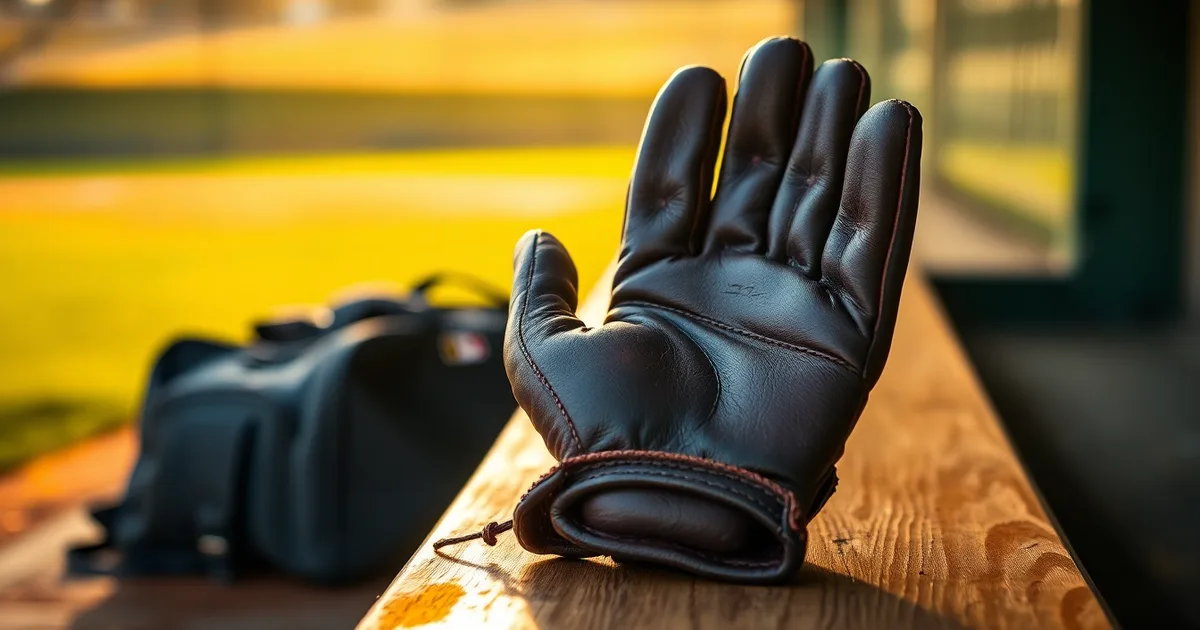
That ammonia smell is bacteria on your hands converting urea in sweat into ammonia, and leather holds the moisture that keeps them working. Clean the glove inside and out with a pH-balanced leather cleaner in the 5–7 range, never vinegar or bleach, then dry it fully away from direct heat.
The sharp, almost urine-like bite is the giveaway. Plain sweat smells sour or salty; ammonia means the urea in your sweat — roughly 1 to 2 grams per litre for an adult — has already been broken down by Corynebacterium and Staphylococcus species that live on human skin. Those bacteria colonise the lining and palm of a batting glove within a few wears and keep producing ammonia as long as the leather stays damp.
And it stays damp far longer than you'd guess. A full-grain leather glove that gets soaked through in a nine-inning game on a humid July afternoon can take 24 to 48 hours to dry at room temperature, and much longer if it's shoved into a gear bag. Rotate two gloves and each one gets the drying window it needs.
Almost every search result on this recommends white vinegar or a bleach solution. Both are wrong. Vinegar sits around pH 2.4 and bleach around pH 12.5; leather is happiest at pH 5–7, so either one strips the tanning oils from the fibres and leaves you with a stiff, cracked glove that smells like vinegar and ammonia.
- Ammonia comes from urea: Skin bacteria break urea in sweat into ammonia, which is why a worn batting glove smells sharp rather than merely salty.
- Leather dries slowly: A saturated leather glove needs 24–48 hours to dry thoroughly, so a single glove used daily never fully dries out.
- Skip vinegar and bleach: Vinegar (pH ~2.4) and bleach (pH ~12.5) both fall outside leather's comfortable pH 5–7 range and cause cracking.
- Use pH-balanced cleaner: A leather cleaner formulated between pH 5 and 7 kills odour bacteria without stripping the tanning oils out of the hide.
- Rotate two gloves: Alternating gloves between games gives each one a full 24–48 hours of air drying, which is the single biggest factor in preventing recurrence.
What actually causes the ammonia smell in batting gloves?
The smell is ammonia, and it is manufactured inside your glove. Human sweat carries roughly 0.5 to 2.5 g/L of urea, a nitrogenous waste your body produces when it breaks down protein. On its own, urea is odorless. The trouble starts when bacteria that live on skin and leather get to it. Species like Staphylococcus epidermidis and Corynebacterium carry urease, an enzyme that splits urea into ammonia and carbon dioxide. That reaction is the entire source of the sharp, cat-urine smell. You are not smelling stale sweat. You are smelling a chemical product.
Your nose is unusually good at catching it. Ammonia becomes detectable at concentrations as low as 5 ppm, which is why a glove can reek the moment you pull it out of a bag even though it looks clean and dry to the touch. Warmth accelerates the whole process: in a moist glove at body temperature, these bacteria can double every 20 to 30 minutes. Leave a sweaty glove in a closed equipment bag overnight and you have given them eight hours of ideal conditions.
Why leather makes it worse
Leather is skin, and it behaves like skin. Its porous, fibrous structure absorbs sweat into the deeper layers rather than letting it sit on the surface where it would evaporate. That trapped moisture becomes a reservoir. Every time you put the glove on, your hand heat re-activates the bacteria still living in those pores, and the ammonia comes back within minutes. This is why wiping the surface with a damp cloth does nothing lasting, and why a glove that smelled fine two weeks ago can suddenly turn. It also explains why synthetic gloves with moisture-wicking fabric linings rarely develop the problem to the same degree: they shed water instead of holding it. Franklin Sports, Nike and Rawlings all sell gloves with varying degrees of leather content, and the more full-grain leather in the palm and backing, the more pronounced this gets.
One thing worth flagging before you reach for a home remedy. The smell is a bacterial signal, not a cleanliness verdict, and the fix has to address both the bacteria and the moisture they need. Most of the advice circulating online skips the second half.
Which bacteria are responsible?
The ammonia smell is a biological process, not a laundry problem. Two groups of bacteria that live on human skin by default get transferred into the glove within the first few wears, and once they are inside a warm, damp leather shell they start converting the urea in your sweat into ammonia gas. Ammonia becomes detectable to the human nose at roughly 5 ppm, which is why the smell can arrive suddenly and seem out of proportion to how much you have actually sweated.
- Staphylococcus epidermidis. This is the most common bacterium on human skin, present on essentially everyone. It is normally harmless, but it is a prolific biofilm former, which is why it clings to the lining of a glove instead of washing away with a rinse.
- Corynebacterium. A genus of Gram-positive rods that colonise skin, particularly in moist areas such as the palms and the spaces between fingers. Corynebacterium species are the ones most strongly associated with the sharp, acrid note in body odour, and they are the reason a glove can smell worse than a gym shirt.
- Urease production. Both organisms produce the enzyme urease, which catalyses the hydrolysis of urea into ammonia and carbon dioxide. Urea is not the waste product you might assume: human sweat contains roughly 0.5–2.5 g/L of it, and it is the raw material the bacteria need.
- Doubling time of 20–30 minutes. Under warm, moist conditions with a urea supply, these bacteria can double roughly every 20 to 30 minutes. A glove worn for a three-hour practice and left in a bag overnight can host several generations of growth before you next open the bag.
- The glove interior is the perfect incubator. Leather is a protein-based material with a natural porosity that traps sweat, and the closed space inside a glove holds moisture for hours. Skin temperature at the palm sits around 32–35°C, which is squarely in the range these bacteria prefer.
- Why the smell gets worse over time. Each session adds more urea, more dead skin cells, and more bacteria. The population compounds, and the leather's ability to release moisture decreases as it becomes saturated with salts and oils.
- Why the smell does not mean the glove is ruined. The bacteria are on the lining and in the surface pores, not bonded into the leather structure. A pH-balanced cleaner with a pH between 5 and 7 will kill them without stripping the leather's tanning agents, which is what alkaline cleaners and bleach do.
The item most people get wrong is Corynebacterium. Because it is a genus rather than a single species, and because it is also the culprit behind underarm odour, players assume the fix is the same as for a shirt: hot water, detergent, bleach. On leather that sequence destroys the finish and accelerates cracking. The bacteria are killed just as effectively by a pH-balanced leather cleaner such as Lexol, Leather Honey, or Bickmore, applied with a soft cloth and allowed to sit for the contact time on the label. Baking soda and vinegar do not kill S. epidermidis biofilms; they just temporarily neutralise the surface ammonia, which is why the smell returns within days.
Is an ammonia smell dangerous?
At the concentrations a batting glove produces, no. Ammonia becomes detectable to the human nose at roughly 5 ppm, and the amount off-gassing from a sweaty glove sits near that threshold. You are smelling it because your nose is extremely sensitive to ammonia, not because the glove is releasing something toxic. Nobody has been poisoned by a batting glove.
The real risk is to your hand, not your lungs. Once Staphylococcus epidermidis and Corynebacterium are established in the lining, they keep multiplying in the warm, damp space between leather and skin. Under favourable conditions that population can double every 20 to 30 minutes. The result is contact dermatitis, itching between the fingers, or a fungal infection such as tinea manuum that hangs around for weeks. If you already have cracked skin or a hangnail, the same bacteria can turn a minor break into something that needs a doctor.
Two groups should treat this less casually. People with diabetes need to be careful with any foot or hand infection because poor circulation slows healing, and a glove that stays damp against the skin is exactly the environment that turns a small abrasion into a problem. The same goes for anyone with eczema or known sensitivity to rubber accelerators, which are common in the synthetic palm panels on Franklin Sports and Nike batting gloves. For those players, a glove that smells strongly is a signal to clean it now rather than at the end of the season.
What the smell does not tell you
Odour intensity is a poor proxy for how contaminated the glove is. A glove can carry a heavy bacterial load and smell only faintly when cold, then release a sharp ammonia hit the moment your hand warms it up. Judge by symptoms instead: persistent itch, redness, skin that peels after you take the glove off. Those are the reasons to act. A smell alone is a hygiene problem, not a medical one.
How to clean a batting glove without ruining the leather
This procedure applies once a glove has a persistent ammonia smell that airing out overnight no longer fixes, and it works for full-leather and leather-palm gloves. It does not apply to a glove that is already cracked, stiff as cardboard, or growing visible fuzz, because the damage is past cleaning. You need a pH-balanced leather cleaner with a pH between 5 and 7, two or three microfiber or terry cloths, a bowl of lukewarm water no hotter than 30°C (86°F), and a dry towel. Budget about 40 minutes of hands-on work and roughly 12–24 hours of drying time. A bottle of Lexol Leather Cleaner runs about $12 for 8 oz, Leather Honey Cleaner about $20, and Bickmore's leather cleaner about $18. One bottle will outlast several gloves.
- Skip the vinegar and the bleach. This is the step people botch badly. Vinegar sits around pH 2.5 and bleach around pH 12.5, and both strip the oils and tanning agents out of leather. You will kill the bacteria and destroy the glove in the same afternoon. A dedicated pH-balanced leather cleaner at pH 5–7 removes the sweat residue and the bacteria without pulling the leather's own chemistry apart.
- Brush or shake off loose dirt and dried salt before anything gets wet. A soft-bristle nail brush works fine. Salt crystals from dried sweat act like sandpaper once you start rubbing, so take the 60 seconds to get them off first.
- Dampen a cloth, do not soak it. Put a small amount of cleaner on the cloth, not directly on the glove. Two or three dime-sized drops per palm is usually enough for a full glove.
- Wipe the inside of the glove first. That is where the bacteria and the urea residue live. Work the cloth into the fingers and the palm with a circular motion for about 30 seconds per hand section, then flip to a clean part of the cloth and repeat.
- Wipe the outside of the glove with a fresh damp cloth. Use only water here if you want to be conservative, since the exterior leather sees less sweat. Keep the cloth barely damp; a wet glove takes twice as long to dry and gives bacteria another growth window.
- Wipe away all residue with a clean, damp cloth. Any cleaner left behind becomes a sticky film that traps dust and holds moisture. Rinse the cloth, wring it out, and go over the whole glove once more.
- Dry at room temperature, away from direct heat. This is the second step people get wrong. Do not put the glove on a radiator, in a car on a hot day, in a tumble dryer, or in front of a space heater. Leather should not see temperatures above 30°C (86°F), and a closed car in September can hit 60°C (140°F) in an hour. That cooks the leather, shrinks it, and cracks the palm. Set the glove on a dry towel in a room with moving air, stuff the fingers with crumpled paper or a cedar shoe tree to hold shape, and leave it 12–24 hours.
- Condition sparingly after drying if the leather feels dry to the touch. A pea-sized amount of leather conditioner rubbed in with a fingertip is enough for one glove. Over-conditioning leaves grease that seals in moisture and brings the smell back within a week.
The failure mode here is drying too fast. A glove that smells fine on the outside but still has damp leather in the finger stalls will bloom with bacteria again in two or three days, because those pockets stay warm and moist and the colony doubles every 20–30 minutes. If you can smell ammonia at all after drying, the interior is still wet, and you should repeat the wipe-and-air cycle rather than reach for a stronger chemical. Rotating two gloves and letting each dry a full 24 hours extends the usable life of both by roughly 50%, which is cheaper than replacing a $40 Franklin Sports or $70 Rawlings glove every season.
Products that work (and ones that don't)
The leather in a Franklin Sports, Nike or Rawlings batting glove is chrome-tanned collagen, and its chemistry is what rules out most of the cleaning advice you'll find in forum threads. A pH-balanced leather cleaner formulated for automotive or equestrian hides sits between pH 5 and 7, close to the leather's own mildly acidic finish, so it lifts sweat residue and the bacteria feeding on it without stripping the tanning agents. That is the whole job: remove the food source, not just the smell.
Household acids and oxidisers do the opposite. Vinegar (roughly pH 2.4) and isopropyl alcohol both pull moisture from the hide and break down the surface finish, leaving it stiff and prone to cracking. Bleach is worse; sodium hypochlorite attacks the protein structure directly and will discolour dyed leather within minutes.
| Product | pH | Typical cost | Effect on leather | Kills odour bacteria |
|---|---|---|---|---|
| Lexol Leather Cleaner | 6.5 | $10–14 per 250 mL | None; conditions as it cleans | Yes |
| Leather Honey Cleaner | 6.0 | $18–22 per 240 mL | None; leaves slight residue | Yes |
| Bickmore Leather Cleaner | 5.5 | $12–16 per 240 mL | None; formulated for saddlery | Yes |
| Saddle soap | 8.5–9.5 | $6–9 per bar | Dries and stiffens if used weekly | Partial |
| White vinegar | 2.4 | $2 per 500 mL | Strips finish, causes cracking | Yes, but damages the glove |
| Household bleach | 11–13 | $3 per 1 L | Destroys protein structure, bleeds dye | Yes, and ruins the glove |
For a glove you plan to keep for a full season, Lexol or Leather Honey is the right call: both land near pH 6, cost under $25, and need only a few drops per glove. Saddle soap is the flip case, and it's genuinely the better pick for one narrow scenario — a heavily caked glove that has never been cleaned, where you need the extra lifting power of a higher-pH bar before switching to a pH-balanced cleaner for routine upkeep. Used more than about once a month, though, that 8.5–9.5 pH saponifies the leather's natural oils and you'll be replacing the glove by midseason. If you rotate two gloves instead of one, the pH-balanced route costs the same per glove and roughly doubles the interval between deep cleans.
How do you prevent the ammonia smell from coming back?
Cleaning kills the colony you have. Prevention keeps the next one from forming, and that comes down to three variables you control: how long the glove stays wet, how much sweat reaches the leather in the first place, and where it sits between games. Miss any one of them and the smell returns within two or three outings, usually sharper than before because the residual ammonia seeds a fresh population.
- Own two gloves and alternate them. A glove worn on Monday is still holding moisture on Tuesday morning, so give each one 24 to 48 hours of air before it goes back on your hand. Manufacturers and reps commonly claim rotation adds about 50% to a glove's usable life, which lines up with the moisture math even if the exact figure is soft. The practical version: buy a second gamer in the offseason, not in June when your primary has already gone sour.
- Switch to moisture-wicking fabric or a liner. Urea only feeds bacteria once it is dissolved in sweat on a warm surface, and leather is very good at holding that film. A synthetic-back glove from Franklin Sports or Nike moves sweat away from the palm instead of soaking the hide, and a thin cotton or synthetic liner under a leather palm does the same job for a few dollars. If you play three or more times a week, this single change usually does more than any cleaning product.
- Air-dry before it goes in the bag. Take the glove out at the field, wipe the palm with a dry towel, and let it sit out for the drive home. Stuffing a damp glove straight into a zippered gear bag at 30 °C (86 °F) is close to ideal incubation: bacteria in warm, moist conditions can double every 20 to 30 minutes, which means one overnight stay in a hot car can undo a week of good habits. Never dry leather above 30 °C, and keep it off the dashboard and out of a clothes dryer.
- Store it breathable. A mesh or canvas drawstring bag beats a sealed plastic bin every time. If your bag has a vented side pocket, use it. The goal is moving air, not a sterile container.
- Add cedar. Cedar shoe trees or inserts in the glove's storage bag absorb residual moisture and mask odor, and unlike a scented dryer sheet they will not leave oils or perfumes on the leather. Refresh the cedar with a light sanding every season or two.
- Reach for a pH-balanced cleaner after wet games, not every game. Lexol, Leather Honey and Bickmore all make leather cleaners in the pH 5 to 7 range that lift sweat residue without stripping the tanning. Once a month during the season is plenty; weekly cleaning dries out the palm and causes cracking faster than the ammonia ever would. Skip the vinegar and bleach entirely.
- Wash your hands and your batting gloves' neighbors. Sweat carries roughly 0.5 to 2.5 g/L of urea, and so does the residue you transfer from a dirty grip, a shared helmet, or last night's practice shirt. Change the batting gloves inside your main glove if you wear them, and wipe down the handle of your bat.
The step people skip is drying time. Most players clean the glove, feel that it is dry to the touch on the outside, and put it back in the bag that night. The palm lining is still damp, and that is where the bacteria live. Give it the full 24 to 48 hours, in open air, at room temperature, and the rest of these habits do the work for you.
When should you replace your batting glove?
Cracked leather is the clearest signal. Once the palm or the webbing splits along a flex crease, bacteria have a permanent home in the exposed fibre and no pH-balanced cleaner will reach all of it. Stiffness matters too: a glove that has dried hard enough to resist closing around the knob is no longer doing the job it was bought for, and conditioning it back usually leaves it stretched in the wrong places. At that point you are spending Lexol and an evening to get a worse-fitting glove than the one you can buy for $40.
If the leather is still soft and intact but the ammonia comes back within two or three wears of a proper clean, the colony has moved past the surface. Staphylococcus epidermidis and Corynebacterium both settle into the inner lining and the seam stitching, which is the one area you cannot scrub without abrading the thread. Ammonia is detectable at 5 ppm, so what your nose picks up after a clean is a small residual population, not a failure of technique. Two clean-and-dry cycles that both revert within a week is the practical cutoff.
What a normal lifespan looks like
Expect one to two seasons per glove with regular use. A high school player taking 200 rounds of BP a summer will land at the short end; a rec-league player twice a week will get closer to three. Rotating two gloves and alternating them between games can push each one roughly 50% longer than a single glove used the same number of times, because the leather gets a full 48 hours to dry at room temperature instead of 12. Never accelerate that with a car dashboard or a dryer — leather above 30°C (86°F) denatures and stiffens, which is how a glove ends up needing replacement for the wrong reason.
If the glove is a $200 Rawlings Heart of the Hide or a Nike Sha|Do and the leather is sound, clean it properly, dry it with a cedar shoe tree stuffed inside, and get another season. If it is a $25 Franklin Sports model with a synthetic palm, the economics flip entirely — moisture-wicking fabric and bonded synthetics hold bacteria in a way full-grain leather does not, and once that layer smells, nothing gets it out. Replace it.
Frequently Asked Questions
Why does my batting glove smell like ammonia even after I wash my hands?
The smell is coming from the glove, not your hands. Sweat contains urea, and bacteria that have colonised the leather and its stitching break that urea down into ammonia. Washing your hands removes new sweat but does nothing to the colony already living in the material. The glove needs treating, not you. Once the odour survives a clean pair of hands, the bacteria are established in the padding and seams, not on the surface.
Can I use vinegar to clean my batting glove?
No. Vinegar sits around pH 2.5, and that acidity strips the natural oils that keep leather supple. Repeated use leaves the palm stiff, pale and prone to cracking along the flex creases, which is where a glove fails first. Use a pH-balanced leather cleaner instead — something in the pH 5-7 range, sold for saddlery or automotive leather. If you have already used vinegar, condition the glove afterwards with a small amount of leather balm.
How often should I clean my batting glove?
Every two to three weeks during regular play, and weekly if you sweat heavily or play in humid conditions. Rotating two gloves so each gets a full 24 hours to dry between sessions roughly halves the bacterial load compared with using one glove every day. A glove that never fully dries between uses will start smelling within about ten days of daily batting practice, regardless of how well you clean it.
Is the ammonia smell a sign of infection?
Not usually. Ammonia on a batting glove is the normal end product of bacteria metabolising urea in trapped sweat, and it says nothing about your health. The exception is your skin, not the glove: if you have persistent redness, itching, cracking or a rash on the palm and fingers that does not clear within a week, see a doctor. That pattern can indicate contact dermatitis or a fungal infection, and neither will resolve from cleaning equipment alone.
Can I put my batting glove in the washing machine?
No. Machine washing, and especially the spin cycle, breaks down the leather fibres and delaminates the palm lining from the backing. Even a cold, gentle cycle will leave most gloves stiff and misshapen once dry. Spot clean by hand instead: a few drops of leather cleaner on a microfibre cloth, worked into the palm and finger gussets, then wiped off. Never soak the glove or submerge it in water.
What's the best way to dry a batting glove?
Stuff the fingers and palm with crumpled newspaper or a cedar shoe tree, then leave it at room temperature with airflow around it. Newspaper wicks moisture from the inside and can be swapped out after two or three hours if the glove is soaked. Cedar also absorbs odour. Avoid radiators, car dashboards and hair dryers — anything above roughly 30°C (86°F) dries leather too fast and causes it to stiffen and shrink.