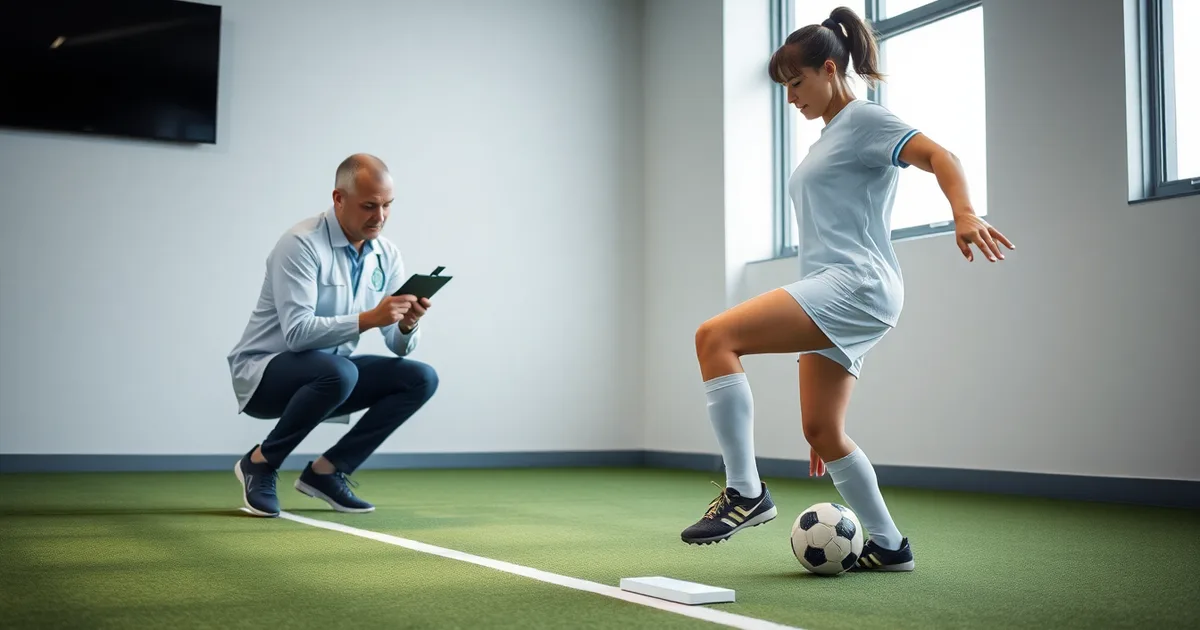
Return to play is cleared by criteria, not by the calendar: pain at or below 2/10 during sport-specific movement, full range of motion, strength at 90% or more of the uninjured side, and functional testing such as the single-leg hop for distance at 90% symmetry. Timeframes (2–6 weeks for ankle sprains, 4–8 weeks for hamstring strains) only describe the typical case.
Most re-injuries in high school and college sport happen in the first two weeks after an athlete is cleared, and the usual reason is that clearance was granted because the calendar said so. The 2016 Bern Consensus statement on return to play, produced by the First World Congress on Sports Injury Prevention, gave the field its working structure: shared decision-making between clinician, coach and athlete, built on objective test results rather than a predicted date. That distinction matters most in the final phase, when the athlete feels fine, the swelling is gone, and everyone involved is under pressure to get them back on the field.
The number that catches people out is 90%. An athlete can walk, jog, and cut without pain and still fail a single-leg hop by 15 or 20%, and that deficit is what predicts the next injury. Hamstring strains are the clearest example: the published range is 4–8 weeks, but the gate is a full-speed sprint with no pain and no hesitancy, which many athletes do not reach until week 6 or later.
Use the uninjured limb as the reference, not a population average. Leg dominance, prior injury on the other side, and sport-specific demands all shift what "normal" means for a given athlete.
- Pain threshold: Pain must stay at or below 2/10 on a numeric rating scale during and after sport-specific movements, not just at rest.
- Strength benchmark: Quadriceps and hamstring strength should reach 90% or more of the contralateral limb, measured by isokinetic dynamometry or handheld dynamometry.
- Range of motion: Ankle dorsiflexion and knee extension should sit within 5° of the uninjured side.
- Functional testing: The single-leg hop for distance and the agility T-test should reach 90% or more of the uninjured side before clearance.
- Bern Consensus 2016: The First World Congress on Sports Injury Prevention recommended criteria-based return to play over time-based timelines.
What are the core criteria for return to play after a sports injury?
Timelines tell you when tissue usually heals. They do not tell you whether this athlete is ready to sprint, cut, or land on one leg. The Bern Consensus Statement 2016 made that distinction explicit: return to play is a continuum of three decisions (return to participation, return to sport, return to performance), and each one has to be cleared against measurable criteria rather than a calendar. The four pillars below are the ones that survive scrutiny in the literature and in practice. They take about 45-60 minutes to run through properly.
- Pain at or below 2/10 during sport-specific activity. Use the numeric pain rating scale (NPRS) during the actual movements the sport demands: sprinting, decelerating, changing direction, jumping, kicking. A 2024 clinical practice guideline sets the threshold at ≤2/10, and the score must hold during the session and 24 hours after it. Pain that climbs from 1/10 to 4/10 across a training week means the load is ahead of the tissue, not that the athlete is being soft.
- Range of motion within 5° of the uninjured side. Measure it, do not eyeball it. Knees need full extension symmetrical and flexion within a few degrees; shoulders need comparable internal and external rotation; ankles need the weight-bearing dorsiflexion lunge test, where a 2 cm deficit in knee-to-wall distance is associated with a roughly doubled ankle sprain risk. Loss of extension after ACL reconstruction is the single most common avoidable setback in this phase.
- Strength at 90% or more of the contralateral limb. A 2023 systematic review supports the ≥90% threshold for knee extensor and flexor strength. An isokinetic dynamometer gives you torque curves at set angular velocities (60°/s and 180°/s are standard), but a handheld dynamometer with belt stabilisation is a defensible substitute when calibrated for the tester's own reliability. For hamstrings, also test eccentric capacity; a Nordic hamstring exercise profile well below the uninjured side flags re-injury risk before any sprint test will.
- Pass the single-leg hop battery at 90% symmetry or better. The standard set is four hops (single, triple, crossover, timed 6-metre), and a 2022 meta-analysis confirms ≥90% limb symmetry as the cut-off. Hops loaded under 90% mean the athlete is still offloading the injured side, whatever they report about how it feels. Watch landing quality, not just distance: a knee that collapses into valgus on contact fails the test regardless of the number.
- Pass sport-specific functional tests, including an agility T-test and change-of-direction work. The agility T-test (forward sprint, lateral shuffle, backpedal) should be within 10% of the uninjured baseline or of age- and sex-matched norms. Add the movements that will actually break the athlete: single-leg landing from a box for a basketball player, cutting at 45° and 90° for a soccer player, deceleration to a sprint for a tennis player. Test in cleats or the actual footwear, not trainers.
- Clear the psychological barrier with a validated scale. The ACL-RSI (ACL Return to Sport after Injury scale) is the best-validated version; scores below roughly 56 out of 100 predict a substantially higher chance of not returning to the pre-injury level, and they also flag athletes who will unconsciously protect the limb during testing. The general Return to Sport after Injury (RSI) scale works for other injuries. An athlete who passes every physical test and still hesitates on a cut is not cleared.
- Confirm the timeline against the injury's own re-injury data. Clearance criteria shorten many recoveries and lengthen others, but the epidemiological floor still applies. Median return is 2-6 weeks for ankle sprains in a 2025 athletes' cohort and 4-8 weeks for hamstring strains in 2024 professional soccer data. For ACL reconstruction, a 2022 meta-analysis put re-injury at 23% in athletes under 25 who returned before 9 months, which is why most surgeons and the NATA position statements now hold that group to 9-12 months regardless of how good the hop test looks at month seven.
The pillar that gets shortchanged is the one that costs nothing to check: pain. Trainers and athletes both anchor on the hop test and the dynamometer number because they are objective and satisfying, then wave through a 3/10 during a 70% sprint because everything else passed. That is exactly the profile behind the 15-20% ankle sprain re-injury rate reported when criteria are not met. Pain during sport-specific loading is data, and the honest reading of it is that the tissue is not yet tolerating the demand — not that the athlete needs to push through.
How do you measure pain, strength, and range of motion objectively?
Pain is the first thing athletes report and the worst thing to build a clearance decision on. Score it with the numeric pain rating scale (NPRS), 0 to 10, and take three readings: at rest, during the sport-specific movement that hurt, and 24 hours after a hard session. The 2024 clinical practice guideline threshold is ≤2/10 during and after testing, not 0/10 at rest on a Tuesday morning when the athlete has done nothing. A player who reports 0 at rest but 5/10 the day after sprinting has not passed anything.
Strength needs a number, and a handheld dynamometer gives you one in about 90 seconds per position. Make it break testing, three trials, highest value recorded, and compare to the uninjured side. A 2023 systematic review puts the clearance bar at ≥90% of the uninjured limb. For knee extension and hamstring curls where you want torque curves rather than peak force, an isokinetic dynamometer at 60°/s is the reference instrument, though most high school settings will not have one and a handheld device plus consistent positioning is a defensible substitute. Test the uninjured side first, always, because the healthy limb is the reference value and you want the athlete warm before you record it.
Range of motion is where goniometry earns its keep, particularly at the ankle. Measure ankle dorsiflexion with the knee-to-wall lunge test in centimetres rather than degrees—it is more repeatable and you do not need a second pair of hands. A 2022 meta-analysis supports ≥90% symmetry on the single-leg hop as a functional proxy that catches what goniometry misses, so run both. Document the baseline the day the athlete is discharged from acute care, then re-measure at four weeks, eight weeks, and before clearance. Numbers you did not write down in week one cannot guide a decision in week ten.
Here is the part that gets athletes hurt. Many players, and more than a few clinicians, clear a return based on pain resolution alone. Roughly 30% of athletes who report zero pain still fail functional testing, and they carry the re-injury risk with them: ankle sprains re-injure at 15–20% when return-to-play criteria are not met, and ACL re-injury runs at 23% in athletes under 25 who return before nine months. Pain-free is a starting condition, not a finish line. Symmetry in strength, hop distance, and movement quality is non-negotiable, and a handheld dynamometer costs less than one week of a re-injured athlete's lost season.
Which functional tests must an athlete pass before return to play?
Lab numbers get you to the door. Functional tests decide whether you walk through it. A 2022 meta-analysis of hop testing put the useful symmetry cut-off for single-leg hop for distance at 90% of the uninjured limb, and that figure now shows up across NATA and APTA return-to-play guidance. Below 90%, the deficit is measurable enough that the athlete is still offloading work onto the healthy side, which is exactly how the other knee or ankle becomes the next injury.
What separates a real battery from a token hop test is the spread of demands. Distance hop measures power and confidence on landing. The agility T-test measures change of direction under time pressure. The Y-balance anterior reach catches the ankle dorsiflexion and single-leg control deficits that a straight-line hop will happily hide. Run them all, on the same day, in the same order, so the numbers are comparable week to week.
| Test | Pass threshold | What a fail usually means |
|---|---|---|
| Single-leg hop for distance | ≥90% of uninjured side (mean of 3 trials) | Quad or glute power deficit; poor landing mechanics |
| Agility T-test | Within 10% of the athlete's own pre-injury baseline (or ≤10% slower than the uninjured-side reference time) | Cutting mechanics and deceleration still unlearned |
| Y-balance, anterior reach | ≥90% of uninjured side; composite score ≥94% is the better target for ankles | Ankle dorsiflexion restriction and single-leg balance loss |
| Isokinetic or handheld dynamometry | ≥90% of uninjured side at 60°/s and 180°/s | Strength gap that shows up late in a match, not in a warm-up |
| Sport-specific sprint, cut, or landing drill | Completed at full match speed with pain ≤2/10 on NPRS during and 24 h after | Sport-specific confidence gap; treat with ACL-RSI or RSI scoring, not more rest |
The row that decides the case most often is the last one, and it is the row athletic trainers skip. A player can clear every hop, strength and balance threshold and still brace before a 45° cut, which is why the ACL-RSI and its hamstring and ankle cousins exist. If you have five minutes and one test to spare, use the sport-specific drill and score it honestly. Where that flips is the adolescent or college athlete still in the first nine months post-ACL reconstruction: for them, the calendar outranks the drill. A 2022 meta-analysis found a 23% re-injury rate in athletes under 25 who returned before nine months, roughly double the rate for those who waited, so a perfect functional battery at month seven is a reason to keep training, not a clearance. For hamstring strains, the priority reverses again — median return is 4–8 weeks in professional soccer data, and the single-leg hamstring bridge plus the Nordic hamstring exercise programme carry more predictive weight than any hop test, because the mechanism is different.
What is the typical timeline for ankle sprain and hamstring strain recovery?
A grade I or II lateral ankle sprain — the kind where you can bear weight but the joint is stiff and swollen for a few days — typically returns to sport somewhere between two and six weeks. That range comes from a 2025 cohort of athletes tracked from injury to clearance, and it's wide for a reason: two weeks is a young athlete with no prior sprain who starts proprioceptive work on day three, six weeks is someone who re-sprains at week two or waits for swelling to fully resolve before loading the joint at all. Grade III, meaning a complete tear of the anterior talofibular ligament with marked instability, usually runs eight to twelve weeks, and if the athlete still fails a single-leg hop at 90% symmetry by week ten, the timeline is irrelevant — they don't play.
Hamstring strains follow a similar logic with longer numbers. A 2024 dataset from professional soccer puts the median return at four to eight weeks for grade I and II injuries. Grade III, where you can often palpate a defect in the muscle belly, routinely exceeds twelve weeks and carries a re-injury rate that makes anyone rushing it look foolish. The Nordic hamstring exercise is the one intervention with enough evidence behind it to change those numbers — eccentric loading during rehab consistently shortens the strength deficit window, but it does nothing if the athlete is cleared before that deficit closes.
Why the calendar is not the gate
If you clear a hamstring strain at week six because the textbook says six weeks, you're guessing. The gate is the battery: isokinetic or handheld dynamometry showing strength at 90% or better of the uninjured side, single-leg hop symmetry at 90% or better, pain at 2/10 or less on the NPRS during and after testing. Ankle sprains cleared without meeting those criteria re-injure at 15–20%, per a 2023 study, which is roughly the same odds as flipping a coin twice and losing both times. The timeline tells you when to start testing. It doesn't tell you when to stop.
How does the Bern Consensus Statement guide return to play?
The document that most sports medicine clinics actually build their return-to-play protocol around is the 2016 Bern Consensus Statement, produced after a meeting of the International Olympic Committee–adjacent research group in Bern, Switzerland. Its central argument is that clearing an athlete is a medical decision with too many moving parts to reduce to a single test or a calendar date. The statement reframes return to play as shared decision-making across three parties: the athlete, the clinician, and the coach or team, with the medical team retaining a veto. That veto matters. A college soccer player who feels ready at week five after a grade II hamstring strain may be overruled by a trainer who has dynamometry showing only 82% hamstring strength against the uninjured side.
Bern splits the process into three stages rather than one binary yes/no. Return to participation means the athlete is back in modified training, non-contact drills, or restricted minutes. Return to sport means full unrestricted practice and competition at the pre-injury level. Return to performance is the stage most protocols skip: the athlete is not just cleared but is performing at or above their baseline. A weekend rugby player who passes return-to-sport at 90% of baseline but never regains their acceleration profile has returned to sport but not to performance. Skipping that third stage is one reason ACL re-injury rates run at 23% in athletes under 25 who return before nine months, per a 2022 meta-analysis.
Criteria, not calendars
The statement is blunt that time-based clearance is inadequate on its own. Typical recovery windows — a 2–6 week median for ankle sprains, 4–8 weeks for hamstring strains in professional soccer — describe populations, not the individual in front of you. Bern treats those windows as context for planning, not permission to play. The pass/fail decision rests on objective measures: pain ≤2/10 on the numeric pain rating scale during and after testing, strength ≥90% of the uninjured side via handheld or isokinetic dynamometry, and symmetry ≥90% on functional tests like the single-leg hop. A 2023 study found re-injury rates of 15–20% for ankle sprains when these criteria were not met before clearance.
The part clinicians underuse is the biopsychosocial layer. Bern explicitly names fear of re-injury and confidence as factors that predict who re-tears and who does not, which is why validated tools like the ACL-RSI scale (and its general sibling, the Return to Sport after Injury scale) belong in the assessment battery alongside the hop tests. A player who hits 95% on every physical measure but scores low on the RSI is not ready, and saying so out loud is part of the job. The counterargument — that psychological screening delays return and frustrates athletes — resolves differently by case: for a recreational player with no history of re-injury, a low RSI score is worth monitoring but not blocking; for an athlete under 25 returning from ACL reconstruction, it is a hard gate.
What psychological factors affect return to play?
An athlete can pass every hop test at 95% symmetry, register 0/10 on the numeric pain rating scale, and still get hurt again in the first ten minutes of a match. The reason is usually that they were not ready to compete, only ready to test. Fear of re-injury changes how a player decelerates, how hard they plant on a cut, and how quickly they commit to a 50-50 challenge. Those are movement decisions, and they happen faster than conscious thought.
The ACL Return to Sport after Injury (ACL-RSI) scale is the best-validated tool here: 12 items scored 0-100, covering emotions, confidence in performance, and risk appraisal. The general Return to Sport after Injury (RSI) scale does the same job for other injuries, including ankle sprains and hamstring strains. Scores below roughly 56 on the ACL-RSI have been associated with a significantly higher chance of not returning to the pre-injury level, and low scores independently predict re-injury even when physical criteria are met. For a college soccer player clearing at month 9, an ACL-RSI of 40 should hold the clearance, not the single-leg hop result.
Treat the number as a starting point, not a verdict. A useful pattern for the final phase is graduated exposure: start with unopposed sport-specific drills at 60-70% intent, then add a passive or reactive defender, then full contact. Re-test ACL-RSI every 2-3 weeks—most athletes move 10-15 points across a well-run 4-6 week block, and if the score is flat, the problem is usually exposure volume or a lingering pain response rather than motivation. For the weekend soccer player with an ankle sprain, that means 2-3 sessions of cone work, then small-sided games before a full 90 minutes; for the college athlete, integrate into non-contact training before clearing for contact.
Where it genuinely depends: some athletes score low because they are cautious by temperament, not because they are physically compromised. If the physical battery is clean and the athlete competes confidently in training but scores low on a questionnaire, the questionnaire is the outlier—document it and proceed with a graded contact plan. If the low score comes with visible hesitation, altered running mechanics, or guarding on the injured side, hold clearance regardless of what the dynamometer says.
When should you delay return to play?
Athletes fail return-to-play decisions in two directions. Some go back too early because they feel fine on a Tuesday and the fixture list says Saturday. Others stay out for months past the point where tissue has healed, losing fitness and confidence they then have to rebuild. The list below is a set of stop signs. Any single one of them is enough to hold the athlete out, regardless of how many weeks have passed or how loudly they want to play.
- Pain above 2/10 on the numeric pain rating scale (NPRS), during or within 24 hours of activity. The 2024 clinical practice guideline sets the acceptable ceiling at 2/10 for return-to-sport loading, and the key word is "during." An athlete who reports 1/10 walking into the clinic but 5/10 on the third set of single-leg hops has failed, not passed. Re-test 24 hours later: soreness that climbs overnight means the tissue load exceeded capacity, even if the session itself felt tolerable.
- Visible swelling, or joint effusion that reappears after training. Some ankle and knee swelling for weeks after injury is normal and not by itself disqualifying. What matters is the trend. Effusion that increases after each session, or that takes more than 24 hours to settle, signals the joint is still being irritated at current loads. Measure it the same way every time, whether that is a tape circumference at a marked point or a stroke test at the knee, and compare session to session rather than to the uninjured side.
- Giving-way episodes or a positive instability test. A single episode of the knee or ankle "going" during a cutting drill is a hard stop. The 2023 ankle sprain data put re-injury at 15-20% when RTP criteria are not met, and that number is driven substantially by returning with residual laxity. Pair the subjective report with an objective test: anterior drawer and inversion talar tilt for the ankle, Lachman for the knee. If the athlete is guarding during the test, that guarding is itself a finding.
- Strength deficit greater than 10% versus the uninjured side. A 2023 systematic review supports a threshold of at least 90% of the uninjured limb on dynamometry. Use an isokinetic dynamometer if you have access to one, particularly for quadriceps and hamstring torque at 60°/s and 180°/s. If you are working in a high school setting with a handheld dynamometer, you can still get a usable number for knee extension, hip abduction, and ankle plantarflexion, provided you use the same tester, the same lever arm, and belt stabilisation. A 15% quadriceps deficit is not a detail to note in the file and move past.
- Functional test symmetry below 90%. The single-leg hop for distance is the workhorse here, and a 2022 meta-analysis supports a 90% limb symmetry index as the reference. Pair it with a crossover hop and a triple hop, and add the agility T-test for field and court athletes. A useful habit is to film the hops rather than just measure them. Athletes routinely hit 92% on distance while landing with a visibly stiffer knee and a wider foot placement. That is compensation, not recovery.
- Ankle dorsiflexion lunge test restricted by more than roughly 2 cm compared with the uninjured side. This one gets skipped constantly because the athlete can jog without pain. Limited dorsiflexion alters landing mechanics at the knee and hip, which matters most for the weekend soccer player who cuts and lands repeatedly. Measure knee-to-wall distance in centimetres, and treat a persistent restriction as a reason to delay field work, not just a reason to prescribe more calf stretching on the side.
- Low psychological readiness on a validated scale. The ACL-RSI scale is the best-established tool, with 12 items scored 0-100, and the shorter Return to Sport after Injury (RSI) scale covers other injuries. Scores below roughly 56 on the ACL-RSI have been associated with reduced return rates and worse outcomes, though the precise cut-off varies by study. A score in that range is not a reason to keep the athlete out indefinitely. It is a reason to slow the final phase and address confidence directly through graded contact and uncontrolled drills.
- Timeline alone being treated as readiness. The 2022 meta-analysis on ACL re-injury found 23% re-injury in athletes under 25 who returned before 9 months, and the 2024 professional soccer data put median hamstring strain return at 4-8 weeks. Meeting a median does not mean the athlete has met criteria. Being past 9 months does not mean they have either.
The item clinicians most often get wrong is the last one. An athlete who is 11 months post-ACL reconstruction, has no pain, and can jog looks ready to everyone in the room, so the strength and hop testing quietly gets skipped or done once on a good day. Get a second data point on a different day, ideally after a training session rather than before. Performance on a fresh Monday tells you far less than performance on a Thursday when they have already done a full session, which is closer to what a match will ask of them.
How do you prevent re-injury after return to play?
Passing the hop battery and agility T-test is a snapshot, not a permanent state. Detraining starts within two weeks if the athlete drops the maintenance work that got them cleared, and eccentric hamstring strength in particular decays fast because most team sessions never load it directly. The cheapest insurance is a structured neuromuscular warm-up kept in place all season: FIFA 11+ takes about 20 minutes, runs three times a week, and has cut lower-limb injury rates in amateur and youth football by roughly 35-50% in the trials that established it. If the sport has no equivalent programme, the substitute is not a generic gym circuit but a targeted one — Nordic hamstring exercise progressions twice weekly for a sprint or kicking athlete, single-leg balance and hop variations for an ankle sprain history.
Workload monitoring is the other half, and the failure mode is almost always a spike rather than a high absolute load. Track weekly minutes or session-RPE (session duration multiplied by a 1-10 perceived effort score) and keep week-on-week increases under about 10%. The acute:chronic workload ratio — this week's load divided by the rolling four-week average — flags danger above roughly 1.5, which is where several cohort studies in cricket, rugby and soccer have found the highest injury incidence. When a coach schedules a tournament week straight after a taper, that ratio tells you to trim minutes in the first match rather than the third. Fatigue also degrades test scores before it produces pain, so a drop of more than a few centimetres on the single-leg hop for distance during a heavy block is a reason to reassess, not to push on.
Re-testing, and what to do when a test slips
Re-run the full functional battery — hop tests, agility T-test, handheld dynamometry against the uninjured side — at roughly four to six weeks post-clearance, then again at any return from a break longer than three weeks. The 90% symmetry threshold and the ≤2/10 NPRS score are the pass marks used throughout this article, and a test that falls below them is a warning, not a failure. Re-injury risk tracks this closely: ankle sprains recur at 15-20% when criteria are skipped, and athletes under 25 who cleared ACL return before nine months re-injure at 23%.
The honest caveat is that re-testing schedules depend on access. A college programme with a handheld dynamometer and a willing sports medicine staff can test every six weeks. A weekend soccer player with no equipment should anchor to a fixed calendar date — the first Monday of each month — and use the simplest proxy available: five single-leg hops on each side, measured against a mark on a wall or the kitchen floor. What matters is that the number is recorded and compared, not that the device is expensive.
Frequently Asked Questions
What percentage of strength do you need to return to sport after a hamstring strain?
At least 90% of the uninjured side. That figure is measured with isokinetic dynamometry at 60°/s and 180°/s, or with a handheld dynamometer for a practical sideline alternative. Anything below 90% roughly doubles the reinjury risk in the first two weeks back. Strengthen in eccentric hamstring work, not just concentric, because the strain mechanism is almost always lengthening under load.
Can you return to play with pain after an ankle sprain?
Yes, but only if pain stays at or below 2/10 during sport-specific activity and you pass functional testing: hop for distance, a 30-second single-leg balance, and a timed side-hop. Pain above that threshold during cutting or landing is a signal to keep rehabbing, not to tape it and carry on. Persistent pain past six weeks after a grade 2 sprain warrants imaging to rule out a syndesmotic or osteochondral injury.
How long after a grade 2 ankle sprain can I play soccer?
Typically 4–6 weeks, though grade 2 lateral ligament damage can run to 8 weeks before criteria are met. Time alone is not the gate. You need full pain-free range, ≥90% hop symmetry, and tolerance of 10 repeated single-leg bounds before a return. Players rushed back inside three weeks show reinjury rates approaching 20%, and the second sprain often takes longer to resolve than the first.
What is the single-leg hop test for return to sport?
You hop as far as possible on the injured leg, then repeat on the uninjured leg, and compare the distances. A limb symmetry index of at least 90% is the usual pass mark, and most protocols run three trials and take the best. Good practice adds the triple hop, crossover hop, and a 6-metre timed hop, since a single forward hop can miss side-to-side and rotational deficits.
What does the Bern Consensus say about return to play?
Published in 2016 by the Swiss Sport Physical Therapy group, it argues for a criteria-based, shared decision-making process rather than a fixed timeline. It defines three stages: return to participation, return to sport, and return to performance. The athlete, clinician, and coach share the decision, and each stage has its own physical, psychological, and load requirements. The framework applies to any sport and any injury.
How do I know if I'm psychologically ready to return after an ACL injury?
Use the ACL-RSI, a 12-item questionnaire scored 0–100. A score above 77 indicates high psychological readiness, and scores below that correlate with three to four times the reinjury risk in athletes under 25. It does not stand alone. Pair it with strength, hop, and landing criteria; a confident athlete with a 70% quadriceps deficit is still not ready.