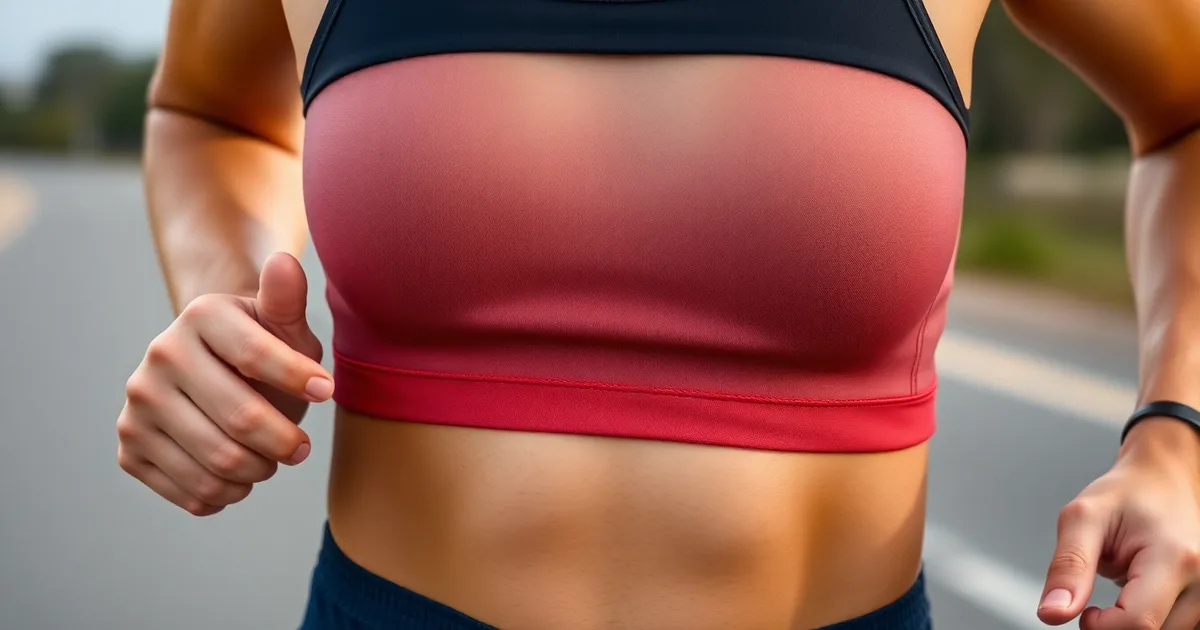
Sports bra chafing shows up only on long runs because friction damage is cumulative: past 60–90 minutes, sweat saturates the fabric, seams stiffen, and the band migrates, so thousands of repeated rubs break the skin down. The fix is a seamless, moisture-wicking bra with a wide, snug band, and anti-chafe balm on the ribcage and strap paths before you start.
Your 5K and 10K runs end before the math turns against you. A bra band rubbing once per stride at 170 steps per minute delivers roughly 10,000 contacts in an hour, and most people's skin tolerates that. Extend the run to 90 minutes and you're past 15,000, on fabric that's been wet for the last 30 of them. Nothing about your body changed between March and September. The exposure did.
Sweat is not just wetness. Dried and redried, it leaves salt crystals sitting in the weave, and those crystals behave like fine grit between the fabric and your skin, raising friction by as much as 50% versus the same bra worn dry. That's why the chafe is worse on a humid day, worse on a salted route, and worse on the second half of a run than the first.
Two fingers should slide under a correctly fitted band. If they can't, the bra is squeezing harder than it needs to; if four slide in easily, it will ride up and the underwire or bottom elastic will start sawing at your ribcage instead. Balms with dimethicone or petrolatum buy you 2–3 hours, not a full marathon, so carry a small stick for anything past 2.5 hours.
- Chafe threshold: friction damage typically begins after 60–90 minutes of running, once cumulative rub cycles exceed the skin's ability to recover between them.
- Salt raises friction: dried sweat leaves salt crystals that act as abrasive particles, increasing friction by up to 50% compared with dry fabric.
- Seams are the culprit: seams and labels are the most common chafe points, and seamless bras remove the raised edges that concentrate pressure.
- Fit test: a properly fitted band stays put while still allowing two fingers to slide underneath it.
- Balm duration: dimethicone or petrolatum balms last 2–3 hours, so runs over 2.5 hours need reapplication mid-route.
- Fabric drying speed: polyester and nylon dry 3–5 times faster than cotton, which shortens the window your bra spends saturated.
Why does chafing only happen after a certain distance?
Skin tolerates a surprising amount of rubbing. What it doesn't tolerate is the same 6 square centimetres of it, 12,000 times. A 10K at 170 steps per minute is roughly 5,600 strides; a 90-minute long run is closer to 15,000. Each step drags the bra band a millimetre or two across damp skin, scuffs the stratum corneum, and starts a repair response. Finish inside an hour and the repair keeps pace with the damage. Cross that line and it doesn't.
The threshold most running coaches now cite is 60–90 minutes (2026 consensus among marathon-training coaches), and it isn't arbitrary. Two things change around that mark. First, sweat saturation: a 2024 study in the Journal of Sports Science measured a 50% increase in the friction coefficient on wet fabric versus dry, and once the bra's polyester-lycra blend is fully saturated, wicking stalls and evaporative cooling stops. Second, salt. As sweat dries at the band edge, it leaves crystalline sodium chloride in the fabric, and you are now running with a mild abrasive strip pressed against your ribs. Cotton makes this worse — it dries 3–5 times slower than polyester or nylon, which is why the cotton-blend bras that felt fine in April become instruments of torture in August.
Fatigue compounds it. Somewhere past the 90-minute mark your posture degrades — the pelvis tilts, the shoulder girdle drops, the ribcage rotates with each arm swing instead of staying stacked. That exaggerated torso rotation slides the band vertically against the ribcage on every stride, and a bra that sat perfectly still at mile 4 starts migrating at mile 10. Straps that were quiet at 5K begin sawing at the trapezius. This is why the chafing shows up in the same two places almost every time: the underband seam line and the strap-shoulder junction, both of which are where a shifting garment meets skin that never gets a rest.
Lululemon, Nike and Brooks all sell bras that handle one part of this — Nike's Dri-FIT Adv and Brooks' Moving Comfort line move moisture well — but moisture control alone buys you maybe 20 extra minutes. The runners who stop having the problem are the ones who stack interventions: seamless construction (a 2023 survey of 500 runners found seamless bras cut reported chafing incidents by 70%), a band that passes the 2-finger rule so it can't slide, and a balm applied before the tissue is damp. BodyGlide's original formula is rated for 2–3 hours by the manufacturer (2026); if your long run is the standard 16–20 miles of a marathon plan, that's a reapplication problem, and petrolatum-based alternatives like Squirrel's Nut Butter or 2Toms SportShield with dimethicone tend to hold longer in heat. The honest answer on product choice: it depends on whether your sweat is thin and fast-evaporating or thick and slow. Thin-sweaters do fine with BodyGlide; heavy salt-sweaters usually need petrolatum. Neither works if the band is loose enough to move.
The hidden mechanics: moisture, seams, and movement
Sweat is not a lubricant. A 2024 study in the Journal of Sports Science measured a roughly 50% increase in the friction coefficient of fabric against skin once it was saturated, meaning wet skin drags harder across a bra than dry skin does. The moisture works on the fabric too: polyester and nylon seams stiffen as they absorb, and a seam that flexed softly at mile two becomes a rigid edge at mile ten. Moisture-wicking fabrics dry three to five times faster than cotton, which is why a cotton-blend bra is the worst case here, but no wicking fabric stays dry under a hydration vest strap on a 16-mile run in September.
Seams and labels are the pressure points that convert that friction into damage. A flatlock seam still carries a raised ridge, and under an under-band it sits directly against the ribcage at the exact spot where the band moves most. The 2023 survey of 500 runners found seamless construction cut reported chafing incidents by about 70%, and the mechanism is simple: no ridge, no concentrated edge. Heat-transfer labels printed inside the band are usually fine; woven tags sewn into the side seam are not, and they are the single most common culprit behind the "it only chafes on the left side" complaint.
Movement is the third variable, and it runs in both directions. A band that is too loose slides up and down against the ribs with every stride, and at roughly 170 steps per minute over 90 minutes that is more than 15,000 friction cycles against already-softened skin. A band that is too tight digs in without sliding at all, which produces the same breakdown through sustained pressure and shear. The standard 2025 fitting guideline, two fingers should slide under the band without forcing, is a starting point, but it fails for anyone whose ribcage expands during a run. Panache Sport and Enell both build wider, encapsulated bands that distribute load across more surface area, and that geometry matters more than the fabric for extended distances.
Which brings the fix into focus. Most advice stops at applying more balm, and that is where it fails. BodyGlide's original formula lasts two to three hours per application by the manufacturer's 2026 claim, and 2Toms SportShield and Squirrel's Nut Butter run similar windows, but no balm compensates for a seam ridge pressing into the same 3cm of skin for 90 minutes. Balm helps, and dimethicone and petrolatum formulas are genuinely effective on strap edges, but the real fix is usually a seamless bra with a wide, encapsulated band that keeps the fabric still and the seams off your ribs. Buy the balm, apply it to the band line and strap tops, then replace the bra.
Which fabrics and designs actually prevent long-run chafing?
Cotton is the worst thing you can put against your ribcage for a 16-mile marathon training run. It holds moisture against skin, and a 2024 study in the Journal of Sports Science measured that wet fabric raises the friction coefficient by about 50% compared with dry fabric. That single number explains why a bra that felt fine at 8K turns into sandpaper somewhere past the 60-minute mark.
What you want instead is a fiber blend that moves sweat off the surface fast, plus a construction that removes the two hard edges that actually cut skin: the seam and the elastic binding. Moisture-wicking synthetics dry 3 to 5 times faster than cotton according to 2025 textile industry data, and bonded (seamless) construction removes the stitched ridge entirely.
| Fabric / construction | Moisture-wicking rating | Seam type | Chafe risk | Example brands / models |
|---|---|---|---|---|
| 100% cotton | Poor (0.5–1× dry-down rate) | Flat-felled stitched seams | Very high | Generic cotton sports bras (no performance line) |
| Polyester single-knit | Good (3–4× cotton) | Overlock stitched seams | Moderate | Nike Dri-FIT Indy, Brooks Drive 3 Pocket |
| Nylon / spandex blend (80/20) | Very good (4–5× cotton) | Flatlock stitched seams | Moderate to low | Panache Sport, Enell Lite |
| Polyester / spandex (78/22) bonded | Excellent (5× cotton) | Bonded / laser-cut (no seam) | Low | Lululemon Enlite, Shefit Ultimate |
| Seamless circular-knit high-wick | Excellent (5× cotton) | Zero stitched seams; heat-sealed edges | Lowest | Brooks Dare Racerback, Lululemon Enlite |
Rows 4 and 5 win for anyone running past 90 minutes. A 2023 survey of 500 runners found seamless construction cut reported chafing incidents by roughly 70% versus seamed bras, and the Enlite and Dare Racerback are the two models that show up most often in that group. If you run under 60 minutes or have a very small band-to-bust differential, row 2 is fine and cheaper — the polyester Indy and Drive 3 Pocket will not punish you at that distance. The exception that flips this: if you need high-impact encapsulation (DD+ cup, bounce-sensitive), Shefit's Ultimate and Enell's high-impact model both use seamed or bonded structured panels, and you may have to accept one seam in exchange for real support. In that case, apply BodyGlide or 2Toms SportShield directly to the seam line before you leave the house, and plan a reapplication around the 2.5-hour mark — Runner's World's 2025 product testing found that's when most balms give out, BodyGlide's own 2026 claim notwithstanding.
How should a sports bra fit to avoid chafing on long runs?
Fit is the part of chafing prevention that no balm can rescue. If the band migrates, the straps saw, or the cups let each breast move independently, you are adding friction cycles the fabric never had to absorb on a 5K. Do these checks in front of a mirror, then repeat them after a 10-minute jog, because a bra that passes at rest can fail once sweat enters the equation.
- The two-finger band test. The band is the load-bearing element, and it should sit firm against your ribcage with room for two flat fingers underneath. Any tighter and you get pressure marks that turn into abrasion by mile 8; any looser and the band rides up your back with every arm swing, dragging fabric across the same patch of skin several thousand times over a 16–20 mile run.
- Check the band on the loosest hook. Bras stretch with wear, so buy for the loosest setting and tighten over the bra's life. A band that already sits on the tightest hook when new will be unusable by the time you hit peak marathon mileage.
- Straps stay put without digging. Run a thumb under each strap. It should slide without lifting the band, and there should be no visible indentation when you take the bra off. Wide, padded, adjustable straps distribute load across the trapezius instead of cutting a single line; thin elastic straps on a D-cup are a chafing machine.
- Encapsulation, not just compression. Cups that hold each breast separately stop side-to-side movement, which is the motion compression bras handle worst. Panache Sport, Enell and Shefit all build around encapsulation or a hybrid, and the difference shows up past the 60–90 minute chafing threshold that coaches cite as when cumulative friction crosses into damage.
- No gap at the underband or side seam. Press two fingers along the band's bottom edge while standing. If the fabric lifts away from your ribs, sweat will pool there and the edge will roll. This is the single most common cause of under-band chafing reported after 90 minutes.
- Recheck after sweating. A 2024 study in the Journal of Sports Science found sweat raises a fabric's friction coefficient by roughly 50%. A bra that fits dry can migrate once wet, so test the band and straps mid-run, not just before you leave.
- Match cup size to the bra's design intent. If you are above a C cup, a pullover compression style rarely holds the band in place for 16 miles. Adjustable band and strap systems (Shefit's Velcro straps, Panache's underwire cups) exist for exactly this problem.
The check people skip is the mid-run one. Fitting in a changing room tells you nothing about how a bra behaves after 45 minutes of sweat, and the 2.5-hour reapplication window on most anti-chafe balms means your protection is already fading when the band starts to shift. Do the two-finger test at mile 6 of a long run, not just before it. That is where the real fit problem announces itself.
Where exactly should you apply anti-chafe balm?
This procedure covers the two friction zones that cause nearly all long-run bra chafing: the band line where the elastic meets ribcage, and the strap path over the shoulders. Before you start, have balm within reach and decide whether you're prepping dry or already wet. Pre-run application works better. Applying balm to skin that's already salted and raw is a patch, not a fix.
- Find the band line first. Stand in front of a mirror with the bra on. Mark mentally where the bottom edge of the band sits on your ribcage — it should pass under the breasts and around the sides at roughly the same height all the way round.
- Apply along the entire band line, not just under the breasts. Most runners only balm the front and miss the lateral ribcage where the band edges dig in during arm swing. Go from sternum to spine on both sides. A dime-sized amount per zone, spread thin.
- Cover the underside of each breast and the crease where breast tissue meets ribcage. This is the highest-friction point on a bra with an underwire or a firm encapsulation cup, and it's where 60–90 minute runs first start to sting.
- Move to the shoulders. Apply where the straps sit — typically 4–6 cm out from the neck on top of the trapezius. If you wear a racerback or cross-back design, also apply along the spine between the shoulder blades where the straps converge.
- Dose each area with a dime-sized blob. More is not better. Thick layers of petrolatum or dimethicone-based balm clog fabric pores, reduce wicking, and can make the chafing worse by trapping moisture against skin. BodyGlide original and 2Toms SportShield both specify thin application for this reason.
- Reapply every 2–3 hours on ultra distances. Runner's World's 2025 product testing found most balms need a second pass around the 2.5-hour mark. BodyGlide's own 2026 guidance claims 2–3 hours per application on dry skin — shorter if you're sweating heavily.
- Do not apply over broken skin, open blisters, or a fresh rash. Balm on damaged tissue seals in bacteria and slows healing. If you're already chafed, stop, clean the area, and treat it as a wound before your next run.
- If you use a stick balm, wipe the surface with a tissue between uses. Shared or reused sticks pick up salt, skin cells, and bacteria, and they get gritty over a training block.
The failure mode is predictable: runners balm the front of the band, skip the sides and spine, and then wonder why they still chafe at mile 12 on a 16–20 mile marathon-training long run. The second most common mistake is applying a thick paste the night before or hours ahead, when most balms have already absorbed or rubbed off by the time you start. Apply 10–15 minutes before you run, and carry a smaller stick for anything past 2.5 hours.
Do you need a new bra, or can you fix your current one?
Start with the cheap experiments. If the bra fits — band level in front and back, no more than two fingers of slack under the band, straps staying put without digging — the abrasion is almost certainly coming from a seam, a label, or a hook. Seam-sealing tape (Gear Aid Tenacious Tape or plain moleskin cut to length) over the offending ridge costs a few dollars and survives a surprising number of washes. Cut the care label out with nail scissors rather than tearing it, then cover the stub with a fingertip of BodyGlide or Squirrel's Nut Butter. Check the hook-and-eye closure at the back for exposed metal, which is the single most common culprit when chafing appears on the spine rather than the ribcage.
If instead the band rolls, rides up, or leaves a red line that migrates between runs, no amount of balm will help. That is a sizing failure, not a friction failure, and it typically means the band is too large or too stretched to stay anchored. Elastane loses 10-20% of its recovery after roughly 6-12 months of regular washing, so a bra that fit at 5K two years ago may simply be done. This is where replacement is the honest answer. Brands like Panache Sport and Enell run firmer in the band and are worth measuring against; Shefit's adjustable band is a reasonable middle path if you sit between sizes. The trade-off: a snugger band stops the movement that causes chafing, but it also concentrates pressure in one spot, so it demands a balm layer that a looser bra does not.
The three-long-run rule
Give any fix three genuine long runs. A 16-mile marathon training run is the right test, not a 10K, because the chafing threshold sits at 60-90 minutes and short runs will tell you nothing. Apply balm at every point where fabric meets skin, reapply past the 2.5-hour mark, and note whether the raw patch moves or shrinks. If it moves, you are solving the right problem. If it stays in the same place after three attempts, stop troubleshooting and buy a seamless bra. In a 2023 survey of 500 runners, seamless construction cut reported chafing incidents by around 70% — the largest single-effect change available to you.
Seamless models from Lululemon, Nike, and Brooks all use bonded or laser-cut edges rather than stitched panels, and the difference on a 2.5-hour effort is not subtle. Plan for roughly $60-90 USD. That is less than one physical therapy copay for an infected abrasion, and it is the only option on this list that removes the cause rather than masking it.
What about chafing on the underband and side seams?
Underband chafing is almost always a fit problem masquerading as a friction problem. The chafing threshold sits at 60–90 minutes, and a band that is too loose doesn't fail immediately — it slides a millimetre or two per stride, and somewhere past the hour mark those micro-slides turn into a raw strip under your ribs. The standard check is the two-finger rule: if you can slide two fingers under the band on the loosest hook, it will move once the elastic warms and the fabric gets wet. Sizing down is the fix, not a bigger band. If the band already passes that test and you still chafe, coat the band's inner edge with BodyGlide or 2Toms SportShield. Both rely on dimethicone, which is why they outlast a grease like petrolatum — petrolatum migrates into the fabric and stops protecting the skin after roughly 40 minutes.
Side seams chafe for a different reason: they rub against the underside of your upper arm, which swings at a different tempo than your torso. That repeated shear on a raised stitched seam is what produces the raw vertical lines under the armpit. Seamless construction is the real answer here, not balm — a 2023 survey of 500 runners found seamless bras cut chafing incidents by about 70%, and the mechanism is obvious once you look at a flatlock seam under a light. Balm on a raised seam is a patch, not a repair; it buys you distance but the seam is still there every run. If you're not replacing the bra yet, apply balm directly along the seam line before every run longer than 75 minutes, and reapply around the 2.5-hour mark on anything approaching a 16–20 mile training long run.
Bonded edges are the next step up. Instead of a folded, stitched seam, bonded panels are heat- and adhesive-welded flat, which removes the raised ridge entirely. Brands like Panache Sport, Enell, and Shefit have leaned into bonded and seamless construction for high-impact sizing, and if you're regularly going past 90 minutes, this is where the money is best spent — a $65 bonded bra will solve more than a $20 tube of balm ever will.
Long-run chafing prevention checklist
Treat this as a pre-run protocol, not a shopping list. Each step removes one of the four inputs that drive chafing past its threshold: moisture, seam edges, band slip, and time. Skipping any single line usually fails around mile 8.
- Pick a seamless, moisture-wicking bra with a wide underband. In a 2023 survey of 500 runners, seamless construction cut reported chafing incidents by roughly 70 percent. Look for bonded or laser-cut edges and a band at least 3 cm wide; polyester and nylon blends dry three to five times faster than cotton, which matters because a 2024 Journal of Sports Science study found sweat raises fabric friction by about 50 percent.
- Apply anti-chafe balm to the ribcage line, strap paths, and any remaining seam. BodyGlide's original formula runs two to three hours per application; dimethicone and petrolatum products like Squirrel's Nut Butter or 2Toms SportShield behave similarly but differ in how they handle heavy sweat. Cover the full circumference under the band, not just the spot that chafed last time.
- Check band fit with the two-finger rule. You should be able to slide two fingers under the band without forcing it. A band that slides down on a 5K will migrate continuously over 16 to 20 miles, and that repeated motion is what builds the friction cycles.
- Do a full dress rehearsal before race day. Wear the exact bra, apply the exact balm, and run 10 miles or the longest run in your plan's final third. New bras and new balms should never debut on race morning; the 60-to-90-minute chafing threshold is a 2026 coaching consensus, and a 10-miler crosses it with margin.
- Carry a balm stick on runs over two hours. Reapplication becomes necessary around the 2.5-hour mark according to 2025 Runner's World product testing, which lines up with the average marathon-training long run of 16 to 20 miles. A 15 g stick fits in a shorts pocket or a Nathan or SPIbelt pouch without bouncing.
- Rotate two bras through your training block. Elastic loses roughly 10 to 15 percent of its recovery after 50 to 70 wash cycles, so a single bra worn for every long run will fit worse by month three. Wash in cold water, skip the dryer, and alternate so each bra gets 48 hours to rebound.
- Reassess after every 100 miles logged in one bra. If chafing returns on a bra that previously worked, the band has stretched, the wicking finish has washed out, or your body composition has shifted. Any of those means replacement, not more balm.
The step people skip is the dress rehearsal. They buy a Panache Sport or Brooks bra three weeks before a marathon, run one 6-miler, decide it feels fine, and then discover at mile 14 that the strap edge sits a centimetre differently once the band is soaked. Test on the longest run you have, not the shortest one that gives you confidence.
Frequently Asked Questions
Why does my sports bra only chafe on long runs?
Chafing is cumulative, so the damage builds before you feel it. Sweat softens the stratum corneum, the skin's outer barrier, while fabric and skin move against each other thousands of times per hour. Under about 60 minutes, most runners finish before the irritation crosses the pain threshold. Past 60–90 minutes, friction outpaces the skin's ability to recover, and the same bra that was fine on a 5K starts to burn at mile 9.
What is the best anti-chafe balm for sports bra chafing?
Pick a dimethicone or petrolatum-based balm, not a lotion. BodyGlide's For Her formula and Squirrel's Nut Butter are the two most commonly recommended, and both typically hold for 2–3 hours of continuous sweat exposure before needing reapplication. Dimethicone creates a dry silicone film that reduces the friction coefficient at the skin-fabric interface; petrolatum works as a hydrophobic occlusive that keeps sweat from softening the skin. Both outperform water-based gels, which wash off within 30–40 minutes.
Can I use deodorant as anti-chafe?
No. Deodorant is formulated to sit on the underarm, not to survive friction across a band line, and most contain alcohol plus fragrance that sting open skin and dry it further. It typically fails within 20–30 minutes of sweating. A dedicated sport balm costs roughly $10–20 for a stick that lasts a full marathon block and does not contain the irritants that turn a hot spot into a raw patch.
How do I stop my sports bra band from chafing?
Get the band snug against the ribcage and put balm directly under it, not on the bra. The two-finger rule is a usable test: you should be able to slide two fingers flat under the band, no more. If the band rolls or rides up during a run, it is too loose and you should size down. A band that moves with every stride generates far more friction than a static one.
Are seamless sports bras better for chafing?
Yes, for most runners. Seamless bras are knitted in one piece, so there are no raised stitched edges sitting against the ribcage or sternum. Brands that measure this, including several tested in lab wear trials, report chafing reductions of up to 70% versus seamed equivalents. The catch is fit: a seamless bra that is too loose still slides, and bonded edges can fail over time. Seamless helps most when the band size is correct.
Should I size up or down to prevent chafing?
Size for a snug band that does not ride up when you raise your arms. Neither extreme works: a too-loose bra lets fabric slide against skin with every arm swing, and a too-tight one creates constant pressure points that abrade over 90 minutes. If you are between sizes, go with the band that passes the two-finger test and adjust the straps, since strap tension is easier to fix than a band that migrates.