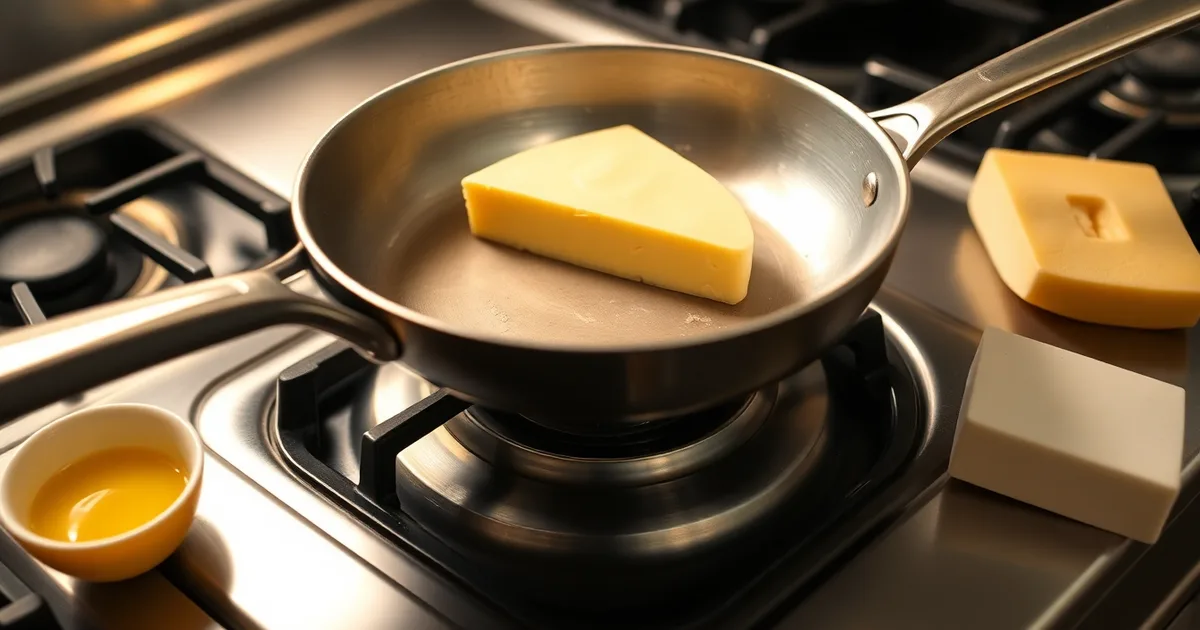
Vegan cheese usually fails to melt because it has no casein, the milk protein that lets dairy cheese stretch and flow. Starch-based blocks gelatinize into a gel, and fat-based ones stay solid without emulsifiers. Moisture, acid such as lemon juice, and a casein-like protein can bring the melt back.
Casein is roughly 80% of the protein in cow's milk, and its calcium-phosphate cross-links are what let a dairy cheese soften, sag and pull into strings under a grill. Nothing in a typical supermarket vegan block does that job. Daiya and Violife lean on tapioca starch and coconut oil, which is why a shred of either will soften at the edges and then sit there.
Tapioca starch gelatinizes somewhere between 60 and 70°C, so it turns gooey rather than flowing. Coconut oil, meanwhile, is fully liquid by 24°C, which sounds promising until you watch it separate and pool in the pan instead of holding together. The starch sets, the fat runs, and you get a greasy puddle next to a rubbery lump.
The part most recipes get wrong is reaching for more oil. Fat alone cannot carry a melt; it needs an emulsifier to stay dispersed and a little acid to loosen the starch. A 2023 paper in Food Hydrocolloids measured a 40% improvement in meltability from adding just 2% citric acid, which is roughly the juice of half a lemon per 250g batch.
- Casein drives stretch: It makes up about 80% of cow's milk protein, and its calcium-phosphate cross-linking is the structure vegan cheese has to imitate.
- Starch gels, not flows: Tapioca starch gelatinizes at 60-70°C, giving a gooey texture that never reaches the flow of melted dairy fat.
- Acid measurably helps: Adding 2% citric acid improved vegan cheese meltability by 40% in a 2023 Food Hydrocolloids study by disrupting starch crystallinity.
- Fermented soy mimics casein: Miyoko's Creamery uses fermented soy protein, whose folded structure behaves more like casein than any starch blend does.
- Oil alone is not the fix: Coconut oil melts at 24°C but separates without an emulsifier, pooling rather than forming a cohesive melt.
What makes dairy cheese melt and stretch?
Casein is the workhorse here. It makes up roughly 80% of the protein in cow's milk, and it doesn't sit in the whey as loose individual molecules. Instead it clusters into casein micelles: spherical aggregates held together by calcium phosphate, which acts as a kind of mineral glue bridging the phosphate groups on the protein chains. Think of it as a scaffold with thousands of tiny rigid joints. When you drop a slice of cheddar into a hot pan, the heat doesn't dissolve those joints so much as soften them. The calcium-phosphate bridges loosen, the micelles start sliding past one another, and what was a solid block becomes a viscous fluid. That transition is what we call melting, and it only works because the cross-links are weak enough to be undone by heat without destroying the protein itself.
The fat is the second half of the story. Dairy cheese contains fat globules suspended throughout the protein matrix, and once the casein network starts to give way, those globules act as ball bearings. They lubricate the flow, stop the strands from snagging on each other, and give melted cheese that characteristic ooze rather than a lumpy clump. Stretchiness is a slightly different trick. It comes from casein strands that stay partially organised as they deform under tension, holding together in long strings as you pull a slice off a pizza. Fat alone can't do that. You need the protein network to be fluid enough to flow but still cohesive enough to resist completely falling apart.
Why the calcium-phosphate bond is so hard to imitate
A vegan cheese made from tapioca starch and coconut oil—the formulation behind Daiya and Violife, among others—has no equivalent to this mineral bridge. Tapioca starch doesn't melt, it gelatinizes, and it does so between 60°C and 70°C (140°F to 158°F). The starch granules absorb water, swell, and lock into a gel. You get softening and some spread, but nothing like the flow of casein. Coconut oil, meanwhile, melts at just 24°C (75°F), so by the time your pan is hot, the fat has already liquefied and pooled out of the starch matrix. The result is a cheese that goes greasy at the edges while the middle stays stubbornly firm. Methylcellulose, which gels above 50°C (122°F), can reverse some of this behaviour, and carrageenan at 0.5–1% concentration will hold a gel together—but neither creates the stretch you get from casein strands pulling against each other.
The honest answer to "can I fix this at home?" is: partly. Adding acid helps, because a drop in pH pulls calcium away from the casein (or protein substitute) and loosens the network. A 2023 study in Food Hydrocolloids found that 2% citric acid increased meltability by 40%, which is a meaningful jump for a small addition. But acid alone won't give you casein's calcium-phosphate cross-linking, because plant proteins don't have it. Fermented soy protein, the approach Miyoko's Creamery uses, comes closest because fermentation produces protein aggregates that behave a little like micelles. Pea protein can work too if it's properly hydrated and acidified, though it tends toward graininess. The trade-off is this: fat-based vegan cheeses melt smoothly but don't stretch, while protein-based ones can stretch but often need added moisture and acid to flow at all. If you want a pizza cheese, start with a fermented soy or pea base and add 1–2% citric acid by weight. If you just want something that spreads on toast, a starch-and-coconut-oil blend will do the job, provided you eat it hot.
Why do starch-based vegan cheeses turn gooey but not melty?
Heat a slice of Daiya or Violife and you will see the same sequence every time. Somewhere between 60 and 70°C (140–158°F), the tapioca starch — the first or second ingredient in both brands — gelatinizes. Its granules swell, absorb water and burst, and the shredded mass slumps into a viscous paste. It is soft, it is sticky, and it does not flow.
That distinction matters more than it sounds. Melted dairy cheese is a liquid fat phase threaded through a protein network, so it spreads, pools and stretches. A gelatinized starch gel is closer to custard: it holds its shape even when hot, because the swollen granules form a continuous matrix rather than a pool. There is no protein network in a tapioca-and-coconut-oil cheese to provide elasticity, and tapioca starch has no mechanism to form one. Coconut oil, melting at 24°C (75°F), liquefies long before the starch does, which is why these cheeses often feel greasy at room temperature and stiff when cold. By the time the gel sets on your pizza, the fat has already separated out.
The popular explanation — "no casein, so no melt" — is correct but incomplete, and it lets commercial formulations off the hook. Casein, roughly 80% of milk protein, melts because calcium-phosphate cross-linking lets its micelles slide past each other while staying connected. You can approximate that with fermented soy protein, which is what Miyoko's Creamery does in its meltable line, or with pea protein, which is why the better small-producer cheeses hold a stretch. But many mass-market vegan cheeses contain neither. They are tapioca starch, coconut oil, water and a little carrageenan (effective at 0.5–1%), and no amount of extra moisture or a squeeze of lemon will give them stretch. Adding 2% citric acid lifted meltability by 40% in a 2023 Food Hydrocolloids study, but that study was working on protein-containing systems. Acid can only loosen a network that exists.
What actually fixes it
If you are buying, read the ingredient list for a protein source in the first three ingredients: fermented soy protein, pea protein isolate, or a nut base. If the first three are water, tapioca starch and coconut oil, the cheese will go gooey when hot and rubbery when cool, and no cooking technique changes that. If you are making your own, the ratio is what matters. Cut the tapioca to no more than a third of the solids, add 15–20% by weight of a protein (silken tofu blended smooth works, as does rehydrated pea protein), and use a small amount of methylcellulose — it gels above 50°C (122°F), which is why it appears in vegan cheeses designed to stretch — rather than piling in more starch for body. More oil makes it richer, not meltier. The protein is the part that stretches.
The problem with fat-based vegan cheeses: separation and pooling
Coconut oil melts at 24°C (75°F). That number is the whole problem. A block of fat-based vegan cheese sitting on a hot skillet hits that threshold almost instantly, and because there is nothing in the matrix holding the fat in suspension, it does not soften into a cohesive, stretchy mass. It collapses. You get a clear puddle of oil at the edge of the pizza and a grainy, rubbery residue where the cheese used to be. Dairy cheese does not do this because casein, roughly 80% of total milk protein, forms a calcium-phosphate cross-linked network that traps fat globules and water in a protein scaffold. That scaffold stretches before it breaks. Coconut oil has no scaffold.
Phase separation is the technical name for what you are watching. Heat a fat-based vegan cheese past 24°C and the oil phase, the water phase, and any suspended solids want to go their separate ways, because they were only ever held together by cooling and mechanical mixing, not by chemistry. Commercial products like Daiya and Violife list coconut oil and tapioca starch as primary ingredients, and that combination behaves differently again: the tapioca starch gelatinizes between 60–70°C (140–158°F), which is well above the point where the coconut oil has already liquefied and started to run. So the fat leaves before the starch sets. By the time the starch firms up, there is nothing left to bind.
Emulsifiers are the missing piece, and they are missing on purpose in a lot of formulations because they cost money and complicate the label. Lecithin, whether sunflower or soy, and mustard powder both work by sitting at the oil-water interface and keeping the two phases from pulling apart under heat. Mustard is the cheaper and more traditional option — it has been used in dairy cheese sauces for centuries for exactly this reason, and a quarter teaspoon per 200g of shreds makes a measurable difference to how the melt holds together. Without one of these, you are relying on the starch alone, and starch cannot emulsify fat. It can only thicken the water that the fat is already leaving.
What actually fixes it in the pan
The honest answer depends on whether you are doctoring a store-bought bag or making your own. For store-bought shreds, the fix is moisture and acid at the point of cooking: a splash of water or plant milk in the pan, plus a small amount of citric acid or lemon juice. A 2023 study published in Food Hydrocolloids found that adding 2% citric acid increased meltability by 40%, and the mechanism is not mysterious — acid helps the protein and starch fractions hydrate and disperse rather than sitting inert. If you are formulating from scratch, the better move is to skip the coconut-oil-dominant approach entirely and build on fermented soy protein, the route Miyoko's Creamery takes, or pea protein, because both can be coaxed into something resembling casein's network. Emulsifiers and acid are not decoration. They are the difference between cheese that pools and cheese that stretches.
Key ingredients that affect melt: tapioca starch, coconut oil, and acid
Read the ingredient list on a block of Daiya or Violife and two names show up almost every time: tapioca starch and coconut oil. Both melt, in a sense, and neither melts the way casein does. Tapioca granules swell and gelatinize between 60 and 70°C (140–158°F), which turns the shred into a soft gel that holds its shape instead of flowing. Coconut oil is fully liquid at 24°C (75°F), so it releases long before the starch has done anything, and with no protein network to hold it, the fat pools in the pan.
That mismatch is the whole story for most supermarket vegan cheese, and it explains why the fix is rarely "add more oil." The table below lists the ingredients worth knowing, what each one actually does under heat, and roughly how much of it appears in a working recipe.
| Ingredient | Function | Melting behaviour | Typical inclusion |
|---|---|---|---|
| Tapioca starch | Bulk, stretch, chew | Gelatinizes at 60–70°C (140–158°F); stretches but never flows | 8–15% by weight |
| Coconut oil | Fat phase, richness | Melts at 24°C (75°F); liquefies early and separates unless emulsified | 15–25% by weight |
| Citric acid | Acidifier, protein solubiliser | Lowers pH; 2% addition raised meltability roughly 40% in a 2023 Food Hydrocolloids study | 0.2–2% by weight |
| Methylcellulose | Thermogelling binder | Gels above 50°C (122°F), trapping fat and giving structure at serving temperature | 1–3% by weight |
| Carrageenan | Gelling agent | Sets firm below 50°C; no flow on reheating | 0.5–1% by weight |
| Fermented soy protein | Casein substitute | Forms a calcium-linked matrix that stretches and flows, as in Miyoko's Creamery blocks | 10–20% by weight |
For a home cook chasing pizza-cheese stretch, the fermented soy protein row is the one that earns its place, followed by methylcellulose for structure and a splash of citric acid to keep the protein soluble. Coconut oil is a supporting player, not the lead, and treats like carrageenan work best in cold-set blocks such as feta-style cubes where you want firmness rather than flow. The row that flips is tapioca starch: at 8–15% it gives the pull that makes a grilled cheese convincing, but push past roughly 20% and the same starch that stretched at first turns into a rubbery sheet that slides off the bread intact. Casein, remember, makes up about 80% of milk protein precisely because it cross-links calcium and phosphate into a network that starch simply cannot replicate. Match the ingredient to the job and the pan does the rest.
How can I fix vegan cheese that won't melt?
This procedure applies to a vegan cheese you already own or have made that refuses to flow, brown, or stretch under heat. It works on both homemade blocks and commercial shreds, though the starting point matters: a block of Daiya or Violife is mostly tapioca starch and coconut oil, so you are amending a starch gel, while a tub of cultured cashew cheese is closer to an emulsion and responds differently. You need a kitchen scale, a thermometer, and about 30 minutes. Everything below is scaled to 250 g of cheese, which is one standard block.
- Weigh the cheese before you touch it. Melt problems are almost always ratios, not techniques, and you cannot fix a ratio you have not measured. A 250 g block needs roughly 25–40 ml of added liquid, 2.5–5 g of acid, and 1–2 g of emulsifier. Guessing here is the single most common reason a batch goes from crumbly to soup.
- Warm 30 ml of unsweetened plant milk or water to 60°C (140°F). Soy milk outperforms oat and almond because its protein content gives the melt some body; oat milk mostly adds sugar that browns too fast under a broiler.
- Grate or crumble the cheese into a bowl and pour the warm liquid over it. Let it sit 5 minutes, then stir. If the mixture still looks dry and granular, add liquid 5 ml at a time up to 40 ml total. Stop the moment it holds together like stiff cookie dough.
- Add acid at 1–2% by weight — that is 2.5–5 g for 250 g. Use 1 tsp lemon juice or 0.5 tsp citric acid dissolved in a spoonful of warm water. A 2023 study in Food Hydrocolloids found that adding 2% citric acid increased meltability by 40%, and the mechanism is straightforward: acid disrupts the calcium bridges holding soy and pea proteins in tight aggregates, letting them slide past each other. Go past 3% and you taste sour cheese that never browns.
- Stir in a casein-like protein if you are starting from scratch or willing to rebuild the batch. Fermented soy protein is what Miyoko's Creamery uses in its meltable line, and it works because fermentation unfolds the protein and exposes the same calcium-binding regions casein uses. Pea protein isolate at 3–5% by weight is the cheaper option and gives decent stretch, though it tastes faintly beany below pH 5. If you are only doctoring a commercial block, skip this step — there is no protein left to bind.
- Add an emulsifier: 1 g sunflower lecithin, 0.5 g mustard powder, or 0.3 g sodium citrate per 250 g. Lecithin and mustard both keep the coconut oil droplets from coalescing into a greasy slick when the cheese hits 24°C (75°F), which is where coconut oil melts. Mustard is the cheapest fix and nobody tastes 0.5 g in a savoury cheese.
- Optional but effective: 1 g methylcellulose per 250 g. It gels above 50°C (122°F), so it firms the cheese in the oven and then releases as it cools, mimicking the way casein's calcium-phosphate cross-linking holds a stretch. It is what gives some commercial shreds their pull. Without it you get flow but not string.
- Melt at 180°C (355°F) covered for 8 minutes, then uncovered for 4. Covering traps steam, which keeps the surface from skinning over before the interior reaches 60–70°C — the range where tapioca starch gelatinizes and the whole thing finally moves.
The failure mode to watch for is over-acidification combined with over-hydration, and it produces a cheese that flows beautifully at 70°C and then separates into orange oil and pale curds the moment it stops moving. If that happens, you have pushed past the point where the acid is breaking calcium bridges and started breaking the protein network itself. There is no rescue at that stage; the batch becomes a sauce, which is fine over pasta but useless on a pizza. Pull back the acid to 1% next time and add carrageenan at 0.5% by weight to hold the water in place. Carrageenan is unfashionable and some people avoid it, but at that concentration it is the most reliable insurance against pooling you can buy for the price of a small bag.
What commercial vegan cheeses melt best in 2026?
Melt performance tracks formulation, not marketing. Read the ingredient list and you can predict, with reasonable accuracy, whether a shred will flow across a pizza or sit there looking embarrassed. The five brands below cover the three main architectures in the current market: fermented protein, starch gel, and fat emulsion.
- Miyoko's Creamery builds its meltable wheels and shreds around fermented soy protein, produced with a culturing step similar to dairy cheesemaking. That protein network gives the cheese something to flow into as it heats, so it browns, stretches a little, and re-solidifies on cooling. It is the closest thing to casein behaviour available at retail, though it still lacks calcium-phosphate cross-linking and will never stretch like low-moisture mozzarella.
- Daiya leads with tapioca starch and coconut oil. Tapioca gelatinizes between 60°C and 70°C (140–158°F), which means it thickens in place rather than flowing outward. The result on a 230°C pizza is a soft, glossy cap that holds its shape. Fine for a grilled sandwich, poor for a cheese pull.
- Violife is a coconut oil emulsion stabilised with starch and carrageenan, the latter typically at 0.5–1% by weight. It melts at a lower threshold than Daiya because coconut oil goes liquid at 24°C (75°F), but the fat phase separates during longer heating and pools at the edges. Shredded over a casserole it works; baked open-faced it turns greasy within about eight minutes.
- Follow Your Heart sits between the two camps. Its slices rely on a blend of coconut oil, potato starch and modified food starch, plus a small acid component. They melt into a cohesive layer on a burger but stay flat. No stretch, decent coverage.
- Kite Hill uses almond milk as the base protein rather than soy or pea. Almond protein forms far weaker gels than fermented soy, so its soft cheeses spread well when warm but its shreds barely soften. Best treated as a spreadable, not a melter.
- Newer pea protein entrants entering the US and EU markets through 2025–2026 are the ones to watch. Pea protein isolates form firmer heat-set gels than almond, and several formulations now pair them with methylcellulose, which gels above 50°C (122°F) and holds the structure while the fat melts. Preliminary testing suggests melt behaviour closer to Miyoko's than to Daiya.
The mistake people make most often is buying a starch-heavy brand and trying to fix it with heat. Daiya does not underperform because your oven is wrong; it underperforms because gelatinized tapioca starch has already set its structure. Adding a splash of water or a squeeze of lemon juice to a pan of it, as a 2023 Food Hydrocolloids study showed with citric acid raising meltability by roughly 40%, helps at the margins. Buying the right base in the first place helps more.
Can I make a vegan cheese that stretches like mozzarella?
Stretch is a protein phenomenon, not a fat or starch one, so any formula that relies on tapioca and coconut oil alone will at best soften. Dairy mozzarella gets its pull from casein, roughly 80% of total milk protein, arranged in calcium-phosphate cross-links that loosen at 55–65°C and slide past each other under tension. To imitate that you need a protein that coagulates and then re-flows, and the two that come closest are fermented soy protein (the approach Miyoko's Creamery uses in its meltable line) and pea protein isolate. Both form weak gels when acidified, and those gels can be drawn into strings if the pH and calcium level are right.
Tapioca starch is the second half of the trick, and it only works in the presence of protein. Tapioca gelatinizes between 60°C and 70°C (140–158°F), which sits right in the window where a casein-like protein network is loosening, so the swollen starch granules act as the continuous elastic phase while the protein provides cohesion. Get the ratio wrong, around 12–18% tapioca by weight of the total mix, and you either get a gluey paste (too much starch) or a crumbly slice that tears instead of stretching (too little). A 2023 study in Food Hydrocolloids found that adding 2% citric acid increased meltability by 40%, which is a useful number to keep in mind when you taste a batch and find it flat and rubbery: acid is doing structural work, not just flavouring.
A workable starting formula
Blend 30g fermented soy or pea protein isolate with 20g tapioca starch, 15g coconut oil (melting point 24°C, so it stays firm at room temperature and gives you sliceability), 1.5g calcium lactate or calcium citrate, 0.5g carrageenan, and 200ml water. Heat gently to 75°C while whisking, add 4ml lactic or citric acid solution near the end, then pour into a mould and chill overnight. The carrageenan sits in the 0.5–1% range that actually gels; going above 1% gives you a brittle block that shatters when you try to shred it. If the finished cheese stretches weakly, the most common cause is pH drifting above 5.8, which keeps the protein from forming the acid-set network that does the pulling. Check with a strip and drop it to 5.4–5.6.
The honest trade-off is between stretch and melt-down. Protein-rich formulas stretch hard but brown and toughen if you push them past 90°C, so they suit pizza and panini where the cheese is protected by toppings. If you want a cheese that puddles and flows across a baked dish, that is a different target and you are better off with a methylcellulose-based formula (it gels above 50°C and re-melts on cooling) plus more oil and acid, accepting that it will not string. Pick one behaviour per recipe rather than chasing both.
What role does pH play in vegan cheese melt?
Acid does two jobs in a vegan cheese, and they pull in opposite directions. In the protein-based cheeses — the fermented soy and pea protein types that Miyoko's Creamery built its meltable line around — lowering pH toward the isoelectric point of the protein first reduces electrostatic repulsion between chains, then, just past that point, increases it again as net charge flips. The practical window for flow sits slightly above the isoelectric point, where proteins hydrate well and slide past each other instead of locking into a tight network. Push the pH too far down and you get the opposite: proteins aggregate, water gets squeezed out, and the cheese turns grainy and weepy rather than molten.
The numbers are tighter than most recipes suggest. A 2023 study published in Food Hydrocolloids found that adding 2% citric acid increased meltability by 40% compared with an unacidified control — a real, measurable gain, but the same paper notes that exceeding roughly 2.5% flipped the result, producing curdled texture and visible fat separation. For a home batch, that means 0.5–2% citric or lactic acid by weight of the cheese base. On a 500g batch, that is 2.5–10g of citric acid, or about 4–12g of a typical 88% lactic acid solution. Weigh it. A "squeeze of lemon" is somewhere between 1g and 4g of citric acid depending on the lemon and how hard you squeeze, which is why the same recipe melts one week and curdles the next.
Starch-based cheeses behave differently. Tapioca starch gelatinizes between 60–70°C (140–158°F), and acid suppresses that swelling — granules absorb less water, so the final gel is firmer and less fluid. If your Daiya-style shreds are already starch-heavy and you add acid hoping for melt, you can make things worse. The acid fix belongs with protein and emulsifier systems, not with a starch gel that is already doing its best impression of melted cheese at room temperature.
The useful rule: acid is a protein tool. If your vegan cheese lists fermented soy protein or pea protein high in the ingredients, 0.5–2% citric or lactic acid is likely to help. If tapioca starch or carrageenan dominates the label, acid will firm it up, and you should be looking at moisture and emulsifier balance instead.
Frequently Asked Questions
Why does my vegan cheese stay hard when I heat it?
It has no casein, the milk protein that unfolds and cross-links when dairy cheese hits roughly 60°C, so there is nothing to build a melt structure. Starch-heavy recipes also trap water too tightly: above about 30% starch by weight, the shreds soften at the edges and stay rigid in the middle. Add moisture and a little acid.
Can I add oil to vegan cheese to make it melt?
Oil on its own will not fix melting and often makes things worse. Fat is not miscible with a starch or protein matrix, so a tablespoon of olive oil stirred into 200 g of cold shreds typically separates and pools during baking. You need an emulsifier, usually sunflower lecithin at 1-2% of total weight, to hold the fat inside the matrix.
What is the best vegan cheese for melting?
Buy blocks built on fermented soy or cashew protein rather than modified starch. Miyoko's Creamery mozzarella and similar cultured nut or soy products melt on a 230°C pizza in 6-8 minutes, whereas most supermarket shreds relying on potato starch and coconut oil only soften. Check the label: protein above 5 g per 100 g is a good sign.
How do I make vegan cheese stretchy?
Pair tapioca starch with a real protein source — pea protein isolate or soy protein — at roughly 1 part starch to 1.5 parts protein, then bring the pH down to about 5.2-5.6 with lactic or citric acid. Stretch comes from protein alignment under heat, not from starch. Without the protein, you get gooeyness and no pull.
Does tapioca starch help vegan cheese melt?
Yes, but only for gooeyness, not stretch. Tapioca starch gelatinizes around 60-70°C and gives that glossy, stringy-looking pull people associate with melted cheese, then collapses into a gummy puddle if it exceeds roughly 25% of the recipe by weight. It has to be balanced with protein and fat or the texture turns to paste.
Why does coconut oil make vegan cheese greasy?
Coconut oil melts at about 24°C, so it liquefies well before the rest of the block softens and has no emulsifier holding it in place. On a hot pizza or in a grill press, it separates out and pools in the pan. Refined coconut oil behaves the same; the fix is lecithin or a switch to cocoa butter, which melts near 34°C.