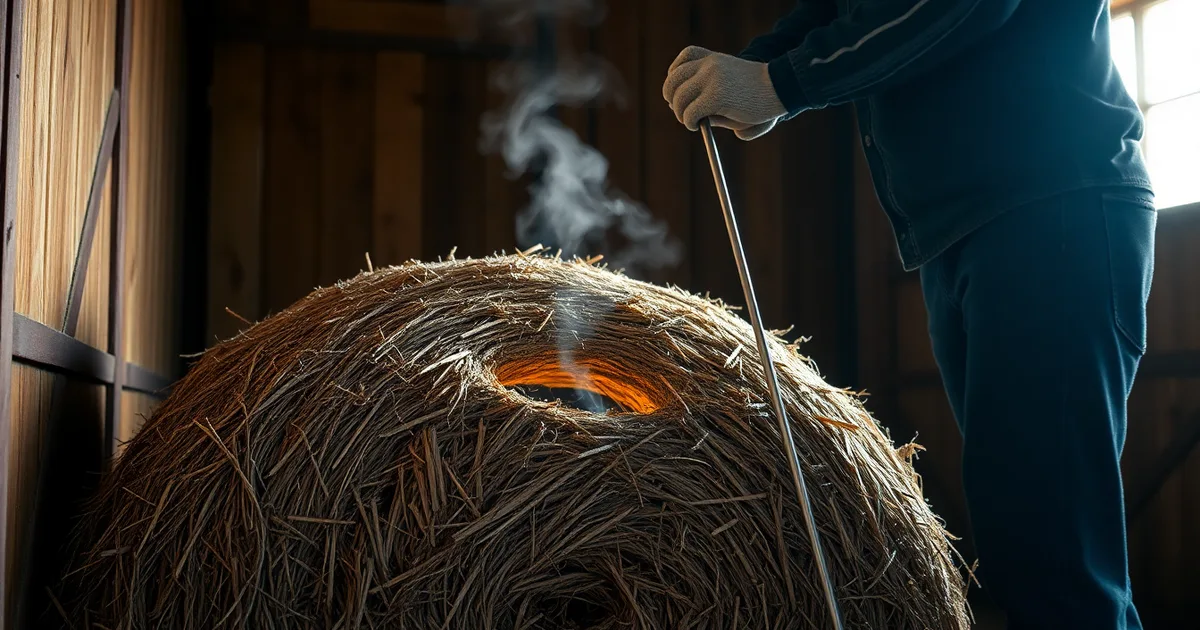
Rain doesn't ignite hay on its own. It re-wets dry material and restarts the microbial respiration that drives internal temperatures past 130°C. Probe 1.5 m deep: below 60°C monitor every four hours, 60–70°C move the stack clear of buildings, above 70°C pull it apart today.
Most people find the problem the wrong way round. They assume the rain did the damage, when the rain only finished a job the baler started. Hay put up at 20% moisture or drier stores fine; the trouble is that a single 10 mm downpour on a dry windrow can lift moisture by 5 to 15 percentage points depending on how dense the swath is, and that is often enough to cross the line. Above 25% moisture, microbial heating can top 70°C inside five to ten days.
The figure that catches people out is 130°C. That is roughly where spontaneous combustion begins, and it needs restricted airflow to get there — a tight stack holding heat it cannot shed. A loose single bale rarely makes it. A stack of 200 does, and one wet bale in the middle is enough to take the rest with it.
There is a second trap. Hay that has already heated once heats faster the next time, because microbial breakdown strips the waxy cuticle off the stems and the material absorbs water more readily. You are not back to square one after a hot spell; you are further forward than you were.
- Probe at depth: Push a 1.5 m probe thermometer into the bale, not the surface — surface readings can sit 20–30°C below the core.
- 60°C threshold: Below 60°C, recheck every four hours; never leave a hot stack unmonitored overnight.
- 70°C means act: At 70°C and climbing, break the stack apart immediately rather than calling for a pump.
- 10 m separation: NFPA 1 (2024) and UK Home Office fire guidance both call for isolating suspect bales at least 10 m from buildings.
- Rain adds points: A 10 mm re-wetting rain on a dry windrow can add 5–15 moisture percentage points, depending on swath density.
What actually happens inside a wet hay bale after rain?
Baled hay is not sterile. It carries a resident population of thermophilic bacteria — mostly Bacillus and Thermoactinomyces species — plus moulds that sit dormant as spores once moisture drops below about 20%. Rain does not start that population; it wakes it up. A field study published in 2025 found that 10 mm or more of rain landing on a dry windrow raised moisture content by 5 to 15 percentage points, enough to push a batch that was already marginal at 16–19% straight past the 20% ceiling. Small square bales go into storage legally and safely at 20% or below; large round bales need 18% or less, because their density holds water far longer. Note the hard rule in NFPA 1: the wetting that matters is not the rain you watched fall. It is the water already inside the bale when the rain arrived.
Once moisture is above roughly 20%, the spores germinate. The bacteria respire, consuming the soluble sugars and starches in the leaf and stem, and their metabolism releases three things: heat, water vapour, and organic acids — acetic and propionic mostly, which is the sweet, sharp, slightly vinegary smell people describe when they open a heating stack. It is the same fermentation that makes silage, run without the anaerobic seal that keeps silage cool. Because hay is a poor conductor of heat (its thermal conductivity is roughly a third that of water), the warmth cannot escape. The core climbs 5 to 10°C per day, with the peak usually arriving 5 to 10 days after the wetting event, and full-blown spontaneous combustion showing up anywhere from two to six weeks after the bale went into the barn.
Around 70°C the chemistry changes hands. Microbial respiration slows and then stops as the colony cooks itself, but a second reaction takes over: direct exothermic oxidation of the plant material. That reaction does not need living organisms and does not need oxygen in generous supply — it only needs the heat already banked in the core. Core temperatures of 130°C are where dry hay can autoignite outright. The British data make the cost of missing this window plain: NFU Mutual reported in 2025 that roughly 70% of hay fire insurance claims were denied when the owner could not produce a temperature log.
The sequence in one pass
So the causal chain runs rain re-wetting → moisture above 20% → bacterial respiration → trapped heat → 70°C handover → exothermic oxidation → 130°C ignition. Rain is the trigger because it removes the ceiling that kept dormant spores from germinating, not because water burns or because wet hay is inherently flammable. A bale that went into the stack at 14% moisture can take 10 mm of rain on its outer 10 cm and stay perfectly safe; a bale that went in at 21% needs no rain at all, and the rain simply removes the last excuse for not having probed it.
Practical consequence: the deciding measurement is not rainfall in millimetres and not the feel of the surface. It is temperature at 1.5 to 2 m (5 to 6.5 ft) into the bale, taken with a probe like a Reotemp Hay Probe Thermometer or a Digi-Sense thermocouple unit, both of which run $40–$120 at 2026 retail prices. A surface reading can sit at 25°C while the core is at 82°C. Probe deep, log the number, and date it. That log is the document your insurer will ask for.
How do I measure internal bale temperature correctly?
This procedure applies to any bale that has been rain-wetted, is under a tarp that has leaked, or is showing steam, a sweet caramel smell, or a warm patch on the stack face. It needs one tool: a 1.5 m (5 ft) probe thermometer, $40–$120 at 2026 retail prices. The Reotemp Hay Probe Thermometer and the Digi-Sense Thermocouple Probe with a 1.5 m stem are the two most common choices among small-scale growers. An infrared gun pointed at the surface is not a substitute — it reads the outer 5 mm of hay, which is typically 20–40°C cooler than the core at 1.5 m depth (University of Wisconsin–Madison Extension, 2024).
- Wait at least 24 hours after the rain event before your first reading. Temperature at the core lags the moisture front by 12–36 hours, so a probe at hour 6 tells you almost nothing. If the rain was ≥10 mm on a dry windrow, treat every bale in that field as suspect.
- Pick bales in a fixed pattern, not the ones that feel warmest. Sample every tenth bale in a row of 50, or every fifth bale in a stack of 20, plus any bale sitting within 10 m (33 ft) of a building. Heating clusters, so a single hot bale almost always has two or three neighbours already climbing.
- Push the probe into the end of a round bale or the side of a square bale until the tip is 1.5–2 m (5–6.5 ft) in. This is the step people botch. A 30 cm stab into the outer wrap reads ambient air and the cool outer layer, and that false low reading is what gets stacks burned down. On a 1.2 m diameter round bale you may need to probe from both ends to reach the true core. Insertion takes 30–60 seconds per bale; leave the stem in for 30 seconds before reading.
- Take three readings per bale: one at the geometric centre, one 30 cm below the top surface, one 30 cm above the bottom. Record all three plus the highest. The highest number, not the average, drives your decision.
- Log four things every time: time of reading, bale ID (paint a number on the flat end), ambient air temperature, and the three probe readings in °C. Use a notebook or a spreadsheet. Photograph the page with your phone — a timestamped photo is what an insurer asks for first.
- Repeat every 4 hours for any bale reading above 50°C. Below 50°C, once daily is adequate. Above 60°C, do not leave the stack unattended overnight. The 5–10 day window from wetting to peak temperature (USDA, 2023) is when most of your readings will be taken.
- Act on the thresholds, not on how things look. Below 60°C: monitor. 60–70°C: isolate and keep probing, move the bale 10 m (33 ft) from buildings and 15 m (50 ft) from other stacks per NFPA 1 (2024). Above 70°C: pull the bale apart and spread the hay — do not wait for the next reading. Above 80°C: call the fire service and stop handling it.
- Keep the log for at least 12 months after the stack is fed out. A 2025 NFU Mutual dataset found 70% of hay fire claims were denied when no temperature log was provided. The log is the difference between a payout and a total loss.
The failure mode is not a broken thermometer. It is the probe that goes in 40 cm because the hay is tight, the reading comes back 38°C, and the stack gets left alone for a week while the real core at 1.6 m climbs past 75°C. If you cannot seat the probe to 1.5 m, drill a pilot hole with a clean 10 mm auger bit first. A $60 tool and ten minutes per bale is the entire difference between a manageable hot spot and a 200-bale burn.
Temperature thresholds: when to monitor, when to pull apart, when to call 999
A number from a probe is only useful if it maps to an action you can take at 11pm in the rain. The thresholds below come from NFPA 1 and the extension services at Wisconsin and Penn State, and they are not advisory. At 70°C the biology inside the bale has stopped being a slow decomposition problem and become a self-sustaining heat source. Above 80°C you have minutes to hours, not days, and the fire service is there to protect buildings, not to save hay.
Take readings at 1.5–2 m depth, in the same three or four bales each time, and write the number and time down. A log is the difference between an insurance payout and nothing: NFU Mutual's 2025 claims data shows roughly 70% of hay fire claims denied where no temperature record was produced.
| Internal temperature | What it means | Action | Timeline |
|---|---|---|---|
| Below 60°C (140°F) | Normal thermophilic activity; moisture likely still above 20% | Monitor every 4–6 hours; keep the 1.5–2 m probe readings logged | Recheck for 6 weeks minimum |
| 60–70°C (140–158°F) | Exothermic oxidation outpacing heat loss | Move bales at least 10 m (33 ft) from buildings, 15 m (50 ft) from other stacks; increase ventilation; do not re-stack | Monitor every 2 hours |
| 70–80°C (158–176°F) | Approaching flash point of dry plant material | Pull the stack apart immediately into single bales; spread them; call 999/911 if any flame or glowing char appears | Act within the hour; fire can develop in under 60 minutes at this range |
| Above 80°C (176°F) | Pre-ignition; 130°C (266°F) autoignition is realistic | Evacuate people and livestock; call the fire service; do not attempt to move or open bales | Minutes to tens of minutes |
| Above 130°C (266°F) | Autoignition threshold under NFPA 1 (2024) | Assume ignition is already underway; withdraw to at least 30 m (100 ft) | Immediate |
The row that carries most of the weight in practice is 60–70°C, because that is where a 200-bale stack can still be saved by isolation and airflow, and where most farmers lose the argument with themselves about whether the reading is "really that bad." For a 50–150 bale operation with bales stored near a barn, treat 60°C as the intervention point rather than the top of the monitor band — the 10 m NFPA 1 isolation distance is not negotiable when a $40–$120 probe is the only thing standing between you and a replaced shed. The flip case is loose, well-ventilated hay stored in the open field, in which case a bale sitting at 62°C with a falling trend over 12 hours is genuinely a monitor-only situation. The trend matters more than the single number, which is why one reading taken in the dark with a cheap stem thermometer tells you nothing useful.
Why does rain on a dry windrow cause more problems than rain on already-wet hay?
A bale made from hay that was already at 25-30% moisture at baling carries a microbial population that has partly finished its work. The thermophilic bacteria and moulds responsible for the initial heating have already consumed much of the soluble sugar, the pH inside the bale has drifted down, and the internal environment has stabilised — sometimes at 45°C, sometimes merely at ambient. That is not safe, but it is a known quantity. If the hay was treated with a propionic-acid preservative at baling, the acid load suppresses further bacterial growth even when rain re-wets the outside. The reason dry hay is different comes down to the same principle: dry hay has a waxy cuticle on every stem that evolved to shed water. Rain hitting a dry windrow does not soak evenly. It runs off the leaf surface, pools at the base of the swath, and wets the stems at the bottom while the top stays at 12-14% moisture. You get a bale with a dry core and saturated outer layers, and that unevenness is where the trouble starts.
That uneven wetting creates hot spots that a wet-baled bale never produces. Penn State Extension field work has repeatedly shown that a dry windrow receiving ≥10 mm of rain can pick up 5-15 percentage points of moisture in the bottom third of the swath. Bale that unevenly and you have regions above 25% sitting inches from regions at 14%, so the microbes in the wet pockets ferment hard while the dry pockets insulate them. Re-wetted hay also has a chemical disadvantage: the soluble sugars that were never consumed during field drying are still present, and there is less organic acid already built up to buffer the pH rise that accompanies bacterial growth. A bale baled wet has effectively pre-acidified itself. A re-wetted dry bale has not.
Once a pocket heats past 55°C, the hay itself becomes hygroscopic. Water that was sitting in the outer layers migrates inward as vapour and condenses in cooler zones, so a bale that was wet on the outside on day two is wet through the middle by day nine. That is the feedback loop: heating dries one zone and wets another, the wet zone feeds thermophilic bacteria, and the cycle restarts. Farmers running a Reotemp Hay Probe Thermometer at 1.5-2 m depth typically see a peak somewhere between day five and day ten, and sometimes a second peak two to three weeks later when the redistribution has finished. If you only probe once, you will miss it.
The practical upshot is counterintuitive but consistent: the re-wetted dry bale is the one to watch with a logbook, not the one that steamed on the day you made it. A bale baled at 28% that stabilised at 42°C after two weeks is doing what wet hay does. A bale baled at 16% that took 12 mm of rain and is now reading 58°C at depth is in the early phase of a process that has no natural stopping point. Probe it daily, keep the readings in writing — NFU Mutual denied roughly 70% of hay fire claims in 2025 where no temperature log was provided — and accept that at this stage the only tool that changes the outcome is your own arm holding the probe.
Can a hay bale really catch fire without a flame?
There is no spark, no lightning strike, no discarded match. The ignition source is the hay itself, and it takes days to arrive. Thermophilic bacteria and exothermic oxidation chew through the soluble sugars in damp hay and release heat as a by-product; because cured hay is one of the better natural insulators you can stack, that heat has nowhere to go. NFPA 1 puts the autoignition range for hay at 130–170°C, which is nowhere near a warm summer day — so nothing "spontaneously" ignites at ambient temperature. The mass has to cook itself there first.
The fire triangle closes slowly and in stages. Fuel is present from the moment the bale is made. Oxygen diffuses into the bale through the outer layers at a rate far slower than the microbes would like, which is precisely why the reaction smoulders instead of flashing — a restricted air supply keeps combustion in the charring regime. At 60°C you have a wet, biologically active bale. Somewhere past 100°C the water is driven off, the organic matter begins to char, and once char forms it can sustain its own smoulder for days before any flame appears. That smoulder is the dangerous part: it produces the sweet, caramel-like smell and the steam that farmers notice, and it can sit inside a stack for a week before the outer surface even feels hot to a bare hand.
This is why the 2023 USDA timeline runs 2–6 weeks from storage to combustion, with peak heating typically arriving 5–10 days after the wetting event. Nothing about it looks urgent until it very suddenly is. By the time you see visible smoke or flame, the fire has usually been burning internally for hours or longer, and a stack already past 80°C is beyond what any fire brigade can extinguish — they can only protect the buildings and the adjacent stacks while it burns out.
What are the warning signs of a hay bale about to ignite?
Your nose and your hands will usually tell you something is wrong before you ever fetch the probe. Thermophilic bacteria and exothermic oxidation inside a bale that went into the stack above 20% moisture produce heat, water vapour and a family of volatile compounds, and all three escape through the outer layers. Walking a stack at dawn with no instrument at all is a legitimate first-pass check. The problem is that the cues are easy to talk yourself out of.
- Steam in cool morning air. A wisp of vapour off a stack at 6am in September is the single most reliable visual tell. Warm, moist air leaving the bale hits cold ambient air and condenses, so you see it most clearly when the temperature difference is largest. Hay that is genuinely dry and stable will not do this.
- A sweet, caramel or slightly tobacco-like smell. This is the smell of Maillard-type reactions between sugars and amino acids at elevated temperature, and it is a genuine warning, not a pleasant farmyard note. An acrid, sharp or burnt-tobacco edge means you have moved past caramelisation toward charring. Trust the shift from sweet to acrid as your cue to probe, not the sweet smell alone.
- Hay that is hot to the touch. Push your hand into the outer 150–200 mm of the bale or between bales in a stack. If you can hold your palm there indefinitely, you are likely under 50°C. If you snatch your hand back, you are probably above 60°C, which is the monitor threshold in the 2024 NFPA 1 thresholds. This is a screening test, not a measurement.
- White or grey ash on the surface. Powdery grey deposits on the outside of a bale, often mistaken for dust or mould, are combustion residue carried outward on convection currents. White ash patches near the top of a stack mean the fire has already started somewhere inside. Do not open the bale in a barn to look.
- Condensation on the underside of tarps. A tarp that is dripping on its inner face in dry weather is trapping moisture the bale is driving off. That water then runs back into the top of the stack and re-wets hay you thought was safe. It also rusts the tarp eyelets and rots the top layer, which is why tarped stacks fail at the crown far more often than at the sides.
- Visible charring at the bale ends or along twine lines. Blackened patches, brittle twine, or a scorched smell on the string itself indicate the heat front has reached the surface layer. At that point you are past monitoring and into the disassembly range. Twine fails around the same time as the surface chars, and a collapsing bale releases a lot of hot hay at once.
- Sagging or settling stacks. Bales that lose their shape faster than expected, or a stack that visibly slumps overnight, can indicate internal loss of structure from heat and moisture damage. This is a slower sign and less specific, but combined with any of the above it raises the odds considerably.
The item people get wrong most often is the smell. A caramel scent coming off a stack in October gets read as "nice hay" by plenty of farmers who have never seen a fire, and the bale gets left another fortnight while temperatures climb through the 60s toward the 70°C evacuation threshold. By the time the smell turns acrid, you are often above 70°C and out of the window where a probe reading alone will save the stack. The other common error is touching the surface of a bale and feeling nothing unusual, then concluding the bale is fine. Surface temperature on a large round bale can sit 20–30°C below core temperature, which is exactly why the 2024 University of Wisconsin Extension guidance specifies 1.5–2 m probe depth and not the outer 300 mm. A $40–$120 Reotemp or Digi-Sense probe thermometer with a 1.5 m shaft costs less than one bale of good hay and will tell you more than any of these sensory cues. If you are relying on smell alone, you are already a step behind.
How should I store hay after rain to prevent combustion?
The cheapest fire prevention tool you own is a moisture tester, and it costs less than one ruined bale. Farmex and Dairyland units run $200–$400 and read bale moisture in about 30 seconds; if you bale above 20% for small squares or 18% for large rounds, you are storing a fire, not feed. The 2025 extension guidelines are not conservative suggestions — they are the line where thermophilic bacteria reliably outpace ventilation. Test before you bale. Test again from a different side of the windrow even if the first reading looks fine, because rain that fell unevenly leaves uneven moisture, and the wettest corner is what burns the stack.
Geometry matters more than most people expect. Set bales in a single row, never stacked, with roughly 1 m of air between each one so heat has somewhere to go. Get them off the ground entirely — pallets or a 10–15 cm gravel pad work, and the airflow underneath is doing real work dissipating heat from the lower third of the bale, which is where thermophilic activity often starts. Keep that row at least 10 m from any building and 15 m from other stacks, per NFPA 1. A Krone Comprima making 1.2 m rounds needs about 1.5 m of clearance per bale in a row; a Vermeer 504R closer to 1.8 m. If you cannot give them that spacing, you have answered your own question about whether you can safely store them.
The tarp is the problem, not the solution
Covering a suspect stack with a tarp is the single most common mistake smallholders make after rain, and it kills stacks that would otherwise have dried out. A tarp traps the moisture already inside the bale and blocks the convective path that would carry it away. Hygroscopic moisture migrates from the core to the outside, hits the underside of the tarp, condenses, and drips back in — you have built a still. If bales are wet, leave them uncovered in the open row described above, or move them under a ventilated roof with open sides where air moves through. A temperature log taken at 1.5–2 m depth, every day for the first 14 days, is what a 2025 NFU Mutual dataset found separated paid claims from denied ones — 70% of hay fire claims were refused when the owner had no log. A $40–$120 Reotemp or Digi-Sense probe pays for itself the moment you need to prove you were monitoring.
What should I do if my hay stack is already smoking?
This procedure applies once you can see smoke, not just steam — steam that dissipates within a metre of the bale face is a 50–60°C problem you can still probe and monitor. Smoke that hangs, drifts, or smells sweet and acrid means the stack is past the point where a thermometer tells you anything useful. You need a phone, a clear exit route, and enough people to move livestock. You do not need a hose.
- Call the fire service before you do anything else. Say "hay stack fire" and give the number of bales and whether it is touching a building. Hay fires burn deep inside the stack and can take 6–24 hours to bring under control; crews need that information before they arrive, and in the UK they will often let a stack burn under supervision rather than soak it. Your call also timestamps the incident, which matters later.
- Evacuate people and animals to at least 50 m upwind. Fifty metres is the floor, not the target — a 200-bale stack can throw burning flakes 20–30 m on a moderate wind, and smoke from a hay fire carries carbon monoxide and fine particulates. Move horses first if they are stabled within the isolation distance of 10 m from the stack.
- Do not move smoking bales and do not open the stack. This is the step people botch, usually while waiting for the fire service with a tractor and a spike. A smouldering stack is oxygen-starved; cracking it open feeds the reaction and can turn a slow burn into a surface fire within minutes. Your earlier readings, if you have them, tell the incident commander more than a rearranged stack will.
- If the fire service instructs you to separate bales, work from the upwind end with a loader, keep the bucket low, and never stand between the bale and the stack. Expect each bale you open to flare. Have water or a bowser standing by only as directed by the officer in charge.
- Do not attempt to extinguish a deep-seated fire with water. Water on the surface of a smouldering bale cools the outer 100–150 mm and does nothing for the core, while the steam it generates can drive heat deeper. Applying water also adds weight and makes the stack harder to pull apart when crews arrive.
- After the fire is declared out, monitor for re-ignition for at least 48 hours, and 72 hours if the stack was over 100 bales. Re-wet the ash and charcoal, check with a probe at 1.5–2 m where any intact bales remain, and log the readings every 2–4 hours. Hay fires routinely restart overnight when wind picks up and no one is watching.
- Document everything as you go: time of first smoke, time of the call, temperatures if you have a log, and the fire service incident number. Insurers deny roughly 70% of hay fire claims when no temperature record exists, so a log kept in the preceding days is worth more than anything you write afterwards.
The failure mode is not the fire itself — it is the second fire. A stack that has been rained on, called in, and hosed down looks finished from the outside while the core sits at 90–130°C. Autoignition needs no flame, only that heat, and 130°C is the point NFPA 1 treats as the threshold where it becomes possible. If you have no probe and no log, assume the worst and keep watching until the ash is cold to the touch at depth.
Frequently Asked Questions
How long after rain does hay spontaneously combust?
Heating usually begins within 24 to 48 hours of baling wet hay, with peak internal temperatures at 5 to 10 days, and full combustion typically 2 to 6 weeks after the wetting event. The delay depends on bale size and density. Large round bales insulate better than small squares, so they hold heat longer and reach dangerous temperatures more slowly but more reliably.
What temperature does hay catch fire at?
Hay autoignites somewhere between 130°C and 170°C (266°F to 338°F), and that range is not negotiable with the weather. The fire does not start there, though. Microbial respiration has to push the internal temperature past roughly 70°C first, because above that point exothermic oxidation takes over and the bale starts generating its own heat faster than it can shed it.
Can wet hay catch fire without a spark?
Yes. Spontaneous combustion in hay needs no ignition source, no electrical fault, no lightning strike. Bacteria and fungi consume soluble sugars in damp hay and release heat; the bale's own mass insulates that heat; the temperature climbs until chemical oxidation becomes self-sustaining. Bales above 25% moisture are the ones that do this, and the process is entirely internal.
How do I check if my hay bales are hot?
Use a 1.5 m (5 ft) probe thermometer and push it 1.5 to 2 m into the bale, not just into the outer windrow. Anything above 60°C means check twice daily and prepare to move the stack. Above 70°C, disassemble it. Never walk on top of a hot stack, and never move bales into a barn while they are still climbing.
What moisture level is safe for storing hay?
Below 20% moisture for small square bales and below 18% for large round bales is the safe storage window. Above 25%, the risk of heating and combustion rises sharply, and bales in that range should be left in the field or fed out quickly rather than stacked. A cheap moisture meter costs less than one ruined barn.
Will rain ruin hay in the field?
Rain on already-dry windrows typically adds 5 to 15 moisture percentage points, which usually means re-drying before baling. A light shower on a thick windrow may only affect the top inch. A soaking rain on a thin, spread windrow is worse, and if you bale it damp anyway, you have set up the same heating cycle that burns barns.