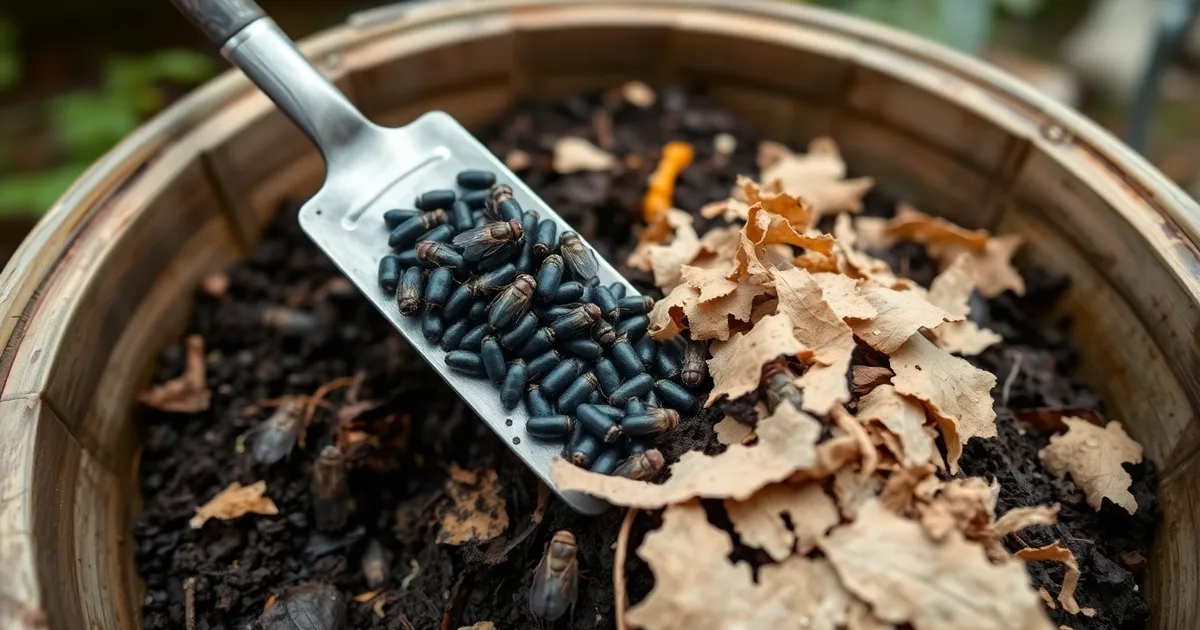
Maggots show up when a compost bin is too wet and too nitrogen-heavy, most often from fruit scraps, grass clippings or uneaten food. Black soldier fly larvae are harmless and help break the pile down; house fly maggots mean scraps sat too close to the surface. Stop adding wet material, mix in dry browns, and turn it.
Lifting a lid onto a seething mass of greyish-white larvae is unpleasant, but it is not a ruined batch of compost. Black soldier fly larvae (Hermetia illucens) run 1-2 cm long and arrive deliberately, laying eggs in moist, protein-rich piles. They eat, they excrete, and they leave. House fly maggots (Musca domestica) are smaller, creamier and a different story: they almost always mean food scraps ended up buried less than 5 cm deep, close enough to the surface for an adult fly to reach.
The number that catches people out is the carbon-to-nitrogen ratio. Compost runs best between 25:1 and 30:1, but kitchen scraps sit near 15:1 and dry leaves near 60:1. A bin fed on peelings alone drifts steadily toward nitrogen and water, which is exactly the condition both fly species need to breed. Target 40-60% moisture, or roughly the wetness of a wrung-out sponge, and the pile stops being attractive.
One caveat worth holding onto: you cannot kill your way out of this. Spraying, drowning or sifting the larvae out leaves the wet, rich conditions intact, and the next generation arrives within the 7-10 days it takes a fly to go from egg to pupa.
- Two species, two verdicts: Black soldier fly larvae (Hermetia illucens), 1-2 cm and greyish-white, are beneficial composters, while creamy house fly maggots (Musca domestica) indicate food buried shallower than 5 cm.
- Moisture target is 40-60%: Squeeze a handful of compost — if it drips or streams water, it is over the limit and needs dry browns added.
- Fix the C:N ratio: Aim for 25:1 to 30:1; vegetable scraps run about 15:1 while dry leaves run about 60:1, so scraps alone pull the pile toward the nitrogen-heavy condition flies prefer.
- Cover every food addition: A 5-8 cm layer of shredded leaves, cardboard or sawdust after each addition of kitchen scraps cuts fly attraction sharply.
- Break the cycle by turning: Weekly turning for 3 weeks, plus a lid or tarp, disrupts the 7-10 day fly life cycle faster than any pesticide.
What are the maggots in your compost bin?
Almost every larva you will find in a backyard bin belongs to one of two species, and they mean opposite things. The black soldier fly (Hermetia illucens) is a composting ally that shows up in wet, protein-heavy pockets and eats its way through them; the house fly (Musca domestica) is a sign that your pile is sitting wet and open enough for flies to breed on the surface. Fruit fly larvae (Drosophila spp.) can appear too, but they are much smaller, rarely more than 3 mm, and track sugary fruit waste rather than rot.
The reliable field test is colour and skin texture, not size, because a full-grown house fly maggot can reach 12 mm and overlap with a young soldier fly larva. Pick one up on a trowel and look at it in daylight. Soldier fly larvae are flattened, leathery, and grey-black with visible segment ridges; house fly maggots are creamy white, smooth, and taper to a point at the head end with no distinct ridges.
| Feature | Black soldier fly larva | House fly maggot |
|---|---|---|
| Colour and skin | Grey to black, leathery, ridged segments | Creamy white, smooth, glossy |
| Length at maturity | 20-27 mm | 8-12 mm |
| Where it clusters | Deep in moist, protein-rich pockets 10-25 cm down | Top 5 cm, near fresh scraps and the bin lid |
| Movement | Slow, aggregates in dense writhing masses | Fast, disperses outward when the lid is lifted |
| Food consumed per larva | Up to 100 mg per day | Roughly 25-50 mg per day |
| Lid-off response | Stays put, may burrow deeper | Scatters within 10-20 seconds |
Read down the colour and location rows first: if the larvae are grey-black and sitting 15 cm down in the middle of the pile, you have black soldier fly and there is nothing to fix beyond moisture management, because that colony is processing roughly 100 mg of food per larva per day and will self-harvest in 7-10 days at 24-30°C. If they are creamy white and crawling up the sides and lid, you have house fly and the pile is too wet and too nitrogen-rich at the surface, which is the failure case worth acting on. The exception that flips this: a bin that is mostly dry browns with a single wet, meaty pocket can hold soldier fly larvae that look alarming in number but are doing useful work — do not confuse a dense but deep colony with a surface infestation just because the count is high. This runs to Master Composter and RHS guidance in the UK, where soldier fly larvae are routinely described as a sign the bin is working, not failing.
Why do maggots appear in the first place?
Flies lay eggs where larvae can survive, and that means wet, nitrogen-heavy, exposed food. Compost moisture should sit between 40 and 60 percent; above roughly 70 percent the pile turns anaerobic, smells sour, and becomes a nursery. The 2024 NRCS standard puts the ceiling at 70 percent for exactly this reason. Push past it and you have created standing water in the pore spaces, which is where fly eggs hatch best.
Nitrogen is the second lever. Food scraps run about 15:1 carbon-to-nitrogen, while the ideal pile sits near 30:1 (2023 Cornell composting guide). Every banana peel and melon rind you add pushes that ratio down, and flies read a nitrogen-rich pile the way you read a restaurant sign. Grass clippings do the same thing in bulk. Dry leaves at 60:1 are the correction, not a garnish.
The third factor is depth. Food buried less than 5 cm deep is reachable by flies; a 5 cm cover of browns after each addition cut egg-laying by up to 90 percent in a 2022 field trial. Most people who find maggots are digging two or three centimetres into a wet pile and wondering why the flies found it.
Leave black soldier fly larvae alone — they are doing your job
If the larvae are large, grey-black, ridged, and up to 2 cm long, you have Hermetia illucens, the black soldier fly. Each larva eats up to 100 mg of food per day (2026 study average) and they voraciously shred soft kitchen waste. They are not pests. They outcompete house fly larvae, they do not bite, and they do not colonise your house. Scoop them into a worm farm or leave them.
House fly maggots (Musca domestica) are smaller, cream-coloured, and legless, often clustering on the surface. That is the signal. Flies complete their lifecycle in 7-10 days at 24-30°C (2025 entomology data), so a pile left alone multiplies fast. Even then, do not reach for insecticide. Add two parts dry leaves or shredded cardboard to every part wet material, work them in, and bury all food below 5 cm. Turning weekly for three weeks raises the internal temperature to 55-65°C and kills eggs and larvae (2025 UC Davis study), which is the honest fix. Killing larvae without changing the pile guarantees they return in a week.
Are black soldier fly larvae bad for compost?
No, and the instinct to reach for lime or boiling water is the wrong one. Black soldier fly larvae (Hermetia illucens) are the large, greyish-cream, segmented grubs that turn up in wet, food-heavy bins, and they are working for you. A single larva eats up to 100 mg of food per day, so a few thousand of them strip a bucket of kitchen scraps in days rather than weeks. They also suppress pathogens: as they feed, their gut flora outcompetes E. coli and Salmonella, which is one reason USDA and EPA composting guidance treats BSF activity in a home bin as a neutral-to-positive sign rather than a contamination event.
If you keep chickens, you have a free protein harvest sitting in the bin. Scoop the larvae out with a trowel and tip them into the run. At 24-30°C the flies complete their whole life cycle in 7-10 days, so a bin can produce a continuous supply through late summer. What BSF larvae will not do is damage your garden. They do not eat living plant tissue and they do not survive long once the pile dries out or cools, so anything that ends up in the finished compost is dead or pupated.
What their presence is actually telling you
Treat the larvae as a readout, not a problem. They thrive where moisture sits above roughly 70%, and they need the nitrogen load that comes from food scraps at around 15:1 C:N against the 30:1 you want. That combination is a wet, sour, anaerobic pile with too little carbon. The larvae are your reward for the imbalance, not its cause.
The trade-off is whether you correct the underlying conditions or leave them be. If the bin smells like ammonia or sewage when you lift the lid, dry it out and rebalance it, because the same conditions that suit BSF larvae also suit the house fly (Musca domestica) whose larvae you do not want near food. If it smells earthy and the larvae are the only thing that looks wrong, leave them. Add a 5 cm layer of dry leaves or shredded cardboard each time you add scraps, keep the moisture between 40% and 60%, and the BSF population will finish the batch and move on.
How to get rid of house fly maggots without killing your compost
Use this method when the larvae are pale, tapering, and legless with a pointed head — Musca domestica, the house fly — and the bin smells sour or ammonia-sharp rather than earthy. Black soldier fly larvae (Hermetia illucens) are a different animal: 2-3 cm long, dark grey when mature, and flat-headed. If that is what you have, close the lid and skip this section entirely. If it is house flies, expect two to three weeks of slightly annoying maintenance and a compost pile that comes out better than it went in. You need a bag of shredded paper or dry leaves, a fork or compost aerator, and a cover that actually seals.
- Stop adding food scraps for 10-14 days. This is the step people botch, and it is the one that matters most. Every fresh banana peel or coffee ground resets the clock. House flies complete their life cycle in 7-10 days at 24-30°C, so a clean two-week break interrupts egg-laying before a second generation can establish. Keep adding browns and garden waste if you like; just no kitchen material.
- Add a 5-8 cm layer of dry browns across the entire surface. Shredded cardboard, dry autumn leaves, sawdust, or torn newspaper all work. Dry leaves run about 60:1 carbon to nitrogen; food scraps are closer to 15:1 and the ideal is 30:1. You are correcting exactly that imbalance. A 2022 field trial found a 5 cm brown cover after each food addition cut fly egg-laying by up to 90%.
- Mix the browns in properly, down to 20-30 cm if your bin allows. Scattering them on top is not enough: the larvae live in the wet, dense layer underneath, and you need the dry material distributed through it. This takes 10 minutes with a fork. If the pile is genuinely sodden, add a second batch of browns and mix again.
- Check moisture as you go. Compost should sit at 40-60% moisture — a handful squeezed hard should feel like a wrung-out sponge and release one or two drops, not a stream. Above 70% the pile goes anaerobic and becomes a fly nursery. If yours is dripping, you are now adding browns for two reasons, not one.
- Turn the pile weekly for three weeks. A 2025 UC Davis study found weekly turning over three weeks pushed internal temperature to 55-65°C, which kills fly eggs and larvae outright and drives off the adults. If your bin is under about 1 cubic metre you will struggle to hit those temperatures — Garden Organic's 2021 guidance sets 1 m³ as the practical minimum for hot composting — so treat turning here as a drying and disruption tool rather than a pasteurisation step.
- Keep the bin covered between turns. A lid, a tarpaulin weighed down at the corners, or a sheet of old carpet all work. Adults need access to lay eggs. On a wooden pallet bin this means checking for gaps at the slats; on a tumbler it means latching the door shut, which is easy to forget when you have been in and out of it all week.
- Bury all future food scraps at least 10 cm deep, in the centre of the pile. If the scraps are especially wet or smelly — cooked food, dairy, fish — wrap them in a sheet of newspaper first. Roughly 15 seconds per addition, and it makes the difference between a bin that stays fixed and one that relapses within a fortnight.
- Reset expectations on timescale. Adults already flying around will keep appearing for a week or so after you start. Larvae in the pile die or pupate out within 7-10 days at 24-30°C, slower in a cool September. Give it a full three weeks before deciding it has not worked.
The failure mode is stopping at step 2. A dry brown layer on top of a wet, compacted, nitrogen-heavy pile looks tidy and does almost nothing, because the fly larvae are 20 cm down in the sludge where the moisture still is. If you take one thing from this: the browns have to go in, not on. The second common failure is resuming food scraps too early — day eight, a bowl of peach skins, and you are back to square one. Wait the full two weeks.
One honest caveat: cold composting in a tumbler or a small dalek-style bin will not reliably reach 55°C no matter how often you turn it. In that case steps 1, 2, 5 and 7 do the work, and you should expect the problem to resolve slowly rather than in a single hot flush. If maggots keep returning every summer, the bin is too small or too wet for the volume of kitchen waste going in — a worm farm or a Bokashi bin handles food scraps without giving flies anywhere to breed.
How do I prevent maggots from coming back?
Prevention is not a separate job from composting well. Get the carbon-to-nitrogen ratio and the moisture right and flies lose interest, because a pile that heats properly and stays crumbly on the surface gives them nowhere to lay. The practices below are the ones that actually move the needle, roughly in order of how much they matter.
- Add browns with every green addition, not after. A 30:1 C:N ratio is the target, and it is not intuitive: kitchen scraps sit around 15:1 and dry leaves around 60:1, so a bucket of vegetable peelings needs roughly two or three buckets of leaves to balance it (2023 Cornell composting guide). Keep a bag of shredded cardboard, sawdust or dead leaves next to the bin so you never have an excuse to dump food in bare.
- Hold moisture at 40-60%, and check it with your hand. Squeeze a fistful of the material. One or two drops should fall; a steady stream means it is too wet, and nothing at all means it is too dry. Above 70% the pile goes anaerobic and starts attracting flies (2024 NRCS standard), so if you are in a wet spell, leave the lid off for a day or turn in dry browns.
- Bury food and cap it with 5 cm of browns. A 5 cm cover after each addition cut fly egg-laying by up to 90% in a 2022 field trial. This single habit does more than any trap or spray, because flies need exposed moist organic matter to lay on.
- Keep the lid on and screen the vents. A lid or tarp deters egg-laying adults, but it also traps moisture, so pair a closed bin with regular turning. If you use a tumbler composter, the sealed drum already helps; the risk shifts to the drainage holes, which should not sit in standing water.
- Leave meat, dairy and oily food out of a cold bin. They are the strongest fly attractants and the most likely to go anaerobic. If you generate a lot of them, that material belongs in Bokashi or a worm farm, not a passive outdoor pile.
- Turn weekly for three weeks to push the pile into the thermophilic range. Reaching 55-65°C kills fly eggs and larvae throughout the material (2025 UC Davis study). You need volume for this: Garden Organic recommends a bin of at least 1 cubic metre for hot composting (2021), which is why a wooden pallet bin beats a small plastic tumbler for heat retention.
- Step up to a sealed system if flies keep winning. A Bokashi bin ferments food scraps anaerobically with inoculated bran, producing no fly-attractive putrefaction at all, and a worm farm handles most kitchen waste indoors or in a shed. Both accept the meat and dairy your cold pile cannot.
The item people get wrong most often is the browns. They add a handful of shredded paper, see the pile still sloppy, and conclude the advice does not work. In practice you rarely have enough browns on hand, especially in spring and summer when greens pile up fast and last autumn's leaves are gone. Stockpile shredded cardboard, newspaper and sawdust through the year, or run two bins so one can finish while the other takes fresh material. That logistics problem, not the ratio itself, is what brings the flies back.
Black soldier fly larvae vs house fly maggots: key differences
Both larvae are legless and both show up in the same wet, nitrogen-heavy conditions, so most people assume they are the same animal at different sizes. They are not even in the same family. Black soldier fly (Hermetia illucens) larvae hatch from eggs laid in cracks above the waste line; house fly (Musca domestica) maggots come from egg batches of 100-150 laid directly on exposed food scraps, which is why a 5 cm cover of browns after each addition cut egg-laying by up to 90% in a 2022 field trial.
The distinction matters because the two require opposite responses. One is doing the work you wanted a compost bin to do. The other is telling you the pile has gone anaerobic.
| Trait | Black soldier fly larvae | House fly maggots |
|---|---|---|
| Colour and size | Grey to black, flattened, up to 2 cm | Pale cream-white, tapered, up to 1 cm |
| Appetite | Up to 100 mg of food per larva per day (2026 study average) | Roughly 25-50 mg per larva per day |
| Moisture they tolerate | Thrives at 60-80% moisture | Breeds above 70% moisture; 40-60% is the target range (2024 NRCS standard) |
| Time to adult | 2-5 weeks, faster above 27°C | 7-10 days at 24-30°C (2025 entomology data) |
| Adult behaviour | Does not bite, feed or enter houses | Bites, feeds on refuse, enters kitchens |
| Correct action | Leave them; harvest the frass when they migrate out | Dry the pile, add browns at 60:1, turn weekly for 3 weeks |
Black soldier fly larvae win on every row that concerns you, and for anyone running a cold 1 m³ bin or a wooden pallet bin in a temperate climate they are the outcome you want: they process food scraps faster than worms, leave a usable frass, and the adults have no interest in your house. The flip comes with volume and location. A tumbler composter or a bin within 15 m of a kitchen door is where house fly maggots cost you more than the larvae give back, because the 7-10 day life cycle at 24-30°C means a single wet batch can produce two generations before you next turn it, and each one sends adults indoors. In that case treat the pile as a house fly problem, not a composting one.
When should you worry about maggots in compost?
Maggots alone are not the emergency. Black soldier fly larvae working through a melon rind are doing what you paid them to do, and a bin at 55-65°C after a weekly turn for three weeks will kill fly eggs and larvae anyway. The threshold that matters is smell. If lifting the lid hits you with ammonia or rotten eggs, the pile has gone anaerobic, which means moisture is above 70% and oxygen has been squeezed out of the pore spaces. That is a genuine failure, and it needs immediate turning plus a dry browns addition. Ammonia specifically means nitrogen is being lost to the atmosphere as gas, so you are bleeding the fertility you were trying to capture.
Two secondary signals worth acting on
Rodents and wasps are the second threshold. Neither is there for the larvae; rats are after the food scraps themselves, and wasps are hunting the flies. A bin with all three problems at once is a bin that smells like a food source from several metres away. A cover of roughly 5 cm of browns after every food addition cuts fly egg-laying by up to 90% in field trials, and it does the same for the scent plume that pulls in rats. Fix the surface, and most of the traffic stops within a week.
The third case is quieter. If the pile does not heat up after you turn it, one of two things is wrong: it is still too wet, or it has run out of nitrogen. Squeeze a handful. Compost should feel like a wrung-out sponge, in the 40-60% moisture range; if water runs, add shredded cardboard or dry leaves and turn again. If it is merely damp and cold, your carbon-to-nitrogen ratio has drifted high. Food scraps sit around 15:1 and dry leaves around 60:1, so a cold pile that has been fed nothing but leaves and cardboard needs a nitrogen hit. Grass clippings, coffee grounds, or a handful of blood meal will restart it. A pile that will not exceed 40°C after two turns has stopped composting, and the larvae will keep breeding in it until something changes.
Frequently Asked Questions
Can maggots in compost harm my plants?
No. Black soldier fly larvae (Hermetia illucens) do not eat living plant tissue and leave behind frass rich in calcium and chitin, so finished compost from an infested bin is safe to spread. House fly maggots are a different signal: they do not damage plants directly, but they mean the pile is too wet and too rich in uncovered kitchen waste.
Will maggots survive winter in my compost bin?
Most survive as pupae, not as active larvae. Black soldier fly larvae burrow into soil or the lower pile to pupate and can stall below roughly 10°C, resuming in spring; house fly pupae tolerate frost in sheltered spots. In USDA zone 5 and colder, exposed larvae usually die but eggs and pupae persist, so turn and empty the bin in October rather than waiting.
How do I stop flies from laying eggs in my compost?
Bury every food scrap at least 10 cm (4 inches) below the surface, then cap the addition with a 5-8 cm layer of browns such as shredded cardboard, dry leaves or wood chips. Keep a lid on the bin and empty the kitchen caddy every two days in summer. Flies lay on exposed, moist, protein-rich material, so removing that surface removes the invitation.
Are maggots in compost dangerous to humans?
House fly maggots are the ones to respect. They develop in faeces and rotting meat and can carry Salmonella, E. coli and Campylobacter on their bodies, so wear gloves and wash hands with soap after handling an infested pile. Black soldier fly larvae are not human pathogens and are farmed commercially as poultry and fish feed, though they still look alarming enough that most people wear gloves anyway.
What is the fastest way to kill maggots in compost?
Turn the pile and mix in dry browns until the material stops clumping. Aim for a core temperature of 55-65°C (131-149°F), which a properly turned cubic-metre pile reaches within 24-48 hours; heat plus dryness kills larvae faster than anything else. Do not reach for pesticides. They kill the worms, beetles and microbes doing the actual composting work, and the flies return within a fortnight.
Can I add maggots to my worm farm?
No. Black soldier fly larvae eat far faster than Eisenia fetida worms and will strip the bedding, raise temperatures and push the worm population down. Remove them by hand or with a sieve. If you are finding house fly maggots instead, the bin is waterlogged: add dry shredded cardboard, drain any standing leachate and stop adding wet scraps until the bedding feels like a wrung-out sponge.