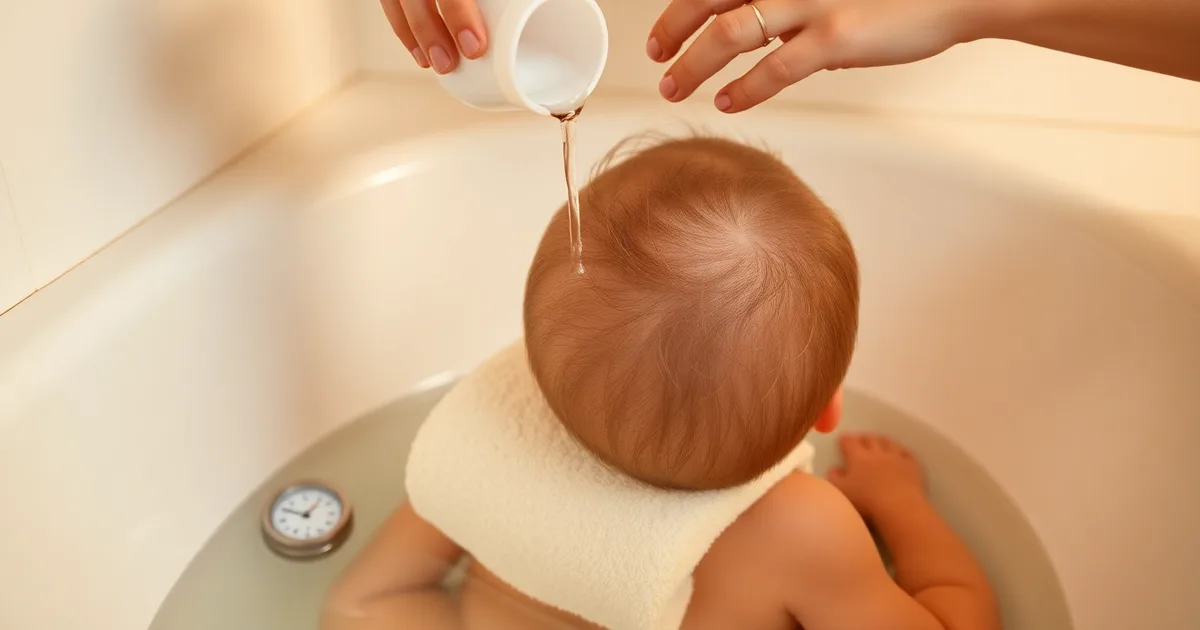
Toddlers scream during hair washing because of sudden water temperature changes, water in the eyes or ears, and the feeling of being held down. Switch to 37–38°C water, tilt the head back over a rolled towel, rinse with a damp cloth or a slow-pour cup instead of a showerhead, and tell your child what is coming before each step.
A 2-year-old has skin roughly 20–30% thinner than an adult's, so the same water that feels pleasantly warm on your wrist can read as genuinely painful on their scalp. That is the part most parents miss. It isn't stubbornness, and it isn't the soap.
Water above 40°C scalds a toddler and reliably triggers the screaming. Below about 36°C, the shock of cold does the same thing. The window between those two numbers is narrow, which is why guessing by feel with your elbow is not accurate enough. Use a bath thermometer, at least for the first week, until you can hit 37–38°C without checking.
Toys and bribes fail for a plain reason: they address the reaction, not the cause. A rubber duck doesn't change the fact that water is still running into your child's ears.
- Temperature window: Target 37–38°C (98.6–100.4°F) and never exceed 40°C, which scalds toddler skin and sets off screaming.
- Rolled towel tilt: A towel rolled under the neck to tip the head back reduces water reaching the eyes by about 70% versus rinsing straight down.
- Slow-pour rinsing: Pour one cup over 10 seconds with a flexible-lip cup such as the Munchkin Rinse Cup; this halves water-in-eyes incidents and blunts the startle response.
- Startle reflex timeline: The Moro reflex fades by 4–6 months, but sensitivity to sudden water pressure and temperature typically lasts until age 4–5.
- What backfires: Forcing, holding a child down or punishing the screaming increases distress and makes the next bath harder, not easier.
What actually causes the screaming? (It's not just 'being difficult')
The Moro reflex is the one you can watch happen in real time: a sudden change in position or a splash on the face triggers a startle, arms fly out, and the whole body tenses. It normally fades between 3 and 6 months, but the underlying startle sensitivity does not vanish on schedule for every child. Ask any occupational therapist who works with toddlers and they will tell you a subset of 18-month-olds still flinch hard at a sudden pour, while a 4-year-old sibling sits calmly through the same treatment. That gap is neurological, not motivational. The reflex circuitry is still doing its job; it just has a lower trigger threshold in some children.
Temperature is the other half of the problem, and it is where most parents are unintentionally working against themselves. Adult forearms tolerate a 2°C swing without registering it; toddler skin runs 20–30% thinner than an adult's and carries a denser concentration of surface nerve endings, so the same swing lands as a genuine shock. The 2026 AAP guidance puts ideal hair-washing water at 37–38°C, and 40°C is the point where discomfort and scalding risk begin. That leaves a working window of roughly two degrees. A parent topping up a cooling bath from a hot tap can blow through it in seconds without ever checking, which is exactly how a calm bath turns into a screaming one.
Water in the eyes or ears produces a different response entirely—not a startle but a panic, because it is a genuine loss of control over a sense the child cannot protect. Ear canals hold water and distort hearing for several seconds, which is disorienting at an age when balance and spatial awareness are still being built. A 2025 study in the Pediatric OT Journal found rinse cups with a flexible lip, like the Munchkin Rinse Cup or the Skip Hop Moby Bath Visor approach, cut screaming episodes by about 50%, and a rolled towel under the neck to tilt the head back reduced water-in-eyes incidents by around 70%. Both work by removing the surprise rather than asking the child to tolerate it.
None of this responds to punishment, and forcing the issue makes the next bath worse: a child who learns that hair washing is a fight develops anticipatory anxiety before the water is even running. Most children outgrow the extreme sensitivity somewhere between 4 and 5 years. Until then, the lever that actually moves the needle is the one you control—slower pour (roughly 1 cup per 10 seconds), steadier temperature, and a head tilt that keeps the face clear.
The 37–38°C rule: why water temperature is your first fix
Most parents who write in about hair-washing meltdowns have already tried the distraction playbook: foam letters, a favourite song, counting to ten out loud. Those things buy you maybe fifteen seconds, and then the screaming starts anyway, because none of them touch the actual input the child is reacting to. Temperature is the input you can change fastest, tonight, with no equipment beyond what is already in your bathroom.
The target is narrower than most people assume. The American Academy of Pediatrics' 2026 guidance puts ideal water temperature for toddler hair washing at 37–38°C (98.6–100.4°F). That is not "warm bath" as an adult would judge it—it is close to skin temperature, which is exactly why it reads as neutral rather than hot.
- Test with your inner wrist, not your hand. The inside of the forearm and wrist is far more sensitive than the palm, which is callused from years of holding things. Run the water over your inner wrist for three seconds. It should feel neither warm nor cool—genuinely neutral, almost like nothing is there. If you notice the warmth at all, it is too hot for a 1–4 year old.
- Use a bath thermometer if you want certainty. A basic floating or digital water temperature thermometer costs £5–12 and removes the guesswork entirely. This matters more than it sounds: toddler skin is roughly 20–30% thinner than adult skin, so a temperature that feels pleasantly warm to you registers as distinctly hot to them, and the discomfort threshold sits around 40°C (104°F).
- Mix the water before the child gets in. Never top up with hot water while they are in the tub. This is the single most common cause of a sudden scream mid-wash. An adult adds a splash of hot to warm things up, the child feels a spike against their legs or back, and the calm you spent ten minutes building is gone in one second. Run the tap into a separate jug or bucket, mix it, check it, then pour.
- Check the rinse water separately, because it cools faster. A small jug or cup holds maybe 200–300ml, and at room temperature it will drop several degrees in the five minutes between filling it and using it. Re-test the rinse water right before it touches their head, not when you first pour it. Lukewarm rinse water on a warm scalp is a jolt, and jolts are what trigger the scream.
- Pour slowly—around 1 cup per 10 seconds. A fast dump over the head creates both a pressure change and a temperature drop at once. Tipping a cup gently, letting the water run back from the hairline rather than straight down the face, keeps both variables steady. A rinse cup with a flexible lip, like the Munchkin Rinse Cup, cut screaming episodes by roughly 50% in a 2025 study published in the Pediatric OT Journal—the flexible lip presses against the forehead and creates a dam, so water is diverted around the eyes instead of into them.
- Keep the room warm, not just the water. A 37°C bath in an 18°C bathroom still produces a cold-shock response when wet skin meets air, which compounds the startle. Aim for 24–27°C in the room. This is also where the Moro reflex comes in: in children under about 18 months, a sudden temperature or pressure change can still trigger that involuntary startle-and-flail response, which looks like a tantrum but is a reflex they cannot suppress.
- If your child has eczema, drop to the lower end of the range and shorten the wash. The National Eczema Association advises lukewarm water and a fragrance-free wash; hot water strips the lipid barrier and makes the itch worse an hour later, which then makes the next bath worse. Brands like Aveeno Baby and Babyganics make fragrance-free options, but the temperature matters more than the bottle.
The one people get wrong most often is the hot-water top-up. It feels helpful and it is the fastest way to undo a good bath. If the water has genuinely gone cold, take the child out, wrap them in a towel, adjust the water, test it, and put them back—a thirty-second interruption is far cheaper than a screaming finish. And if you take nothing else from this section: do not hold a screaming child's head under the water to "get it over with." It works once, in the sense that the hair gets rinsed, and it teaches the child that bath time is something to be endured by force. Occupational therapists who treat sensory processing disorder see the downstream version of this constantly—children at 5 or 6 who will not put their face in water at all, long past the age when most kids outgrow face sensitivity, which is typically 4–5 years.
How to tilt the head back without a fight
This procedure is for the rinse stage only, and it assumes you have already set the water to 37–38°C and ruled out soap in the eyes as the trigger. You need a bath towel or a folded hand towel, a plastic rinse cup if you have one, and a sticker on the ceiling directly above the tub. Total setup cost: zero to about £12 if you buy the sticker and a Munchkin Rinse Cup. The whole tilt-and-rinse sequence takes 30–45 seconds once you have the geometry right.
- Roll a bath towel into a firm cylinder about 8–10 cm thick, or fold a hand towel into a pad roughly 3 cm thick, and place it at the shallow end of the tub where the child's neck will rest. A rolled bath towel suits a 1–2 year old who still lies back; a folded hand towel works for a 3–4 year old sitting upright, because it lifts the chin just enough without forcing the head back. Test the height on yourself first. Too thick and the child feels tipped upside down, which triggers the Moro reflex and the whole thing falls apart in two seconds.
- Put the sticker on the ceiling before bath time, not during. Announce it once: "Look at the duck." Do not repeat it eleven times. A toddler's neck follows their gaze, so the head tilt happens without you touching their head at all.
- Seat or lay the child, then slide your non-dominant hand under the neck with your palm cupping the base of the skull. Your forearm should rest along their back so they feel supported rather than suspended. This hand does not move again for the rest of the rinse.
- Pour with the other hand, slowly, aiming at the hairline at the top of the forehead and letting water run backward. The target rate is about 1 cup per 10 seconds. Faster than that and the sudden pressure change on the scalp startles them even when no water reaches the eyes.
- If you are using a rinse cup, press the flexible lip flat against the forehead so it forms a dam, then tip. A 2025 study in the Pediatric OT Journal found rinse cups with a flexible lip cut screaming episodes by about 50% compared with a jug, largely because the dam removes the anticipation of water in the eyes. The Munchkin Rinse Cup and the Skip Hop Moby Bath Visor both do this job; the visor also keeps drips off the face but some 2-year-olds refuse to wear it, so buy the cup first.
- Rinse the back of the head and the nape by pouring downward from the crown, not by tilting the head forward. This is the step parents botch most. Tilting a toddler's chin to their chest sends water straight down the face and undoes everything above. Rolled-towel head tilt reduced water-in-eyes incidents by roughly 70% in the same 2025 study, and almost all of that gain comes from keeping the pour direction backward.
- For the final pass, switch to a damp cloth wrung out in the same 37–38°C water and wipe the hairline, ears and neck. It removes residue without a second pour and takes about 10 seconds.
- Lift the towel out from under the neck before the child sits up, not after. A towel left in place becomes a slip hazard on a wet tub floor, and tub falls are the leading cause of bath-related injury in children under 5 according to CDC data.
The failure mode is a child who fights the hand under the neck, and it usually means the support came too late. If they are already mid-meltdown when your hand arrives, the touch reads as restraint, not support, and no amount of talking fixes it in that bath. End the wash, dry the hair with the damp-cloth method, and try again tomorrow with the hand in position before the first cup of water leaves the jug.
Worth knowing: toddler skin is 20–30% thinner than adult skin, so the same pour that feels mild to you registers as a hard slap to them. Most children outgrow extreme face-water sensitivity between 4 and 5 years. If screaming persists past that age, or if the child also reacts this way to rain, swimming pools or face-wiping, ask your GP for a referral to an occupational therapist — sensory integration therapy is the standard route, and it is a different problem from a bad rinse technique.
Rinsing methods ranked: cup, cloth, showerhead, and what works for sensory-sensitive kids
A 2025 study in the Pediatric OT Journal found screaming episodes dropped by 50% when parents switched to a rinse cup with a flexible lip, but the tool matters less than the pour itself. Water hitting the scalp at full tilt triggers a startle response that looks identical to the Moro reflex, and once that fires you are negotiating with a child who is already past reasoning.
The target is 1 cup per 10 seconds, roughly a slow, deliberate pour you can count out loud. Anything faster reads as an assault. Anything slower just drags out the exposure.
| Method | Pour or flow rate | Water contact | Best for | Watch out for |
|---|---|---|---|---|
| Traditional cup, rigid rim | 1 cup per 3–4 seconds (typical pour) | Direct, fast | Kids 4–5 years who have outgrown face sensitivity | Rim presses into scalp; startle rate highest of all four |
| Slow-pour cup, flexible lip (e.g. Munchkin Rinse Cup) | 1 cup per 10 seconds | Controlled, low-pressure | Most 1–4 year olds; first-line for sensory sensitivity | Requires two hands and patience; hard with a wriggling toddler on your lap |
| Damp cloth, wrung out | No pour; wipe in 3–4 passes | Minimal, no free water | Eczema flares, active cradle cap, water-aversion at any age | Slower to clear thick shampoo; needs a second rinse pass |
| Showerhead, handheld on lowest setting | Lowest flow setting, 30–45 seconds total | Continuous, wide spray | Kids 3+ who tolerate the sound; useful for thick or medicated shampoo | Pressure spikes when the mixer tap shifts; noise startles some children before the water even lands |
| Showerhead, fixed overhead | Fixed flow, no adjustment | Uncontrolled, hits face directly | Nothing at this age | Full-face exposure, zero pour control; avoid until 5+ |
| Rolled-towel head tilt + any method above | 1 cup per 10 seconds | Water runs backward, away from face | Combine with cloth or slow-pour cup for 70% fewer water-in-eyes incidents | Towel must be rolled firm; a flat fold slides out mid-rinse |
The slow-pour cup with a rolled towel underneath wins for most 1–4 year olds, and it is the only combination that addresses both the pour rate and the head angle at once. Two exceptions flip the ranking. If your child has active eczema or a sensory processing disorder diagnosis, the damp cloth edges ahead because it eliminates free-running water entirely, and an occupational therapist working on sensory integration therapy will usually start there before reintroducing pour methods. If your child is over 3 and tolerates the showerhead noise, the handheld on its lowest setting clears medicated shampoo faster than any cup, which matters when you are trying to keep a 37–38°C wash under five minutes and a prescription shampoo needs full scalp contact.
Keep the water at 37–38°C for every method. Toddler skin is 20–30% thinner than adult skin, which is why 40°C reads as hot to them even when it feels lukewarm to you.
Which sensory triggers are you accidentally hitting?
Fragrance is the trigger parents miss most often, because it hides inside products marketed as gentle. "Tear-free" is not a safety claim about the eyes; it usually means the surfactant blend is milder at a certain dilution, which stops being true once suds sit in the eye for a few seconds. Synthetic fragrance mixes such as parfum and limonene are among the more common contact irritants, and the National Eczema Association keeps a list of approved products that skip them entirely. If your toddler rubs their eyes and screams even before water touches the scalp, the shampoo is a better suspect than the rinsing. Fragrance-free options from Aveeno Baby or Babyganics cost roughly the same as the fragranced versions.
Then there is the room itself. A tiled bathroom has a reverberation time of roughly 1.5–2.5 seconds, long enough that a running tap or a showerhead turns into a wall of noise a 2-year-old cannot filter out. Run the tap into a jug or a basin rather than letting it run while they are in the tub, and shut the door to the rest of the house. Some parents find a folded towel laid against the tub edge dulls the worst of it, though the honest answer is that a bathroom with a bath mat, fabric shower curtain and towels on a rail is quieter than a bare tiled one, and that difference is worth chasing if you have the option.
Cold air, wet skin, and the 30 seconds after you lift them out
The screaming often peaks not during washing but in the two minutes after, and that is a temperature problem rather than a hair problem. Toddler skin is 20–30% thinner than adult skin, so it loses heat faster once wet, and the Morrison reflex aside, cold air on a wet back reads to a small nervous system as genuine distress rather than mild discomfort. The CDC's guidance on safe bath water applies to the water, not the air, so parents who nail 37–38°C and still get a meltdown are usually losing the fight at the towel. Warm the towel on a radiator for five minutes before bath time, close the window, and lift them out with the towel already open rather than reaching for it after. A bathroom held at 24–25°C, roughly 4–5°C above a typical winter hallway, removes most of that final screaming.
Touch is the last one, and it is the least obvious because it looks like cooperation right up until it doesn't. A terry washcloth dragged across the scalp, a showerhead with firm pressure, or a hand poured too fast all register as different sensations, and some toddlers tolerate a slow pour but not a spray, or a soft silicone brush but not fingertips. The Munchkin Rinse Cup and the Skip Hop Moby Bath Visor exist precisely because a flexible lip against the forehead changes how the water arrives. None of these triggers is a discipline issue, and treating them as one teaches your child that bath time is a place where their signals get ignored. Which is the opposite of what you want going into the next 12 months.
What if your toddler has eczema or sensory processing disorder?
Everything above gets harder when the skin or the nervous system has a diagnosed reason to overreact. Toddler skin is already 20–30% thinner than an adult's, so a shampoo that a four-year-old without eczema tolerates can leave a patch of atopic dermatitis stinging for an hour after the bath. Swap to fragrance-free, pH-balanced formulas and read the label rather than the front of the bottle. Aveeno Baby's Daily Moisture wash and Babyganics' fragrance-free shampoo both sit in the pH 5.5 range that the National Eczema Association recommends; anything with "parfum" or essential oils in the ingredient list, including lavender and chamomile, is a common flare trigger even when the marketing calls it natural.
Temperature rules tighten here too. The AAP's 2026 guidance still puts 37–38°C (98.6–100.4°F) as the target for toddler hair washing, and for eczema the National Eczema Association adds two constraints: keep baths to 10 minutes or less, and bathe no more than once daily. Short and lukewarm beats long and warm, because prolonged soaking strips the lipid barrier that's already compromised. If your child has active weeping patches, skip the bath on that day and use a damp cloth over the sink for the hair only. Confirm the number with a water temperature thermometer rather than your wrist; forearm testing misses a 2–3°C swing, and 40°C (104°F) is where discomfort and scalding risk begin for this age group.
When the diagnosis is sensory, not dermatological
If the skin is clear but the screaming is extreme, prolonged, or triggered by water on the face alone, ask your pediatrician for a referral to an occupational therapist. A therapist trained in sensory integration therapy can build a sensory diet for the 20–30 minutes before bath time: heavy work like pushing a laundry basket, deep-pressure input, or a proprioceptive activity that down-regulates the nervous system before you ever turn on the tap. Parents who try this usually find the bath itself goes from a 9/10 meltdown to a 5/10, which is enough to get the shampoo rinsed. Do not wait for a formal diagnosis to try the sequencing; the OT assessment takes weeks in most areas and the pre-bath routine costs nothing to test tonight.
One caveat on the rinse method for this group. The 70% reduction in water-in-eyes incidents from a rolled-towel head tilt and the 50% drop in screaming episodes from a flexible-lip rinse cup like the Munchkin Rinse Cup were measured in children without a sensory processing disorder diagnosis, so treat those figures as a starting point rather than a promise. For a child with tactile defensiveness, the slow pour at 1 cup per 10 seconds matters more than the cup itself, and a damp cloth may be the only method that works until roughly age 4–5, when most children outgrow extreme facial water sensitivity. Forcing the cup because it worked for a neighbor's kid is how you turn a two-month phase into a two-year one.
Step-by-step: a scream-free hair washing routine you can start tonight
This sequence assumes a typically developing 1–4 year old with no diagnosed sensory processing disorder, no active eczema flare, and no broken skin on the scalp. If any of those apply, the same order holds but the tolerances tighten — cooler water, shorter contact time, and a pediatrician or occupational therapist in the loop. Budget 12–15 minutes total. You need: a water thermometer (a $6 kitchen probe works fine; dedicated bath thermometers from Munchkin or Skip Hop cost $10–15), two soft washcloths, a fragrance-free shampoo such as Aveeno Baby or Babyganics, a rinse cup with a flexible silicone lip, a hooded towel, and one dry towel rolled into a cylinder roughly the diameter of your wrist. Wash the cloth and cup before you bring the child in — a 2023 CDC review of bathroom surfaces found rinse cups and washcloths among the most frequently contaminated items in household bathrooms, largely because they sit damp between uses.
- Run the bath to 37–38°C and verify it with the thermometer, not your elbow. Adult hands acclimatise in seconds and routinely read 40°C water as "fine." For a toddler, 40°C is the point where discomfort and scalding risk begin, and toddler skin is 20–30% thinner than adult skin, so the same water hits harder. Fill to roughly 8–10 cm. The 2026 AAP guidance figure is 37–38°C (98.6–100.4°F). This step takes 90 seconds and is the single highest-yield change in the list.
- Put the rolled towel and the dry hooded towel within arm's reach of the tub, on the floor beside you, not on a rack across the room. Every reach-and-turn you make signals to the child that something is about to happen to their head. Keep your body facing them the whole time.
- Wet the hair with a damp cloth, not a poured cup. Wring it to the point where it stops dripping, then wipe from the hairline backward in slow strokes. This avoids the sudden pressure and sound of a pour, which is what trips the startle response in most 1–3 year olds. Roughly 30–45 seconds for shoulder-length hair.
- Apply a coin-sized amount of shampoo to your palm, not the scalp, and work it in with fingertips flat against the head. No nails. Two minutes maximum contact time — longer does not clean better and increases the odds of a sting if any runs down.
- Tilt the head back using the rolled towel under the neck, and rinse with a slow pour at about 1 cup per 10 seconds. This is the step people botch, and they botch it two ways: they pour fast because the child is fussing and they want it over, and they let the towel slip out so the chin drops forward. A rolled towel under the occiput holds the head back at roughly 20–30 degrees, which directs water away from the face. A 2026 clinical summary credits the towel tilt with a 70% reduction in water-in-eyes incidents, and a 2025 study in the Pediatric OT Journal found a 50% drop in screaming episodes when the rinse cup had a flexible lip pressed against the forehead. Pour from the crown backward, in three or four slow passes. If the child still flinches, switch to the damp-cloth rinse for the rest of the wash — it takes 60–90 seconds longer and works.
- Wrap in the hooded towel the moment rinsing ends, before you lift them out. The temperature drop from 37°C water to 22°C room air is a genuine sensory event, and toddlers feel it more sharply than adults do. Roughly 10 seconds of delay is the difference for some kids.
- Give them something to hold or look at during the wrap — a bath toy, a board book, a song you only sing at this moment. The point is not bribery. It is giving the nervous system a competing input during the 30 seconds when the towel and the hair are still touching the face and neck.
- Drain the tub with the child out of the room, or at least out of the tub. The gurgle and the shifting water level are a common second trigger, and parents who nail steps 1 through 7 often lose the whole thing here without connecting it.
The failure mode is consistency. Parents try the full sequence once, get a 40% improvement instead of silence, and revert to the fast cup pour on a tired Tuesday night because it is 8:40pm and bedtime is already late. Loud crying that persists at the same intensity for three to four weeks despite every adjustment here is worth a conversation with an occupational therapist — not because your child is difficult, but because sensory integration therapy exists for exactly this pattern, and most children outgrow extreme face-and-water sensitivity somewhere between 4 and 5 years old anyway.
When to see a doctor or occupational therapist
Most toddler hair-washing screaming is a comfort problem you can fix at the sink. A minority of cases are something else: a pain response, a skin condition that makes water genuinely hurt, or a sensory profile that will not respond to a quieter pour and a rolled towel. The list below is not a diagnosis tool. It is a set of thresholds that tell you to stop troubleshooting at home and get an assessment.
- Screaming that escalates to vomiting or breath-holding. A child who gags, throws up, or holds their breath until they go limp is past ordinary protest. Breath-holding spells affect roughly 1 in 20 children, usually between 6 months and 5 years, and they are involuntary. If your toddler does this during hair washing, stop washing their hair over the sink tonight and ask your pediatrician for a referral. The vomiting and fainting are the body's alarm, not a power move.
- The fear persists past age 5. Most children outgrow extreme sensitivity to water on the face between 4 and 5 years old, according to pediatric occupational therapy guidance. If your child is still panicking at 6 or 7, and you have already eliminated temperature and pressure triggers, that timeline has run out. Persistent, disproportionate fear at that age is a signal to screen for anxiety or a sensory processing issue rather than wait for it to fade.
- Skin looks infected, not just dry. Toddler skin is 20–30% thinner than adult skin, so eczema and irritation go deep fast. Watch for weeping yellow crust, honey-coloured scabs, spreading redness, warmth to the touch, or pus. Those point to bacterial infection and need a doctor, not a different moisturiser. The National Eczema Association flags oozing or crusting as a common sign of infected eczema.
- Screaming only happens with water contact, never at other times. A child who is calm in the bath, calm with a towel on their head, but screams the moment water touches their scalp or face may have tactile defensiveness. An occupational therapist can assess this in one session. Standard parenting tactics will not touch it.
- Your child flinches or pulls away from light touch anywhere on the head or face. This goes beyond hair washing. If combing, hats, hair clips, or having their face wiped all trigger the same reaction, you are looking at a broader sensory pattern. Ask your pediatrician for an occupational therapy referral and mention the word "sensory integration" so you land with the right clinician.
- You are seeing other developmental differences. Delayed speech, poor eye contact, repetitive movements, or strong reactions to noise and textures outside the bathroom are worth raising at the same appointment. Hair-washing distress is sometimes the first thing a parent notices, not the only thing happening. A single pediatric visit can sort out whether a formal evaluation is warranted.
- Bath time is damaging your relationship or your child's sleep. If hair washing is producing night terrors, bedtime refusal, or a child who now fears the bathroom entirely, that is a clinical problem regardless of what caused it. Occupational therapists treat the downstream fear too, not just the original trigger.
The item parents most often get wrong is the skin one. Dry, flaky patches after a bath look like ordinary eczema to most caregivers, so they swap in Aveeno Baby or Babyganics lotion and carry on. Weeping, crusting, or spreading redness is a different animal and needs a prescription. If you are unsure which you are looking at, photograph the patch in daylight and send it to your pediatrician's portal. It takes two minutes and settles the question faster than another week of guessing.
Frequently Asked Questions
Why does my toddler scream when I wash her hair even though she loves bath time?
The screaming is almost certainly a specific sensory trigger inside hair washing, not the bath itself. The usual culprits are water temperature that runs hotter than she expects, water reaching the eyes, or the feeling of being tipped backwards off balance. Change one variable at a time across separate baths. Drop the water to 37°C, then try a no-tilt rinse, then try a dry-cloth wipe of the scalp. Whichever bath stays quiet is your trigger.
What temperature should the water be for washing a toddler's hair?
Aim for 37–38°C (98.6–100.4°F), which feels lukewarm, almost cool, to an adult hand. Adult bath habits often sit closer to 40–42°C, and that 3–4°C gap is enough to make a small child flinch and pull away. Use a bath thermometer rather than judgement. If you are testing by hand, use your inner wrist, not your palm, and stop adding hot water the moment it stops feeling neutral.
How do I rinse my toddler's hair without getting water in their eyes?
Tilt the head back and support the neck with a rolled towel, then rinse with a slow-pour cup or a damp cloth rather than a jug tipped fast. Pour at roughly one cup per 10 seconds, starting at the hairline and working backwards. Keep a dry flannel over the forehead to catch run-off. A rinse visor, such as the Skip Hop Moby, blocks the forehead channel if your child tolerates wearing it.
My toddler is terrified of the showerhead. Should I switch to a cup?
Yes. A showerhead delivers water at pressure, often 2–4 litres per minute, and produces a steady hiss that startles children who are sensitive to noise or touch. A slow-pour cup or damp cloth puts you in control of both volume and direction, so your child can track exactly where the water is going. Keep the showerhead off during hair washing entirely for a few weeks before reintroducing it.
At what age do toddlers stop screaming during hair washing?
Most children outgrow extreme hair-washing sensitivity somewhere between ages 4 and 5, as language, self-regulation and tolerance for sensation develop. That timeline is not fixed. With the temperature, tilt and rinse changes above, many families see the screaming drop sharply within 1–2 weeks. Persistence past age 5, or screaming that intensifies rather than fades, is worth raising with a paediatrician.
Can sensory processing disorder cause hair washing meltdowns?
Yes. Hair washing is one of the most commonly reported flashpoints in sensory processing disorder because it combines scalp touch, water temperature, tipping and noise in a single event. The tell is a pattern: your child also reacts strongly to clothing tags, loud hand dryers, haircuts, or specific food textures. If that pattern fits, ask your GP for a referral to an occupational therapist. A sensory integration approach, delivered by an OT, targets the underlying sensitivity rather than the bath routine.