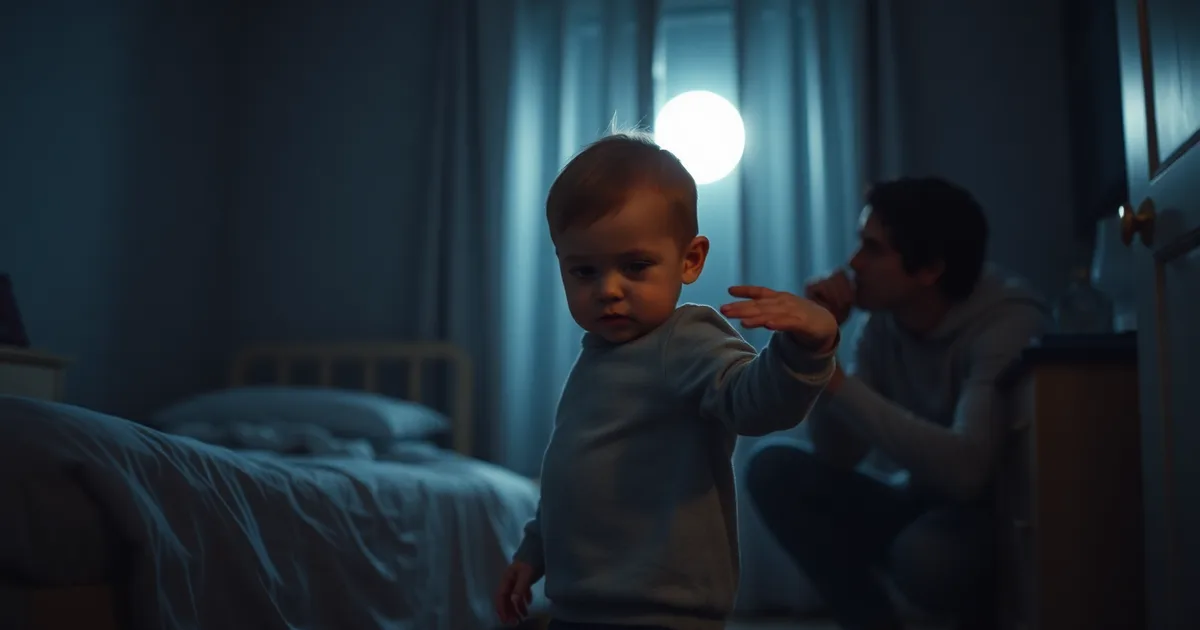
Sleep terrors are episodes of inconsolable screaming that happen during deep non-REM sleep, usually one to three hours after bedtime. Your child may look awake, with eyes open and breathing fast, but is not. Do not wake or restrain them. Keep them safe, wait it out, and know that most children outgrow this by age 5.
The distinction that matters is timing. A nightmare arrives in the last third of the night, during REM sleep, and the child wakes, remembers it, and wants you. A sleep terror lands in the first deep non-REM cycle, often before you have gone to bed yourself, and the child does not wake at all in any meaningful sense. Roughly 6.5% of children experience them, with cases clustering between ages 3 and 7. Onset at 18 months is uncommon but well documented.
Here is what usually goes wrong. A parent hears screaming, runs in, picks the child up, and tries to wake them, which typically makes the episode louder and longer. The child is not scared and cannot be comforted, because the part of the brain that would register comfort is not online. Some parents call an ambulance the first time.
If episodes happen at a predictable hour, scheduled awakenings 15 to 30 minutes before that time cut frequency by as much as 80% in clinical reports. Sleep deprivation and a shifting bedtime are the two triggers that show up most often, which is why a consistent schedule does more than any intervention at the bedside.
- Timing is diagnostic: Episodes occur 1-3 hours after falling asleep, during the first deep non-REM cycle, not in the pre-dawn hours like nightmares.
- Do not wake them: Waking or restraining a child mid-terror usually prolongs and intensifies the episode; guide them back to bed only if they are walking.
- Scheduled awakenings work: Briefly rousing the child 15-30 minutes before the usual episode time reduced frequency by up to 80% in published case series.
- Prevalence figure: Sleep terrors affect up to 6.5% of children, peaking between ages 3 and 7, though onset can occur as early as 18 months.
- Persistent cases: Most children outgrow sleep terrors by age 5; episodes continuing past age 7 warrant a referral to a pediatric sleep specialist.
What exactly is a sleep terror and how does it differ from a nightmare?
A sleep terror is a parasomnia — a disorder of arousal, not a disorder of dreaming. The International Classification of Sleep Disorders, third edition (ICSD-3) groups it with confusional arousals and sleepwalking, all three of which emerge from deep non-REM sleep, specifically stage N3. That detail explains almost everything else. Stage N3 is concentrated in the first third of the night, so episodes cluster 1 to 3 hours after sleep onset, and the child's cortex is running on partial arousal rather than full wakefulness. Estimates vary by how you count: the American Academy of Sleep Medicine puts lifetime prevalence at up to 6.5% of children, while Mayo Clinic gives 1 to 6%, with boys and girls affected equally. A 2023 study found roughly 30% of children with sleep terrors have a family history of parasomnias, which is why clinicians often start by asking about a parent who sleepwalked.
Nightmares are the opposite architecture. They rise out of REM sleep, which is front-loaded toward the last third of the night, so a nightmare typically lands between 4 and 6 a.m. rather than at 11 p.m. The child wakes fully, remembers the dream, and does the thing a sleep-terror child does not: turns toward you. A nightmare produces a child who wants the hallway light on and a glass of water. A sleep terror produces a child who screams, thrashes, sweats, has open eyes with dilated pupils, and pushes you away when you try to hold them — because you are not, in any meaningful sense, in the room with them yet. The child is not scared. Fear is a felt experience, and the part of the brain that registers it is not online.
Why the memory gap matters
Parents often assume a child who cannot recall an episode must be repressing it or protecting them. Neither is true. During a sleep terror, the hippocampus and the frontal regions that build a continuous narrative of self are not engaged, so there is nothing to encode. The child may wake the next morning cheerful, or describe a fragment of a dream unrelated to the screaming. That gap is a diagnostic feature, not a sign of denial. Polysomnography — an overnight sleep study — is rarely needed for typical cases, but it is ordered when episodes are frequent, atypical in timing, or accompanied by snoring, since obstructive sleep apnea and restless legs syndrome both fragment sleep and trigger arousals in susceptible children.
One thing to watch for: if your child is older than 7, or episodes start suddenly in a child who never had them, the picture shifts toward other causes and warrants a referral. Stanford Sleep Medicine Center and most pediatric sleep clinics use the same threshold. For a toddler within the usual window, the pattern is ordinary, and roughly 90% of children outgrow it by age 5.
Why does my toddler wake up screaming but not seem scared?
The answer is in the timing as much as the behaviour. Sleep terrors are a disorder of arousal from non-REM sleep, and they cluster 1–3 hours after sleep onset, when slow-wave sleep is at its deepest (Sleep Foundation, 2026). That is why they almost never happen during a nap or in the last hour before morning. The screaming starts because the brain has partly surfaced from deep sleep without completing the transition to wakefulness. There is no dream narrative, so there is nothing to be frightened of.
What you are watching is a body switched on while the mind is still off. Heart rate and breathing climb, pupils dilate, sweat appears on the forehead and neck, and the child may thrash or push you away. None of that requires conscious fear to run. It is the autonomic nervous system firing as a unit, the same way it would during a sudden fright, except the cortex is still asleep and cannot label the feeling or remember it afterwards. The clinical term for this mixed state is partial arousal, and the ICSD-3 classes it alongside confusional arousals and sleepwalking because all three share the same mechanism.
A 2023 study found that 30% of children with sleep terrors have a family history of parasomnias, which fits a brain that is simply wired to arouse this way rather than a child who is processing something upsetting. Roughly 1–6% of children are affected and boys and girls equally so (Mayo Clinic, 2025). The condition peaks between ages 3 and 7 but can begin at 18 months, and up to 6.5% of children experience episodes at some point (American Academy of Sleep Medicine, 2017; Journal of Clinical Sleep Medicine, 2019). Emotional disturbance is not the cause; it is not even a common precipitant. Overtiredness, a disrupted routine and fever are far more reliable triggers.
Do less, not more
Most of what you will read online tells you to wake your child or hold them until they settle. That advice is wrong, and following it tends to stretch a two-minute episode into ten. Waking a child mid-terror produces genuine confusion and often more distress, because you have yanked a sleeping brain into full consciousness. Restraining or shouting over them does the same. The episodes end on their own once the arousal cycle completes; your job is to stop them hurting themselves on a bed frame or stairs, keep the room dim and quiet, and wait. Say nothing, or say very little in a flat voice. Once the episode passes, most children settle back into sleep with no memory of it, and the odds are good this is temporary: around 90% outgrow sleep terrors by age 5 (Cleveland Clinic, 2024). If episodes are frequent and predictable, a scheduled awakening about 15–30 minutes before the usual time has been shown to cut them by around 80% in a randomised controlled trial published in 2021—but that is a planned intervention done in advance, not something you attempt in the middle of one.
What else can cause a toddler to wake up screaming and inconsolable?
Sleep terrors are the loudest option on a short list, not the only one. A child who wakes at 11pm, eyes open, screaming at a wall, unresponsive for eight minutes and asleep again by 11:12 is almost certainly having a terror. A child who wakes at 3am, recognises you, and tells you about the dog chasing him is having a nightmare. Timing and memory separate most cases before you ever reach a doctor.
The dividing line that matters most is whether the episode happens in the first third of the night or the last. Non-REM parasomnias — terrors, confusional arousals, sleepwalking — cluster in the first 1–3 hours after sleep onset, when slow-wave sleep is heaviest. REM-heavy nightmares cluster in the final third. Snoring changes the picture entirely, because the arousal is being triggered by something mechanical.
| Cause | Typical timing after sleep onset | What the child looks like | Recollection next morning | Consolability |
|---|---|---|---|---|
| Sleep terror (non-REM parasomnia) | 1–3 hours | Eyes open, pupils dilated, screaming, sweating, heart rate around 150 bpm | None or a vague sense of something bad | Unresponsive to voice or touch for 1–15 minutes |
| Nightmare (REM) | 3–6 hours, or late in the night | Wide awake, tearful, reaches for parent | Full dream recall, often detailed | Settles within 5–10 minutes of being held |
| Confusional arousal | 30–120 minutes | Whimpering, thrashing, sitting up, eyes glassy | None | Confused but answers to name; settles in under 5 minutes |
| Obstructive sleep apnea | Any time, in 20–40 second cycles | Snoring above 60 dB, pauses in breathing, gasping, mouth breathing | None; often irritable the next day | Wakes fully between apneas; may need 20–30 minutes to resettle |
| Reflux (GERD) | 1–2 hours, often after a late or heavy meal | Arching the back, coughing, sour breath, crying with eyes open | None | Settles faster sitting upright; 10–20 minutes |
| Ear infection or teething pain | Any point, peaks 10pm–2am | Hand to ear or jaw, tugging, fever above 38°C, drooling | None | Cries at full volume, responds to paracetamol or ibuprofen within 30 minutes |
For the parent reading this at 2am with a search history full of "night terror", the row that most often turns out to be wrong is obstructive sleep apnea. It is easy to miss because the snoring sounds like ordinary toddler snoring, and a child with mild OSA can have a terror-like arousal two or three times a week without ever pausing long enough for a parent to notice. That is the case where the answer flips: if your child snores most nights and the episodes are frequent, the right next step is a referral for polysomnography, not a behavioural plan. A 2023 study found that 30% of children with sleep terrors have a family history of parasomnias, so a parent who sleepwalked as a child should weight terrors higher on the list. A parent with no such history and a child who snores should weight apnea higher.
How to tell sleep terrors from nightmares and other sleep disruptions
Most parents arrive at the right answer by elimination. They have already ruled out pain, a wet nappy, hunger, and the obvious bad dream, and they are left with a child who screamed for ten minutes and then went back to sleep as if nothing happened. The four checks below separate sleep terrors from nightmares on the basis of when the episode happened, what the child looked like during it, what they remember afterwards, and what actually stopped it.
- Clock time. Sleep terrors fire 1–3 hours after sleep onset, which puts them in the first third of the night, during slow-wave non-REM sleep. Nightmares come out of REM sleep, which clusters in the last third, so a child who sits bolt upright at 9:40pm after a 7:30pm bedtime is far more likely to be in a terror than a dream.
- Eyes and gaze. During a terror the eyes are usually open but the child is not looking at you and does not track your face or a light. Nightmares wake a child fully, and they make eye contact immediately, often within seconds.
- Physical pattern. Screaming, thrashing, sweating, a racing pulse, and sometimes sleepwalking or bolting out of bed are typical. The child may push you away, arch their back, or go rigid. A child waking from a nightmare reaches for you.
- Response to your voice. Call their name loudly and you get nothing usable. A terror lasts roughly 1–10 minutes and up to 30 in longer episodes, and the child cannot be redirected or soothed during it. A nightmare ends when the child is properly awake, which usually takes under a minute of contact.
- Morning recall. Children remember essentially nothing of a terror, and some describe a vague sense that something happened. Nightmares are recalled in detail, often the same dream several nights running, and the child can tell you who or what was in it.
- Behaviour the next day. No daytime anxiety, no avoidance of the bedroom, no clinginess attached to the episode. Nightmares frequently leave a child reluctant to go to bed at all, which is a useful signal that you are dealing with REM-based dreaming.
- Family history and frequency. Around 30% of children with sleep terrors have a family history of parasomnias, so ask both sides of the family about childhood sleepwalking, confusional arousals, and night terrors. Up to 6.5% of children experience terrors at some point, boys and girls equally, and they can start as early as 18 months even though the peak sits between ages 3 and 7.
The item parents get wrong most often is the fifth one. Comfort works on nightmares and does nothing for terrors, so the instinct to scoop the child up, stroke their back, and whisper reassurances is exactly the intervention that stretches a four-minute episode into fifteen. Trying to wake them fully is worse still, because a partially aroused child in slow-wave sleep can become more agitated, not less. If you are uncertain which you are looking at, note the clock time before you do anything, keep the room dim, and stay close without touching or talking. Persistent episodes that follow a regular pattern are also worth logging for two weeks, since scheduled awakenings timed to pre-empt the episode cut their frequency by around 80% in a 2021 randomized controlled trial. And if the screaming comes with loud snoring, pauses in breathing, or a child who is hard to wake in the morning, ask about a sleep study: obstructive sleep apnea and restless legs syndrome both fragment deep sleep and trigger terrors, and treating the airway often ends the episodes outright.
What should you do during a sleep terror episode?
This procedure applies once you have watched an episode unfold and recognised the pattern: the screaming starts 1–3 hours after lights out, the eyes are open but unfocused, and your child pushes you away rather than clinging. The distinction matters because the standard comforting playbook will make things worse. During a sleep terror, a child is in deep non-REM sleep and is not dreaming, not processing your voice, and not storing the event in memory. What you do in the next ten minutes is mostly about safety and restraint — your own.
- Do not try to wake them, and do not pick them up or hold them still. Arousing a child mid-terror usually produces confusion, thrashing, and a longer episode, and some children push back hard enough to fall. Set a timer if it helps you resist the urge; the first 60 seconds are where most parents blow it.
- Check the immediate space. Move furniture corners, a floor lamp, a stair gate left open, or anything on the carpet your child could trip over. If they are already on their feet, walk a half-step behind them with your hands hovering near their shoulders — contact is optional, blocking a fall is not.
- Keep the room dim and quiet. No overhead light, no bright phone screen. Low light keeps the arousal from tipping into full waking, which is the outcome you want to avoid.
- Say almost nothing. If you speak, use a single short phrase in a flat, low voice — "you're okay" repeated quietly is enough. Long explanations, questions, or name-calling ("wake up, it's Mummy") deepen the confusion.
- Guide, don't carry, if they leave the bed. Take a wrist or an elbow and steer them back toward the mattress. Most children lie back down on their own within a minute or two without any instruction.
- Wait it out. Episodes typically run 5–15 minutes from the first scream to the child going quiet, though the tail end — muttering, sitting up, flopping down — can add another five. Do not restart the clock if they cry out again at minute twelve.
- Once the child is settled and breathing slowly, step back to the doorway and give them two to three minutes alone. Most fall straight back into deep sleep and have no memory of the event the next morning.
- Note the time of onset and what happened that day: late nap, missed dinner, a fever, a new bed. A written log is what turns a vague worry into a pattern your clinician can act on — sleep specialists at centres such as Stanford Sleep Medicine routinely ask for two weeks of timings before considering anything further.
The failure mode is the parent who cannot tolerate the helplessness and reaches in. Waking the child, turning on the light, or rocking them through a full arousal converts a self-limiting event into 40 minutes of genuine distress and a child who is now wide awake at 2 a.m. If episodes are frequent enough to be logged as nightly — roughly three or more per week — the timing log is what enables the next step, because an episode that starts at a reliably similar point each night can be interrupted with scheduled awakenings, a technique that has cut episode frequency by around 80% in a randomised controlled trial published in 2021. That is a separate intervention, done before the episode starts, and it does not belong in the middle of one.
Can sleep terrors be prevented? Strategies that work
The intervention with the best evidence behind it is also the strangest-sounding: you deliberately wake your child. Scheduled awakenings mean rousing the toddler 15 to 30 minutes before the episode usually hits, based on the pattern you have logged over the previous week or two. A randomized controlled trial published in 2021 found this cut episode frequency by roughly 80%, and the effect held after parents stopped the routine. The mechanism is not fully settled, but the leading explanation is that a brief arousal interrupts the descent into the slow-wave sleep stage where terrors ignite, and it partially resets the timing of that cycle. The catch is that you have to actually wake the child enough that they open their eyes and shift position, not just stir them. A hand on the back for five seconds does nothing. Keep it up for one to two weeks, then stop and see whether the episodes return.
Everything else in prevention comes down to protecting the depth and regularity of sleep, because overtiredness is the most common trigger parents can control. A toddler at 18 months typically needs 11 to 14 hours total across a 24-hour period including naps, and children at 3 to 4 need 10 to 13; falling an hour short for two or three nights in a row is often enough to produce a cluster of terrors. Bedtime drifting later after a holiday, a dropped nap, or a 7pm bedtime pushed to 8:30pm because of a family dinner will do it. The 2019 Journal of Clinical Sleep Medicine review noted that terrors beginning as early as 18 months follow the same slow-wave sleep pattern seen in older children, so the same sleep-pressure rules apply. Keep the wind-down the same each night, keep the room dark and cool, and if your child is between 18 months and 4 years, treat the bedtime routine as close to fixed as your household allows.
When the trigger is something you can treat
If scheduled awakenings and a tightened schedule do nothing after three or four weeks, stop assuming this is purely developmental and look for a physical disruptor. Obstructive sleep apnea is the one worth taking seriously: snoring, mouth breathing, pauses in breathing, or restless thrashing in the first hours of sleep all point toward it, and enlarged tonsils and adenoids are a common cause in this age group. Reflux, restless legs syndrome, and iron deficiency can fragment sleep in the same way. Family history matters too — a 2023 study found that about 30% of children with sleep terrors have a relative with a parasomnia such as sleepwalking or confusional arousals, which tells you the threshold is partly inherited and not something you caused. Where the pattern is severe, happening most nights, or accompanied by injury risk, a referral to a pediatric sleep center for assessment — sometimes including polysomnography — is the appropriate next step rather than another month of waiting.
Set expectations honestly: roughly 90% of children outgrow sleep terrors by age 5, and most of that happens without any intervention at all. Prevention shortens the runway and reduces the number of nights you spend standing in a dark hallway, but it does not eliminate the underlying tendency before the brain matures out of it.
When should you see a doctor about your toddler's sleep terrors?
Most sleep terrors need no medical work at all. Roughly 90% of children outgrow them by age 5, according to Cleveland Clinic, and the episodes themselves are harmless even when they sound like the opposite. What earns a referral is not the intensity of the screaming but the pattern around it: how often it happens, whether someone is getting hurt, how long the problem persists, and whether the daytime picture has changed.
- Multiple episodes in a single night, or most nights of the week. A 2019 paper in the Journal of Clinical Sleep Medicine notes that sleep terrors peak between ages 3 and 7, but roughly 1 to 6% of all children experience them and the rate climbs higher when episodes are frequent. A child having two or three episodes nightly for weeks is burning off deep sleep in fragments, and that pattern is worth a paediatric assessment.
- Any injury during an episode, or a realistic risk of one. Sleep terrors sit alongside sleepwalking on the same non-REM arousal spectrum, and a thrashing toddler can hit a headboard, fall off a bed, or bolt down stairs. If your child is mobile during episodes, put a gate at the top of the stairs, clear the floor, and consider a mattress on the ground. Repeated near-misses are a reason to call the doctor, not a reason to hope.
- Episodes that continue past age 7, or that start for the first time after age 10. Late onset is unusual and changes the diagnostic picture. New-onset terrors in an older child or adolescent can overlap with other parasomnias, including REM sleep behaviour disorder, which is a different mechanism entirely and generally needs a sleep specialist.
- A suspected breathing problem behind the arousals. Obstructive sleep apnea fragments non-REM sleep and triggers arousals that can surface as terrors. Snoring, mouth breathing, long pauses in breathing, or restless sleep every night point that way. Enlarged tonsils and adenoids are a common cause in the 2-to-4 age band, and treating the airway often reduces episodes without any other intervention.
- Leg discomfort or an inability to settle at bedtime. Restless legs syndrome and periodic limb movements both drive arousals from deep sleep and are frequently missed in toddlers, who describe the sensation as "my legs feel funny" or simply refuse to lie still. Iron status is part of that workup. Ask about it.
- Daytime symptoms that do not fit the night-time story. Persistent sleepiness, falling asleep in the car every trip, new behavioural problems at nursery, poor concentration, or a drop in school performance all suggest the nights are not being repaired by sleep. A child with pure sleep terrors is normally wide awake and completely fine the next morning.
- Episodes that look like something other than a sleep terror. Stiffening, jerking, tongue biting, bedwetting that returns after being dry, or an episode that can be triggered by a sound or a startle may be a seizure rather than a parasomnia. Video of the episode is the single most useful thing you can bring to the appointment, since polysomnography is not routinely ordered for typical terrors.
The item parents most often misjudge is frequency. Two episodes in a month feels alarming the first time, and it is well within normal. The threshold clinicians actually care about is closer to several episodes a week sustained over weeks, because that is the point where sleep architecture starts to suffer and a treatable trigger such as apnea, iron deficiency or a chaotic bedtime becomes worth chasing. If you are keeping a log, note the time of each episode, how long it lasts, whether the child remembers it, and what happened in the 90 minutes before bed. That four-column record tells a paediatrician or a specialist at a centre like Stanford Sleep Medicine more than any description you can give in a ten-minute consultation.
Do sleep terrors mean my child is anxious or stressed?
No. A child who sits bolt upright ninety minutes after falling asleep, eyes open, screaming, is not processing a difficult day and is not the product of a permissive bedtime routine. Sleep terrors are classified in the ICSD-3 as a non-REM parasomnia, which places them in the same family as confusional arousals and sleepwalking, not in the same family as anxiety disorders. They arise out of the deepest stage of non-REM sleep, stage N3, when the brain's arousal circuitry fires partway through a transition instead of completing it. The result is a body that looks terrified while the mind stays asleep.
The underlying mechanism is immaturity. A toddler's arousal system is still learning how to move cleanly between sleep stages, and in roughly 1–6% of children it misfires (Mayo Clinic, 2025). That number is not distributed evenly by household, by parenting style, or by how much screen time a child gets before bed. The American Academy of Sleep Medicine puts the figure at up to 6.5%, and a 2023 study found that 30% of children with sleep terrors have a family history of parasomnias. Genes, not emotional climate, are doing most of the work here. Boys and girls are affected equally.
Where stress does fit, and where it does not
Stress is a trigger, not a cause, and the distinction matters when you are deciding what to change. A missed nap, a fever, a night in an unfamiliar bed, a longer-than-usual stretch of poor sleep, or a disrupted schedule can all push more of the night into deep non-REM sleep and increase the odds of an episode. Obstructive sleep apnea and restless legs syndrome do the same thing by fragmenting sleep and provoking partial arousals, which is one reason a doctor may ask about snoring before anything else. Remove the trigger and episodes often thin out. They do not stop because a child feels safer.
So when a parent tells me they are sure the terrors started after a move, a new sibling, or a hospital visit, I believe them, and I also tell them the move did not create the parasomnia. It exposed one that was already there. Roughly 90% of children outgrow sleep terrors by age 5 (Cleveland Clinic, 2024), whether or not anything in the home changed. That is the fact worth holding onto on the third bad night of the week.
Frequently Asked Questions
Can a toddler have sleep terrors every night?
Yes. A minority of children have episodes nightly, and some have two or three in a single night, usually 90 minutes to 3 hours after falling asleep during the first deep non-REM stage. Frequency tends to fall as the nervous system matures, often dropping noticeably between ages 3 and 5. If the pattern is predictable, scheduled awakenings — rousing your child 15 to 30 minutes before the typical episode time for two to four weeks — reduce how often they occur.
Are sleep terrors harmful to my toddler?
The episodes themselves cause no physical or psychological damage, and children have no memory of them the next morning. The real risk is injury: a thrashing 2-year-old can hit the headboard or fall out of bed, and a child who bolts from the room can take a staircase at speed. Sit between your child and the edge of the bed, clear the floor, and fit a stair gate. Long-term studies, including the 2019 follow-up work from the Avon Longitudinal Study of Parents and Children cohort, found no link to later anxiety or behavioural disorders.
What is the difference between a sleep terror and a night terror?
Nothing. They are the same condition. "Sleep terror" is the clinical term used in the ICSD-3, the International Classification of Sleep Disorders, and in the DSM-5. "Night terror" is the everyday synonym that appears in parenting books and most search results. Pavor nocturnus is the older Latin label still used in some European paediatric literature. A doctor who says sleep terror and a grandparent who says night terror are describing the identical event.
Can sleep terrors be a sign of autism or ADHD?
Sleep terrors are more common in children with autism spectrum disorder and ADHD, but they are not a diagnostic marker for either. Roughly 30 to 40 percent of children with ASD experience parasomnias, compared with about 15 percent of the general paediatric population, and ADHD is independently associated with more fragmented slow-wave sleep. If your child also shows language delay, poor eye contact, or persistent inattention by age 3, ask your paediatrician for a developmental referral. The terrors alone do not justify one.
How long do sleep terrors last in toddlers?
A typical episode runs 5 to 15 minutes, though some stop in under 2 minutes and a few stretch past 30. Your child will seem awake but won't recognise you, may sweat heavily and have a racing heart rate above 130 beats per minute, then settle back into quiet sleep without fully waking. Most children outgrow sleep terrors entirely by age 5, and roughly 90 percent have stopped by adolescence.
Should I wake my toddler during a sleep terror?
No. Waking a child mid-episode tends to prolong it and leaves them disoriented and frightened when they surface. Sleep terrors happen in deep non-REM sleep, so a forced wake pulls them out of the wrong stage. Keep the room dark and quiet, prevent falls or collisions, and wait. Don't try to hold or comfort them — most toddlers push a parent away. If episodes last longer than 30 minutes or include injury, see a paediatric sleep specialist.