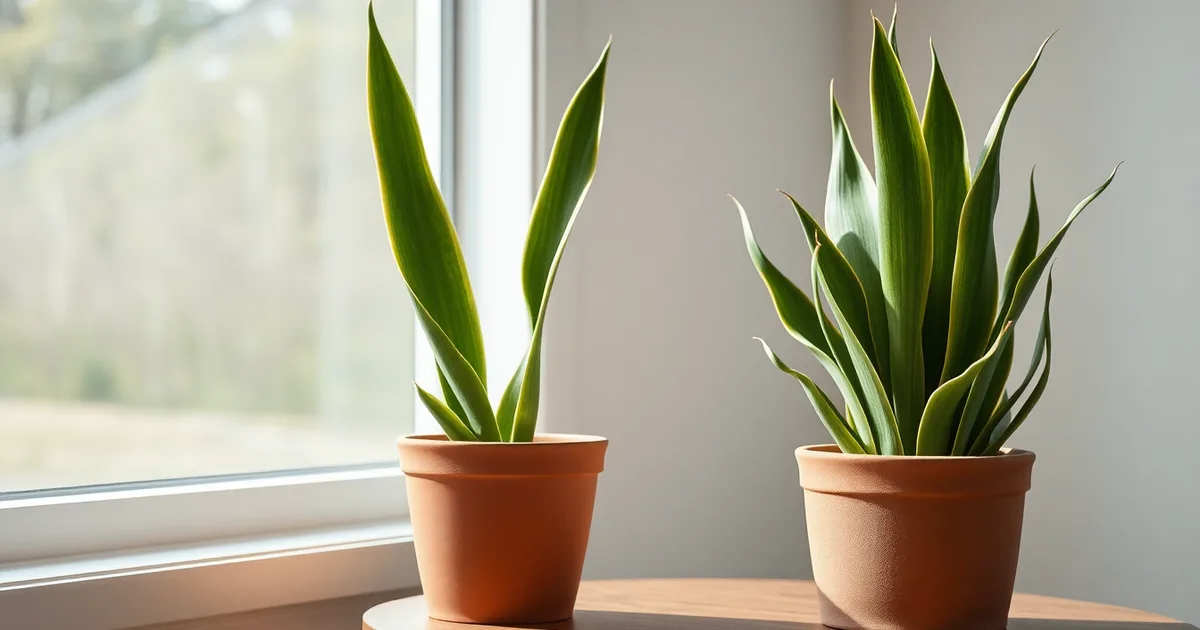
A snake plant leaf bends because the plant is leaning toward the nearest light while its roots lose grip from overwatering, a cramped pot, or cold. Fix it by moving the plant into bright indirect light, letting the soil dry fully, and repotting into a container 2–3 cm wider than the root ball.
Look at which way the leaf falls. A leaf that arcs toward a window and keeps its firmness is doing phototropism, and it usually starts doing it once daily light drops below roughly 1,000 lux for six hours or more. That is a north-facing sill in most of the UK, northern US and northern Europe from October through March. The leaf is not sick. It is stretching toward the only usable light in the room.
The part that catches people out is that the bend and the rot arrive on the same timeline. Water a snake plant every week and the base of the leaf goes soft and yellow within 7–10 days of that first overwatered session, because the rhizome has no way to shed the excess. Circling roots in an undersized pot make it worse: nothing anchors the plant, so a leaf that would have held upright starts to lean.
Cold is the third cause and the one most often missed. A leaf touching a single-glazed window in January, where the glass sits near 8 °C, will curl and develop soft spots that look identical to rot but sit higher up the leaf. Check the leaf before you check the soil.
- Bent leaves stay bent: a leaf that has already folded will not straighten, so cut it at the base with sterile shears and let new upright growth take over.
- Water on dryness, not schedule: wait until the top 5 cm of soil is dry, which is roughly every 2–3 weeks in summer and every 4–6 weeks in winter at average indoor humidity.
- Repot wider, not deeper: move the plant into a container 2–3 cm wider than the root ball when roots show at the drainage holes or the pot tips easily.
- Light is the usual culprit: below 1,000 lux for more than six hours a day triggers the leaning, so a spot 1–2 m back from a south or east window beats a dark corner.
- Below 10 °C is damage territory: keep leaves off cold glass in winter, since temperatures under 10 °C (50 °F) cause curl and soft spots within days.
Why is my snake plant leaf bending and falling over?
The three most likely causes, in order, are overwatering, light coming from the wrong direction, and a pot that has become too small. In a plant you have owned for six to twenty-four months, they usually arrive together. The leaf does not bend because it is weak; it bends because the tissue that holds it upright has stopped working.
A snake plant leaf is rigid because of turgor pressure — water pushing outward against the cell walls of the leaf and, more importantly, of the rhizome buried just under the soil surface. Cut the water supply to that rhizome and the pressure drops within days. In Dracaena trifasciata (still sold almost everywhere as Sansevieria trifasciata), visible yellowing appears roughly 7 to 10 days after a serious overwatering event, and the leaf starts to fold at the point where it leaves the soil. That is root rot, usually Fusarium or Pythium, and no amount of staking will reverse it. Watering every 14–21 days in summer and every 28–42 days in winter is the working range for a 20 cm pot in a temperate room; most floppy plants I see have been on a weekly schedule since purchase.
Count the leaves before you decide. One bent leaf is almost always mechanical — knocked against a doorframe, or the oldest leaf in a crowded clump leaning away from a dark corner as the plant reaches for light (phototropism). Light in a typical north-facing room runs 100–300 lux, well under the 1,000–2,000 lux for 6–8 hours a day these plants want, so the leaf elongates and thins as it stretches sideways. Several leaves bending at once, especially the younger inner ones, points to root rot or cold stress. Keep the plant above 10 °C (50 °F); below 5 °C (41 °F) the tissue collapses and stays collapsed, and no watering regime will bring it back.
One thing that catches people out: a pot that is too small makes overwatering far worse, because there is less soil volume to buffer the excess. A snake plant's rhizome spreads sideways, not down, and a 15 cm nursery pot bought in 2026 for $12–$25 USD (£10–£20 in the UK) is often already tight by month twelve. Move it into a container 2–3 cm wider in diameter than the current root ball, not deeper, and mix roughly 50% potting soil, 30% perlite, 20% coarse sand or cactus mix. A terracotta pot helps here because it wicks moisture through the walls.
How do I know if it's overwatering or root rot?
Overwatering and root rot sit on the same continuum, and the difference is time. A plant that has been watered every 10 days for three weeks in a 20 cm terracotta pot with 50% potting soil, 30% perlite and 20% cactus mix will show soft, slightly discoloured leaf bases — but the rhizome is still firm and the roots still cream-coloured. Give it 28–42 days between waterings over winter and it recovers. A plant sitting in dense, unamended soil with no drainage hole passes that stage in about a week.
Two inspections settle it. First, smell the soil at the base of the plant: healthy media smells like wet earth, while Pythium and Fusarium infections produce a sour, ammonia-like or sewage odour you will notice before you see anything wrong with the leaves. Second, pull the plant out and look at the roots. This takes three minutes and tells you more than a month of watching.
| Symptom | Overwatering (early) | Root rot (active) |
|---|---|---|
| Leaf base colour | Pale green to olive at soil line, no distinct border | Yellow halo spreading up the leaf within 7–10 days, base turning brown-black |
| Leaf texture | Firm but slightly pliable; bends without creasing | Mushy or water-soaked within 7 days of the last watering; leaves collapse and crease at the fold |
| Soil smell | Damp earth, no off-note | Sour, ammonia or sewage odour detectable at 10–15 cm from the pot rim |
| Root appearance | Cream to pale tan, firm, rhizome solid at 20 °C (68 °F) | Black or dark brown, hollow when squeezed, sloughing outer sheath; rhizome soft at the centre |
| Speed of decline | One leaf affected over 3–6 weeks; plant otherwise stable | Two or more leaves down within 7–14 days; spread accelerates above 24 °C (75 °F) |
| Pot weight after 14 days | Noticeably lighter than at watering | Still heavy; soil at 5 cm depth is wet to the touch |
Read the table by column, not by row. If the leaf base is still firm and the pot is light after two weeks, you are looking at simple overwatering and the fix is a longer interval — 28–42 days for a 20 cm pot in winter, 14–21 days in summer — not a smaller drink. If the base gives under finger pressure, the smell is off, or the black has reached the rhizome, you are past scheduling and into surgery: cut away every brown root with sterilised secateurs, dust the cuts with sulphur or cinnamon, and repot into fresh mix in a container only 2–3 cm wider than the surviving root ball. The one case where this reading flips is cold damage. A plant kept below 10 °C (50 °F) for several nights shows mushy, dark bases and collapsed leaves that look identical to rot, but the roots stay cream and firm and the soil smells normal. If your plant has been near a single-glazed window through a cold snap, check the root colour before you cut anything.
Light direction: the hidden cause of sideways leaves
A snake plant in a room with one window doesn't grow straight up. It grows toward the glass. The cells on the shaded side of a leaf elongate faster than the cells on the lit side, a response called phototropism, and over 6–24 months that uneven growth produces a lean that eventually tips the leaf past its own structural limit. The plant isn't weak. It is doing exactly what a plant is supposed to do — reaching for the 1,000–2,000 lux (100–200 foot-candles) it wants for 6–8 hours a day — and a leaf that has spent a year curving toward a south-facing bay window is already committed to that curve. You cannot straighten it by staking, and you should not try. Cut it at the base if it bothers you; new growth from the rhizome will come up vertical if you fix the geometry.
Fixing the geometry without darkening the plant
The lazy version of this advice is "move it into brighter light," which is how people end up with a Sansevieria trifasciata parked on a windowsill in full summer sun, scorched, and flopping worse than before. The actual fix is rotation. Turn the pot 90° every two weeks, on the same day you check the soil, so that every side of the plant takes a turn facing the window. Growth stays upright because no single side gets a sustained directional advantage. On a windowsill this is a 10-second job; if the pot is heavy terracotta, mark one side with a piece of tape so you know where you started.
Distance matters more than most people expect. Beyond about 1 m from a window, light falls off to the point where even a "bright" room delivers a few hundred lux at the leaf surface — enough for the plant to survive, not enough for it to grow upright, and the leaf will keep stretching. If you cannot get the plant within a metre of glass, put a grow light on it. Aim for 2,000–3,000 lux at canopy height for 8 hours daily; a 10 W LED bar at 30 cm gets you there. That is a higher figure than the 1,000–2,000 lux a window-grown plant needs, deliberately. Grow lights are static, so you're compensating for the absence of the directional cue that outdoors does the work for free.
One caveat: phototropism and overwatering look similar from above, and they are not mutually exclusive. A bent leaf on a plant you water every 10 days is a root problem wearing a light problem's clothes — yellowing shows within 7–10 days of sustained overwatering, well before a rhizome collapses, so check the soil before you rotate anything. And rotate on a schedule you'll actually keep. A plant sitting on the same side of the pot since you bought it in 2024 has been quietly compensating for eighteen months, and no grow light will undo that on its own.
When is the pot too small?
Repot only if the bending is not caused by light or watering. Those two fix themselves in 1-3 weeks; a pot problem does not. Look at the drainage hole first. A 20 cm Dracaena trifasciata that has been in the same container for 18 months will usually show white or pale yellow roots curling around the inside of the drainage hole, sometimes 2-4 cm of them, and the whole root mass will slide out as one dense cylinder when you tip the pot. If instead the plant lifts 1-2 cm out of the soil, or the pot rocks because the rhizome is pressed against the wall, that is the same answer. Repotting is a 20-40 minute job and costs roughly $8-15 USD for the container plus $5-10 for perlite and coarse sand.
Do it in spring or early summer. Repotting at 21-24 °C (70-75 °F) lets damaged roots callus over in days; the same job in a 12 °C room can stall for a month.
- Unpot and inspect. Slide the root ball out by turning the pot on its side and pulling the plant at the base, not the leaves. If it will not move, run a knife around the inner wall. Shake off the old mix gently with your fingers; a 20 cm plant typically loses 30-50% of its medium this way. Cut off any root that is brown, mushy, or smells sour with clean scissors.
- Choose the container. New pot 2-3 cm wider in diameter than the root ball, and 2-3 cm shallower. Snake plant rhizomes spread sideways, so width matters more than depth. Terracotta is the safer choice in a humid room because it wicks moisture; glazed ceramic is fine in a dry one. There must be at least one drainage hole. A pot 5 cm wider will sit wet for weeks.
- Mix the medium: 50% potting soil, 30% perlite, 20% coarse sand or cactus mix by volume. For a 20 cm pot that is roughly 2 parts soil to 1¼ parts perlite to ¾ part sand. Commercial cactus mix alone works but often holds more peat than the label suggests.
- Position the plant so the base of the leaves sits level with, or 5 mm above, the rim. Burying the rhizome more than 1 cm deep under mix is a common error and invites Fusarium or Pythium.
- Do not water. Leave the pot dry for 3-5 days. Freshly cut or torn roots need that window to heal; water in the first 24 hours turns the wound into an entry point and you will see yellowing 7-10 days later. Keep the plant at 18-24 °C and out of direct sun for that period.
- First watering after the wait: soak until water runs from the drainage hole, then empty the saucer within 30 minutes. Never let the pot stand in water.
- Do not feed for 4-6 weeks. Then resume a normal schedule: every 14-21 days in summer, every 28-42 days in winter for a 20 cm pot.
The failure mode is repotting into a larger, deeper container because the plant "looked cramped." Extra volume of mix holds water the roots cannot reach, and the rhizome sits in damp soil for 5-7 days past the point of harm. The leaf that was bending sideways will often stay bent, since mature snake plant leaves do not straighten once the fibre has creased. New growth from the rhizome is what tells you the repot worked.
Could cold drafts be curling my snake plant's leaves?
Cold is the least common of the four main causes, but it produces the most distinctive symptom: a leaf that curls lengthwise, like a taco, rather than leaning in one direction. That curl happens below roughly 10 °C (50 °F). Below 5 °C (41 °F) the cell walls rupture outright and you get dark, water-soaked patches that turn mushy within days. A leaf sitting against a single-glazed window on a January night in Leeds can hit 4 °C while the room's thermostat reads 20 °C, which is why the damage usually shows up on one side of the plant and not the other. Compare that to a light-starved leaf, which leans toward the nearest window without curling at all.
The usual culprits are single-pane windows, unheated conservatories, doors that get propped open for a dog, and air-conditioning vents running through summer. Move the pot 60–90 cm back from the glass and out of any direct vent path. If you cannot move it, a sheet of bubble wrap against the pane buys you 2–3 °C. The Royal Horticultural Society lists Dracaena trifasciata (still widely sold as Sansevieria trifasciata) as hardy only to about 10 °C, so treat that as your floor, not your target. Aim to keep the plant between 18 °C and 24 °C, which is also the band where leaf cuttings root in 4–6 weeks.
What to do once the leaf has already curled
A curled leaf will not straighten. The tissue has lost its turgor and the shape is permanent, so leave it if it is still green and supporting the plant, or cut it clean at the base with sterilised shears. Cutting also matters because cold-damaged tissue is where Fusarium and Pythium get their opening, and those are the same pathogens that drive root rot once a rhizome is compromised. Do not water on a schedule after a cold event. Check the soil at 5 cm depth first; a plant recovering at 18–24 °C will drink far more slowly in winter than the every-14-to-21-day summer rhythm most owners have internalised.
One thing to rule out before you blame the draft: a leaf curling upward and inward with dry, brown edges is more often a humidity or underwatering problem than a cold one. Cold curl is soft and pale. If you press the leaf and it gives, that is cold or rot. If it crackles, look at your watering and your light first.
What should I do right now? A 5-step rescue plan
The sequence below matters more than any single step. Most people jump straight to staking the leaf upright or moving the pot to a brighter windowsill, which buys a few weeks and hides a rhizome that is quietly turning to mush. Work through it in order, and stop wherever the plant tells you it is fine.
- Stop watering and test the soil 5 cm down. Push a finger or a bamboo skewer into the mix to roughly the second knuckle. If it comes out cool and dark with soil clinging to it, the plant has been sitting wet for days and you are almost certainly looking at the start of rot. A 20 cm pot in a temperate living room should go 14–21 days between waterings in summer and 28–42 days in winter. If you cannot remember the last time you watered, that is the answer.
- Cut the bent leaf off at the base with sterile shears. A leaf that has creased at the fold will not straighten again — the cell walls at the bend are crushed, and no amount of staking reverses that. Wipe the blades with isopropyl alcohol first. Cut as close to the soil line as you can reach without gouging the rhizome, and leave 1–2 cm of stub if the leaf is badly kinked, since a clean flush cut into wet tissue is an open door for Fusarium and Pythium.
- Slide the root ball out and inspect it. Turn the pot on its side, tap the rim, and work the plant free rather than yanking it by the leaves. Healthy Sansevieria trifasciata roots are firm, pale orange-yellow, and smell of nothing much. Rotten roots are black or dark brown, feel like cooked pasta, and carry a sour, earthy smell you will recognise immediately.
- Trim every mushy root back to clean tissue. Use sterilised scissors and cut into healthy root until the cross-section is white or pale, not brown. Dust the cut ends with sulphur powder or cinnamon if you have neither fungicide nor a garden centre nearby. If more than about a third of the root mass is gone, expect the plant to sulk for two to three months before it pushes new growth.
- Repot into dry mix in a wider, shallower container. Choose a pot 2–3 cm larger in diameter than the root ball and never deeper than it needs to be — snake plants spread sideways through the rhizome, not downward. Terracotta is the safer default because it wicks moisture through the walls. Use roughly 50% potting soil, 30% perlite, and 20% coarse sand or cactus mix. Do not water after repotting; the roots need to callus.
- Move it to bright, indirect light and wait 7–10 days before the first drink. Aim for 1,000–2,000 lux (100–200 foot-candles) for 6–8 hours a day, which in practice means 1–2 metres back from a south- or west-facing window, or right at an east-facing one. Keep the room above 10 °C (50 °F); below 5 °C (41 °F) you get cold damage on top of everything else. The same one-third rule applies indoors: turn the pot a quarter turn every fortnight so the rhizome does not lean permanently toward the glass.
The step people skip is the wait. A repotted snake plant looks thirsty, and the instinct after surgery is to give it a drink to help it along. That single watering is what kills it — wounded roots in damp, sterile mix have no defence, and visible yellowing shows up within 7–10 days of overwatering, by which point you are back at step three. Seven to ten dry days is not a compromise. It is the treatment.
Will a bent snake plant leaf straighten on its own?
No. A snake plant leaf bends because the cells on the stretched side have elongated and the cells on the compressed side have collapsed, and plant tissue does not reverse that. You can test this yourself on a leaf that has been flopped for a week or more: straighten it gently with your hand and let go. It springs back to the bent shape within a minute or two. The leaf will keep growing from the tip and will keep photosynthesising, but its structural geometry is set. Only new leaves emerging from the rhizome come up straight.
Staking works, and it is not useless, but be honest about what it does. A bamboo skewer plus two loose loops of soft twine will hold the leaf vertical so the plant doesn't look like it collapsed in a windstorm, and it keeps the leaf from kinking sharply against the pot rim and splitting. What it does not do is change the two forces that bent it in the first place: a light source that is pulling the leaf sideways (phototropism) and a root system under enough water stress that it can no longer hold turgor in tall tissue. Stake a plant whose conditions stay wrong and you will be staking a second leaf in six weeks. Tie the loops loosely — a tight band around a snake plant leaf cuts into the epidermis and leaves a permanent scar, and it gives Fusarium and Pythium an entry point on an already stressed plant.
What to do with the bent leaf, and what to expect from new growth
Cut the bent leaf off at the base with clean secateurs rather than living with it. Detach it low, right where it meets the rhizome, and don't leave a stump that will rot in the soil. If the leaf is still firm and green, cut it into 8–10 cm sections and propagate them — sections root in 4–6 weeks in water or a free-draining mix at 21–24 °C (70–75 °F), though be aware that variegated varieties like 'Laurentii' revert to plain green when grown from leaf cuttings. The trade-off is real: you lose the yellow margins, so if the exact cultivar matters to you, wait for a rhizome offset instead.
New growth should come up straight within one to two growing seasons once the underlying conditions are right — 1,000–2,000 lux for 6–8 hours a day, watering cut back to every 14–21 days in summer and every 28–42 days in winter for a 20 cm pot, and a mix of roughly 50% potting soil, 30% perlite and 20% coarse sand or cactus mix. Check the rhizome before you wait anything out. If it is firm and pale, you have time. If it is soft, brown or smells sour, the plant is already past the point where recovery is about patience. That is rot, and the only route back is division. Homes in temperate climates sit well above the 10 °C (50 °F) floor a Sansevieria trifasciata (now classified Dracaena trifasciata) needs, so cold is rarely the culprit indoors — the Royal Horticultural Society's houseplant guidance and the University of Minnesota Extension's root-rot notes both point the same way: when a snake plant loses its upright habit, suspect the roots and the light before you suspect the temperature.
How to prevent bending in the future
Bending is a slow event. By the time a leaf flops, the plant has usually spent two or three months leaning toward a window while sitting in wet soil that was never quite right. The list below is the maintenance routine that stops that sequence from starting again. Copy it into your phone notes, because none of it is obvious from looking at the plant on any given day.
- Water only when the top 5 cm of soil is dry. Push a finger or a bamboo skewer in to that depth; if it comes out cool and dark, wait. For a 20 cm pot in a warm room, that works out to roughly every 14–21 days in summer and every 28–42 days in winter. Sansevieria is a CAM plant — it opens its stomata at night and stores water in the rhizome, so it uses far less than a fern or a pothos of the same size.
- Rotate the pot 90° every two weeks. Snake plants grow toward light, and a single leaf on the shaded side will lean harder each week until the base can no longer hold it. A quarter turn on the 1st and 15th puts the whole plant through an even cycle and keeps new growth vertical. If you can only remember one thing from this section, remember this one: it costs nothing and takes four seconds.
- Keep it between 18–24 °C, and above 10 °C in winter. Below 10 °C (50 °F) the rhizome stops taking up water and the leaves go limp; below 5 °C (41 °F) the tissue is damaged outright. A windowsill that sits above a radiator is fine in summer and lethal in January, because the plant gets warm air on one side and cold glass on the other.
- Repot every 3–5 years, or sooner if roots circle the pot. Snake plants like being slightly underpotted, which is why people leave them alone for a decade — but a pot that is too narrow tips the plant because the rhizome has nowhere to spread. The new container should be 2–3 cm wider in diameter than the current root ball, and shallower than it is wide. Terracotta is the better choice here: it wicks moisture through the wall and adds weight that resists tipping.
- Use a mix that drains in seconds, not minutes. Roughly 50% potting soil, 30% perlite and 20% coarse sand or cactus mix is the working ratio. A 50/50 blend of potting soil and perlite also works and is easier to buy. Standard houseplant compost straight from the bag holds water long enough to start Pythium and Fusarium in the rhizome, and once those fungi are established the leaf will yellow within 7–10 days.
- Give it 1,000–2,000 lux for 6–8 hours a day. That is 100–200 foot-candles, which is bright indirect light — a metre back from a south or east window, or behind a sheer curtain. A phone light-meter app will read this in about ten seconds. Below roughly 500 lux the plant etiolates: new leaves come in thin, pale and weak at the base, and they are the ones that flop first.
- Check the base once a month. Push a thumb into the soil at the edge of the pot and feel for firmness. A rhizome should be hard and pale; a soft, brown, or foul-smelling one is rot, and the leaf above it is already lost. Cutting it off at the soil line with clean secateurs is the only useful response.
The item people get wrong most often is not the watering interval — it is the pot shape. A tall, narrow container looks better on a shelf and holds the plant upright for a year, then the roots hit the wall, the rhizome grows upward instead of outward, and the whole thing becomes top-heavy. A wide, shallow pot is uglier and works. The second most common mistake is treating a limp leaf as a sign of thirst and watering it, which is how a recoverable plant becomes a rotten one. If you are unsure, wait one more week and rotate the pot a quarter turn in the meantime. The Royal Horticultural Society puts Sansevieria in its low-watering group for good reason, and the University of Minnesota Extension makes the same point about succulents generally: when in doubt, the answer is less water, not more.
Frequently Asked Questions
Why is my snake plant leaf falling over but not yellow?
A green leaf that flops sideways usually points to light direction or a pot that has quietly become too small, not rot. Lift the pot and look for roots circling the drainage hole; a Dracaena trifasciata in a 15 cm pot can fill it within 18 months. Rotate the pot a quarter turn every two weeks so the leaf pulls toward the window instead of leaning away.
Can overwatering cause just one leaf to bend?
Yes. Water pools unevenly in a pot, so a single rhizome sitting in a wet pocket can lose its footing while the rest of the plant looks fine. Push a finger 5 cm into the soil right at the base of that leaf. If it is damp, stop watering and leave the pot to dry out for two to three weeks.
Should I cut off a bent snake plant leaf?
Cut it if the leaf is badly folded or the base feels mushy. A bent snake plant leaf never straightens, and the plant keeps spending resources on tissue that cannot hold itself up. Use sterile shears, cut at soil level, and leave a 2 cm stub to callus over. Green, firm leaves that are only slightly leaning can stay.
How often should I water a snake plant in summer?
Every 14 to 21 days for a 20 cm pot in summer, and only after the top 5 cm of soil is dry. In a south-facing window that may mean every 14 days; in a dim corner, closer to 21. From November through February, stretch the interval to every 28 to 42 days and water even more lightly.
What kind of pot is best for a snake plant?
Terracotta or glazed ceramic with drainage holes, 2 to 3 cm wider than the root ball and slightly shallow. Terracotta wicks moisture through its walls and cuts rot risk noticeably compared with plastic, which traps water against the roots. Skip pots without holes entirely; a decorative cachet is fine only if the nursery pot drains freely inside it.
Can a snake plant recover from root rot?
Yes, if you catch it early. Pull the plant, rinse the roots, and cut away every brown or mushy section with sterile shears until you reach firm white tissue. Repot in fresh dry mix, wait five to seven days before the first watering, then water sparingly. Expect four to eight weeks before new growth confirms the plant has recovered.