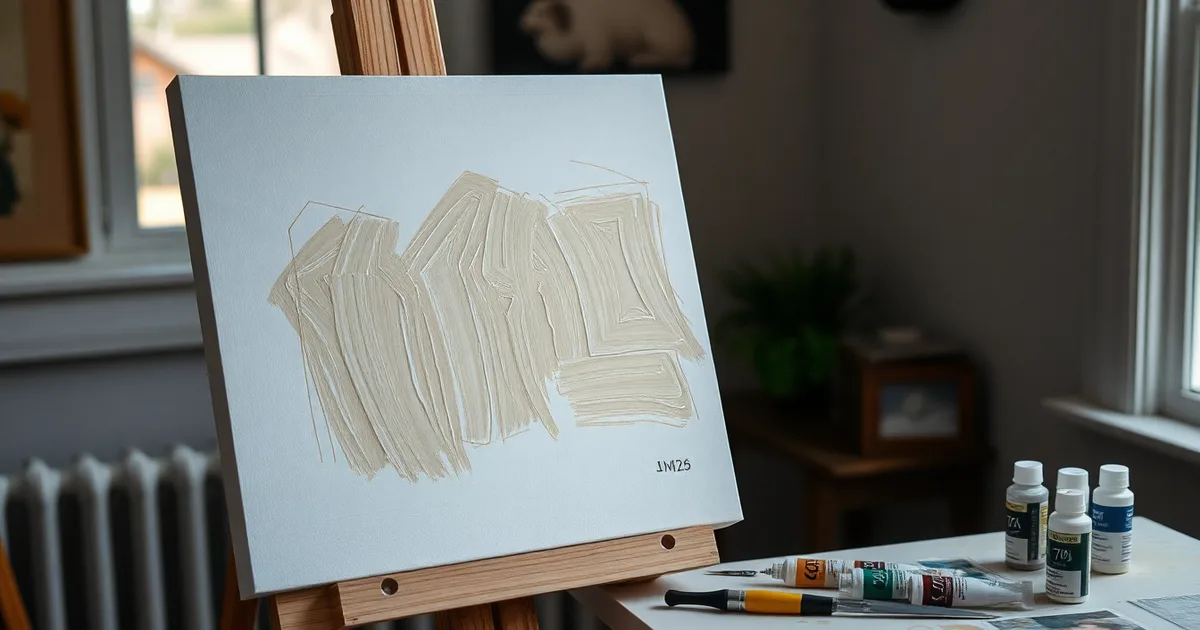
Dry to the touch, not sticky — that is what a week-old oil painting should be. If yours is still tacky, one of five things went wrong: paint laid on thicker than about half a millimetre, too much oil or overloaded alkyd medium, a heavy impasto layer, varnish applied too early, or studio humidity over 70%. Find the cause first; waiting longer fixes none of them.
Oil paint does not dry the way acrylic does. There is no water or solvent to evaporate off and leave a film behind — the binder cures by oxidation, pulling oxygen out of the air and cross-linking the fatty acids in the oil. That reaction is slow, and it is thickness-dependent in a way that catches people out. A layer around 0.1 mm can be touch-dry overnight and safe to overpaint within a couple of days. A 1 mm layer is a different animal entirely: expect 6 to 12 months before it is genuinely cured through, not merely skinned over.
Home studios without climate control are the usual setting for this problem. Above 70% relative humidity the oxidation rate drops sharply and drying times can stretch to double or triple the norm; 40–50% is the range you want. A cheap hygrometer costs less than a tube of good cadmium and will tell you more about your drying problems than any medium will.
Alkyds deserve their own warning. Liquin, Galkyd and Neo Megilp do speed things up, and used as a small addition they behave well. Push them past roughly 30% of the paint volume, or trap them under a thick oil-rich layer, and they can stay permanently tacky — not slow-drying, but never-drying. No amount of extra time in a dry room will rescue that.
- Oxidation, not evaporation: Oil films cure by absorbing oxygen, so a 1 mm layer can need 6–12 months to harden fully even in good conditions.
- Humidity slows everything: Above 70% relative humidity, drying time can double or triple; keep the studio at 40–50%.
- Alkyd overload: Liquin, Galkyd and Neo Megilp can leave a permanently sticky film when mixed beyond about 30% of paint volume.
- Impasto traps solvent: Thick strokes skin over on the outside while oil and solvent stay mobile underneath, which stays soft for months.
- Varnish timing: Standard varnish needs paint at least 6 months old, preferably 12 — applying it at two weeks seals in uncured binder.
How long should an oil painting actually take to dry?
The word "dry" is doing a lot of unhelpful work here. Oil paint does not dry the way acrylic or watercolour does. The solvent component, whether that is turpentine or an odorless mineral spirit such as Gamsol, flashes off within hours. What is left behind is a film of drying oil that has to react with oxygen in the air, molecule by molecule, cross-linking into a solid network. That process is oxidation, it never fully stops, and it runs on a completely different clock.
For the practical question of whether you can touch the surface without leaving a fingerprint, the answer is short. A layer under roughly 0.5 mm — the ceiling Gamblin cites for a single day's work — is touch-dry in 24 to 72 hours at around 20°C and 50% relative humidity. Two days is typical for a thin scumble or a glaze over a dry underpainting. Three days is common for a slightly fatter passage of linseed oil paint applied at normal brushing consistency. If you finished a painting on 1 September, most of its surface should have been dry to the touch by 3 or 4 September, and you should have been able to rest a palm on it by the 6th without a mark.
Full cure is a different animal entirely. The same 0.5 mm film that is touch-dry in 72 hours will not be ready for varnish for at least six months, and a year is a safer target. Push the layer to 1 mm of impasto and you are looking at 6 to 12 months before the interior of that stroke has finished oxidising. Alkyd-modified paints speed the reaction considerably — Galkyd, Liquin and Neo Megilp all shorten the touch-dry window to a few hours to overnight — but they do not compress the varnishing window the same way, and using more than about 30% alkyd medium by volume of paint invites a brittle, underbound film.
So a week is generous. A thin passage still tacky on day seven is not slow-drying paint, it is paint that is not oxidising properly, and no amount of extra time in the same conditions will fix it. The next sections cover the five things that produce that symptom — from a layer applied too thick to a medium that never should have been mixed in — and how to tell which one you are dealing with before you touch the canvas again.
The five causes of a sticky oil painting, ranked by likelihood
Diagnosis matters more than patience here. A thin layer of linseed oil paint reaches touch-dry in 24–72 hours at 20°C and 50% relative humidity, so a surface still tacky on day seven has a cause with a name. Work down this list in order; most painters find their answer in the first three.
- Layers applied too thick, then skinned over. Oil paint dries by oxidation from the surface inward, so a heavy passage forms a dry film while the paint underneath stays soft. Gamblin's working rule caps safe build-up at 0.5 mm (0.02 in) per day, and a true impasto ridge of 1 mm can take 6–12 months to cure through. If the sticky areas sit exactly where you laid paint on with a palette knife or a loaded filbert, this is your cause. Thinning it back with a blade is faster than waiting.
- Too much medium, or the wrong one. Alkyds such as Galkyd and Liquin speed the surface dry but should not exceed roughly 30% of total paint volume; past that, the film stays soft and can remain slightly soluble. Mixing alkyd into a slow oil like poppy or safflower makes it worse, since those oils are naturally non-yellowing but very slow to oxidise. Neo Megilp is a gel medium, not a dryer, and behaves much the same way when overused.
- Varnish applied before the paint cured. This is the one that punishes waiting. Damar and mastic varnishes need a fully cured film underneath—a minimum of 6 months, ideally 12—and trapping solvent and unreacted oil under a resin layer can keep a painting tacky for years. If you varnished within days of finishing, the sticky layer is on top of the paint, not in it, and no amount of drying time will fix it. Removal with the appropriate solvent, following the manufacturer's MSDS and testing on a corner first, is the only route.
- Humidity above 70% or temperature below 15°C. Oxidation slows sharply in the cold, and high humidity interferes with the drying film even in a warm room. The workable window is roughly 40–50% RH at 20°C; a damp basement studio in a British autumn will keep a thin layer tacky well past a week. A cheap hygrometer tells you in ten seconds whether this is your problem before you touch the painting.
- Underlying layers still wet when you painted over them. Fat-over-lean is the rule for a reason, and adding a leaner or solvent-heavy layer onto a soft one traps the lower film. Solvent such as turpentine or odourless mineral spirits flashes off in hours, but the oil beneath it oxidises over weeks to months, so the surface reads dry while the layer below is not. Press a thumb near the edge of an in-progress area—if it gives, you layered too soon.
- A contaminating additive or a non-drying oil. Poppy and safflower oils, some student-grade paints, and household oils mixed in by mistake will keep a film soft indefinitely. Less common than the four above, but worth checking if nothing else fits.
- Genuine under-curing due to a cold, still studio. Rarely the sole cause after a week, but it compounds every other fault on this list.
The item painters most often misdiagnose is the varnish. A tacky surface that feels slightly glossy and smells faintly of resin is not the same problem as a tacky surface that smells of oil, and the distinction changes everything: one needs solvent and careful removal, the other needs airflow and warmth. Smell the painting before you do anything else.
How thick is too thick? The 0.5 mm rule and why impasto stays sticky
Oil paint does not dry. It cures, and it cures from the outside in. Oxygen attacks the binder at the surface first, cross-linking the fatty acids in linseed or safflower oil into a solid film while the paint underneath is still soft. That film is why a ridge of impasto can feel dry to a light touch on day three and still be mushy at the core in November. Gamblin's working rule is 0.5 mm (0.02 in) of wet paint per day, maximum. A palette knife ridge laid down in one pass is routinely 2–5 mm thick, which means the surface sealed over roughly six to ten times faster than the interior could cure.
The arithmetic is unforgiving. Roughly 1 mm of cured oil film takes 6–12 months at 20°C and 50% relative humidity, so a 3 mm ridge is a 2027 problem, not a September problem. What makes it worse is what gets trapped. Turpentine and odorless mineral spirits evaporate in hours from a thin layer, but in a heavy ridge the solvent has nowhere to go once the skin closes, and the oil underneath is still oxidising slowly, generating heat and shrinking as it goes. That is why thick passages sometimes wrinkle, or develop a shrivelled, alligator-skin surface, months after the painting looked finished.
What the skin actually costs you
A surface that is tacky after seven days with a thick build-up usually means the skin is thin, incomplete, and still letting solvent leach through — the worst of both states. Poking it with a fingernail to check will tell you less than you think, because the skin resists and the core does not. If you can press a thumb into a ridge and leave a print that holds its shape, the interior is nowhere near cured and no amount of extra waiting in a cold room will fix it quickly.
The honest trade-off: if the tackiness is confined to a few impasto highlights and the rest of the canvas is dry to the touch, leave the painting flat, dust-free, at 18–24°C with 40–50% RH and accept a long cure — think in months, not weeks, and hold off varnishing for at least 6 months, ideally 12, per standard conservation guidance. If instead the whole surface is uniformly sticky and your layers were all thin, thickness is not your problem and you should be looking at medium ratios, solvent quality, or the drying oils you chose. Adding more alkyd such as Galkyd or Liquin to speed a thick ridge is a mistake: alkyd resin above roughly 30% of total paint volume makes the film brittle over time, and it does nothing for a core that is 4 mm deep.
Which medium is making your paint tacky?
Medium is the first thing to check because it is the only variable you controlled completely. Tube paint straight from the manufacturer will skin over in 24–72 hours at 20°C and 50% RH, even titanium white ground in safflower oil. Add a medium and that clock resets, sometimes in the wrong direction. Galkyd and Liquin are alkyd resin solutions, and they do two things at once: they speed up the early part of the dry, and they leave a surface that stays slightly soft for far longer than the underlying film.
Past roughly 30% of total paint volume, alkyd medium stops being a drier and starts being the film. The tack you are feeling is the alkyd's own slow tail, not uncured oil. Linseed oil sits at the other end: it adds gloss and body, extends open time, and wrinkles badly when applied cold in a thick layer because the surface skins before the interior has oxidised. Poppy and safflower are the slow ones, pale and resistant to yellowing, which is why Winsor & Newton and Gamblin both use them in whites.
| Medium | Effect on drying | Maximum safe ratio | Typical tackiness if exceeded |
|---|---|---|---|
| Galkyd (Gamblin) | Touch-dry in 24–48 h; full cure still weeks | 30% of total paint volume | Surface soft for 3–4 weeks; fingerprints at 14 days |
| Liquin Original (Winsor & Newton) | Touch-dry in 12–24 h at 20°C | 30% of total paint volume | Rubbery, slightly greasy feel past 40% |
| Cold-pressed linseed oil | Adds 3–7 days to touch-dry film | 20% of total paint volume | Wrinkled skin over 0.5 mm layers; tacky for 10+ days |
| Poppy oil | Adds 7–14 days to touch-dry film | 20% of total paint volume | Non-drying stickiness that can persist past 21 days |
| Safflower oil | Adds 7–14 days; slowest of the common oils | 20% of total paint volume | Permanently soft film if used as a sole medium |
| Damar varnish in medium | Dries fast, then stays brittle | 10% of total medium volume | Gummy surface; also yellows within 5–10 years |
For most readers with a sticky painting and no climate control, the alkyd row is the problem and the fix is dilution: measure your medium as a share of the paint pile, not the palette, and hold it at or under 30%. If you are in a cold studio below 15°C (60°F), drop that to 20% and add a few drops of turpentine or odorless mineral spirits, which evaporate in hours and leave no residue. The case where this advice flips is poppy or safflower used heavily in whites: dilution will not save you there, because those oils genuinely do not set hard, and the correct move is to strip the tacky layer with odorless mineral spirits and rebuild it with a linseed-based white. Whichever route, do not varnish the result for at least 6 months, ideally 12, or you will trap the soft film under damar or mastic and it will never cure.
Did you varnish too early?
Varnish is a film, not a fixative, and it goes on top of chemistry that has to finish on its own first. Oil paint does not dry by evaporation the way acrylic does; the solvent leaves in hours, but the binder cures by oxidation, cross-linking over weeks and months. Seal that surface too soon and you trap residual solvent and cut off the oxygen the film still needs. The paint underneath stays soft, the varnish sits on a moving substrate, and the whole thing feels tacky for as long as the trapped layer remains uncured. Damar and mastic varnishes, both natural resins, are the usual culprits here because they form a tight film quickly and are difficult to remove once they have bonded to undercured paint.
The waiting time most manufacturers publish is a minimum of six months for a thin, normally painted canvas, and twelve months is the safer working figure. Gamblin and Golden Artist Colors both give the six-month floor; neither treats it as a target. If your painting has any impasto, a millimeter of thick paint can take six to twelve months to cure on its own, so a varnish applied at week two is not early by a little. It is early by a season.
Testing before you commit
You can check readiness without guessing. Take a cotton swab, dip it in odorless mineral spirits or turpentine, and rub a small area in a lower corner where damage would not show. If pigment lifts onto the swab, the film is not cured and varnish will only make the problem worse. Do the same test in three or four spots, since thick passages cure far more slowly than thin ones. If the swab comes back clean and the paint feels hard rather than leathery, you are likely past the threshold.
If you have already varnished and the surface is still sticky, the honest answer is that the varnish has to come off. Removal means working with the appropriate solvent for the resin you used, in a ventilated space, following the MSDS rather than a forum post, and it is slow, unpleasant work on a fully painted canvas. The alternative, waiting it out, can take another six to twelve months and may never fully resolve if the varnish has sealed a soft layer. Temperature and humidity matter through all of this. Below 15°C (60°F) oxidation slows markedly, and above 70% relative humidity the process stalls again; a home studio at 20°C and 50% RH is what the six-month figure assumes.
How humidity and temperature are slowing your drying time
Oil paint does not dry by evaporation the way acrylic does. It cures by oxidation: the linseed or safflower oil absorbs oxygen from the air and cross-links into a solid film. That reaction is slow by nature, and it is temperature- and moisture-sensitive. A thin layer that reaches touch-dry in 24–72 hours at 20°C and 50% relative humidity can sit there for a week or more if your studio is cool and damp. Turpentine flashes off in hours, which is why the painting feels dry to a light touch and then betrayingly soft when you press it. The solvent has left. The oil has not cured.
Humidity is the bigger of the two variables. Above roughly 70% RH, drying time commonly doubles, and in a persistently damp room it triples. Water vapour competes with oxygen at the film surface and slows the uptake that drives cross-linking. Temperature compounds it: below 15°C (60°F), oxidation slows significantly, and a garage or unheated spare room in a British or Pacific Northwest autumn sits in exactly that band from October through March. The ideal working window is narrow and specific — 20–25°C, 40–50% RH. If your studio has a damp patch on the wall, a single-glazed window and no air movement, you are not in that window, and no amount of patience will substitute for it.
What actually fixes it
A dehumidifier is the single most effective intervention, and it is usually cheaper than the painting. Set it to hold 45–50% RH and leave it running in a closed room; a domestic 10–20 litre/day unit will pull a small studio down from 75% in a few hours. A thermostatically controlled heater set to 21°C handles the temperature half. Do not point either device directly at the canvas — a hot draught across a freshly painted surface can skin the top layer while the paint underneath stays soft, which is worse than slow drying because it feels cured when it is not.
If the painting is genuinely tacky after two weeks in corrected conditions, the environment was not the cause and you should look elsewhere: layer thickness, the medium you mixed in, or an early varnish. Raising the temperature will not rescue a 3 mm ridge of impasto, which can take 6–12 months to cure regardless of how dry the air is.
How to fix a tacky oil painting without ruining it
Run this procedure only after you have identified the cause. It assumes the painting is between seven and fourteen days old, is not wet enough to smear, and is not already cracking. You need a hygrometer (about $12–20 on Amazon), a small fan, a clean soft brush, and, if varnish is the culprit, odorless mineral spirits plus a pack of cotton swabs. Budget roughly two hours of hands-on time across several days, most of it waiting.
- Get the painting out of the damp room first. Move it to the driest space you have, ideally one holding 40–50% relative humidity at 20°C (68°F). Above 70% RH, oil oxidation effectively stalls, so no other fix will work while the painting sits in a humid basement or bathroom-adjacent studio. A $15 hygrometer tells you in seconds whether this is the whole problem.
- Aim a fan to move air across the surface, not at it. Indirect airflow at low speed for 6–8 hours a day strips the solvent vapor sitting on the film without kicking up dust. Do not point a box fan directly at the canvas; that just deposits lint.
- Warm the room to 21–24°C if you can. Below 15°C (60°F), oxidation slows significantly, and a cool studio can add weeks to a drying timeline that should have taken 24–72 hours for a thin layer. A cheap space heater running during the day is usually enough. Cost: a few dollars a week in electricity.
- If the tackiness is varnish — and you can usually tell because the surface feels uniformly sticky rather than variably tacky — remove it now. Dampen a cotton swab with odorless mineral spirits and work in 2×2 inch sections, rolling the swab gently across the surface rather than scrubbing. Swap swabs every few passes; a dirty swab redeposits softened varnish. Expect 45–90 minutes for a 16×20 inch canvas. Let the painting sit 24 hours afterward before judging the result.
- For thick impasto, do nothing except keep the airflow going. A 1 mm layer of paint can take 6–12 months to cure fully, and no additive will shorten that. Gamblin's own rule caps safe layer thickness at 0.5 mm (0.02 in) per day, and anything past that cures from the outside in, leaving a soft core. Adding more paint or medium on top traps the layer underneath and makes the problem permanent.
- Do not varnish again until the painting has cured for at least six months, ideally twelve. Damar and mastic varnishes applied over uncured oil will stay tacky themselves and, worse, can bond with the paint film and become impossible to remove without solvents that damage the underlying layers. If you need surface protection sooner, wait. There is no shortcut.
- Recheck on a schedule rather than by touch. Press a knuckle to a hidden corner every three days and log the result. If the surface is still tacky after 30 days of correct humidity and airflow, the cause is almost certainly a medium ratio problem — likely more than 30% alkyd such as Galkyd or Liquin by volume — and the fix is scraping back the top layer, not more waiting.
The failure mode here is impatience dressed up as technique. Heat guns, hair dryers, and direct sunlight all feel like they should speed oxidation, and they do the opposite: they flash off the solvent in the top layer while the oil underneath stays soft, and the resulting differential shrinkage cracks the film within days. Sunlight also bleaches and yellows pigments unevenly. If you take nothing else from this, take that. Slow air and moderate warmth cure a painting; heat destroys it.
Preventing tackiness in your next painting
Everything above is rescue work. This is the part that stops you needing it. None of these rules are expensive or difficult, and four of the five cost nothing but attention. The one that people ignore is the waiting.
- Work fat over lean, layer after layer. Each successive layer needs a higher oil-to-solvent ratio than the one beneath it, because a flexible top layer over a brittle lower one will crack as the underlayer finishes curing. If you add Linseed oil or a medium to layer three, layer four needs at least as much. The common failure is a lean, turpentine-thinned passage painted over a rich, oily one, which skins fast and stays soft underneath for months.
- Keep any single day's layer under 0.5 mm (0.02 in). Gamblin publishes this figure and it is the one number worth memorising. A 1 mm ridge of impasto can take 6 to 12 months to cure through, not because the surface is wet but because oxygen cannot reach the interior. Build thick passages in successive thin applications across separate sessions rather than one loaded stroke.
- Cap alkyd medium at 30% of total paint volume. This applies to Galkyd, Liquin, and Neo Megilp alike. Alkyd resin accelerates the early stages of drying and then leaves a film that stays slightly softer than a pure oil film for a long time. More medium does not mean faster curing past that point; it means a permanently more flexible, more tacky-prone surface.
- Wait 6 months minimum before varnishing, 12 ideally. A Damar varnish or Mastic varnish layer over paint that has not fully cured traps residual solvent and oxidation byproducts underneath. The result is a film that never hardens properly and can cloud. Six months is the floor for a thin painting in good conditions; thick or humid-studio work needs the full year.
- Hold the studio at 40–50% relative humidity. Above 70% RH, oxidation slows dramatically and a thin layer that should touch-dry in 24 to 72 hours at 20°C and 50% RH may take a week or more. A £30 hygrometer tells you whether you have a problem before you start painting. Below 40% you get the opposite trouble: skinning over, with wet paint underneath.
- Keep the room above 15°C (60°F). Below that threshold the oxidation reaction that cures oil paint slows significantly, and no amount of medium compensates. A cold spare bedroom or garage studio in a British or northern European winter is a genuine cause of week-old tackiness, not a superstition.
- Pick the right oil for the job. Poppy oil and Safflower oil are pale and slow-drying, which suits whites and delicate passages but works against you in a full underpainting. Linseed oil yellows slightly and dries fastest of the three. Match the oil to the layer rather than using one for everything.
The one people get wrong is the 30% alkyd limit. Medium feels like it should speed things up, and past a certain point it does the opposite. If you find yourself reaching for Galkyd on every layer because the last one still felt tacky, you have already gone too far.
Frequently Asked Questions
Why is my oil painting still tacky after a week?
Oil paint dries by oxidation, not evaporation, and a week is often far too short for anything but the thinnest films. The usual culprits are layers applied thicker than 0.5 mm, too much linseed or stand oil, varnish applied before the paint cured, or relative humidity above 70%. Diagnose first: press a clean fingertip near an edge. If the surface skins but slides, it is medium. If the whole layer stays soft, it is thickness.
Can I speed up the drying of oil paint?
Yes, but only by changing chemistry or conditions, not by adding heat. Alkyd mediums such as Gamblin Galkyd or Winsor & Newton Liquin cut drying from days to roughly 12–24 hours, and holding the room at 20–25°C with 40–50% relative humidity helps considerably. Apply thinner layers. A dehumidifier does more for a tacky canvas than any additive you can buy.
How long should I wait before varnishing an oil painting?
Six months minimum, twelve months preferred. A cured oil film is still cross-linking long after it feels dry, and varnish seals the surface, which traps residual solvent and slows oxidation. Paint applied in thick impasto needs the longer end of that range. Conservators at the National Gallery in London commonly cite six months as the floor, and they are talking about thin, professionally applied layers.
Will a tacky oil painting eventually dry?
Sometimes, but not reliably. A film under 0.5 mm will usually harden within a few months once humidity drops. Thick impasto with excess medium, or a painting varnished after two weeks, can stay soft for years. If the surface is still tacky at the six-month mark, scraping back the sticky layer and repainting in thin passes is the honest fix.
What is the 0.5 mm rule in oil painting?
It is a guideline popularised by Gamblin: never apply oil paint more than 0.5 mm thick in a single day. The reason is that oxygen diffuses into oil slowly, so a film thicker than that dries on the outside while the interior stays wet. The classic failure is a painting whose surface feels dry at month three but dents like putty at month nine.
Can I use a hairdryer to dry oil paint?
No. Heat makes the surface skin over within minutes while trapping solvent and medium underneath, and the resulting differential shrinkage causes cracking, wrinkling and, on thick passages, blistering. A hairdryer on a fresh canvas is one of the fastest ways to ruin a painting that would otherwise have cured fine. Move the work to a drier, warmer room instead.