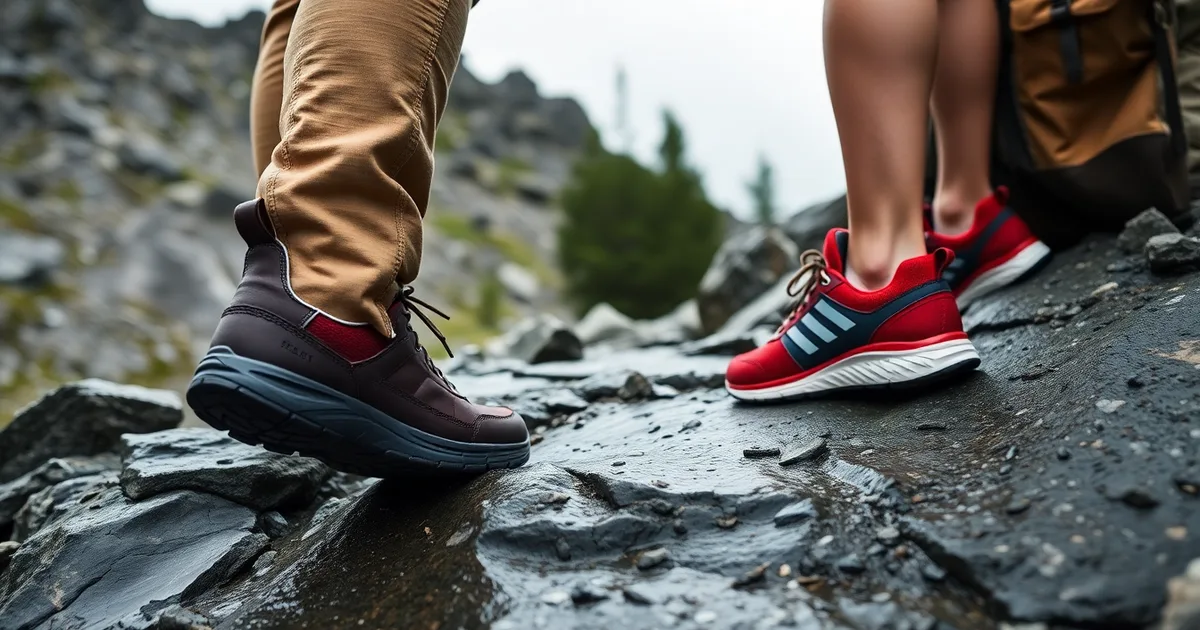
High-cut boots genuinely cut ankle inversion risk on rough ground — a 2023 Footwear Science study measured a 22% reduction in inversion angle versus low-tops. But for mild instability, low-cut trail runners with a 4–8mm drop and a rock plate let your ankle do the work that builds real strength. Reserve boots for packs over 15kg or severe instability.
That 22% figure is smaller than the marketing suggests. It comes from a simulated lateral cutting task, not a four-hour descent on wet granite, and it measured the ankle's movement, not whether anyone actually fell. Ankle sprains still account for 15–20% of hiking injuries according to a 2022 review in Wilderness & Environmental Medicine, and most of those are inversion sprains — the exact motion a boot collar is designed to block.
Here is the trap nobody puts on the box. A stiff collar does the stabilising for you, so your peroneal muscles and ankle proprioceptors get less practice reading uneven ground. Wear boots every weekend for two seasons and you can end up with a weaker ankle than the one you started with, just better protected. The American College of Sports Medicine puts the countermeasure at 2–3 sessions a week of single-leg balance work, which cuts recurrent sprain risk by roughly half — a bigger effect than any boot collar delivers.
- Boots reduce inversion: High-top boots lowered ankle inversion angle by 22% versus low-top shoes in simulated lateral cutting, per a 2023 study in Footwear Science.
- Sprains are common: Ankle sprains make up 15–20% of all hiking injuries, with inversion sprains the most frequent type, according to a 2022 review in Wilderness & Environmental Medicine.
- Drop matters: Trail runners typically run a 4–8mm heel-to-toe drop against 10–12mm in boots, and the lower drop loads the calf and ankle more, building strength over time.
- Training beats footwear: The American College of Sports Medicine recommends 2–3 proprioceptive sessions weekly, such as single-leg balance, to halve recurrent sprain risk.
- Boots cost energy: A pair of boots adds 200–400g over trail runners, raising energy cost 3–5% on long hikes, per a 2021 Journal of Applied Physiology study.
Do high-cut hiking boots actually prevent ankle sprains?
Inversion sprains — the foot rolling outward under a turned ankle — account for the large majority of ankle injuries on trail, and they represent 15–20% of hiking injuries according to a 2022 review in Wilderness & Environmental Medicine. The mechanics matter here: when your foot inverts past roughly 30 degrees under load, the lateral ligaments (chiefly the anterior talofibular) take forces they were never built to absorb. A boot collar sits above the malleolus and physically blocks some of that rotation. A 2023 study in Footwear Science measured a 22% reduction in peak inversion angle with high-top boots compared to low-top shoes under controlled loading. That is a real number, not marketing copy.
But that 22% figure describes a mechanical constraint in a lab, not an injury rate on the Appalachian Trail. When researchers track actual sprains in the field, the picture gets murky. Several prospective studies have found no statistically significant difference in ankle injury rates between hikers wearing high-cut boots and those in low-cut shoes. The reason is that most sprains happen when the ankle is already near its end range and the foot lands on unpredictable ground — a root, a talus shift, a rock edge — and no collar height saves you from a 40-degree inversion at speed. The boot buys you margin. It does not buy you immunity.
There is also a cost to that margin. A stiffer, higher collar restricts the small corrective movements your ankle makes constantly on uneven ground — what clinicians call ankle proprioception. If you spend years in rigid boots, those neuromuscular pathways get less practice. The American College of Sports Medicine's 2021 position stand found that proprioceptive training two to three times per week reduces recurrent sprain risk by roughly 50%, which is a larger effect than any boot collar has ever demonstrated. A Salomon or La Sportiva mid-cut with a 10–12mm heel-to-toe drop will feel protective on day one. It will not make your ankle stronger.
The honest answer depends on what you are carrying and where. For pack loads over 15kg, the American Hiking Society's 2024 guidance still recommends high-cut boots, because the added leverage of a heavy pack amplifies inversion torque and the boot's collar earns its weight. Below that threshold — day hikes, fastpacking, most Pacific Crest Trail sections — a low-cut trail runner from Altra or Hoka One One with a 4–8mm drop, paired with a twice-weekly balance and eccentric strengthening program, outperforms a boot for most hikers with mild instability. Boots also add 200–400g per pair, raising energy cost 3–5% per the Journal of Applied Physiology (2021), which compounds over a long day. Spend the $130–$180 on trail runners and the rest on a physio session. Your ankles will thank you more than the boot ever could.
What are the trade-offs of low-cut trail runners for unstable ankles?
Cutting the collar off your shoe changes three things at once: how much your ankle is allowed to move, how much the shoe weighs, and how much protection sits between your sole and a sharp rock. Those three trade-offs pull in different directions, and most of the online argument about "boots versus runners" collapses them into one question. Here is what you are actually buying and giving up.
- Your ankle gets to work. Trail runners typically run a 4–8mm heel-to-toe drop against 10–12mm on most hiking boots, which keeps the foot closer to level and lets the ankle travel through a fuller range. That motion is the stimulus. Loaded repeatedly on uneven ground, the peroneal tendons and the small stabilising muscles around the joint get stronger and the nervous system gets faster at reading the ground.
- Less passive resistance to inversion. The 22% reduction in inversion angle that high-cut boots buy you (Footwear Science, 2023) is real, and it disappears the moment you switch to a low collar. During the weeks your ankle is still adapting, a rolled rock or a root edge can put you past your end range before the muscles fire.
- Weight, and the fatigue it drives. Boots add roughly 200–400g per pair, which raises energy cost by 3–5% (Journal of Applied Physiology, 2021). Leg fatigue is itself an injury risk factor, because tired stabilisers react later. On a 20km day with 900m of climbing, that difference shows up in the last two hours, not the first.
- Thin soles and no rock plate. Many lightweight models (the Altra Lone Peak, the Hoka Speedgoat) trade underfoot protection for ground feel. On talus, scree or the root-choked sections of the Appalachian Trail, your plantar fascia and metatarsals absorb what a boot's midsole and plate would have blocked. Two hours of that is uncomfortable; eight hours is a foot injury.
- Softer uppers let the foot slide. A flexible upper that fits badly lets your heel lift and your foot rotate inside the shoe, which is worse than a low collar on its own. Fit decides whether the low-cut design helps or hurts, and it matters more than the collar height.
- You can add protection without adding a collar. A rock plate, a stiffer last or a cushioned midsole (Salomon's Ultra Glide, La Sportiva's Jackal) gets you most of the underfoot protection of a boot while keeping 6mm of drop and a 320g weight. Vibram Megagrip outsoles handle wet granite about as well as anything on the market.
- Water and snow change the arithmetic. A Gore-Tex trail runner traps water as effectively as a Gore-Tex boot and dries slower. Above the treeline in shoulder season, a low collar lets snow and grit in over the top, and cold ankles sprain more easily than warm ones.
The item people get wrong most often is the first one. They buy the trail runner, feel the freedom, and assume the strengthening happens by itself. It does not. Proprioceptive training two to three times per week cuts recurrent sprain risk by roughly 50% (American College of Sports Medicine, 2021) — but that training is a separate activity, done on a balance pad, on one leg, with eyes closed, not something the shoe delivers. Buy the runner, then book fifteen minutes three times a week for the first two months.
Where this flips: pack weight. Above 15kg, the American Hiking Society's 2024 guidance to wear high-cut boots is sound, because a heavy load raises your centre of mass and puts the ankle under moments your muscles cannot counter fast enough. Below that threshold — which covers most three-season backpacking and essentially all day hiking — a low-cut trail runner on a trained ankle is the better long-term bet. It costs $130–$180 against $180–$300 for a boot, and it builds the joint instead of bracing it.
Which ankle and terrain factors should drive your choice?
Three variables do almost all the work: how many sprains you have had, how loose the ground is underfoot, and how much weight is on your back. A 2023 study in Footwear Science measured a 22% reduction in peak inversion angle with high-top boots versus low-top shoes, but that protection is passive and disappears the moment your foot lands on a surface the boot collar was not designed for. Ankle sprains account for 15–20% of hiking injuries according to a 2022 review in Wilderness & Environmental Medicine, and the recurrence pattern matters more than the count.
Read the table by finding the row that matches your worst variable, not your average one.
| Factor | Boot recommendation | Trail runner recommendation |
|---|---|---|
| One sprain, 12+ months ago, no residual laxity | Mid-cut (Salomon Quest 4 GTX, ~$230) is optional, not required | Low-cut with 4–8mm drop (Altra Lone Peak 8, ~$155) plus 2–3 proprioception sessions/week |
| Two or more sprains, or any sprain in the last 6 months | High-cut (La Sportiva Nucleo High II GTX, ~$239) for the first 3–6 months back on trail | Low-cut only if you have completed 8+ weeks of balance/strength work and cleared by a physio |
| Pack weight under 10kg | Overkill; adds 200–400g per pair for a 3–5% energy cost increase (J Appl Physiol, 2021) | Preferred. Hoka Speedgoat 6 (~$155) or Salomon Sense Ride 5 (~$140) |
| Pack weight 10–15kg | Mid-cut with a rock plate (Merrell Moab 3 Mid, ~$165) handles the load shift | Workable on maintained trail; choose a 4mm or lower drop for a stabler base |
| Pack weight over 15kg | High-cut, per American Hiking Society guidance (2024). Non-negotiable for most | Not recommended; the load torque exceeds what a low collar can resist on uneven ground |
| Loose scree, talus, or off-trail on the Appalachian Trail or Pacific Crest Trail | High-cut with a Vibram Megagrip outsole and full rand | Acceptable only with trekking poles and a pack under 8kg; expect more roll events |
| Prior ankle surgery or diagnosed chronic instability | High-cut, and discuss a rigid or semi-rigid brace with your surgeon | Not advised without medical clearance and a custom orthotic |
The row that wins for most readers is the third one: under 10kg and no recent sprain, a $130–$180 trail runner plus a documented strength program beats a $180–$300 boot on both cost and long-term ankle resilience, because 2–3 weekly proprioceptive sessions cut recurrent sprain risk by roughly 50% (ACSM, 2021) while a boot collar only reduces the angle of a roll you were already going to have. That flips the moment your pack crosses 15kg, or a surgeon has already been inside that joint, at which point the passive restraint of a high-cut boot stops being optional and the extra 200–400g is a cost you pay willingly.
How can you strengthen your ankles to hike in trail runners?
This protocol is for someone who has rolled an ankle before, has been cleared by a physio or doctor, and wants to move to low-cut shoes without rolling it again. It needs a resistance band (light and medium, roughly $10–$15 each), a step or stair, and 10–15 minutes, three days a week. What it does not need is a $220 boot.
The evidence here is stronger than the boot evidence. The American College of Sports Medicine's 2021 position stand on lateral ankle sprains found that proprioceptive training two to three times per week cuts recurrent sprain risk by about 50% — a larger effect than the 22% reduction in peak inversion angle that high-tops buy you (Footwear Science, 2023). Muscles adapt. Leather does not.
- Single-leg balance, eyes open, then eyes closed. Stand on one foot for 30 seconds, three sets per side. Once that is boring, close your eyes, then stand on a pillow. Aim for the point where you wobble but do not fall. This is the exercise most people skip because it looks too easy; it is also the one that produces the most measurable change in ankle proprioception.
- Heel walks and toe walks. Twenty metres each, three passes, barefoot on a hard floor if you can manage it. Toes up for heel walks is the harder direction and the one that loads the tibialis anterior, which resists the plantarflexion-inversion motion of a classic roll.
- Resistance band eversion. Anchor the band to a table leg at floor level, loop it around the outside of your forefoot, and rotate the foot outward against resistance. Three sets of 15 per side, slow on the return. This trains the peroneals, the muscles that are supposed to catch you before your lateral ligaments do.
- Resistance band dorsiflexion and inversion. Same setup, opposite direction. Three sets of 15. You want strength in all four directions, not just the one that feels like the injury.
- Lateral hops and side-to-side shuffles. Ten hops each direction, both feet, then single-leg. Start on a firm surface, then move to grass. This is where balance work becomes reactive strength, which is what actually fires during a stumble on a rock.
- Graduated trail exposure. Start on easy, non-technical trails — think a graded fire road rather than the rocky sections of the Appalachian Trail in New Hampshire. Walk 5–8km in your trail runners, then add a day per week and terrain complexity every two to three weeks. Your first technical descent should come around week four, not week one.
- Add load gradually. Once flat trails feel fine, carry a 5kg pack, then 8kg, then 12kg. The American Hiking Society's 2024 guidance still recommends high-cut boots above 15kg, so this is where the trail-runner decision gets tested honestly rather than ideologically.
- Retest every six weeks. Repeat the eyes-closed single-leg balance and note how many wobbles you get. If the number has not moved in twelve weeks, your problem may not be muscular — get it looked at rather than buying stiffer footwear.
For most people with a history of one or two sprains, this program over eight to twelve weeks is what makes trail runners viable, and it costs under $40 plus the shoes. It does not make you invincible. If you are carrying 18kg over talus for six days on the Pacific Crest Trail, or you have had a surgically repaired lateral ligament complex, the boot still earns its 200–400g and its 3–5% energy cost (Journal of Applied Physiology, 2021) — put it on and stop feeling bad about it.
What do podiatrists and hiking experts recommend?
Ask a podiatrist what to put on a chronically unstable ankle and you will rarely hear "a taller boot" as the first answer. The more common clinical advice is to address the mechanics directly: a custom orthotic or a semi-rigid insole to control rearfoot motion, and for higher-risk ankles a lace-up brace such as an ASO or a hinged stirrup design, worn either inside a low-cut shoe or with the boot's collar loosened to avoid pressure points. The reasoning is that a brace applies counterforce at the joint itself, while a boot collar applies it several centimetres above the malleoli, where it has more leverage but also more room to slip. If you have had a documented grade II or III inversion sprain, that brace is the single highest-yield $40–$90 you will spend, and it works in a Salomon trail runner as well as in a La Sportiva boot.
The American Hiking Society's 2024 guidance draws the line at load, not at ankle history: high-cut boots are recommended once pack weight exceeds roughly 15kg. That number is doing real work. A 15kg pack changes your centre of mass and the torque your ankle has to resist on a sidehill, and the 200–400g per pair that boots add (worth 3–5% in energy cost, per the Journal of Applied Physiology, 2021) is a fair trade at that load. Below it, the calculus flips. Boots do reduce peak inversion angle by about 22% compared with low-cut shoes (Footwear Science, 2023), but that is a passive, short-term effect, and no study has shown it lowers sprain rates over a full season of hiking.
Where the experts split
A growing group of long-distance hikers, physiotherapists and gear analysts argue the opposite case: trail runners for everything short of crampons and deep snow. Their claim rests on the proprioception argument. A stiff, high collar reduces the sensory input your ankle needs to fire the peroneal muscles fast enough to catch a roll, and the 50% reduction in recurrent sprain risk from proprioceptive training two to three times per week (American College of Sports Medicine, 2021) is a far larger effect than anything a collar delivers. Light, flexible uppers with a 4–8mm heel-to-toe drop (versus 10–12mm in most boots) also let your foot move closer to the ground, which many hikers find they can read and correct faster. This is the dominant view on the Appalachian Trail and Pacific Crest Trail, where cumulative ankle injuries are common but catastrophic ones are not.
Resolve it by asking what your ankle has actually done. One sprain five years ago, no instability since, and a pack under 12kg: a low-cut trail runner with a rock plate (Altra and Hoka One One both build wide-platform models that resist rolling) plus a twice-weekly balance and peroneal programme is the better buy, and it will cost you $130–$180 instead of $180–$300. Recurrent sprains, a pack over 15kg, or sidehilling on scree with a heavy load: buy the boot, but buy the brace and the strength work too. The boot buys you time; it does not buy you an ankle.
Are there specific boots or trail runners designed for ankle support?
No shoe will stabilise an ankle the way a trained peroneal muscle does, but manufacturers do build lateral reinforcement into certain models, and knowing which ones saves you from paying $250 for a boot whose only ankle feature is extra height. The list below covers the current shortlist for hikers with a history of inversion sprains: three high-cut boots and three low-cut trail runners, with the specific structural details that matter.
- Salomon Quest 4 GTX ($240–$260, 2026 retail). A 4D Advanced Chassis — a TPU frame running under the midfoot and up the medial and lateral sides — is the actual stabilising element here, not the collar height. The boot also carries a Gore-Tex membrane and a fairly stiff heel counter. Weight is roughly 640g per boot in a men's US 9, which is where the 3–5% energy cost penalty in the Journal of Applied Physiology data comes from.
- La Sportiva Nucleo High II GTX ($229). La Sportiva cuts its lasts narrower than Salomon, and this model wraps a firmer TPU heel counter around a Nubuck upper. The high collar sits lower than the Quest's, so it interferes less with calf range of motion while still giving lateral coverage above the malleolus. Good match for a narrow, previously sprained ankle; poor match for wide feet.
- Merrell Moab 3 Mid ($150–$170). The cheapest entry on this list and the most forgiving fit, with a wide toe box. Be aware of the trade-off: the Moab 3 Mid's ankle support is largely the height of the collar and a padded tongue, not a structural chassis. It is a comfortable boot, not an orthopaedic one, and it is the model people most often buy expecting stability they don't get.
- Hoka One One Speedgoat 5 ($155–$175). A low-cut shoe with an inherently stable geometry: 4mm heel-to-toe drop and a wide, flared midsole that resists rolling. The Meta-Rocker encourages a faster, flatter foot strike, which reduces the lever arm that drives inversion. Not a support shoe in the traditional sense, but the platform does measurable work.
- Altra Olympus 5 ($180). Zero drop, a foot-shaped toe box, and a Vibram Megagrip outsole. For a weak ankle, the zero drop matters more than the cushioning: it lowers your centre of gravity and puts the ankle closer to neutral. Some hikers find the transition from a 10–12mm boot drop to zero takes two to three weeks of shorter days before the calves stop complaining.
- Salomon Sense Ride 5 ($140–$160). An 8mm drop, a TPU rock plate under the forefoot, and a moderately firm heel counter. The rock plate protects against stone bruising on rocky terrain, which indirectly helps stability because you stop bracing against sharp edges. A reasonable first trail runner for someone coming off a boot.
- Look at construction, not category. Three features do the real work across both types: a firm TPU heel counter (grab the heel and squeeze — it should not collapse), a rock plate or stiff midsole under the arch and forefoot, and a wide toe box that lets your toes splay for balance. A high collar without those is mostly cosmetic.
The item people most often get wrong is the Moab 3 Mid. It sells in enormous volume, it is genuinely comfortable out of the box, and its mid-height collar creates the impression of ankle support that the shoe's structure does not back up. If you have had two or more inversion sprains and you are carrying a 12kg pack, that impression is worth nothing on a scree slope. Spend the extra $70 on a Quest 4 or a Nucleo High II, or drop down to a Speedgoat 5 and put the savings into the strength work that actually reduces your recurrence risk by roughly half.
How does pack weight change the boot vs. trail runner equation?
A 12kg pack on a low-cut Salomon Sense Ride feels fine on groomed trail. The same pack on the same shoe after a 900m climb, on a sidehill of loose granite, is a different animal. Load doesn't just tire you out; it raises your centre of gravity and lengthens the lever arm your ankle has to control every time you plant a foot. That's why the American Hiking Society's 2024 guidance puts the line at 15kg: below it, a trail runner is usually the better call for a hiker with mild instability who's doing the strengthening work. Above roughly 15kg, the calculus flips.
Boots cost you 200–400g per pair, which the Journal of Applied Physiology (2021) ties to a 3–5% increase in energy cost over a day's walk. That's real. But the stability trade is also real: Footwear Science (2023) measured a 22% reduction in inversion angle with high-cut boots versus low-top shoes. On a multi-day trip with a 17kg load—say a five-day food carry on the Appalachian Trail or a Sierra section of the Pacific Crest Trail—that 22% matters more than the gram count, because a rolled ankle 12km from the nearest road is a genuine problem, not an inconvenience.
Where trail runners fall down at load is subtler than most people expect. It isn't the shoe's cushioning or its lug depth. It's that a heavier pack pushes your torso forward, your step shortens, and your foot lands more times per kilometre on tired stabilisers. A low-drop shoe (4–8mm heel-to-toe, typical of Altra or Hoka One One models) asks more of the calf and peroneals in that posture than a 10–12mm boot does. With 8kg, that's manageable. With 18kg and 20km to go, it isn't.
Where the 15kg line actually lands
Two cases resolve cleanly. Ultralight or fastpacking under 10kg total, with a history of mild inversion sprains and no current pain: a trail runner with a rock plate, paired with two or three proprioceptive sessions a week, is the stronger long-game choice. Above 15kg—winter gear, a rope, a week of food, a child's share of the load—wear the boot. Between 10 and 15kg it genuinely depends on terrain: buffed trail favours the runner, off-camber scree and talus favour the boot regardless of what the scale says. Price isn't the deciding factor here; trail runners run $130–$180 and boots $180–$300 at 2026 retail, and a $300 boot won't fix weak peroneals any more than a $150 shoe will.
Frequently Asked Questions
Can trail runners prevent ankle sprains as well as hiking boots?
No. A 2021 study in Footwear Science found high-cut boots reduced peak inversion angle by up to 22% compared with low-cut shoes on a 15-degree tilting platform. That said, trail runners paired with 2-3 weekly balance sessions are enough for mild instability. Runners with a history of two or more sprains in the past year should not rely on low-cut shoes alone.
What is the best footwear for hiking with chronic ankle instability?
High-cut boots with stiff midsoles and custom orthotics are the safest option. A physiotherapist-moulded orthotic controls rearfoot motion, and a boot shaft above the malleoli limits the roll that causes giving-way episodes. Pair that with proprioceptive training — single-leg balances, wobble board work — because footwear alone does not retrain the ligament feedback that chronic instability has degraded. Expect to spend roughly £180-280 (about $230-360) on a properly fitted boot and orthotic.
Do I need high-top boots for backpacking?
If your pack weighs over 15kg, yes. The American Hiking Society recommends high-cut boots at that load because a heavier pack raises your centre of gravity and multiplies the leverage on a rolling ankle. Under 15kg, many hikers do fine in trail runners, particularly on groomed or non-technical trails. Rocky off-trail routes with a heavy pack are where the boot earns its weight.
How much does ankle strength matter more than boot height?
Considerably more. A 2020 meta-analysis in Sports Medicine found 2-3 proprioceptive sessions per week cut recurrent sprain risk by roughly 50%, independent of footwear choice. Boot height only limits how far the joint can roll; it does nothing for the muscles and nerves that catch a roll before it becomes a sprain. Hikers with recurrent sprains should treat strength work as the primary intervention and footwear as secondary.
What heel-to-toe drop is best for ankle stability?
A lower drop of 4-8mm, common in trail runners like the Altra Lone Peak, encourages more natural ankle motion and lets the foot adapt to uneven ground. Higher drop — 10-12mm, typical of boots such as the Salomon Quest — often feels more stable at first because the heel sits closer to the shoe's rear edge. Transition slowly: dropping 6mm or more at once commonly triggers Achilles soreness within two weeks.
Are rock plates necessary in trail runners for bad ankles?
Not necessary, but genuinely useful. A rock plate — usually a nylon or TPU sheet under the forefoot — spreads point loads from sharp stones and cuts foot fatigue on long rocky descents. Less foot fatigue means less sloppy foot placement, which indirectly protects the ankle. If you have bad ankles and hike scree or talus regularly, choose a trail runner with a rock plate.