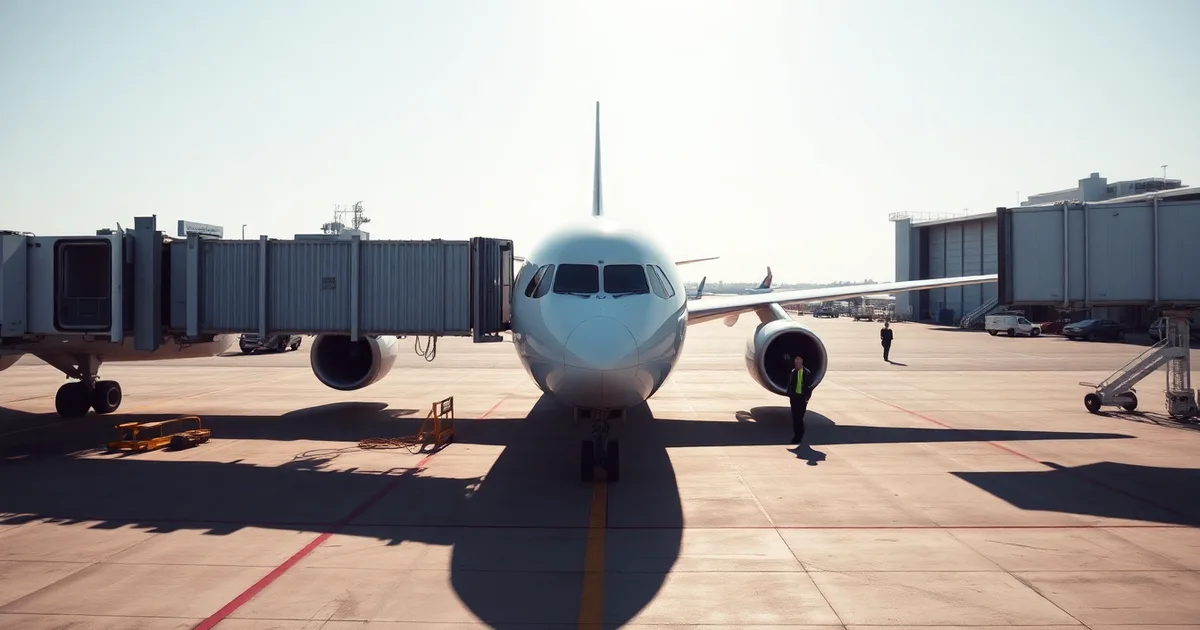
It is almost always a clock problem, not a broken airplane. Before boarding even started, the airline knew about one of four constraints: a crew rest limit under 14 CFR Part 117, an unreleased ATC slot, a load sheet that needs recalculating, or baggage still being reconciled. Ask the crew which one.
Pushback and taxi-out are not the same as departure. A plane can leave the gate, sit on a taxiway for 40 minutes, and never come close to the runway — at LaGuardia, Kennedy, Newark and Chicago O'Hare, holding at the gate or on a pad for 30 to 90 minutes past scheduled departure is routine, not exceptional.
The number that catches people out is ten. Under 14 CFR Part 117, a flight crew needs at least 10 consecutive hours of rest before reporting for a flight, and once that clock starts running down, no amount of passenger impatience moves it. If the delay pushes the crew past their legal duty limit, the airline has to find replacement pilots who are themselves rested and legal — which can take longer than the original delay.
Weight and balance is the quieter culprit. If the final passenger or bag count differs from the planned load by more than 1% of maximum takeoff weight, the load sheet must be recomputed before the aircraft can legally depart — a process that takes minutes, not seconds, and cannot be skipped. And if any bag is loaded without a matching passenger, TSA rules require reconciliation before the flight leaves. A dispatcher can hold a flight up to 3 hours for a crew rest reset without cancelling, but beyond that the flight may be legally required to return to the gate.
- Crew rest clock: Part 117 mandates 10 hours of rest before a flight, and a delay that breaches the limit forces a crew swap rather than a rushed departure.
- ATC slot holds: At congested airports like LGA, a released slot time can keep a boarded plane waiting 30 to 90 minutes past schedule.
- Load sheet trigger: A variance of more than 1% of maximum takeoff weight between planned and actual load requires a recalculated weight and balance before departure.
- Bag reconciliation: TSA requires that any bag loaded without a matching passenger be identified and removed before the aircraft departs.
- Three-hour limit: A dispatcher may hold a flight up to 3 hours for a crew rest reset, after which the flight may be legally required to return to the gate.
What are the four main reasons a plane sits at the gate after boarding?
Almost every post-boarding hold falls into one of four categories, and three of them were visible on an operations screen before the first passenger scanned a boarding pass. The distinction matters because it tells you whether you are waiting on a person, a machine, or a clock. If nobody from the airline has given you a reason and the door is still open, you are most likely in the first category below.
- The crew rest clock. Under 14 CFR Part 117, flight crew need 10 hours of rest before a duty period, and the duty period itself caps at 8 hours for a two-pilot crew, extendable to 9 with a relief pilot on board. If your inbound aircraft was late, the operating crew may have timed out before boarding even began, and the replacement crew is coming from a hotel or another terminal. The airline generally knew this two to three hours earlier and boarded anyway because the alternative was cancelling outright.
- An ATC slot time or ground stop. Flow control programs at congested airports assign each departure a wheels-up window, and at LaGuardia during peak hours a slot delay typically runs 30 to 90 minutes. FAA data attributes roughly 25% of post-boarding delays to flow control. There is nothing to fix here. The aircraft is airworthy, the crew is legal, and the clock simply has not reached your slot.
- Weight and balance recalculation. A late change in cargo, a fuel top-up, or a passenger reseating can push the computed takeoff weight past a threshold. A deviation of 1% or more from the filed maximum takeoff weight triggers a fresh load sheet and a re-signature from the dispatcher. On a Boeing 737 MAX or Airbus A320 this is usually a 10 to 20 minute exercise, but it restarts every time numbers move.
- Late baggage reconciliation. A bag that arrives at the gate after the door closes cannot simply be thrown in the hold. Someone has to confirm the bag belongs to a passenger who is actually on board, which is the positive passenger bag match rule that TSA enforces on international departures and most carriers apply domestically as policy. Industry estimates put the reconciliation of a single late bag at around 45 minutes, because the bag has to be located, scanned, and either matched to a manifest name or offloaded.
- A weather hold that is not about your weather. This is a fifth case that behaves like a slot problem but gets reported as weather. A thunderstorm 600 miles away can close a departure corridor and force a ground stop at your airport with clear skies overhead. Delta and other majors route these through their dispatchers rather than the gate, and the gate agent often learns the reason at the same moment you do.
- A maintenance item that clears quickly. Occasionally a genuine technical write-up surfaces during the pre-departure walk-around, and if it is a deferred-item sign-off or a reset, it resolves in under 30 minutes. This is the one case where a mechanic is actually involved, and it is rarer than passengers assume.
- Connecting passengers on a protected itinerary. At hubs like Hartsfield-Jackson Atlanta International, the airline will hold a departure for a bank of inbound transfers if the delay cost of rebooking them exceeds the delay cost of burning the slot. Ten connecting passengers on a full A320 can justify a 15-minute hold that the airline plans for in advance.
The one people get wrong most often is the ATC slot. Passengers hear "air traffic control" and assume something has gone wrong in the sky, then get angry when the plane sits motionless for 40 minutes with no explanation. In reality, the crew was assigned that slot before pushback, and the hold is the system working as designed — the alternative is circling over Pennsylvania burning fuel you already paid for. The second most misread case is the crew rest clock, which passengers tend to attribute to "the pilot is late," when in fact the pilot who boarded the aircraft is legally prohibited from flying it and a replacement is en route.
How does the crew rest clock actually work?
Under 14 CFR Part 117, a two-pilot crew gets a maximum flight duty period of 8 hours, extendable to 9 with a relief pilot on board. That duty clock starts when the crew reports for work — not when the boarding door closes, and not when the plane pushes back. It runs through the pre-flight briefing, the walk-around, the boarding process, the taxi, the flight, and the post-flight paperwork. Separately, the same regulation guarantees a minimum rest period of 10 hours between the end of one duty period and the start of the next. Rest and duty are different clocks, and mixing them up is why passengers sometimes hear "the crew needs their rest" when the plane is sitting at a gate at 2 p.m.
Here is the part that matters when you are already seated. A dispatcher or crew scheduler at Delta, American, or United runs the numbers before boarding even begins. They know the 8-hour duty limit, they know the crew's report time, and they can see the projected taxi and flight time. At LaGuardia during peak hours, an ATC slot delay of 30 to 90 minutes is routine. Add that to a 90-minute flight and the crew is fine — barely. Add a ground stop on top of it and the same crew goes illegal by 20 minutes. That is when the gate agent's radio call changes from "we're waiting on a slot" to "we're waiting on a new crew."
Why thirty minutes becomes two hours
Once a crew times out, the replacement does not appear instantly. The inbound crew has to be located, their own duty and rest status verified against Part 117, and their position confirmed — they might be finishing another flight, or they might be at a hotel 20 minutes away. The replacement crew then walks to the gate, receives a handover briefing from the outgoing crew, and re-runs the pre-flight checks. Industry estimates put that whole chain at 90 minutes to 2 hours on a good day, longer at a hub like Hartsfield-Jackson during a weather event. A 30-minute slot delay that pushes a crew over their limit therefore does not produce a 30-minute departure delay. It produces a delay equal to the time it takes to legally and physically replace them.
The airline knows this risk before the first passenger scans a boarding pass. Boarding anyway buys the carrier two things: it preserves the flight number and the slot, and it avoids a cancellation that would trigger rebooking obligations and DOT scrutiny. The trade-off is that passengers sit on a plane that was never going to leave on time. If the crew still has legal duty time when the delay clears, the gamble pays off and you depart. If they do not, you wait for their replacements — and the clock was already running when you sat down.
ATC slot times: why you miss your takeoff window
A slot time, formally the Calculated Take-Off Time or CTOT, is an appointment with the air traffic system. It is not a gate assignment or an airline preference. ATC issues it when demand at an airport or in its surrounding airspace is expected to exceed what the runways and controllers can handle: too many departures filed for the same 15-minute window, a runway closed for resurfacing, thunderstorms sitting over a departure fix 200 miles away, or a ground stop that holds all traffic inbound to a hub. When that happens, each flight gets a window (commonly 15 minutes wide, sometimes five) and the system expects it airborne inside that window.
LaGuardia is the reference case most crews know by heart. During peak hours, a slot delay there typically runs 30 to 90 minutes, and it can stretch further when afternoon convective weather moves up the East Coast and traffic into Atlanta and the Northeast corridors gets metered together. FAA data from 2025 attributes roughly a quarter of all post-boarding delays to ATC flow control, which is the machinery that produces slots. Note what this means: the airline frequently knows before boarding starts that the aircraft has a 4:15pm CTOT, and boards anyway, because a planeload of passengers sitting at a gate is worse for everyone than a planeload sitting on a taxiway.
Why "we'll just go when we're ready" does not exist
There is no informal queue. A crew that departs without a valid slot is either turned back to the gate or, more often, vectored into a holding pattern that burns the same hour while also burning fuel. Dispatch and the airline's ATC coordinator can request a new slot, but the new one lands behind every aircraft already assigned to that window, and the request itself can take 20 to 40 minutes to answer. What the pilots are doing during a gate hold is usually watching a clock on a screen in the flight deck, not waiting on a mechanic. If you hear the engines spool up and then stop, that is often a slot revision, not an abort.
Two outcomes follow, and they are not equivalent. If the window is missed by a few minutes and the airport is running a metered flow, the crew may get a revised CTOT 15 to 30 minutes out — annoying, survivable, and the reason your business meeting starts late. If the miss happens during a ground stop or a severe weather program, the next available slot can be an hour or more away, and at that point the crew rest clock and duty limits start to matter: 14 CFR Part 117 caps a two-pilot crew at roughly 8 hours of flight duty, extendable toward 9 with a relief pilot, and the 10-hour minimum rest that follows means a further delay can cancel the flight outright rather than push it.
Weight and balance: the invisible calculation that can ground you
Every flight leaves with a legal document called a load sheet. It records the aircraft's zero-fuel weight, the takeoff weight, the centre of gravity as a percentage of mean aerodynamic chord, and the trim setting the pilots will dial into the stabiliser before they release the brakes. On a Boeing 737 MAX or an Airbus A320, a narrowbody carrying 150-190 passengers, the difference between an acceptable and an unacceptable centre of gravity can be a few rows of seats' worth of people.
If anything changes after that sheet is signed — one more passenger walks on, a bag is pulled, a no-show is offloaded — the sheet is void. Under the 1% rule most carriers use, any shift in takeoff weight or CG that breaches roughly 1% of maximum takeoff weight requires a fresh calculation and a fresh signature. That work happens on the ramp or in the dispatcher's office, not in the cabin, and the flight cannot legally move until it is done.
| Trigger after boarding | Who does the work | Typical time added | What the crew can do meanwhile |
|---|---|---|---|
| Late passenger added to a full A320 (approx. 80 kg plus 23 kg bag) | Ramp agent plus dispatcher recompute trim | 15-20 minutes | Nothing — brakes stay set |
| Checked bag offloaded after a no-show | Ramp, then load control rebuilds the sheet | 20-30 minutes | Request a new pushback slot from ATC |
| Bag reconciled with a passenger already seated (positive passenger bag match) | Ground staff physically match tag to boarding pass | 45 minutes average | Brief the approach, refile the flight plan |
| Fuel top-up exceeding planned uplift by 500 kg or more | Dispatcher recalculates takeoff performance | 10-15 minutes | Little — this also resets the trim figure |
| Seat reallocation moving 6 or more passengers across the cabin | Load control only | 10 minutes | Continue with cabin secure checks |
The 45-minute positive bag match row is the one that ruins connections, and it is the reason a single late passenger is more disruptive than a full planeload of them. If Delta at Hartsfield-Jackson Atlanta International Airport cannot reconcile a bag with its passenger, the bag comes off — TSA and the FAA treat an unmatched bag as a security event, not a logistics one — and that offload invalidates the load sheet a second time. For a business traveller with a 90-minute connection, 45 minutes on the ground at ATL is the whole trip. If you are already seated and the door is closed, though, the arithmetic flips: a late passenger who never boards at all costs you nothing, while a passenger who boards at the last second and then moves seats costs you 20 minutes you will not get back. Watch the jet bridge, not the cockpit door.
Late baggage reconciliation: when a bag without a passenger stops everything
Checked bags fly under a rule that does not apply to you as an individual but to the pair of you: the bag and the passenger must be matched at departure. In the United States this is enforced by TSA through what carriers call the positive passenger bag match (PPBM) requirement. If the manifest says you are on board and the scanner says your suitcase is not, the load cannot close. That is not the airline being cautious. It is a regulatory condition of carrying the bag at all.
The reason is straightforward. A checked bag that flies without its owner is unattended cargo — nobody has to be accountable for what is inside it, and no one has to board the aircraft with it. So the reconciliation runs the other way too. When a passenger scans off the flight, their bag has to come off, and it cannot be pulled until it is physically located in the hold among the other containers. That search and offload is where the 45-minute industry estimate for a late bag comes from, and it is why a single no-show can hold a 180-seat Airbus A320 for the better part of an hour. The clock is not running on a repair. It is running on a baggage handler crawling through a bulk hold looking for a tag number.
Why the domestic and international rules diverge
On strictly domestic itineraries in the US, the match is usually resolved electronically: the carrier confirms that the bag and the passenger were both screened and boarded, and the aircraft can go. On international segments, and on any flight departing the US for a foreign destination, the match is stricter — the bag must be affirmatively identified against a boarded passenger, and offloading procedures are more rigid. That is why the same airline can absorb a late bag in ten minutes on a LaGuardia to Atlanta run and hold the gate for forty on a transatlantic departure. If you are on an international itinerary and hear the gate agent asking for a name over the PA, this is almost always what is happening.
The practical consequence for you is that a bag issue is one of the few post-boarding delays with a genuinely soft end. ATC has a minute. A crew rest clock counts down. A bag search finishes when someone finds the bag, which could be three minutes or thirty. And no dispatcher, not one working a 737 MAX or a fully loaded A320 out of ATL, will sign the load sheet with an unresolved match — the weight and balance is the last thing standing between the gate and the runway, and it does not move until the bag question is answered.
How can I tell which reason applies to my flight?
This works from seat 23F with a phone at 40% battery. You do not need the airline's internal systems or a friendly gate agent. You need three sources of information, checked in the right order, and about six minutes. The order matters because the cheapest sources give the broadest answer, and the most reliable source costs a crew member's attention.
- Listen to the next PA announcement and write down the exact words. Crews read from scripts, and the scripts leak the cause. "Waiting on paperwork" almost always means weight and balance or a late load sheet. "Waiting on a new slot time" means ATC flow control. "Waiting on a crew member" means the rest clock under 14 CFR Part 117, which cannot be argued with. "Waiting on a bag" is self-explanatory. Announcements that mention nothing specific ("a brief delay") usually mean the airline does not yet know, or does not want to say. Two minutes.
- Open the airline app and compare the departure time against the time printed on your boarding pass. A departure time that has moved in five-minute increments is a sign the airline is chasing an ATC slot rather than fixing a defect. A departure time that jumped by 45 minutes or more in one edit usually points to a bag reconciliation or a crew legality issue. Delta and United both push these updates to the app before the crew announces them, often by several minutes. One minute.
- Check the FAA's real-time status page for your origin airport, and check whether your destination shows a ground stop or a ground delay program. At LGA during peak hours, a flow-control delay runs 30–90 minutes, and roughly 25% of all post-boarding delays trace back to ATC flow control rather than anything on the aircraft. If your destination is under a ground stop, no amount of asking will move your flight. Ninety seconds.
- Look out the window at the jet bridge. If the door is still open and a gate agent is standing at the top of the bridge with a radio, someone is negotiating. If the door is closed and the bridge has pulled back, you are almost certainly waiting on a slot time or a weight calculation, not a late passenger. Thirty seconds.
- Ask the flight attendant directly, but ask the right question. "What are we waiting on?" gets a script. "Is the door closed and are we waiting on a slot?" gets a real answer, because it tells the crew you already understand the system. Ask during a lull, not while they are running a safety check. This is the step people botch: passengers who ask "how much longer?" get a shrug, and passengers who ask twice in ten minutes get ignored for the rest of the flight. A precise question buys a precise answer. One minute.
- If the answer is a crew rest clock, do the arithmetic yourself. Under 14 CFR Part 117, a two-pilot crew has a maximum flight duty period of 8 hours, extendable to 9 with a relief pilot, and a minimum rest period of 10 hours before the next duty. If your flight is already three hours late and the crew has been on duty since early morning, the airline may be holding you at the gate to preserve the crew's ability to fly the next leg, not to fly yours. Two minutes on a calculator.
- Set a hard checkpoint at the three-hour mark. Under the DOT tarmac delay rule, an airline must give passengers the chance to deplane after three hours on a domestic flight, four hours international. If you are approaching that line and the crew has not mentioned it, ask. That clock is your only guaranteed leverage, and it resets if the aircraft returns to a gate, which is why some airlines would rather wait than push back.
- Check the status of the aircraft's next flight, not just yours. If the same tail number is scheduled to turn around and fly back within 90 minutes of your arrival, and your delay is eating into that buffer, the airline has a financial reason to get you moving. If the next leg has already been cancelled, your aircraft may be reprioritised behind others. This is the single most useful piece of publicly visible data, and almost nobody checks it. Ninety seconds.
The failure mode is treating the announcements as the whole picture. Crews are told what to say, and "we're waiting on a slot" covers everything from ATC flow control to a dispatcher recalculating a load sheet after a late bag pushed the aircraft over the 1% threshold that triggers a recalculation. If the app, the FAA status page, and the flight attendant's answer all agree, you have the reason. If they conflict, trust the flight attendant, then the app, then the PA. The PA is written for 180 people, and you are only one of them.
What are my rights during a post-boarding delay?
The rules that matter when the door is shut come from one place: the U.S. Department of Transportation's tarmac delay rule, in force since 2010 and still the operative standard in 2026. It applies to every flight operating to, from, or within the United States on a carrier with more than 30 seats, and it starts counting from the moment the cabin door closes — not from scheduled departure, not from pushback.
- The 3-hour domestic clock. On a domestic flight, you must be given the chance to leave the aircraft no later than three hours after the door closes, unless the pilot determines that returning to the gate or deplaning would jeopardise safety or security, or that Air Traffic Control (ATC) advises a takeoff is imminent. "Imminent" is the airline's word and it gets tested in enforcement cases more often than any other.
- The 4-hour international clock. Flights arriving from or departing to a foreign airport get four hours, not three. A LaGuardia–Toronto hop that boards and then sits is a domestic leg for this purpose if it is the departing U.S. segment; the longer window generally bites on long-haul departures to Europe or Asia.
- Water and a working toilet at two hours. By the two-hour mark on a domestic flight, the carrier must provide food and potable water — snack bars and a cup of water count — and lavatories must be available and unlocked. On international flights the same amenities are owed by the two-and-a-half-hour mark. This is where Delta Air Lines and the other majors have historically been cited, mostly for the lavatory clause on aircraft parked at remote stands.
- Airlines must have a plan, filed with the DOT. Every covered carrier publishes a contingency plan for long tarmac delays, covering food, water, medical care, and deplaning procedures, and it must be submitted to the DOT for review. You can ask the crew for it. They will not have a copy, but the requirement is real and it is why a supervisor appears with a cart around the 120-minute mark.
- No automatic cash compensation, on any delay. The DOT rule is an amenities-and-deplaning rule, not a compensation rule. Unlike EU Regulation 261/2004, which pays €250–€600 depending on distance, the U.S. framework obliges the airline to get you off the plane and keep you fed and watered — nothing more. Compensation in the U.S. comes from the airline's own customer service commitment, which is a contract you can cite but not one the DOT enforces on the tarmac.
- Medical and disability needs override the clock. If you have a medical condition, or you are travelling with a disability, the airline must let you off earlier on request — the three-hour figure is a ceiling, not a threshold you have to wait for. Ask the lead flight attendant directly and be specific about the condition. Ambiguity is the main reason these requests get parked.
- The clock restarts if the aircraft returns to a gate. If the plane goes back, the door opens, and you stay aboard through a second boarding, the three hours begin again from the new door-close time. This is one of the few places where the regulation is genuinely generous to passengers, and it is why some carriers prefer to hold at a remote pad rather than taxi back for a top-up.
The item people most often get wrong is the first one. Three hours is not a target the airline has to reach before it acts, and it is not a guarantee you will be released at 180 minutes exactly — the safety and "imminent takeoff" exceptions are broad enough to swallow an extra 30 to 90 minutes at a slot-constrained field like LGA during peak flow, which is precisely the situation where a post-boarding delay is most likely to happen. If the captain comes on at 1,000 feet and finally explains the reason, that is a courtesy, not a legal requirement. The requirement was the water and the unlocked lavatory, and you already had a right to both.
Can a post-boarding delay affect my connection?
Yes, and the airline's minimum connection time is the number that decides your fate, not your scheduled arrival. MCTs are set airport by airport and terminal by terminal — Delta publishes roughly 35 minutes for a domestic-to-domestic transfer at ATL, but closer to 50 at LGA, where terminal changes eat the difference. Those figures assume everything runs on time. A 45-minute tarmac hold at your departure airport does not shave 45 minutes off your buffer; it burns the whole thing, because your inbound aircraft still has to park, and on a busy afternoon at LGA a gate can take another 10 to 20 minutes to free up after you land.
What most passengers do not realise is that the airline already knows. Dispatchers and the operations control centre watch inbound aircraft and connection loads continuously, and once a delay crosses the MCT threshold for a given set of passengers, the system flags them as misconnects before the flight even lands. If you are on a single ticket, that is good news: the carrier is contractually obliged to rebook you at no cost, and the rebooking is usually done automatically, with a new boarding pass waiting in the app by the time you reach the podium. If you booked two separate tickets, even on the same airline, there is no such obligation. The second carrier treats you as a no-show, and you buy a new fare. That asymmetry is the single most expensive thing frequent flyers get wrong, and it is worth checking your itinerary before you book the cheap split-ticket option next time.
The podium conversation, and when a voucher is actually owed
Walk to the gate agent before the flight lands if you can see the misconnect coming — they can start the rebooking while the aircraft is still taxiing, and seats on the next departure go fast. Ask specifically for the earliest confirmed seat, not standby, and ask whether a partner airline has availability. On three-hour-plus delays that are within the airline's control, US carriers typically owe meal vouchers; for a genuine overnight misconnect caused by a controllable delay, a hotel voucher is standard at Delta, United and American, but not guaranteed by DOT rule. Weather and ATC flow control count as outside the airline's control, and that is the case for roughly a quarter of post-boarding delays. In those situations you are usually negotiating for goodwill, not enforcing a right. If the agent says no, ask for the delay code written on the record — it determines what you are owed under the carrier's own contract of carriage, and it is a question they can answer.
Frequently Asked Questions
Why do planes wait at the gate after boarding is complete?
The usual causes are crew duty limits, an ATC slot time the flight cannot yet meet, a weight-and-balance recalculation, or a late baggage reconciliation. Mechanical problems are actually the minority of post-boarding holds. A single passenger who checks a bag and then walks off the aircraft can stall departure for the entire cabin.
Pilots often know about the hold before the door closes, but gate agents frequently do not get the update until pushback clearance fails to arrive.
How long can a plane legally stay at the gate after boarding?
There is no fixed legal cap on time spent at the gate with the door open. The US Department of Transportation tarmac delay rule only starts its clock once the aircraft has left the gate: 3 hours for domestic flights and 4 hours for international flights before passengers must be given the option to deplane. Sitting at the gate for 90 minutes is annoying but not a violation of anything.
What is a crew rest clock and how does it delay flights?
The crew rest clock is the FAA-mandated minimum rest period, generally 10 hours for Part 121 airline crews, that must be completed before a flight operates. Once a crew is on duty, they have a maximum duty day, often 14 hours but variable by start time and number of legs. Push past it and the airline must swap in a reserve crew or cancel.
A two-hour mechanical delay in the morning can consume the margin a crew needed for a late-evening leg.
What does 'ATC slot time' mean for my flight?
A slot time is a specific takeoff window assigned by Air Traffic Control, or by a slot coordinator at capacity-constrained airports like Heathrow and JFK, to spread demand across the runway. Miss your window, and the next available slot can be 30 to 90 minutes out, sometimes longer during weather or a ground stop. Boarding may still finish on time; the aircraft simply has nowhere to go.
Why does weight and balance need to be recalculated after boarding?
Any last-minute shift in passenger count, carry-on placement, checked baggage, or cargo changes the aircraft's center of gravity, and the load sheet the pilots sign off on must reflect the actual configuration before takeoff. Adding a 90 kg passenger in row 32 or moving 200 kg of freight changes the trim calculation. Dispatch issues a revised load sheet; the pilots verify and accept it. That process runs 10 to 20 minutes.
What happens if a bag is loaded but the passenger is not on the plane?
Under TSA positive passenger bag matching rules, a checked bag cannot fly without its owner on board. If a passenger fails to board or leaves after boarding, ground crew must locate the bag in the hold, offload it, and reconcile the paperwork, which typically takes 15 to 45 minutes on a widebody. The aircraft does not depart until that is complete. On a narrowbody with a single bag, it can move faster; on a full 787 with a misconnected transfer bag, expect closer to the upper end.