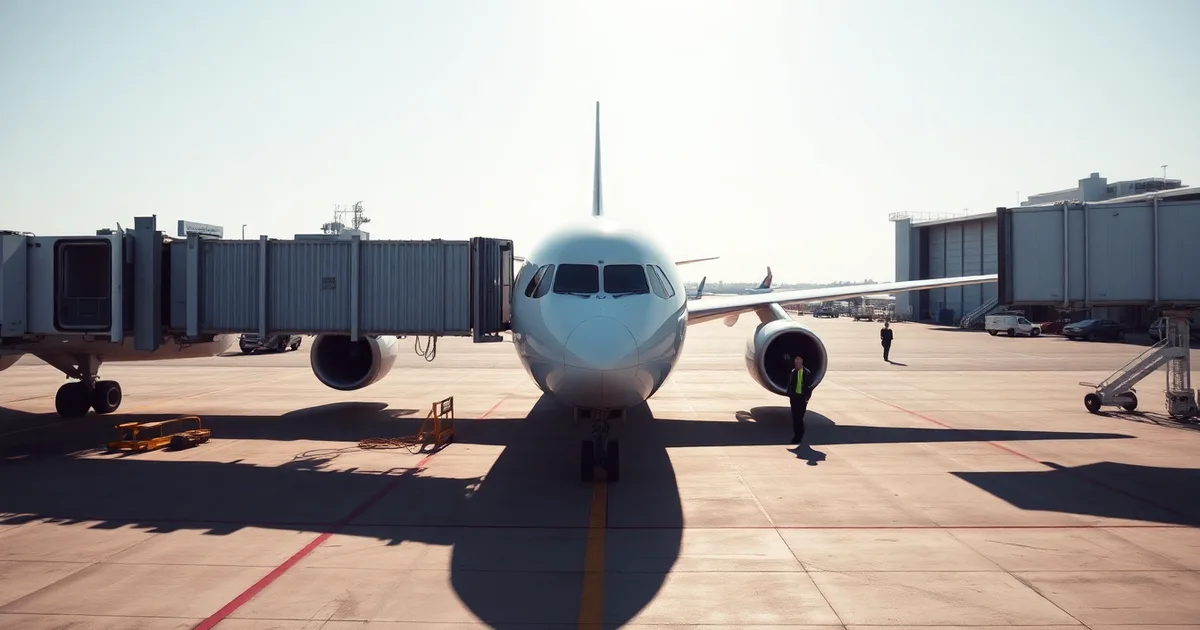
Clear skies do not protect a flight from cancellation. Crew duty limits under FAR Part 117, aircraft left out of position by an earlier delay, and ATC flow programs such as ground stops can all ground a departure. Under EU Regulation 261/2004 you may owe €250–€600 unless the airline proves extraordinary circumstances.
Weather is the excuse that costs the airline least. Thunderstorms 500 miles away can trigger a ground delay program at your airport, holding arrivals until the traffic jam upstream clears. Your terminal window shows blue sky the entire time. Meanwhile the aircraft assigned to your flight is still sitting at a hub three states over, its previous leg cancelled or spinning in a hold.
That single aircraft typically flies four to six legs a day, and so does its crew. Push one delay into the morning and every downstream departure absorbs it. When the knock-on reaches a crew's limit, the flight cancels even though the plane is at the gate and the fuel truck is already there.
The number that catches people out is the duty ceiling itself: 9 hours of flight duty if a crew signs on early in the morning, stretching to 14 hours for a late-afternoon start, with mandated rest after. A cancelled inbound flight eats into that window without anyone onboard touching a control. If the reserve list is thin, recovery runs 24 to 48 hours before a legal crew can be assembled.
- Duty limits cancel flights: FAR Part 117 caps flight duty at 9 to 14 hours depending on report time and required rest, and a delayed inbound leg can breach that cap before departure.
- ATC flow programs bite: Ground stops and ground delay programs can cancel departures in clear local weather when thunderstorms disrupt traffic 500 or more miles away.
- Aircraft fly many legs: A four-to-six-leg daily rotation means one upstream cancellation at a hub can leave both your aircraft and its crew out of position.
- EU rules pay out: Regulation 261/2004 entitles passengers to €250–€600 for cancellations unless the airline proves extraordinary circumstances, a test technical and crew shortfalls typically fail.
- Recovery takes days: Rebuilding a legal crew from reserves commonly takes 24 to 48 hours, since reserve pilots and cabin crew may already be out of hours or committed elsewhere.
Crew Duty-Time Limits: The Invisible Clock That Cancels Flights
Your flight is scheduled, the aircraft is parked at the gate, the sky is blue. What cancels it is a clock nobody at the airport can see. Under FAR Part 117, the rule that has governed US airline crew scheduling since January 2014, a pilot's maximum flight duty period runs from 9 hours for a very early report to as much as 14 hours for a later start, and the allowance shrinks with each additional flight leg. A two-leg day starting at 06:00 gives a crew far less legal room than a four-leg day starting at 14:00. That duty period begins when the crew reports for work, not when the aircraft pushes back—so the delay that strands you may have happened on a flight you never boarded.
This is how a sunny-day cancellation actually unfolds. A crew flies Buffalo to Chicago, then Chicago to Denver. A ground delay at Chicago eats 90 minutes. They arrive in Denver late, and the return leg now has to be flown inside a duty window that has already been half spent. Scheduling looks at the numbers and sees two choices: dispatch the crew and risk a violation, or cancel. The FAA can levy civil penalties against an airline for every pilot who exceeds duty limits, and the airline also loses the crew's services for the following day because FAR Part 117 requires a minimum 10 hours of rest after duty ends. Airlines cancel. It is arithmetic, not weather.
Why they cancel instead of fixing it
Reserve crew exist precisely for this, but a call-out typically takes 2 to 4 hours before the pilot is even at the gate, and reserves are usually stationed at hubs. If you are in Spokane on a Saturday evening, no reserve is coming. Airlines could also ask for a waiver, but the FAA grants those rarely and mostly for defined operational emergencies, not for one flight's convenience. So the flight dies quietly while the weather app on your phone shows a clear radar loop.
What this means for you is that the cancellation is very likely a controllable, internal airline decision rather than an "extraordinary circumstance." That distinction matters enormously under EU Regulation 261/2004, which pays €250 for flights up to 1,500 km, €400 for 1,500–3,500 km, and €600 above 3,500 km. A crew timing out is generally considered within the airline's control, so compensation is normally owed—and roughly 95% of eligible passengers never claim it, according to 2025 EU data. Airlines are not required to volunteer the real reason, and "weather" is the easiest word in the industry to write on a delay notice.
How Upstream Hub Disruptions Cancel Your Clear-Weather Flight
The aviation industry runs on a hub-and-spoke system, and that design concentrates risk in a way passengers rarely see from Gate B12. A thunderstorm over Dallas, Chicago or Atlanta shuts down arrivals for two or three hours, and the disruption does not stay there. It propagates outward to every outstation those aircraft and crews were scheduled to serve that evening. The FAA's 2019 ground stop at Newark, triggered by weather roughly 600 miles away, cancelled more than 500 flights, most of them in clear skies.
Your aircraft is almost certainly not based at your airport. Short-haul fleets average four to six flight legs per day, so the plane assigned to your 6:40pm departure is probably finishing a rotation that began in the disrupted hub that morning. When that hub closes, the aircraft either sits or diverts, and your leg is the one dropped because it is the last and cheapest to cancel. Airlines Operations Control Center staff make these calls in real time, weighing which cancellations strand the fewest passengers and preserve the next day's schedule. Your clear-weather flight loses when the maths says so.
The crew has the same problem, with a harder constraint. Pilots and cabin crew inbound from the hub are subject to FAR Part 117 flight duty period limits and a minimum 10 hours rest after duty. If their inbound flight lands three hours late, they may time out before your departure, and no dispatcher can override that. Reserve crew exist for exactly this, but call-out typically runs two to four hours per airline pilot forums, which is often longer than the delay itself. A hub closure at midday can therefore cancel an evening flight 1,000 miles away purely because the people qualified to fly it never arrived.
This is why "weather" appears as the stated cause on your cancellation notice more often than the weather at your airport justifies. Under EU Regulation 261/2004, weather genuinely outside the airline's control counts as extraordinary circumstances and removes the €250 to €600 compensation obligation. Crew duty time, aircraft repositioning and routine ATC flow programs usually do not meet that bar, yet carriers still label them weather because most passengers accept it and only around 5% of eligible claimants ever file. Ask the airline in writing for the specific disruption cause and the aircraft's prior routing. Under the US DOT automatic refund rule effective 28 October 2024, you get your money back within 7 business days for credit card purchases regardless of the label, but the difference between a weather excuse and an operational failure is worth several hundred euros.
ATC Flow Programs: When the Sky Is Clear but the System Isn't
Your departure airport is 24°C and visibility is 10 miles. Your arrival airport is the same. Neither fact matters to the FAA Air Traffic Control System Command Center in Warrenton, Virginia, which can throttle or stop traffic across an entire region based on a thunderstorm 600 miles away, a controller staffing gap, or simply too many airplanes filed into the same corridor at the same hour. A Ground Delay Program assigns your flight a new, later departure slot: instead of pushing back at 14:05 you now hold until 16:40, and the airline eats the cost of the gate, the fuel, the crew and your patience. A Ground Stop is harsher. It halts departures to a specific airport outright, with no assigned slot, for a defined window that can run from 30 minutes to several hours.
Here is the part that catches people out. A ground stop issued for Newark in 2019 because of storms over the Midwest cancelled more than 500 flights, many of them on days when the weather at both ends of those routes was completely clear. The weather has to be somewhere, but it does not have to be where you are. Convective weather over a hub reroutes hundreds of aircraft into new jet routes, those routes hit their capacity limit, and the Command Center's only lever to prevent airborne holding and fuel emergencies is to stop the flow at the source. Volume is the other trigger: on a Friday evening, the New York airspace simply cannot accept every flight airlines sold, and someone's departure gets pushed.
Why the airline cancels rather than waits
A three-hour ground delay is survivable for a short-haul crew on an early start, who has a 9-hour flight duty period under FAR Part 117. It is often fatal for the last rotation of the day, because a delay that pushes the crew past their limit leaves the aircraft stranded at the outstation with nobody legal to fly it back, and the airline has a minimum 10 hours of rest to find before that crew can touch the aircraft again. Reserve crew need 2 to 4 hours of call-out according to the scheduling discussions pilots trade on forums, which is usually longer than the delay itself. So the Operations Control Center cancels the flight, protects the aircraft's next morning departure, and tells you "weather" because that is the phrasing that closes the file fastest.
Which is precisely the problem for your wallet. Under EU Regulation 261/2004, a cancellation caused by extraordinary circumstances such as genuinely severe weather removes the airline's obligation to pay the €250, €400 or €600 owed for flights up to 1,500 km, 1,500–3,500 km, and over 3,500 km respectively. A cancellation caused by crew duty limits, aircraft repositioning or a staffing-driven ground stop is generally not extraordinary, and the compensation stands. The airline has no incentive to correct the record, and with roughly 5% of eligible passengers claiming according to 2025 EU data, most never find out. Ask for the specific reason in writing, and if the answer is a ground stop or a crew timeout rather than weather at your airports, you have a claim.
Aircraft Repositioning: Why an Empty Plane Might Fly Without You
Look out the window at a cancelled flight and you may see something that makes no sense: an aircraft of the same type pushing back and taking off, mostly empty, while you queue at the service desk. That flight is not a mistake. It has a flight number, a departure slot, and a destination chosen by an Airline Operations Control Center that is solving a problem three cities away. Here is what that empty movement usually is, and what it does to your ticket.
- It is a ferry flight, not a passenger service. Ferry legs are filed with a callsign ending in "F" (BAW9256F, for example) and carry no revenue passengers. They exist because the aircraft is worth more somewhere else in six hours than it is sitting at your gate.
- The aircraft is chasing its next rotation. Under a hub-and-spoke system, a single narrowbody typically flies 4–6 short-haul legs per day (2–3 for long-haul, per 2025 IATA utilisation data). Break one link and every downstream leg is orphaned. Ferrying the jet to the next spoke restores five or six future departures at the cost of your one.
- Your route is the low-yield one. If an AOC has to lose a rotation, it compares revenue per available seat-kilometre. A Tuesday-midday regional hop loses that comparison to a Friday-evening trunk route nearly every time. This is the part airlines will not say out loud, because "commercial" is not an extraordinary circumstance under EU Regulation 261/2004.
- It can also be a rescue mission. When a hub is short of metal after a ground stop, the airline may ferry a spare aircraft in from a quieter station to protect a bank of connecting departures. The FAA Air Traffic Control System Command Center runs Ground Delay Programs and Ground Stops precisely to meter that traffic, and an AOC will sometimes pre-position aircraft before the program lifts.
- Repositioning also happens after crew time-outs, not just weather. FAR Part 117 caps a flight duty period at 9 hours for early starts and up to 14 hours for later starts, with a minimum 10 hours rest afterwards. Once a crew times out mid-rotation, the aircraft is stranded with nobody legal to fly it, and the fastest fix is often to fly it empty to a base where reserve crew are on standby. Reserve call-out time is typically 2–4 hours, so the maths rarely works in your favour at the gate.
- Your rebooking is the byproduct, not the objective. The airline's obligation is to move the asset; yours is handled afterwards. You will usually be rebooked on the next available seat, which on a high-demand day can mean tomorrow morning, or a routing through a city you never intended to visit.
- The reason code on your booking will not say any of this. Expect "operational reasons" or "aircraft on ground". Neither is a weather code, which matters for what you are owed.
The item people get wrong is the compensation question. A repositioning cancellation is an airline decision, so it generally does not qualify as extraordinary circumstances, and EU261 payouts of €250 (up to 1,500 km), €400 (1,500–3,500 km) or €600 (over 3,500 km) can apply as of 2026. In the US there is no equivalent cash compensation, but the DOT automatic refund rule effective 28 October 2024 requires a refund within 7 business days for credit card purchases if you choose not to travel. Roughly 95% of eligible EU passengers never claim, per 2025 EU data, largely because the airline's stated reason sounds like weather. Ask for the specific disruption code in writing before you accept a rebooking voucher, because accepting one can complicate a later claim.
What Compensation or Rebooking Rights Apply to Clear-Weather Cancellations?
Under EU Regulation 261/2004, a cancellation on a flight departing an EU airport, or arriving into one on an EU carrier, triggers fixed compensation of €250 up to 1,500 km, €400 between 1,500 and 3,500 km, and €600 beyond that. The airline owes it unless it can prove "extraordinary circumstances" — a phrase that has done more work than any other three words in European aviation law. Weather is the classic qualifying event. A crew shortage caused by the airline's own rostering, or a Ground Delay Program at a hub 600 miles away, is not. If your cancellation email cites "operational reasons" and nothing else, that vagueness is worth challenging, because only about 5% of eligible passengers ever file under EU261 according to 2025 EU data.
The US has no equivalent flat payment. What it has, since 28 October 2024, is an automatic refund rule: if your flight is cancelled or significantly changed and you don't accept the alternative offered, the airline must return your money without you having to ask, within 7 business days for credit card purchases and 20 days for other payment methods. That refund is your fare, not compensation for the four hours you spent in a Terminal C queue. US DOT rules also require the airline to rebook you on its own next available flight at no cost, but on a competitor only if the carrier chooses to — a gap that European passengers do not face.
Where the "extraordinary circumstances" defence usually breaks
Airlines lean on weather constantly, and sometimes honestly. The 2019 FAA ground stop at Newark, triggered by storms 600 miles away, cancelled more than 500 flights in a single day — nobody at that airport saw a cloud, and nobody was owed a cent beyond a refund. But the defence has limits. If your aircraft went tech and the replacement crew could not be called out within the typical 2–4 hour reserve window, or if the inbound leg was cancelled because a hub ran out of duty hours under FAR Part 117, that is a commercial decision dressed as an act of God. EU courts have repeatedly held that technical faults and staffing failures are inherent to running an airline, not extraordinary.
So the practical rule: accept the rebooking, keep every receipt, photograph the departure board, and note the exact wording of the cancellation message. If it says "weather," check what the weather was actually doing at your departure airport and at the arrival airport, not at the hub you never touched. Then file. The airline will refuse the first time. It often pays the second.
Table: Common Clear-Weather Cancellation Causes and Your Rights
When you ask the gate agent why a 22°C afternoon flight with a 2 km/h breeze is cancelled, the answer usually comes in four words or fewer: "weather in the system." That phrase is doing a lot of work. What it often means is that the aircraft is 900 km away and illegal to fly under FAAs FAR Part 117 because the crew has been on duty for 13 hours and 40 minutes, or that the FAA Air Traffic Control System Command Center has issued a Ground Delay Program out of an airport the forecast never mentioned. US DOT automatic refund rules, effective 28 October 2024, cover the refund side. EU Regulation 261/2004 covers compensation, and the difference between "extraordinary circumstances" and "normal airline operations" is where most claims succeed or fail.
The table below matches the five most common clear-weather causes to the excuse you'll hear, the likely EU261 outcome, and the care you're owed regardless of compensation. Care entitlements under EU261 (meals, hotel, transfers) apply whether or not compensation is payable, but only if the delay exceeds the thresholds. Compensation itself runs €250 for flights up to 1,500 km, €400 for 1,500–3,500 km, and €600 for over 3,500 km, as of 2026.
| Cause | Typical airline excuse | Likely EU261 compensation | Required care (meals/hotel) |
|---|---|---|---|
| Crew duty time (FAR Part 117 cap reached) | "Operational reasons" or "weather" | Yes — €250–€600. Courts have repeatedly rejected crew rostering as extraordinary. | Meals from 2h delay; hotel + transfers if overnight required |
| Aircraft repositioning (plane stuck elsewhere) | "Late inbound aircraft" | Yes — €250–€600. Repositioning is an airline scheduling decision, not extraordinary. | Meals from 2h; hotel + transfers for same-day overnight |
| ATC flow program (Ground Delay Program / Ground Stop) | "Air traffic control restrictions" | Usually no. Genuine ATC flow = extraordinary circumstances, no compensation. | Meals + hotel still required if delay exceeds 2h / overnight |
| Upstream hub disruption (weather at connecting hub 1,500 km away) | "Weather in the system" | Depends on cause at the hub. Weather = no; crew/tech at hub = yes, €250–€600. | Meals from 2h; hotel + transfers for overnight |
| Staff shortage (no reserve crew available) | "Crew availability" | Yes — €250–€600. Staffing is the airline's responsibility. | Meals from 2h; hotel + transfers for overnight |
Crew duty time and staff shortage are the two rows that win the compensation argument almost every time — FAR Part 117 sets a maximum flight duty period of 9 hours for early starts up to 14 hours for later starts, and a minimum 10 hours rest after duty, so a missing reserve crew is a rostering failure, not a weather event. The row that flips is ATC flow: a real Ground Stop, like the 2019 FAA stop at Newark that cancelled over 500 flights because of weather 600 miles away, is a legitimate extraordinary circumstance under EU261, and no compensation is owed — but meals and hotel still are. That distinction trips up most passengers: care is owed far more often than compensation. Roughly 5% of eligible EU261 passengers ever claim, per 2025 EU data, which is exactly why airlines prefer "weather" as the default script.
How to Push Back When the Airline Blames the Weather
This works when your flight is cancelled, the sky is visibly clear at both ends, and the airline's app or gate agent says "weather." It needs three things from you: the exact wording of the reason they give, the flight numbers of your aircraft's previous legs, and roughly 20 minutes on your phone. It costs nothing to file. The only real cost is time, and you already have that, because you are sitting in an airport.
Roughly 5% of eligible passengers under EU261 ever claim, according to 2025 European Commission data. That number is low because the process looks tedious, not because the claims fail. Here is the order that actually works.
- Get the reason in writing before you leave the airport. Ask the gate agent or the airline's chat support for the specific cause and the regulation they are citing: "Please confirm in writing whether this is being treated as extraordinary circumstances under EU Regulation 261/2004, and the specific cause." Screenshot it. A verbal "weather, sorry" vanishes; a written claim that the cancellation is weather-related is something you can later contradict. This takes 5–10 minutes and is the step most people skip because they are already rebooking.
- Pull the actual weather, not the forecast. Check METAR or TAF reports for your departure airport, your arrival airport, and a midpoint along the route on a site like aviationweather.gov for the US or the equivalent national provider. If both ends are showing visual flight conditions and no convective activity in between, the weather excuse is doing a lot of work. Save screenshots with timestamps.
- Find your aircraft's previous leg. Look up your flight number on FlightRadar24 or FlightAware and open the aircraft's tail number, then walk back through its day. Short-haul jets typically fly 4–6 legs a day. If its third leg was already running two hours late out of a hub, the cancellation is a crew duty time problem wearing a weather costume, because under FAR Part 117 a crew that has already hit a long flight duty period cannot simply keep going, and the minimum 10 hours rest after duty resets the clock. That tail number and the delayed earlier leg is the single most useful piece of evidence you can hold.
- Log everything in one place. Time of notification, the reason given, the tail number, the previous leg's arrival time, the weather screenshots. Ten minutes, one note on your phone. Enforcement bodies ask for a specific set of facts, and a clean timeline beats a long story.
- File with the national enforcement body, not just the airline's customer service form. In the EU, that is the National Enforcement Body of the country of departure or arrival. In the US, it is the US DOT consumer complaint portal. The EU process is free and usually acknowledged within a few weeks; DOT complaints get a response from the airline within 60 days. Attach the timeline. Cite the amount you believe you are owed: €250 for flights up to 1,500 km, €400 for 1,500–3,500 km, €600 over 3,500 km, as of 2026.
- Push on rebooking at the same time, separately. Compensation and rebooking are different obligations. Under EU261 the airline owes you a replacement flight or a refund, and it owes you the refund within 7 days. For US itineraries, the DOT automatic refund rule effective 28 October 2024 requires refunds within 7 business days for credit card purchases. Ask explicitly for the next available flight on any carrier, not just theirs.
- If the airline refuses, escalate in writing once more, quoting the evidence: "The cancellation was recorded as weather. The aircraft's previous leg arrived 2 hours 40 minutes late, and both airports were VFR at the time. Please reconsider." A single specific rebuttal moves more claims than a long complaint. Give them 14 days to respond before you consider a claims service, which typically takes 25–35% of your compensation — a real cost, and usually unnecessary if you filed the enforcement body complaint yourself.
The failure mode is filing too late and too vaguely. Most EU261 and DOT complaint processes have time limits, and vague complaints that just say "they lied about the weather" get closed without a payout. The other botch: accepting the rebooking and letting the airline close the file before you have logged the reason in writing. Once you have boarded the replacement flight, the paper trail gets much harder to assemble.
Your Rebooking Playbook: What to Do at the Airport
The queue at the service desk is the slowest route to a new seat, and it grows fastest exactly when you need it most. A 2019 FAA ground stop at Newark, triggered by weather 600 miles away, cancelled more than 500 flights in a single afternoon; every one of those passengers joined the same line. Work the phone and the airline's app before you join anything.
- Check other carriers before you queue. Open the apps for two or three competing airlines and search your route for today and tomorrow. If seats exist and the price is survivable, book one. Under EU Regulation 261/2004 you can claim the difference back from the original carrier in some cases, though enforcement varies by national authority and the airline will resist. A paid seat you actually fly beats a free one three days out.
- Look at nearby airports and split tickets. A hub-and-spoke network can usually move you via a second city the same day. Search your origin to an alternate hub, then hub to destination, even on separate bookings. The risk is real: if leg one is late, leg two is your problem, not theirs. Take it only when the alternative is a two-night hotel.
- Ask for a same-day confirmed seat on a partner airline. Use the exact words "same-day confirmed" or "endorsement to a partner carrier." Major alliances can reaccommodate you on a partner metal at no cost, but the agent has to actively look. If the first agent says no, call back. Rebooking authority varies by agent seniority, and a 2026 survey of pilot forums suggests reserve call-outs take 2–4 hours, which means the airline may not yet know what it can fly tomorrow.
- Request hotel and meal vouchers the same night. If the delay forces an overnight, the airline owes you accommodation and transport to it under EU261 when the cause is within their control, and under most US carriers' contracts of carriage even when it isn't. Weather is the excuse, not always the legal answer. Get the voucher in writing before you leave the desk, or the cost is yours to chase later.
- Keep every receipt. Meals, taxi, hotel, parking, a change fee, a phone charger. Photograph each one and email the images to yourself with the date and flight number in the subject line. US DOT rules effective 28 October 2024 require refunds within 7 business days for credit card purchases when a flight is cancelled and you choose not to travel, but reimbursement for incidental expenses is separate and rarely automatic.
- File your compensation claim within days, not weeks. EU261 pays €250 for flights up to 1,500 km, €400 for 1,500–3,500 km, and €600 for over 3,500 km, as of 2026. Only about 5% of eligible passengers ever claim, according to 2025 EU data, which is exactly why airlines keep blaming weather. A crew duty-time cancellation is not "extraordinary circumstances" and does not excuse payment under FAR Part 117 or EU261. The airline's own operations log, not the weather report, decides.
The step people skip is the last one. Most passengers accept the weather explanation, take the rebooking, and never file. That number, 5%, is the airline's margin. If the sky was clear at both airports and the cancellation traces to a duty-time limit, a repositioning leg, or an ATC flow program, the burden shifts to the carrier to prove otherwise, and the carrier knows it. File, keep the reference number, and let them argue with the regulator instead of you.
Frequently Asked Questions
Why was my flight cancelled when the weather is perfectly clear?
Your aircraft, its crew, or the airspace it needs is almost certainly somewhere else in bad weather. Crews hit FAA duty-time limits after delays, aircraft get stranded at other airports, and air traffic control slows arrivals because of storms 800 miles away. A 2019 FAA study found weather causes roughly 70% of delays, but only about a third of those happen at the airport where passengers are standing.
Can I get compensation if my flight is cancelled due to crew shortage?
Usually yes, under EU261. The Court of Justice of the European Union ruled in 2021 (case C-826/19) that crew shortages are inherent to running an airline and do not qualify as extraordinary circumstances, so the €250-€600 payout generally applies. Airlines still deny these claims routinely, so keep your booking reference and the cancellation notice.
What is a ground stop and how does it cancel flights in good weather?
A ground stop is an FAA order halting departures to a specific airport, issued when that airport cannot accept more traffic. It covers congestion, staffing, or weather at the destination, not where you are. A ground stop at Newark in June 2025, triggered by thunderstorms over the Midwest, cancelled hundreds of flights departing from airports with clear skies and 10-mile visibility.
Does FAR Part 117 apply to all airlines?
Yes, for US scheduled operations. FAR Part 117, effective since January 2014, sets flight duty period limits for all Part 121 carriers, from Delta to a regional flying 50-seat jets under the Delta Connection banner. It caps flight time at 8 or 9 hours depending on start time and requires 10 hours rest between duty periods. Charter and Part 135 operators follow different, looser rules.
What are my rights if my flight is cancelled due to aircraft repositioning?
You are likely owed compensation, because repositioning is an airline operational decision, not an extraordinary circumstance under EU261. That means up to €600 plus rebooking or a full refund. On a US domestic itinerary, DOT rules do not require cash compensation, but you are entitled to a refund if you decline the rebooking, regardless of the reason.
How long does it take to get compensation for a cancelled flight?
EU261 claims typically run six weeks to six months. Airlines have no statutory deadline, though national enforcement bodies in Germany and Ireland generally expect a response within 8-12 weeks. US DOT refunds are faster: carriers must process credit card refunds within 7 business days and cash or check refunds within 20 calendar days, per the April 2024 rule.