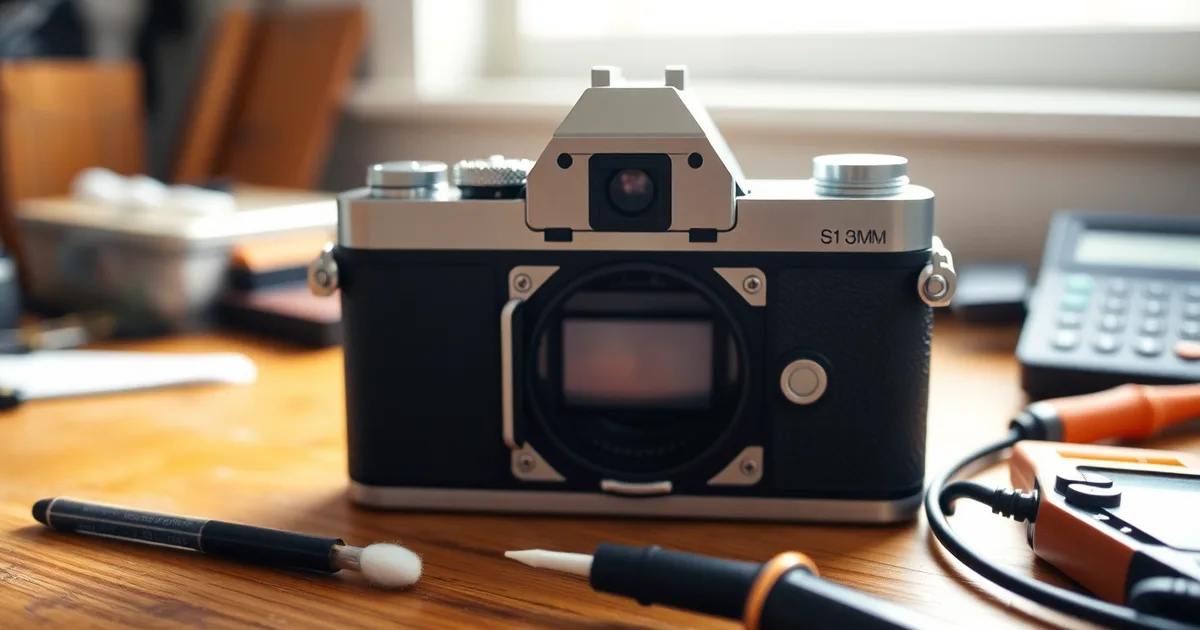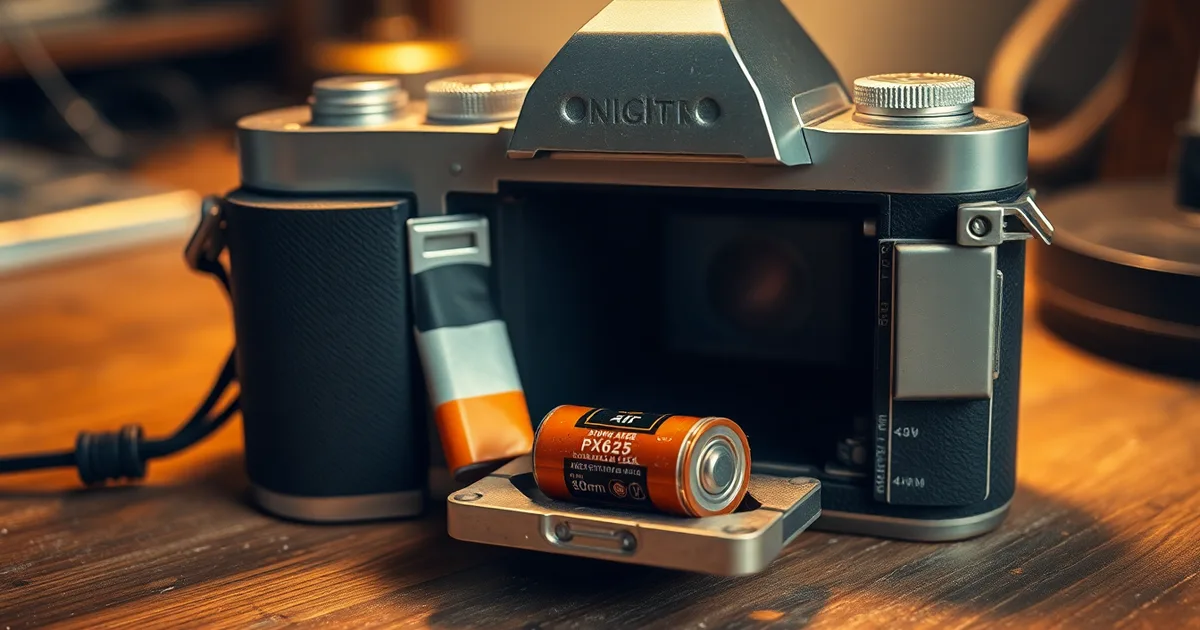
Zinc-air hearing aid batteries rest at 1.45V open-circuit but sag to about 1.2V under a vintage meter's tiny load. Mercury cells were 1.35V, so that 0.15V deficit throws a mercury-calibrated meter roughly two stops off, usually underexposing. Fit a voltage-converting MR-9 adapter or a Wein cell; a bare hearing aid battery will not work.
The camera that brought you here was almost certainly designed around a PX625 or PX13 mercury cell, rated 1.35V. Mercury cells were banned in the EU in 1993 and phased out in the US under the Mercury-Containing and Rechargeable Battery Management Act, which took effect in 1996. Every substitute on the shelf today is a compromise, and the 675 zinc-air cell is the most popular one.
Here is the part that catches people out. A 0.15V error against a 1.35V reference looks like about 11% on paper, which sounds like a fraction of a stop. It is not. Cadmium sulphide meter bridges behave non-linearly near the bottom of their range, so that 11% routinely shows up as 1.5 to 2 stops on the dial. On a Canon AE-1 or a Pentax K1000, that is the difference between a correctly exposed frame and a thin, muddy negative.
Silver-oxide is no better in the other direction. An SR44 or S76 sits at 1.55V and pushes the same meter the other way, typically overexposing by 1 to 1.5 stops.
- Voltage figures: A 675 zinc-air cell measures 1.45V open-circuit but settles near 1.2V under the microamp draw of a CdS bridge, against the 1.35V mercury reference.
- Why it is not linear: That 0.15V deficit is an 11% voltage error, but CdS bridges are non-linear near threshold, so it lands as 1.5 to 2 stops of exposure error.
- Wein cells: A Wein cell is a zinc-air cell with a 1.35V regulator built in, lasts 3 to 12 months depending on air exposure, and costs roughly $8 to $12 in 2026.
- MR-9 adapters: Kanto Camera's MR-9 drops a 1.5V silver-oxide cell to 1.35V; the diode version drifts with current and temperature, so get the linear-regulator version.
- The diode hack: Stacking a Schottky diode inline is unreliable because its forward drop changes with temperature and load, and it offers no regulation at all.
Why does a 1.45V hearing aid battery make my meter read two stops off?
The meter in a Canon AE-1, Nikon FM, or Pentax K1000 was never designed around 1.45V or 1.5V. It was designed around a mercury cell: 1.35V nominal, and — this is the part people miss — 1.35V under load, held flat until the cell was nearly dead. The PX625 and PX13 that fed these meters were banned in the EU in 1993 and in the US under the Mercury-Containing and Rechargeable Battery Management Act of 1996, and nothing since has replicated that voltage curve. A zinc-air 675 cell reads 1.45V on a multimeter with no load, which is why hobbyists assume it's "close enough" or "slightly hot." Put it in the camera and the CdS bridge pulls 10–100 µA through it, and the cell sags to roughly 1.2V. That's 11.1% below the 1.35V reference the meter was nulled against.
Why that percentage turns into two stops rather than a fraction of one is the counterintuitive part. A CdS meter works as a Wheatstone bridge: the cell voltage and the photoresistor form one leg, a fixed divider forms the other, and the needle or LED nulls when the two match. The bridge doesn't measure voltage, it measures the ratio between the reference leg and the light-dependent leg, and it's calibrated so that ratio equals unity at 1.35V for a given EV. Drop the reference leg by 0.15V and the bridge rebalances at a different resistance, which corresponds to a different light level. On most of these circuits the relationship between reference voltage and indicated EV is steep near the metering threshold — the point where the needle first lifts off its stop — and gentler in the middle of the range. That's why 0.15V, about 11%, translates to roughly 1.5–2 stops of underexposure at the bottom of the scale and closer to 1 stop at the top. It is not a fixed offset you can dial out with the ISO ring.
What "underexposure" actually means here, and why the fix isn't a diode
Because the bridge sees a low reference, it thinks the scene is dimmer than it is, so it opens the aperture wider than the film needs or drags the shutter slower. Two stops of underexposure is the practical result in the low-light conditions where the error bites hardest — the same conditions where you bought the camera in the first place. Stacking a Schottky diode in series to drop 1.45V down to 1.35V is the hack everyone tries first, and it fails for a reason worth understanding: a diode's forward drop is a function of current and junction temperature, so it drifts as the meter's load changes and as the camera warms up in your hand. You get a different correction on a bright day than at dusk, and a different one again in winter. A $30–$60 MR-9 adapter from Kanto Camera or a generic equivalent does the job properly: it contains a voltage reference that holds 1.35V under load, so the bridge sees what it was built to see. The alternatives are equally clear. A silver-oxide SR44 at 1.55V pushes the meter the other way, giving roughly 1–1.5 stops of overexposure. Zinc-air Wein cells at $8–$12 each get you the right chemistry but the wrong curve, and they die within a few weeks once the tab is peeled regardless of use. Recalibrating the bridge itself to a 1.2V reference is the only other correct fix, and it's the one you'd choose if the camera is already on a technician's bench for a CLA.
What voltage do vintage meters actually expect?
Almost every through-the-lens meter built between the mid-1960s and the early 1980s was designed around a single mercury cell: 1.35V, sold as the PX625, PX13 or MR9. Mercury chemistry held that voltage flat for most of its life, which is exactly what a CdS photoresistor bridge needs — the Canon AE-1, Nikon FM and Pentax K1000 all assume a stable reference on one leg of a Wheatstone bridge, and the meter's needle or LED display is only as accurate as that reference.
Mercury cells were banned in the EU in 1993 and in the US by the Mercury-Containing and Rechargeable Battery Management Act of 1996, and nothing since has matched them on both voltage and stability at once.
| Chemistry | Nominal voltage | Voltage under meter load | Compatibility with a 1.35V bridge |
|---|---|---|---|
| Mercury (PX625, PX13) | 1.35V | ~1.35V, flat until end of life | Original spec — exact match |
| Zinc-air (675 / PR44) | 1.45V open-circuit | ~1.2V at 10–100 µA | 11.1% low; roughly 2 stops underexposure |
| Silver-oxide (SR44, 357) | 1.55V | ~1.5–1.55V | ~1–1.5 stops overexposure |
| Alkaline (LR44, A76) | 1.5V fresh | 1.5V down to ~1.0V as it drains | Worst option: error changes continuously |
| Zinc-air in MR-9 / Kanto adapter | 1.55V in, 1.35V out | 1.35V regulated | Equivalent to a mercury cell |
The MR-9 adapter with a silver-oxide cell is the row that actually solves the problem: a Schottky-diode regulator inside drops the 1.55V input to a stable 1.35V, and the silver-oxide cell holds its voltage far flatter across discharge than alkaline or zinc-air ever will. That pairing costs $30–$60 (2026, Kanto Camera or a generic equivalent) and lasts roughly two years on a single SR44 in a camera used weekly. It flips only for the photographer who shoots one roll a year on a shelf-queen Leica M6: there a $8–$12 Wein cell, replaced every few months, is cheaper than the adapter and no less accurate while fresh — but it self-discharges once the tab is pulled, so a Wein cell that has sat in the camera for six months is not a reliable reference either.
Is stacking a Schottky diode a good fix?
The appeal is obvious: a diode drops voltage, you need to drop voltage, so wire one in series with the battery. In practice the drop you get has almost nothing to do with the drop you need. A silicon Schottky junction loses somewhere between 0.2V and 0.4V, and that figure moves with both the current through it and the temperature of the junction. A 1N5817 at 1 amp and 25°C is not the same component as a 1N5817 carrying 40 microamps at -5°C.
That current dependence is the part that kills the idea. A CdS photoresistor bridge in a Pentax K1000 or Nikon FM draws in the tens of microamps, right at the bottom of the diode's forward-conductance curve, where the datasheet graph is steepest and least trustworthy. You can measure 0.31V on the bench with a multimeter that supplies its own test current and get 0.14V in the camera, which leaves the meter running at roughly 1.31V instead of 1.35V. Close enough to look fine on a sunny day, and two-thirds of a stop wrong at dusk. Then the ambient temperature shifts 15°C and it moves again.
What the commercial adapters actually do
The MR-9 and its Kanto Camera equivalent are not diodes in a brass shell. They contain a small bandgap voltage reference and a regulator that holds the output at 1.35V regardless of the 1.2V to 1.45V going in, which is why they cost $30–$60 rather than $0.40 for a diode and some heatshrink. That regulated output is also why they work in a Canon AE-1, where the meter and the shutter electronics share the same rail, and in a Leica M6, where the load changes sharply when the shutter fires. A diode cannot do either job because it has no reference to compare against.
DIY diode mods do work on some cameras. A single-series selenium meter with a high-impedance input, or a body whose bridge you can trim with a potentiometer, can be brought back to correct readings with a diode and half an hour with a known-good reference like a Sekonic L-308X. The catch is that it is a per-camera calibration, not a recipe. The diode you fit, the specific sample you bought, the temperature you calibrated at, and the age of the CdS cell all end up baked into the trim. Change any one of them and you are back at the bench. If you want a fix that survives a winter shoot and a summer one, buy the adapter or rebuild the bridge properly.
Wein cell vs MR-9 adapter vs external meter: which should you buy?
Three products solve the same physics problem, and they cost between $8 and $400 depending on how many cameras you own and how often you shoot them. The right pick is mostly a function of which camera is in your bag and whether the meter is the reason you bought it. Price the options against the value of the body, not against each other.
- Wein cell (zinc-air, 1.35V). Drops into the PX625 or PX13 chamber with no modification, holds roughly 1.35V under load until it dies, and matches the original mercury spec. The catch is air activation: peel the tab, wait 5–30 minutes for the cell to stabilise, and accept that the same cell may read differently on day one than on day ten. At $8–$12 each in 2026, a heavy shooter burning two cells a month is spending $200+ a year. That is more than a used Pentax K1000.
- MR-9 adapter ($30–$60, Kanto Camera or generic). A machined housing that takes a silver-oxide SR44 (1.55V) and steps it down to a stable 1.35V using either a Schottky diode or a small regulator circuit. One purchase, then you feed it cheap SR44s that last a year or more in a CdS meter. The failure mode is mechanical: the adapter is taller and wider than a PX625, and it will not seat in every chamber. It fits the Nikon FM and Canon AE-1 fine. It does not fit the Leica M6 without the right shim, and some Olympus and Minolta bays simply do not close over it.
- External meter (Sekonic L-308X, ~$250 new). Reads incident light, which is often more accurate than any in-camera reflected meter regardless of battery chemistry. No voltage problem at all, because it does not touch the camera. Costs more than most vintage bodies and adds a step to every shot: meter, set aperture and shutter by hand, shoot. For studio and landscape work that step is nothing. For street shooting it is a deal-breaker.
- Camera value matters more than people admit. On a $60 Pentax K1000, a $50 MR-9 is most of the camera's worth. A $10 Wein cell used occasionally is the honest answer. On a $1,200 Leica M6 or a CLA'd Nikon FM, the adapter pays for itself within a year and removes a variable from every frame.
- Frequency of use flips the recommendation. Under roughly one roll a month, Wein cells are simpler and cheaper. Over that, the per-shot cost of zinc-air becomes the dominant expense, and the MR-9 wins even if you have to buy a second adapter for a second camera.
- Wheatstone-bridge recalibration is the fourth option, not a product. A technician can adjust the meter circuit to expect 1.55V silver-oxide, which is the cleanest permanent fix and costs $80–$150 including a CLA. It only makes sense on a body you intend to keep for a decade, and it locks you into silver-oxide cells forever.
- Selenium meters need none of this. If your camera predates CdS cells and the meter still works, it generates its own voltage and the battery question does not apply. Do not buy an adapter for a camera that does not need a battery to meter.
The mistake people make most often is buying an MR-9 before checking chamber depth. Measure the old cell's height with calipers, or just buy from a seller who lists which bodies the adapter has been verified in — the generic $30 units on eBay frequently do not fit the same cameras the Kanto does, and returns are a hassle. The second most common error is treating a fresh Wein cell as accurate the moment the tab comes off. It is not. Give it half an hour, then compare against a known-good reading before you trust it on a paid shoot.
Can I recalibrate my meter for 1.5V instead?
Recalibration is the right answer when you intend to run one battery chemistry forever, and when the meter you own has a trim pot you can actually reach. It costs nothing but an hour and a reference meter. It is the wrong answer if you plan to swap between zinc-air, silver-oxide and adapters, because each chemistry needs its own adjustment and you will be opening the camera every time.
What you are adjusting is the meter's sensitivity so its needle nulls at the correct exposure for a given light level. On a CdS meter like the Canon AE-1's, that means changing the effective gain of the bridge; on a selenium meter it usually means a mechanical linkage. Either way, the goal is to make the meter read correctly at whatever voltage your chosen cell delivers under load, not at the 1.35V the factory assumed.
- Pick your permanent battery first. A zinc-air 675/PR44 sits at roughly 1.2V under the meter's 10–100 µA load, a silver-oxide SR44 at 1.55V. Write that number down: the calibration you are about to do is valid for that cell only.
- Set up a stable, repeatable light source. A blank white wall lit by a single incandescent bulb at a fixed distance works better than daylight, which drifts. Let the bulb warm for ten minutes; a 60W bulb changes output by several percent in the first few minutes.
- Measure the actual scene luminance with a reference meter. A Sekonic L-308X set to reflected metering, held at the same position and angle as the camera, gives you a target EV. Note the aperture and shutter you want the camera to indicate.
- Remove the baseplate and locate the trim pot. On many 1970s bodies it is a small slotted screw on or beside the galvanometer, sometimes marked with paint. On a Pentax K1000 it sits behind the front plate; on a Nikon FM you may need to lift the top cover. Budget 20–45 minutes for a first-time teardown.
- Turn the pot in tiny increments, re-null after each one. A quarter turn is often ten times too much. The window between "reads correctly" and "pegs the needle" can be less than 15 degrees of rotation, and there is no detent to tell you where the factory setting was.
- Check at three light levels, not one. Aim for EV 6 (dim indoor), EV 12 (overcast outdoor) and EV 15 (bright sun). If the meter is correct at one and two stops off at another, you are chasing a nonlinearity the pot cannot fix.
- Log the result. Write the battery type, date, indoor/outdoor readings and the pot's position on a slip of tape inside the film chamber. You will need it when the cell dies.
The failure mode is drift after battery replacement. A zinc-air cell's output depends on how much air reaches it and how long it has been running; a fresh one reads 1.45V open-circuit and settles to about 1.2V under load over the first hour or two, so the calibration you set on a brand-new cell will be off until it stabilises. Silver-oxide is more stable but still drops from 1.55V to around 1.5V over its life, and the 0.05V difference between fresh and exhausted is roughly a third of a stop. If your camera has no accessible pot, or the pot's range will not reach the offset, recalibration is not available to you and the honest options are the MR-9 adapter or an external meter.
Do all cameras suffer equally?
The error is a property of the meter circuit, not the cell. A meter built around a Wheatstone bridge compares the CdS photoresistor against fixed resistors and references the result to the supply rail, so its needle position scales with whatever voltage it is fed. Drop 0.15V into a bridge that was trimmed for 1.35V and the whole galvanometer response shifts down by that 11.1%, which is why the failure mode looks like a clean two-stop underexposure on a Canon AE-1, Nikon FM or Pentax K1000. Those three are the usual suspects because all three run exactly that topology, and none of them contains a regulator.
Simpler is often luckier. A selenium meter generates its own current from the cell itself and carries no battery at all, so no hearing aid cell can ruin it. Several late-1970s and 1980s SLRs sit between the two cases: they feed the metering circuit through a small voltage regulator or a Zener reference, so the meter sees a stable internal voltage regardless of whether the battery is at 1.2V or 1.45V. The catch is that a regulator needs headroom to hold its output, so a sagging zinc-air cell can still push it out of regulation near the end of its life even when it performs fine when fresh.
Where the circuit stops being the excuse
The Leica M6 is the awkward case. Its meter draws from a 1.5V silver-oxide pair and is trimmed for that voltage, so an MR-9 or Kanto adapter built to step 1.55V down to 1.35V will push the M6 the wrong way. Owners report consistent 1 to 1.5 stops of overexposure with the wrong adapter, and the same problem appears with any camera whose designer assumed 1.5V. Match the adapter to the meter, not to the mercury cell you think it wants. If you cannot identify the reference voltage, a Sekonic L-308X outside the camera is cheaper than guessing.
What about silver-oxide batteries?
Silver-oxide is the other cheap answer, and it fails in the opposite direction. An SR44 or SR44SW sits at 1.55V nominal, which is 0.2V above the 1.35V the meter was calibrated against. That is not two stops the way zinc-air is; it lands around 1 to 1.5 stops of overexposure, which is arguably worse because the results look usable. Slightly blown highlights on negative film, slightly dense slides, and nothing obviously broken enough to make you investigate. You can shoot a whole roll of Portra 400 at EI 250 and only notice when you compare it against a second body metering correctly.
Some cameras really do tolerate 1.5V better than others, and it is worth knowing which kind you own. Simple match-needle metering circuits like the Pentax K1000 and the Nikon FM often run on a Wheatstone bridge that compares the CdS photoresistor against a reference resistor rather than reading absolute voltage, so a 0.2V shift nudges the needle rather than throwing the calibration. The Canon AE-1 is a different animal. Its metering is electronically governed and its aperture-priority automation will happily compute a wrong shutter speed from a wrong voltage all day without the needle ever looking odd. A Leica M6 is somewhere between. None of this is a guarantee, because forty-year-old resistor values have drifted and the tolerance from the factory was never tight. Treating "my FM seems fine on silver-oxide" as a general rule is how people end up buying a second body and finding out it is not.
The honest answer is that silver-oxide without correction is the same gamble as zinc-air without correction, just cheaper to discover because it overexposes rather than underexposes and colour negative film forgives overexposure more gracefully than it forgives underexposure. If you want to use it properly you have two routes: an MR-9 or Kanto Camera voltage-reducing adapter, roughly $30–$60 in 2026, which drops 1.55V down to 1.35V and lets you run SR44s indefinitely; or a recalibration of the meter's reference leg to suit 1.5V, which is the better long-term fix if you plan to keep the camera and are willing to open it or pay someone to. Anything else, including just accepting the error and mentally adjusting your ISO dial, is workable but only if you are disciplined about it on every single frame.
The one case where silver-oxide wins outright
If the camera is a selenium-meter model, none of this applies, because there is no battery to get wrong. For everything else, silver-oxide beats zinc-air on shelf life (five to ten years versus a few months once the tab is pulled), availability, and cost per shot, and it beats a Wein cell on the same measures at roughly a quarter of the running cost. The voltage problem is real but it is a solved problem. Buying a $40 adapter once is less aggravating than buying $10 Wein cells four times a year and still wondering whether the zinc-air sag under load is leaving you half a stop shy.
How do I test whether my meter is accurate?
Run this before you spend anything on an adapter. It applies to any centre-weighted or averaging meter that takes a 1.35V button cell: Canon AE-1, Nikon FM, Pentax K1000, Leica M6, and the rest of that generation. Budget 20 minutes and one clear morning. You need a uniform target, a reference meter you trust, and ideally a multimeter with a 200 µA or 2 mA DC range.
- Pick a target with no texture and no gradient. A painted garage door, a north-facing wall, a sheet of matte grey card taped flat. Avoid grass, brick, and anything with a shadow line running through the metering circle. Shoot in open shade or under an overcast sky, not in and out of cloud. Total cost: nothing.
- Load the zinc-air cell you have been using and give it 60 seconds to stabilise. Fresh 675 cells need air to reach full open-circuit voltage; the tab you peel off starts a reaction that takes a minute or two to settle. If you are testing a Wein cell, same rule.
- Meter the wall with your reference. A Sekonic L-308X in incident mode is the honest option because it does not care about reflectance. A phone app in reflected mode is acceptable if you point it at the same spot from the same distance. Write down the EV it reports.
- Aim the camera so the wall fills the entire metering field, not just the centre circle. Match the film speed on both meters. Read the camera's suggested shutter/aperture pair, then find the pair the reference suggests for the same EV.
- Translate the difference into stops, not volts. Divide the shutter speeds: 1/500 against 1/125 is two stops. A reading of 1/125 where the reference says 1/500 means your meter is telling you the scene is dimmer than it is, so you will overexpose film or, more commonly with zinc-air cells, you compensate the wrong way and underexpose. Note the sign.
- Repeat at three light levels, roughly EV 10, EV 12 and EV 14. EV 10 is a shaded interior wall; EV 12 is open shade outdoors; EV 14 is a bright but overcast day. Fifteen seconds per reading. What you want is the same offset at all three. A constant 2-stop gap points at the battery voltage. A gap that grows or shrinks with light level points at the CdS cell ageing, not the cell chemistry.
- Check the cell under load if you own a multimeter. Measure open-circuit first (expect around 1.45V on a fresh 675). Then measure across a resistor that draws roughly what the meter draws, 100 µA or so, meaning about 12 kΩ. A good cell holds close to 1.2V. One that collapses below 1.1V under that load is dying, and you will chase the wrong fault for a week.
- Re-test one week later with the same cell still in the camera. Zinc-air cells self-discharge once the tab is off, and a cell that reads correctly on day one can be flat enough to skew readings by day ten. If the offset has drifted, buy cells in small quantities rather than a card of six.
The failure mode is a test run under mixed light. If half your frame is sunlit concrete and half is shadow, the meter's weighting pattern and the reference meter's pattern disagree by more than the battery error you are trying to measure, and you will conclude you have a two-stop fault when you have a one-stop fault and a bad test. Uniform target, or the numbers mean nothing.
Frequently Asked Questions
Will a 675 hearing aid battery work in my Canon AE-1?
It will physically fit with an adapter or a rubber O-ring, but it will not meter correctly. A zinc-air 675 delivers about 1.2V under the load the AE-1 circuit draws, against the 1.35V mercury cell the meter was calibrated for in 1976, so the needle sits low and you underexpose by roughly two stops. Use a Wein cell or an MR-9 adapter instead.
How long does a Wein cell last in a camera?
Three to twelve months, and how you handle the tab decides which end you land on. A zinc-air cell starts reacting the moment air reaches the cathode, so peeling the tab off begins a drain that continues whether or not the camera is switched on. Photographers who leave the tab in place until a shoot and reseal between sessions routinely get a year.
Can I use a 1.5V alkaline battery instead?
No. Alkaline cells start at 1.5V and then sag as they discharge, so the meter is wrong by a different amount at every session. A fresh alkaline pushes the meter about half a stop off; a half-used one is off by more than a stop, and there is no way to know which without testing. Buy a zinc-air or silver-oxide solution.
What is the difference between an MR-9 and a Wein cell?
An MR-9 is a reusable brass adapter that holds a 386 silver-oxide cell and drops its 1.55V output to 1.35V with a built-in Schottky diode; it costs roughly $35-50 once, then pennies per cell. A Wein cell is a disposable zinc-air 675 with the regulator built in, about $8-10 each. The MR-9 wins on long-run cost; the Wein wins if you shoot twice a year and want no fuss.
Why does my meter read correctly with a silver-oxide battery but my photos are overexposed?
The meter is not reading correctly, it is reading consistently wrong in a direction that fools you. A silver-oxide cell supplies 1.55V against the 1.35V reference, a 15 percent error, so the meter believes the scene is brighter than it is and recommends a smaller aperture or a faster shutter. The slides come back overexposed. You need a voltage-reducing adapter, not a different cell.
Can I just adjust the ISO to compensate?
You can, but it is a hack that only holds if the error is linear across the whole meter range, and on most 1970s CdS circuits it is not. With a 1.2V zinc-air cell the underexposure runs about two stops, so rating 400 ISO film at 100 gets you close in bright light and drifts badly in dim conditions, where the meter's response curve bends. Fix the voltage instead.