A repeated click with no charge session usually means the control pilot handshake between the EVSE and the car never completed. The click is the contactor trying to close. Check pilot voltage at the J1772 handle: 12V means the EVSE is ready, 9V means the vehicle is requesting power, 6V means charging, and 0V means a fault.
That test takes under five minutes with a multimeter and a back-probe, and it splits the problem into three very different repairs. Twelve volts sitting steady with the car plugged in points at the handle latch or the proximity pilot circuit. A pilot that flickers or drops to zero the moment the contactor clicks points at a ground fault, either in the EVSE's internal GFCI or at the upstream breaker. A clean 9V that never advances to 6V means the EVSE is fine and the onboard charger has set a diagnostic trouble code.
The latch is the one people skip, because a cracked or gummed-up J1772 clip still feels like it clicks into place. What it stops doing is pulling the proximity pilot pin to the resistance the EVSE expects, so the unit energizes, hears nothing back, and opens again. SAE J1772 gives the EVSE 100 milliseconds to de-energize once the pilot signal is lost, which is exactly why the click and the failure seem simultaneous.
Home Level 2 units in North America run 208–240 V AC at 32–48 A in most garages, though the standard allows up to 80 A (19.2 kW). A ground fault at those currents will trip a GFCI long before you smell anything, which is the system working. A scan tool reading DTCs is the fastest confirmation on the vehicle side; most onboard chargers log an invalid pilot signal rather than failing silently.
- Pilot voltages map to states: SAE J1772 defines 12V as EVSE ready, 9V as vehicle connected, 6V as charging, 3V as ventilation required, and 0V as fault.
- Latch failures mimic dead chargers: a broken or stuck handle latch breaks the proximity pilot circuit, so the EVSE clicks, de-energizes, and never starts a session.
- Ground faults click repeatedly: moisture or a wiring fault trips the EVSE's internal GFCI or the upstream breaker, producing the same click with no charge current.
- De-energize window is 100 ms: J1772 requires the EVSE to cut power to the connector within 100 milliseconds of losing the pilot signal, heard as a contactor click.
- Scan tools read charger codes: most onboard chargers set a DTC on an invalid pilot signal or ground fault, which distinguishes a vehicle fault from an EVSE fault.
What does the clicking sound actually mean?
The click is a contactor closing. Inside every Level 2 EVSE — ChargePoint Home Flex, JuiceBox, Siemens VersiCharge, ClipperCreek, the Tesla Wall Connector with its J1772 adapter — there is a heavy relay that connects mains power to the J1772 handle. When you plug in, the EVSE's logic board decides whether to energise that relay. If it does, you hear a solid clack and 240 V appears at the pins. If the handshake never completes, the relay either stays open or chatters as the board retries.
That handshake runs on the control pilot pin, and SAE J1772 defines it as a voltage ladder. The EVSE puts 12 V ±0.5 V on the pilot when nothing is connected. The vehicle pulls it down to 9 V ±0.5 V to signal "present." The EVSE then drops it to 6 V ±0.5 V (or 3 V ±0.5 V, depending on the ampacity it wants to advertise), which tells the car the maximum current available. Only after the car acknowledges does the contactor close. Measure at the handle and you can see exactly which rung failed. A stuck 12 V means the car isn't being detected at all — usually a broken latch or a dirty pilot pin. A pilot that drops to 9 V and never reaches 6 V points at the EVSE's own logic or its ground reference. A pilot that collapses to 0 V under load is a ground fault, which is why the GFCI trips at 5 mA ±1 mA per UL 2231.
One click versus many
A single click followed by silence and no charge current is the common latch failure. The EVSE saw the 9 V handshake, tried to close, then immediately lost pilot continuity because the connector isn't seated. Roughly 40% of clicking faults in 2024 EVSE service data trace back to a worn or broken J1772 handle latch — a $50–$150 part, not a $1,500–$3,000 onboard charger. Repeated clicking in a steady rhythm, roughly every two to three seconds, is different: the EVSE is retrying a handshake that keeps collapsing, and the usual culprits are a ground fault or a failing pilot resistor inside the car. Per SAE J1772 the contactor must de-energise within 100 ms of pilot loss, so the click-clack you hear is the relay obeying that rule, over and over.
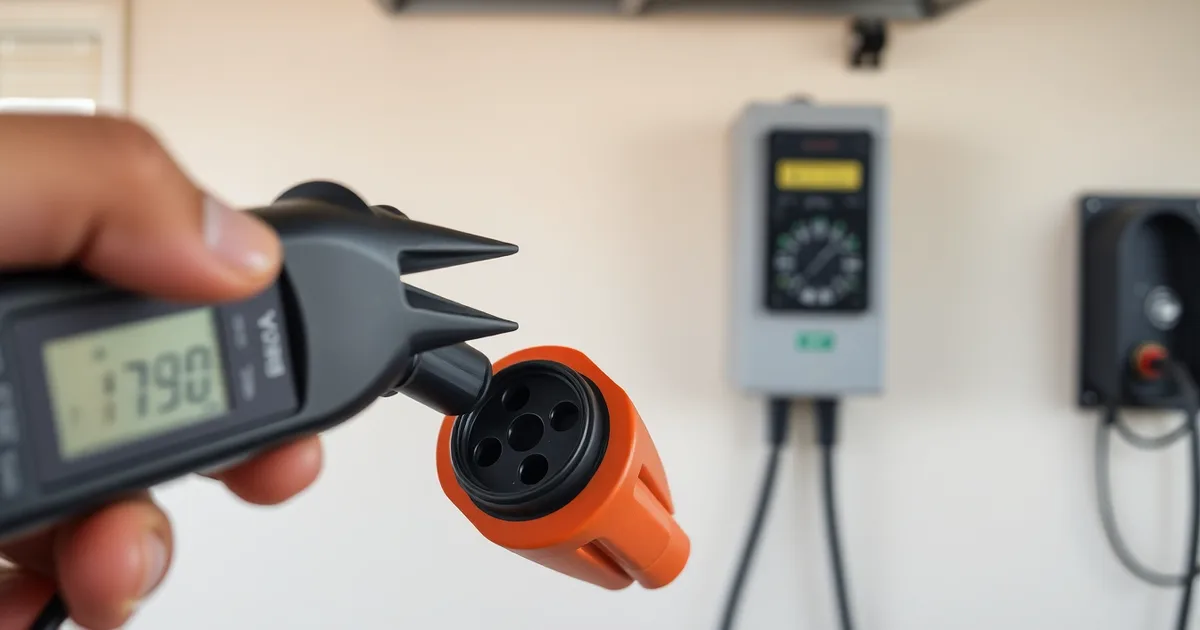
Before you spend anything on a repair, do the cheap test. Put a multimeter across the pilot and ground pins at the handle with the EVSE powered and the car unplugged. You should read 12 V ±0.5 V. Plug into the car and watch the voltage step down. If it never leaves 12 V, the connector isn't being detected and the problem is the handle or the car's inlet. If it steps to 9 V and stops, the fault is in the EVSE or its pilot circuit. If it reaches 6 V and then the click happens with no current, the EVSE thinks it succeeded — which points at the car's onboard charger. That sequence takes under five minutes with a $30 meter.
How to tell if the handle latch is the problem
This applies when your EVSE clicks once or repeatedly and no current flows, and you have already tried a second outlet or a different circuit. You need a digital multimeter with a continuity or resistance mode, a small flathead screwdriver, and a zip tie or a strip of electrical tape. Total time is under five minutes. The J1772 connector has five pins, and the one that matters here is pin 5, the proximity pilot.
- Unplug the handle from the car and look at the latch. The thumb release on the top of the J1772 handle should spring back fully when you let go. Press it down and release it three times. If it sticks, moves less than roughly 3 mm, or the plastic around the pivot is cracked, the latch is not holding the connector seated and the proximity pilot circuit is the likely culprit. Latch faults account for around 40% of clicking complaints in EVSE service data from 2024. Takes 20 seconds.
- Set the multimeter to continuity or resistance (the 200 ohm range is fine). Confirm the meter reads near 0 ohms when you touch the two probes together and shows open circuit when separated. A meter with a dying 9V battery will give you a false open and send you chasing the wrong fault.
- Identify pin 5. On a standard SAE J1772 handle, looking into the connector with the latch on top, pin 5 is the lower-right position on the car side of the socket. The pin layout is documented in the J1772 standard, and pin 5 sits next to the two larger power pins. If you are unsure, the pilot pin is the one that is visibly shorter and thinner than the power pins. Takes 30 seconds.
- Test continuity between pin 5 and the small switch inside the handle. With the latch released (not pressed), you should read open circuit or very high resistance above 1 megohm. Press the latch button and hold it: you should read a low resistance, typically under 100 ohms, because the latch closes a switch that ties the proximity pilot to ground through an internal resistor. If you get open circuit in both states, or low resistance in both states, the switch has failed. This is the step most people botch: they measure with the handle plugged into the car, where the vehicle's internal resistor loads the reading and makes a good switch look bad. Test the handle disconnected. Takes 90 seconds.
- If the switch checks out but the car still clicks and refuses to charge, the fault is probably upstream. Move to the control pilot pin (pin 4 on the same connector). With the EVSE powered and the handle not plugged in, you should see 12V ±0.5V on pin 4 relative to ground. If you see 9V, 6V or 3V with nothing connected, the EVSE thinks a vehicle is attached and the latch or connector body is the problem. If you see 0V, the EVSE has shut down and you are looking at a control board or ground fault issue, not a latch issue.
- Temporary fix to confirm the diagnosis: with the handle plugged into the car, wrap a zip tie or two turns of electrical tape around the handle and the charge port to hold the latch fully closed. If charging starts and holds, the latch is your fault. This is a test, not a repair. Do not leave it on overnight, and do not use it in rain, because a taped connection can defeat the strain relief and the connector's weather seal. Cost: under $1.
- Order a replacement handle if the zip tie test works. A new J1772 handle runs $50–$150 at 2025 prices, and most are field-replaceable with a screwdriver and a torx bit. Compare that to an onboard charger replacement at $1,500–$3,000 in parts and labor. If your unit is a ChargePoint Home Flex, JuiceBox, ClipperCreek or Siemens VersiCharge, check whether the manufacturer sells the handle separately before you buy a whole new EVSE.
- If the latch is fine, the proximity pilot switch is fine, and the control pilot still sits at 0V with a vehicle attached, run the EVSE's ground fault test. Press the TEST button on the unit. A functional GFCI trips at 5 mA ±1 mA per UL 2231 and resets cleanly. If it trips and will not reset, or trips without a button press, you have a ground fault, not a latch problem, and the clicking you hear is the contactor trying to close and immediately opening. Per SAE J1772 the contactor must de-energize within 100 ms of pilot loss, which is exactly the rapid click-click you are hearing.
The failure mode: people replace the entire EVSE or take the car to a dealer because the click sounds like a relay failure inside the unit. It usually is not. The click is the contactor doing its job and then losing the pilot signal a few milliseconds later. A $20 multimeter and the eight steps above separate a broken latch from a ground fault from a dead onboard charger in less time than it takes to drive to the dealer. Replace the latch, not the station.
Is the pilot signal or the onboard charger at fault?
The fastest way to separate an EVSE fault from a vehicle fault is to back-probe the control pilot pin at the J1772 handle while the connector is plugged into the car and the EVSE is powered. You are looking for a DC voltage between the pilot pin and ground. A healthy EVSE presents 12 V ±0.5 V with no vehicle attached; once the car is connected and closes its internal resistor network, that level drops to 9 V ±0.5 V, then 6 V ±0.5 V once the EVSE energises the contactor and offers current, then 3 V ±0.5 V when the car requests a charge. If your meter holds steady at 12 V with the car plugged in, the EVSE never saw the vehicle — that is a proximity or latch problem, not a charger problem. If the pilot drops correctly to 6 V or 3 V and the car still does not draw current, the fault has moved downstream to the onboard charger (OBC), the high-voltage interlock, or the pack itself.
Access is straightforward on most J1772 handles. Peel back the rubber boot at the base of the connector, or remove the two Torx screws holding the shell halves together, and you will expose the five conductors: L1, L2/N, ground, control pilot, and proximity pilot. The pilot pin is the one at the 12 o'clock position looking into the connector face; it is usually a 22 AWG wire with a distinct colour, often orange or white on ChargePoint Home Flex and ClipperCreek units, and grey on older Siemens VersiCharge hardware. Use a meter with fine needle probes rated for CAT III 600 V, set to DC volts, and clip the ground lead to the J1772 ground pin before inserting the probe. Do not unplug the connector while probing, and do not touch the L1 or L2 pins — the handle is carrying 240 V AC at up to 80 A on a hardwired circuit per NEC 625.42, though typical home units cap at 32 A (7.7 kW) or 48 A (11.5 kW). Keep one hand in your pocket, wear Class 0 gloves if you have them, and never probe a connector that is wet or sitting on a conductive surface.
| Pilot voltage (car plugged in) | What the EVSE is signalling | Most likely fault location | Next test |
|---|---|---|---|
| 12 V ±0.5 V, held steady | No vehicle detected; state A | J1772 handle latch or proximity pilot circuit — roughly 40% of clicking faults in 2024 EVSE service data | Physical latch check; swap handle ($50–$150, 2025 prices) |
| 0 V | EVSE sees a ground fault or internal failure and has locked out | EVSE ground fault circuit — UL 2231 personnel threshold trips at 5 mA ±1 mA | Press the TEST button on the EVSE; note whether it trips and resets |
| 9 V ±0.5 V, no drop to 6 V | Vehicle connected but EVSE will not offer current | EVSE internal contactor or pilot generator board | Confirm contactor de-energisation timing (<100 ms per SAE J1772); if it never pulls in, replace EVSE |
| 6 V ±0.5 V or 3 V ±0.5 V, car still not charging | EVSE offering current; vehicle not accepting it | Onboard charger, HV interlock, or battery management fault | Scan vehicle for OBC DTCs; expect $1,500–$3,000 repair (2025 prices, parts and labour) |
| Fluctuating between 9 V and 12 V | Intermittent pilot continuity | Broken wire in the J1772 cable or a cold solder joint in the handle | Flex the cable at both ends while watching the meter; replace handle if the reading moves |
| 3 V ±0.5 V with current flowing (measure AC amps on L1) | Normal charging state — C or D | No fault; clicking was likely the contactor closing once | None; confirm kWh accumulating in the app |
For most readers, the 12 V row is the answer: a stuck latch or a broken proximity loop accounts for the largest single share of these calls, and a replacement J1772 handle at $50–$150 is a 30-minute repair. The 0 V and 9 V rows point at the EVSE itself and are usually covered under a 3-year warranty on ChargePoint Home Flex and Tesla Wall Connector units, so check the serial number before buying anything. The case that flips the conclusion is the 6 V or 3 V row — if the pilot is healthy and the car still refuses current, you are almost certainly looking at an OBC failure, and no amount of EVSE swapping will help. That is the scenario where the $1,500–$3,000 bill is real, and it is also the one where the clicking you heard was the car's own contactor attempting to precharge into a faulted OBC and immediately dropping out.
Common causes of a ground fault trip in Level 2 chargers
A ground fault trip is a different failure from a pilot signal problem, and the click pattern gives it away. Where a latch fault clicks once and stays silent, a GFCI trip often clicks, waits a few seconds, then clicks again as the EVSE retries. Under UL 2231, the equipment must cut power when it senses a 5 mA (±1 mA) imbalance between hot and neutral. That threshold is deliberately low because the current is assumed to be passing through a person. Anything that leaks a few milliamps to earth will trip it, and the EVSE will keep retrying until you stop it.
- Moisture in the J1772 handle or the car's inlet. This is the single most common cause after a rainstorm or a car wash, and it is the easiest to rule out. Water bridging the pilot or ground pins creates a leakage path to earth that exceeds 5 mA almost immediately. Blow the handle out with compressed air, inspect the inlet for standing water behind the flap, and leave both to dry for an hour before retrying.
- A damaged charge cable. Look for cracks, pinch points, or chew marks along the full length, especially where the cable exits the EVSE enclosure and where it enters the handle. A cracked jacket lets moisture reach the conductors and produces an intermittent leak that only trips under vibration or when the cable hangs at a particular angle. Flex the cable by hand while watching the EVSE indicator; a trip that coincides with movement confirms the fault.
- Loose or corroded terminations inside the EVSE or the wall box. Heat cycling on a 32 A or 48 A circuit loosens screw terminals over a few years. A high-resistance joint bleeds current to the enclosure ground and trips the GFCI intermittently, usually after 20-40 minutes of charging when things warm up. Torque the line and ground lugs to the manufacturer's spec (typically 1.5-2.0 Nm for a 6 AWG terminal) and look for discoloured insulation.
- A shared neutral on the branch circuit. If the EVSE circuit shares a neutral with another load, return current from that load can flow through the EVSE's neutral path and register as an imbalance. This shows up as a trip that happens only when a specific appliance runs. It violates NEC 625.42 wiring requirements and needs a dedicated circuit, not a filter or a workaround.
- Poor or missing equipment ground. A high-resistance ground path means the EVSE's own leakage detection circuit has no stable reference, and small capacitive currents in the cable can push it over threshold. Check the ground electrode conductor at the panel and the bonding jumper inside the EVSE. A reading above 1 ohm from the EVSE ground pin to the panel ground bus is suspect.
- Internal EVSE component degradation. The GFCI sensing coil and its associated circuitry age. On older ChargePoint Home Flex and JuiceBox units, a failing sense board produces false trips with no external fault present. Press the TEST button: if it trips and resets cleanly, the GFCI is functional. If it will not reset, or trips with nothing plugged into the car, the unit itself is the problem.
- The car's onboard charger presenting a fault to ground. An OBC with internal isolation breakdown leaks DC onto the pilot and ground pins, which the EVSE reads as a ground fault. This is rare, and you should only suspect it after eliminating every item above. A clamp meter on the ground conductor during a charge attempt will show measurable current if the OBC is leaking.
The item people get wrong most often is the shared neutral, because it looks like a nuisance trip and gets treated as one. Owners add a ferrite bead, swap the breaker, or replace the EVSE, and the fault returns as soon as the other load runs. If your trips correlate with a dryer, a welder, or a subpanel load, stop replacing hardware and call an electrician to verify the circuit is dedicated. The second mistake is condemning the onboard charger first. At $1,500-$3,000 for a replacement OBC versus $50-$150 for a J1772 handle, that ordering is expensive when the handle latch or a wet inlet was the actual cause.
When the problem is the car, not the charger
If the pilot signal reads correctly at the J1772 handle (9V ±0.5V with the latch engaged, dropping to 6V when the car requests charge) but the contactor closes and no current flows, the fault is on the vehicle side. The diagnostic starting point is the car, not the wall box. Pull charging-related DTCs with an OBD-II scan tool: on a Chevy Bolt, look for P0D26 through P0D31; on a Nissan Leaf, B2820 through B2824. Generic readers often miss these because they live in the battery management or hybrid/EV control module, so a dealer-level tool or a Bluetooth dongle running an EV-specific app is usually required.
A failing onboard charger (OBC) behaves differently from a latch or pilot fault. You get no click at all from the EVSE, or you get one click and the charger immediately de-energizes. The contactor does its job, the handshake looks fine on paper, and the OBC simply never converts AC to DC. Common culprits are blown internal fuses or a failed diode bridge inside the OBC. Replacement runs $1,500–$3,000 in parts and labor at 2025 prices, which is why ruling out a software cause first matters. A car that charges fine on a 120V Level 1 cord but refuses a 240V Level 2 session is a strong OBC tell, since the two paths use different internal rectification stages.
Check the firmware before you buy parts
Software glitches that stall the handshake are more common than most owners expect, and they are cheap to rule out. Tesla pushed a Wall Connector firmware update in early 2024 that fixed a known bug where the unit would click and then drop the session due to a pilot timing mismatch with certain Model 3 and Model Y builds. ChargePoint released a Home Flex firmware revision in 2023 addressing a similar handshake timeout. For non-Tesla vehicles, check the automaker's service bulletins for your model year: several Hyundai and Kia E-GMP cars received OBC control module reflashes between 2022 and 2024 to correct intermittent charging aborts. If your EVSE vendor has an app, confirm the firmware version and update it before spending money on hardware.
A battery management system (BMS) error can also mimic a charger fault. If the BMS reads a cell voltage or temperature outside its safe window, it will refuse to accept current even though the pilot signal and OBC are healthy. You will hear the EVSE click, see the charge port light come on briefly, then watch it go dark. The car may display a generic "charging system fault" message with no further detail. In that case, the problem is inside the pack or its monitoring hardware, and no amount of EVSE troubleshooting will help. Clearing the DTC and retrying the session is worth one attempt; if the code returns immediately, stop and book a service appointment.
Can a firmware update fix a clicking charger?
Sometimes, yes — but only when the click is a repeated relay chatter rather than a clean single actuation. ChargePoint Home Flex units on firmware before 5.5.1.6 (the release that began rolling out in early 2023) logged a known fault where the EVSE would re-run its control pilot startup sequence every eight to twelve seconds, producing a rhythmic click pattern with no current delivered. JuiceBox 40 units sold between 2021 and 2022 shipped with an older Wi-Fi module firmware that could drop the openADR session mid-handshake, and the unit responds by cycling the contactor. Both cases look identical to a driver: click, pause, click, pause, no electrons.
The vehicle side has its own firmware. Tesla Wall Connector and the onboard charger (OBC) in the car negotiate over the same J1772 control pilot line, which per SAE J1772 must settle at 9V ±0.5V for "vehicle detected" and 6V ±0.5V for "ready to charge." If the OBC firmware hangs after a failed handshake, it may hold the pilot at 9V indefinitely, and the EVSE — designed to de-energize the contactor within 100 ms of pilot loss — will keep clicking through retry attempts. Tesla has issued OTA updates for Model 3 and Model Y that corrected pilot-state timing; other manufacturers have been slower to publish changelogs, so you often cannot tell whether your car has the fix.
Checking and applying updates without guesswork
For the EVSE, open the manufacturer's app and look for a version number, then compare it against the release notes page — ChargePoint, JuiceBox (now under Enel X Way in some markets), Siemens VersiCharge, and ClipperCreek each publish these. ClipperCreek units are largely non-networked and rarely receive updates, which is worth knowing before you spend an evening troubleshooting firmware on a 2018 unit that has none. If the app shows "up to date" and the clicking continues, the firmware is not your problem, and roughly 40% of clicking faults traced in 2024 EVSE service data came back to the handle latch instead — a $50 to $150 part, not a $1,500 to $3,000 onboard charger.
Contact the manufacturer when the click is reproducible across two different vehicles and the EVSE is under warranty, or when a firmware update fails to install and leaves the unit in a boot loop. When you call, have the control pilot voltage ready if you can measure it: a steady 12V at the handle with a car plugged in means the vehicle never pulled the pilot down, and that points upstream of the EVSE's software. A pilot that oscillates between 12V and 0V with no command from the app is a firmware or ground-fault issue the manufacturer needs to see.
What should a qualified electrician check?
Bringing in an electrician costs money, so the visit should start with the things a multimeter and a torque wrench can settle rather than a parts-cannon guess. The list below is roughly the order a competent EVSE tech works through on a 240 V hardwired or NEMA 14-50 install. Most of it is covered by the same NEC article that governs the original installation, Article 625.
- Voltage drop under load, not at rest. A circuit that reads 240 V open can sag hard once the contactor closes and 32 A or 48 A starts flowing. Anything more than about 3% drop (roughly 7 V on a 240 V circuit) points at undersized conductors. A genuine 48 A (11.5 kW) continuous load needs 6 AWG copper at minimum; a 32 A (7.7 kW) unit gets away with 8 AWG. Measure at the EVSE terminals while charging is attempted, not before.
- Torque every terminal connection to spec. NEC 110.14 requires terminations to be tightened to the lug manufacturer's listed value, and that number lives on the label inside the EVSE or on the breaker, not in your head. A loose line terminal on a 50 A breaker is a classic intermittent-fault source: it heats, resistance climbs, voltage collapses under load, and the EVSE drops the pilot. Re-torque to the printed value and re-check after a full charge cycle.
- Grounding electrode conductor and bonding. The equipment grounding conductor must land on a bonded terminal, and continuity from the EVSE enclosure back to the panel ground bus should read under 0.1 ohm. A floating or high-resistance ground is exactly what trips the EVSE's internal GFCI at 5 mA ±1 mA (UL 2231), producing the click-and-stop you already heard. Check bonding jumpers on any metal raceway too.
- The breaker itself. Confirm the breaker is the correct type and rating for the EVSE's continuous load, generally 125% of the charging current. A tired breaker can hold at 40 A and nuisance-trip the moment a real 32 A load appears. If in doubt, clamp the actual current on the hot leg and compare it to the nameplate.
- GFCI protection and its interaction with the EVSE. Since the 2017 NEC, many 240 V receptacle installs require GFCI protection upstream, and stacking an upstream GFCI with the EVSE's own ground-fault detection causes spurious trips on some units. The tech should confirm which device is tripping by watching both at once, using the EVSE TEST button to verify its own GFCI is functional.
- Pilot and proximity signal integrity at the handle. With the connector seated, the electrician should see 12 V ±0.5 V idle, dropping to 9 V, 6 V or 3 V as the vehicle requests current. A scope or a good meter catches a pilot that looks fine at rest but collapses under a 1 kHz PWM load. Also verify the proximity pilot, which tells the car the handle is latched.
- The J1772 handle and cable as a unit. If the latch is worn, the pilot contact can make and break as the handle shifts. A replacement handle runs $50–$150 in 2025 prices, and roughly 40% of clicking faults trace to the handle latch. Swapping the handle is cheap insurance before condemning a $1,500–$3,000 onboard charger.
The item electricians most often skip is torque verification, because it feels like a formality. It is not. A terminal tightened to 20 in-lb when the lug calls for 45 in-lb will pass a visual inspection, charge fine on a cool morning, and fail intermittently at 3 p.m. in July. Re-torque to the printed value, then measure voltage drop under load before declaring the circuit healthy. If everything on this list checks out and the pilot signal is still clean at the handle, the fault is almost certainly in the vehicle's onboard charger, and the EVSE has been doing its job correctly the whole time.
Frequently Asked Questions
Why does my EV charger clicking but not charge?
That click is the contactor inside the EVSE trying to close, and it keeps aborting because the control pilot handshake never completes. The usual culprits are a broken handle latch, a ground fault on the circuit, or an onboard charger fault that pulls the pilot below the 6V charging threshold. Check the latch first: it is the cheapest fix.
How do I test the control pilot signal on a J1772 charger?
Set your multimeter to DC volts and probe between pin 4 (control pilot) and pin 3 (ground) on the J1772 connector. You should read roughly +12V with nothing connected, 9V when the vehicle is plugged in but not requesting power, 6V when charging is authorised, and 0V during a fault. Anything outside those bands means the EVSE or onboard charger is failing.
Can a bad handle latch cause clicking?
Yes. The latch closes a proximity pilot circuit through pin 5, telling the EVSE the handle is physically seated. A snapped or worn latch leaves that circuit open, so the EVSE refuses to start and may click the contactor repeatedly as it retries. Test by pressing the handle firmly into the port while watching for the charge session to begin.
If it charges when you hold it, the latch or the port's retention clip is the fault. Handles are cheap; port assemblies are not, so diagnose before ordering parts.
Why does my EV charger click every few seconds?
Cyclic clicking almost always means the pilot signal is dropping in and out or the GFCI is tripping and resetting. Moisture in the handle, a nicked cable, or a failing 20mA ground-fault module are the three common causes. Unplug the vehicle and inspect the full cable run for cuts, then check whether the click continues with nothing plugged in.
Is it safe to use my EV charger if it clicks but doesn't charge?
No. Stop using it and isolate the circuit at the breaker. Repeated clicking points to a ground fault or a wiring defect that can expose you to mains voltage or start a fire in the wall box. A single click at the start of a session is normal contactor operation; clicking that repeats for minutes is not.
How much does it cost to replace a J1772 handle?
A replacement J1772 handle runs $50–$150 for the part as of 2025, depending on whether it is a bare connector or a moulded assembly with cable attached. If you hire an electrician, expect another $50–$100 in labour. Replacing the handle alone is a 30-minute job for anyone comfortable working de-energised.