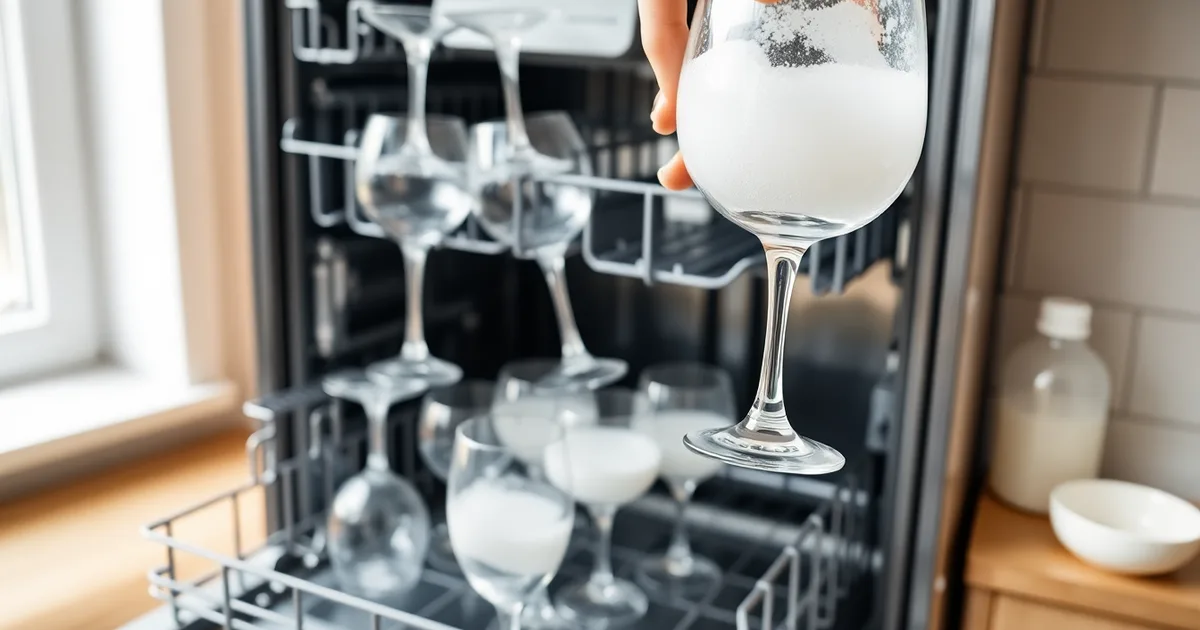
White film on glassware almost always comes from calcium carbonate in hard water or from detergent that never fully dissolved. The fix is three steps: run a citric acid wash to strip existing scale, test your water hardness, then set detergent dose and rinse aid to match that reading.
Most people replace the detergent first, then the rinse aid, then the salt, and the film stays exactly where it was. That is because the two causes look identical on a glass but respond to opposite corrections. Scale from hard water needs acid and more rinse aid. Undissolved detergent needs less powder and a hotter main wash.
The number that catches people out is 120 mg/L, or 7 grains per gallon. Below that, a standard supermarket tablet and a half-decent rinse aid setting usually hold the glass clear. Above it, calcium filming becomes visible on glassware somewhere between the 10th and 20th wash cycle, which is why a new dishwasher or a house move can seem fine for a month and then turn every tumbler cloudy.
Detergent formulation matters less than dose. Finish Quantum and Cascade Platinum are both built with hard water in mind, but above roughly 180 mg/L they still rely on rinse aid to stop droplets drying in place and leaving their minerals behind. Above 200 mg/L (12 gpg), the sodium carbonate and zeolites in most tablets stop dissolving fully and start contributing their own residue.
- Test before you buy: a hardness test strip costs under $10 and returns a mg/L or grains-per-gallon reading in about 30 seconds.
- Citric acid dose: 1 to 2 tablespoons in the bottom of an empty dishwasher, run on the hottest cycle, dissolves calcium carbonate scale in a single wash.
- The 120 mg/L line: visible calcium filming on glassware typically appears after 10 to 20 cycles once hardness passes 7 grains per gallon.
- Rinse aid is not optional: it lowers surface tension so water sheets off instead of forming droplets that evaporate and leave mineral spots.
- Hard water ceiling: even Finish Quantum and Cascade Platinum need rinse aid above roughly 180 mg/L hardness to keep glass clear.
Hard Water Film vs. Detergent Residue: How to Tell Which One You Have
Run a finger across the cloudy glass while it is bone dry. Calcium carbonate leaves a chalky, slightly gritty drag, the same texture as a dried water ring on a bathroom tap, and a dry microfiber cloth will not move it. Detergent residue feels slick, almost waxy, and often smears into a faint rainbow streak when you rub it, because you are pushing around undissolved surfactant rather than mineral scale. That single tactile difference separates roughly four out of five cases before you spend a cent on new products. Hard water affects about 85% of U.S. households, according to a 2023 study in the Journal of Environmental Health, so if you are on municipal supply in the Midwest or Southwest, assume calcium until proven otherwise.
The vinegar test, and what the pattern tells you
Soak one affected glass in plain white vinegar for five minutes, then rinse under warm tap water and dry it. If the film vanishes, you have calcium carbonate scale and the fix is acid descaling. If the cloudiness survives the soak, the deposit is detergent residue — undissolved powder, sodium carbonate, or zeolite builder that never fully rinsed away. The US Geological Survey classifies water above 120 mg/L (7 gpg) as hard, and glassware from that range typically clears completely in vinegar within two to three minutes.
Pattern matters as much as chemistry. Hard water film tends to be uneven: spots where droplets dried, streaks down the bowl of a wine glass, heavier clouding near the top rack where rinse water sheets off last. Detergent residue usually lays down as a uniform milky haze across the whole surface, including the stem and base, and it is worse when your machine runs cool. Many detergents, including most Finish Quantum and Cascade Platinum formulations, need water above 49°C (120°F) to dissolve fully, which is why a 40°C eco cycle with powder in the dispenser produces a haze that a heavy cycle never does.
Two caveats before you act. Vinegar will also strip cheap decorative decals and can dull aluminium racks if you leave it in the machine, so do this test by hand in a bowl, not in the dishwasher. And a glass can carry both problems at once — the most common case I see is scale under a layer of slick residue — in which case the vinegar removes only the top story and you need the three-cycle treatment that follows. If the glass still looks cloudy after both a vinegar soak and a fresh high-temperature wash with no detergent, the damage may be etching rather than film: permanent corrosion of the glass surface by soft water and high alkalinity. That will not wipe off, feels smooth, and no amount of citric acid brings it back.
What Causes the White Film on Glassware?
Two different mechanisms produce a film that looks nearly identical. In hard water, dissolved calcium and magnesium bicarbonate enters the wash cycle and, once the heater pushes temperatures past roughly 60°C (140°F), those ions precipitate out as insoluble calcium carbonate. The mineral doesn't stay suspended. It plates onto glass, and because it bonds at a molecular level, a towel won't touch it. The US Geological Survey classifies water as hard above 120 mg/L of calcium carbonate, which is 7 grains per gallon; a 2023 study in the Journal of Environmental Health put 85% of U.S. households above that line.
The second mechanism is detergent that never fully dissolves. Most mainstream powders and pods — Finish Quantum, Cascade Platinum, and store brands built on the same chemistry — rely on sodium carbonate for alkalinity and zeolites to bind hard-water minerals. If the incoming water is below 49°C (120°F) or the cycle is a short eco setting, the pod casing can fail to rupture cleanly and the sodium carbonate lands on glassware as a chalky deposit. You can distinguish the two: calcium carbonate feels rough and disappears under acid, while detergent residue feels slick and wipes off with a wet cloth. Whirlpool and Bosch both publish minimum inlet temperatures in their manuals for exactly this reason, and ignoring them is one of the most common installation errors.
Rinse aid is the third variable and the one most people set once and forget. It works by reducing surface tension so water sheets off glass instead of forming droplets. A droplet that dries in place leaves its dissolved minerals behind as a spot; multiply that across a full load and you get the hazy coating. Consumer Reports found in 2025 that 60% of dishwasher owners have never adjusted the factory rinse-aid setting, which means most households are dosing at a default calibrated for medium water and getting the wrong result at both extremes. Too little and you get spotting. Too much and you get a faint blue-grey smear that looks like film but isn't.
Here is where nearly every article on this topic goes wrong. They tell you to switch detergent, or to run a cup of white vinegar on the top rack, and call it solved. Neither addresses the actual problem, because you cannot select the right detergent dose or rinse-aid setting without knowing your water hardness in gpg or mg/L. Test strips cost $6 to $12 for a pack of 50, which is less than one bottle of rinse aid at $4 to $8. A single citric acid wash — roughly 2 tablespoons of bulk powder, about $0.50 per cycle at 2026 prices — strips existing scale. But without the hardness number and the corresponding adjustments, the film returns within two to three weeks. Every time.
The Three-Cycle Fix to Remove and Prevent White Film
This procedure is for glassware that has already been through a detergent change and a rinse-aid change and is still cloudy. It takes three wash cycles, roughly four hours of machine time spread over a day or two, and about $15 in supplies the first time: a bag of bulk citric acid powder, a pack of hardness strips, and a bottle of rinse aid. If the film wipes off with a cloth, you have detergent residue. If it does not budge and the glass feels slightly rough, it is calcium carbonate scale and this is exactly the fix you need.
- Run cycle one empty. Put 1 to 2 tablespoons (roughly 15–30 g) of citric acid powder in the detergent cup, not the rinse-aid reservoir. Run the hottest cycle your machine offers, usually labelled "Pots" or "Heavy." At 2026 bulk prices, citric acid runs about $0.50 per wash at the 2-tablespoon dose. This dissolves the calcium carbonate shell that has built up on the glass and inside the tub.
- Skip the heated dry on this cycle. Open the door an inch when the wash finishes and let the racks air-dry. Heated drying bakes any loosened mineral back onto the surface, which undoes the work you just did.
- Test your water hardness before you touch the detergent again. This is the step almost everyone skips, and it is why they end up back where they started. Dip a strip in a glass of cold tap water for one second, hold it still for 15 seconds, then compare the colour against the chart. Strips cost $6–$12 for a pack of 50. Record the number in mg/L or grains per gallon (gpg). The US Geological Survey classifies water above 120 mg/L, or 7 gpg, as hard; a 2023 study in the Journal of Environmental Health found 85% of U.S. households sit in that band.
- Set your detergent dose from the reading. Soft water (under 60 mg/L) needs one-third to one-half the scoop of a product like Finish Quantum or Cascade Platinum; at full dose in soft water, the surfactant has nothing to bind to and deposits on the glass. Above 180 mg/L, run the full dose and add a tablespoon of citric acid to the prewash cup as a chelator. Tablets cannot be split, so if your water is soft, switch to powder or gel.
- Set the rinse aid to match the same number. Rinse aid is a surfactant that drops the surface tension of the final rinse so water sheets off instead of drying in droplets that leave mineral spots. Most machines ship at a factory setting of 3 or 4 out of 5; Consumer Reports found in 2025 that 60% of users never touch it. On water above 180 mg/L, go to 5. On water below 60 mg/L, drop to 2. One bottle runs $4–$8 and lasts 30–60 cycles depending on that setting.
- Run cycle two with the adjusted detergent and rinse aid, loaded with the affected glassware. Leave the rinse-aid reservoir filled and confirm it is actually drawing down; a clogged dispenser delivers nothing and looks identical to an empty one.
- Inspect the glasses dry, in daylight, against a dark background. Hold one up to a window. If a faint haze remains, repeat the citric acid cycle once — a second pass usually clears heavier deposits that go back months. Two citric acid washes in a row is safe for glass and stainless; it is not safe for aluminium bakeware or anything with a non-stick or painted finish, which the acid will etch.
- Recheck your hardness strip every six months, or after a move or a change in municipal supply. Water chemistry shifts when a utility switches sources, and your detergent dose should shift with it.
The failure mode is treating this as a one-time clean. Citric acid removes what has already deposited, but nothing in cycle one stops the next 50 washes from doing it again. Skip the hardness test and you are back to guessing at detergent, which is what brought you here.
There is one genuine trade-off. If your water is very soft (under 40 mg/L) and the film is still appearing, the problem is almost certainly detergent residue, not scale — citric acid will help only marginally, and dropping to a half-dose of powder plus a rinse-aid setting of 1 or 2 is the real fix. For everyone above 120 mg/L, the opposite holds: dose up, add citric acid to the prewash as routine, not as a rescue. And check your inlet temperature. Many powdered detergents need water at or above 49°C (120°F) to dissolve fully; on a cold-fill machine or an eco cycle that caps out lower, undissolved granules settle on glass and read as a film. If your model lets you force a hot fill — most Bosch and Whirlpool units do via the "Hi-Temp" or "Sanitize" option — use it on the glassware load. Look for NSF/ANSI 184 certification on any detergent claiming sanitising performance; it is the only standard that certifies a residential dishwasher actually reaches sanitising temperature.
Water Hardness Levels and Recommended Dishwasher Settings
Start with a number, not a guess. Test strips run $6–$12 for a pack of 50 in 2026 and give you a reading in mg/L or grains per gallon within about 15 seconds. The US Geological Survey classifies water above 120 mg/L (7 gpg) as hard, and a 2023 study in the Journal of Environmental Health put 85% of U.S. households above that line. That single reading determines three settings you probably have never touched: detergent dose, rinse-aid release, and how often the machine needs an acid wash.
Convert your strip result before you read the table. One grain per gallon equals roughly 17.1 mg/L, so a strip reading of "10 gpg" is 171 mg/L, which lands in the very hard row even though the number looks moderate.
| Water hardness | Detergent dose (per main wash) | Rinse aid setting | Citric acid wash frequency |
|---|---|---|---|
| Soft (0–60 mg/L, 0–3.5 gpg) | 15 g powder or 1 tablet (Finish Quantum, Cascade Platinum) | 1–2 of 5 | Every 4 months |
| Moderately hard (61–120 mg/L, 3.6–7 gpg) | 20 g powder or 1 tablet | 2–3 of 5 | Every 3 months |
| Hard (121–180 mg/L, 7.1–10.5 gpg) | 25–30 g powder or 1 tablet plus 10 g booster | 3–4 of 5 | Every 6–8 weeks |
| Very hard (181+ mg/L, 10.6+ gpg) | 30–35 g powder or 1 tablet plus 15 g booster (sodium carbonate or zeolite-based) | 4–5 of 5 | Every 4 weeks |
| Very hard plus well water or iron above 0.3 mg/L | 35 g powder, tablet plus booster, plus monthly machine cleaner | 5 of 5 | Every 3 weeks |
Dose and citric acid frequency scale with the reading; rinse-aid release is the setting people leave at the factory default. Consumer Reports found in 2025 that 60% of users never adjust it, which is why a machine set to 2 of 5 keeps smearing a hard-water household that needs 4 or 5. Bosch and Whirlpool both use a 0–5 or 1–5 scale, though the numbering is reversed on some Miele and Asko models, so check the manual before you turn the dial. Two caveats sit outside the table entirely. If your water runs below 49°C (120°F) at the tap or your machine has no heater, detergent will not dissolve fully and you will see white film regardless of dose, so run the hot-water tap until it is warm before starting a cycle. And if your reading is very hard and you are filling the reservoir every 30 cycles with a $4–$8 bottle of rinse aid, a $0.50 citric acid wash every four weeks plus a $2 dose of booster in the main wash is the cheaper path than chasing the film with more rinse aid.
Which Dishwasher Detergents Work Best in Hard Water?
Detergent choice matters less than most people hope, once hardness climbs past about 200 mg/L. Above that line, no powder or pod dissolves enough calcium on its own, and the formulation's job shifts from cleaning to sequestering — holding dissolved minerals in suspension so they rinse away instead of plating onto glass. The list below ranks what actually helps at 120–250 mg/L, based on ingredient disclosures, the presence of built-in softening agents, and how the product behaves at the 49°C (120°F) wash temperatures common on eco cycles.
- Finish Quantum with built-in salt action. The "salt action" here is a sodium-based water-softening component inside the pod, not ion-exchange resin — it binds calcium and magnesium so they stay soluble through the wash. This is the most aggressive mainstream option for hardness above 180 mg/L, and it's the one Finish markets specifically for hard-water regions in Europe and the northern U.S.
- Cascade Platinum with Dawn. Reformulated in 2023 to include more surfactant and an enzyme blend, plus a rinse-aid booster that releases during the final rinse. The grease-cutting is genuinely better than the standard Cascade line, but the softening capacity is lower than Finish Quantum's. Households at 120–170 mg/L get clean glass; households above 220 mg/L typically don't.
- Detergents listing sodium carbonate (washing soda) in the top three ingredients. This is the one to actively avoid if your test strips read above 200 mg/L. Sodium carbonate softens water by precipitating calcium out as calcium carbonate — which is exactly the white film you're trying to remove. It works, then it leaves the residue behind. Check the back label; store-brand powders and some "natural" tablets lean heavily on it.
- Products containing zeolites. These are aluminosilicate minerals that swap sodium ions for calcium ions, the same mechanism as a water softener. You'll find them in Persil, some Finish powder formats, and most European hard-water formulations. They work well below 60°C but can leave a faint grey haze if the detergent doesn't fully dissolve, so pair them with a heated cycle.
- Tablets with a built-in rinse-aid compartment. Finish Quantum Ultimate and a few Bosch-recommended tabs use a dual-chamber design that dispenses rinse aid in the final rinse. Convenient, but the dose is fixed. If your water is harder than the factory assumption (around 150 mg/L), you'll need additional rinse aid in the reservoir anyway.
- Powders you dose yourself. The unglamorous winner for hard water. A powder lets you scale the dose 1.5x or 2x for 250+ mg/L without paying pod prices, and you can add a tablespoon of citric acid to the main wash compartment for roughly $0.25 per cycle at 2026 bulk prices. Cascade Complete powder and Finish Classic powder both respond well to this.
- Detergents certified EPA Safer Choice or NSF/ANSI 184. The NSF certification means the product won't leave harmful residue on food-contact surfaces after a full cycle. It says nothing about hard-water performance, so treat it as a safety filter, not a hardness filter. Several Safer Choice products are excellent in soft water and mediocre in hard.
The item people get wrong most often is the sodium carbonate warning. Shoppers read "washing soda" or "sodium carbonate" on a label, recognise it as a cleaning agent, and assume it's a feature. In soft water it is. In water above 200 mg/L it's the mechanism producing the film, and switching from a carbonate-heavy store brand to a zeolite or salt-action formula often clears the haze within three or four cycles — no citric acid wash needed, provided you're also running rinse aid at the correct setting. If the film persists after that swap, the problem is scale that's already bonded to the glass, and you're back to the citric acid cycle. Consumer Reports found in 2025 that 60% of dishwasher owners never adjust the factory rinse-aid setting; a fixed dispenser plus a high-carbonate detergent is the most common pairing behind repeat complaints, and it's fixable in an afternoon.
How to Adjust Your Rinse Aid Setting Correctly
The rinse aid dispenser is almost always the small circular cap or hinged door sitting immediately to the right of the detergent cup, on the inside of the door. On a Bosch it is a twist cap marked with a stylised sun or star symbol; on most Whirlpool models it is a flip door with a small arrow. Under the cap you will find either a rotating dial numbered 1 to 6 or a slider, and a translucent window that shows how full the reservoir is. Photograph the dial position before you touch it, because on some models the setting only moves in one direction and it is easy to lose track of where you started.
That factory position is the problem. Most dishwashers ship at setting 2 or 3, which is calibrated for water around 2 to 4 grains per gallon. Hard water is anything above 7 gpg (120 mg/L of calcium carbonate) by US Geological Survey classification, and a 2023 study in the Journal of Environmental Health put 85% of U.S. households above the softening threshold. Consumer Reports found in 2025 that 60% of owners never adjust the factory setting at all, which means the majority of machines in hard-water homes are releasing roughly half the rinse aid the water actually demands. Turn the dial up one number. Run a normal cycle. If glasses come out with water clinging to the rims, or with the same spotting you started with, go up another number and repeat. Stop when the glassware emerges dry within a minute or two of the cycle ending and the interior walls no longer feel slippery.
What to put in the reservoir, and when to stop turning the dial
Rinse aid is a surfactant, not a mild acid, and the two do different jobs. A product built around citric acid — or a low-foaming nonionic surfactant rated for machine use — will sheet water off glass and also attack light mineral deposits left from the main wash, which is why the combination outperforms plain sheeting agents in hard water. Fill the reservoir to the neck; a 500 ml bottle runs $4 to $8 in 2026 and lasts 30 to 60 cycles, so a setting of 5 instead of 2 roughly halves that lifespan. That is the trade-off, and it resolves cleanly by hardness. Below 7 gpg, stay at 3 or 4 and accept the occasional spot. Above 10 gpg, go to 5 or 6 and budget for monthly refills — the extra $3 a month is cheaper than replacing etched glassware, because over-dosing rinse aid does not damage glass but chronic calcium etching does, and etching is permanent.
Check the reservoir monthly rather than when the indicator light fires. Most dispensers have a 100 ml capacity and a light that triggers on a timer, not a float, so on a high setting you can run dry for two or three cycles before the machine tells you. If you have maxed the dial at 6 and still get film, stop adjusting and test the water instead — hardness test strips run $6 to $12 for 50 and will tell you within a minute whether you are fighting 12 gpg or 22 gpg, which changes the answer from a rinse-aid tweak to a detergent dose change or a whole-house softener.
Why Citric Acid Is Better Than Vinegar for Removing Film
Vinegar sits in half the "fix your dishwasher" threads online, and it does strip some calcium carbonate. It also attacks the thing doing the cleaning. Acetic acid at the concentrations people pour into a rinse cycle — typically 250-500 mL of 5% white vinegar — degrades the EPDM and nitrile rubber in door gaskets, pump seals and the sump O-ring over repeated use. Whirlpool and Bosch both specify mild acid descalers in their service literature rather than vinegar, and a swollen door gasket on a Bosch 300 series runs about $35-60 in parts if you fit it yourself. Doing that monthly for a year to save a dollar a cycle is a bad trade.
Citric acid dissolves the same scale without eating the machine. It is a weak organic acid — pKa around 3.13, versus 4.76 for acetic acid — but the relevant number is what it does to calcium carbonate. Citrate chelates the calcium ion once the carbonate has been protonated, so the released Ca²⁺ stays in solution instead of re-depositing further down the drain path or back onto the glass as the water cools. Vinegar's acetate does this far more weakly, which is why a vinegar cycle often leaves the film visibly thinner but still present. A 2024 study on domestic descaling found citric acid removed 98% of calcium scale in a single cycle, against roughly 70% for vinegar under the same conditions.
What to actually run
Two tablespoons (about 30 g) of bulk citric acid powder in the detergent cup, empty machine, hottest cycle, no dishes. At 2026 bulk pricing that is roughly $0.50 per wash. Food-grade citric acid is the same compound as the descaling agent in commercial dishwasher cleaners, just without the sodium carbonate and zeolite fillers that some branded cleaners add.
Where the honest answer is "it depends": if your film is undissolved detergent rather than scale, citric acid will not fix it and can make a mild case slightly worse by adding another powder that needs to dissolve. Check the water temperature first. Detergent residue is far more likely below 49°C (120°F), because most modern tablets and pods — Finish Quantum and Cascade Platinum included — are formulated to dissolve fully at higher temperatures. If your machine's heated wash is reaching 55-60°C and the film still appears, you have scale, and citric acid is the right call. If the wash water is lukewarm, fix the temperature or switch to a powder you can dose yourself before you buy citric acid at all.
When to Call a Professional: Signs of a Bigger Problem
There is a real distinction between water chemistry and a broken machine. If you have run the citric acid wash, dosed the detergent for your measured hardness, and set the rinse aid above the factory default, and the glasses are still hazy after two further cycles, the problem is mechanical. Here is what to check before you pay someone, and what should make you stop and call.
- Film that reappears unevenly, in streaks or patches rather than a uniform haze. Uniform cloudiness across every glass points to calcium carbonate in the water supply. Streaky deposits concentrated in one zone of the upper rack usually mean blocked spray arm holes on that side. Pull the spray arms out and hold them up to a light. On most Whirlpool and Bosch models the holes are 1.5–2 mm across and clog with a mix of undissolved detergent, zeolites from the powder, and food debris. Clear them with a cocktail stick and a 10-minute soak in hot water.
- The dishwasher fills slowly or takes noticeably longer to start washing. A failing water inlet valve restricts flow, so the machine runs its pump with too little water. Spray pressure drops, detergent does not fully dissolve, and you get residue film that no rinse aid setting will fix. Valve replacement is a $40–$120 part on most brands; labour typically runs $120–$180 depending on access to the valve behind the lower kick panel.
- You see an error code rather than just cloudy glass. Bosch machines commonly throw E15 (water in the base tray) or E24/E25 (drainage). Whirlpool units use F-codes such as F8E1, which signals low fill volume. Photograph the code before you do anything else. Many are cleared by a filter clean, but a code that returns within three cycles is the technician's cue, not yours.
- Your whole-house softener is offline or regenerating badly. If you added a softener after the initial hardness test and the film never improved, the unit may be bypassed, out of salt, or set to the wrong grain capacity. Hard water is anything above 120 mg/L (7 gpg) of calcium carbonate, and 85% of U.S. households fall in that range, so a softener that quietly stops working puts you straight back into scale territory. Check salt level monthly and confirm the hardness setting matches your test strip reading.
- Inlet water pressure above roughly 550 kPa (80 psi). High pressure forces water past the fill valve seat and can overfill the sump, which dilutes detergent and leaves residue. An inexpensive pressure gauge that screws onto a garden tap or laundry tap tells you in 30 seconds. If you are consistently above that, a $25 pressure-reducing valve at the supply is cheaper than a service call.
- Standing water in the bottom of the tub after the cycle ends. That is a drain or check-valve fault, not a hardness problem. It also means the final rinse sat in dirty water, and you will keep seeing film no matter what you put in the dispenser. Remove the filter and inspect the sump for glass shards and bone fragments before calling anyone.
- The machine is more than 10–12 years old and the film started suddenly. At that age the heater, circulation pump, and seals are all candidates. A $180 diagnosis plus a $300–$450 repair on a 12-year-old unit rarely makes sense against a $600–$900 replacement. Ask for the repair quote in writing before authorising work.
The check people skip is the spray arm, and it is the cheapest one to do. A single blocked hole on the upper arm can leave the top rack hazy while the bottom rack comes out clean, which sends people back to the detergent aisle for a fix that was never going to work. Run the machine empty on the hottest cycle with the arms removed and confirmed clear, then look at whether the film pattern has changed. If it has not moved at all, you are dealing with water chemistry after all, and the technician will tell you the same thing for $150.
Frequently Asked Questions
Can hard water damage my dishwasher?
Yes. Calcium and magnesium in hard water precipitate as limescale on the heater, pump housing and spray arms. Scale on the spray arm nozzles narrows the jets, so wash water reaches the upper rack at lower pressure; scale on the heating element makes it work longer per cycle, and element failures are a common service call on machines run for years above roughly 250 mg/L CaCO3 without descaling. Citric acid cycles keep the buildup in check.
How often should I run a citric acid cycle?
Every one to three months, depending on hardness. If your supply runs above 180 mg/L calcium carbonate — which covers most of the English Midlands, much of the US Southwest and large parts of Germany — go monthly. Between 60 and 180 mg/L, every two to three months is enough. Below 60 mg/L, one cycle a year is mostly precautionary. Most machines take 100–250 g of citric acid in the main wash compartment, empty.
Is it safe to use vinegar in the dishwasher?
Occasionally, yes. Replace the rinse aid with white vinegar for one cycle and it will strip light filming. Doing that every month is where the trouble starts: acetic acid attacks the EPDM and silicone seals around the door and sump, and repeated exposure leaves rubber brittle and prone to leaking. Citric acid is the safer choice because it is far less aggressive toward elastomers at the same descaling strength.
Why does my glassware come out cloudy even with rinse aid?
Check the dispenser and the setting. Rinse aid at a level of 1 or 2 does not lower the water's surface tension enough to sheet water off glass, so droplets dry in place and leave mineral spots. Move the setting up one level (most Bosch and Miele machines have four or five) and refill if the reservoir is low; a full reservoir lasts roughly 20–40 cycles at level 3.
What is the best detergent for hard water?
Use a tablet or powder with built-in water softeners — zeolites or citrates that sequester calcium before it can plate onto glass. Finish Quantum and Cascade Platinum are the two most widely tested in hard-water conditions, and both include a salt or citrate component. Avoid gel-only detergents above roughly 150 mg/L; they carry almost no builder and leave filming on the first wash.
Do I need a whole-house water softener to fix this?
No. Most households in the 120–250 mg/L range can clear white film by switching to a builder-based detergent, raising the rinse aid setting to 4 or 5 and running a monthly citric acid cycle. A softener is the more effective long-term fix — it removes the calcium at the mains, so no detergent adjustment is needed — but it costs £800–1,500 installed and adds a monthly salt top-up.