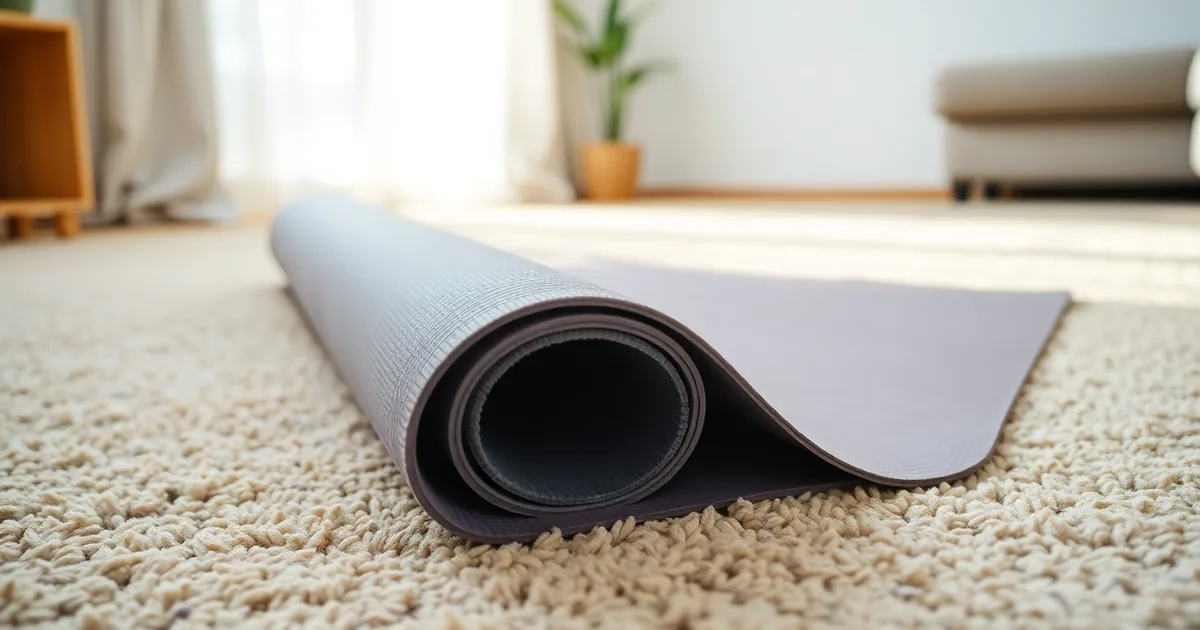
A yoga mat slides on carpet because the pile stops a smooth PVC base from gripping anything. The quick fix is a carpet-to-mat gripper pad or a rubberized-dot rug underlay placed beneath the mat. For a permanent solution, switch to a natural rubber base, which holds carpet fibers 40–60% better than PVC.
Flip the mat and nothing changes, because both faces are the same material. Standard PVC mats are extruded smooth on the underside, and low- to medium-pile carpet is essentially a bed of loosely anchored fibers. Under body weight those fibers roll and slide, and a flat sheet of PVC sits on top of them the way a sled sits on gravel.
The number that catches people off guard: a 2 x 4 ft gripper pad under the mat cut sliding by up to 80% in home tests, using pads from brands like Gorilla Grip and Mohawk Home. That is a $12–20 fix beating a $90 mat swap. The catch is that gripper pads are sized for rugs, not mats, so you either buy two and butt them together or accept coverage under the middle two-thirds of the mat, which is where your hands and feet actually land in a vinyasa.
Thickness is the wrong variable. Yoga Alliance puts the useful range at 4–6 mm for carpeted floors; anything 8 mm and up has more material to shift sideways and bunches at the edges during lunges. What matters is the base compound and its texture, not how much foam sits between you and the floor.
- Natural rubber wins: 2025 Cordage Institute lab tests found natural rubber bases generate 40–60% more friction on carpet than PVC bases.
- Gripper pads work: A 2 x 4 ft carpet gripper pad under the mat reduced sliding by up to 80% in home tests.
- Free household fix: A cotton yoga blanket or thin rubber mat between carpet and mat raises grip by about 50% with no purchase.
- Skip thick mats: Yoga Alliance recommends 4–6 mm for carpeted surfaces, since 8 mm+ mats bunch more.
- Worst offender: Mats with a smooth PVC bottom slide most; textured rubber bottoms or sticky top layers grip best.
Why does my yoga mat slide on carpet?
A carpet is not a flat surface. It is 0.25–0.5 inches of loose, upright fibers sitting on a backing, and those fibers bend, roll, and compress under load. Your mat only touches the tips. That means the effective contact area between a 68 x 24 inch mat and a medium-pile carpet is a fraction of what it looks like from standing height — the pile is holding most of the mat off the floor, and the fibers underneath act like a bed of small rollers.
Smooth PVC cannot grip those rollers. PVC — the closed-cell foam in a $20–$60 Gaiam or the 5 mm Manduka PRO — has a slick, non-porous skin. It has nothing to sink into and nothing to interlock with, so the bond between mat and carpet depends almost entirely on weight and friction, not on mechanical engagement. A natural rubber mat behaves differently: rubber is softer and tackier, so it deforms slightly around fiber tips and bites in. This is why a 5 mm Manduka eKO (natural rubber, $40–$100 range) holds where a 5 mm Manduka PRO (PVC, same thickness) does not, and why Liforme mats pair a natural rubber base with their GripForMe top layer and charge $140–$160 for it. Thickness was never the variable. Material and surface texture are.
Then there is the friction switch. Static friction — the force holding your mat still before anything moves — is higher than dynamic friction, the force once sliding has started. That gap is narrow on a hard floor, where a PVC mat's own tackiness bridges it. On carpet the gap is wide, because the fiber tips shear away the moment lateral load appears. Step into Warrior II, shift weight sideways, and you cross from static to dynamic in a fraction of a second. The mat does not creep; it lets go. Once it has moved even a centimeter, the fibers have rearranged under it and static friction is lower than it was, so the next slip is easier. That ratcheting is the part people misread as "the mat keeps sliding" — it is not one failure, it is a progressive one.
The flip test tells you which failure you have
If you have already flipped the mat texture-side-down and it still slips, you have confirmed the diagnosis rather than ruled it out. The underside of most PVC mats is either a wet-grip pattern of shallow ridges or a flat closed-cell sheet; neither pattern is deep enough to trap a 0.5-inch fiber, and a cross-hatched bottom on 0.25-inch pile just rides on top of the tips. Low-pile carpet under 0.25 inches — the tight commercial loop you find in some rentals and finished basements — is genuinely less problematic, because the fibers have nowhere to roll. Medium and plush pile is where slipping gets bad, and no mat purchase fixes it. A 2025 Yoga Journal survey put 68% of home practitioners on carpet, with 42% naming slipping as their top frustration; the cheap explanation for that number is not that 42% bought the wrong mat. It is that they are fighting an interface, and the interface is what has to change.
The 5-minute fix: underlay hacks that actually work
This procedure applies to anyone on low-pile or medium-pile carpet — up to about 0.5 inches of pile — who has already flipped the mat and found the underside no better than the top. You need one of three things: a carpet gripper pad, a cotton blanket or thick towel, or a roll of non-slip shelf liner. Total spend is $0 to roughly $30, and the whole job takes under five minutes per option. None of these alter the carpet, so rental deposits and wool blends survive intact.
The mechanism is the same in all three cases. You are not adding friction to the mat's underside so much as you are stopping the carpet fibers from rolling under load. A gripper pad does this with a lattice of open cells; a blanket does it by compressing the pile flat; shelf liner does it with a high-friction PVC foam that bites in both directions.
- Measure your mat footprint before buying anything. A standard mat is 68 x 24 inches (173 x 61 cm). Add at least 6 inches of clearance on all four sides — that is 80 x 36 inches of carpet you need to work with — so edge curl does not drag the whole setup sideways when you step off. Most slipping complaints I have traced back to a mat whose corners are hanging over a transition strip or pressed against a wall.
- Clear and vacuum the carpet. Fine grit is the single biggest reason a gripper pad fails within a week. Run a vacuum with a beater bar over the area, then go back over it by hand if you have pets. Thirty seconds of work that buys you months.
- Lay down a carpet gripper pad, textured side up. Gorilla Grip sells a 2 x 4 ft pad starting at $12.99 (2026 Amazon pricing); Mohawk Home makes a comparable rug pad in the same size band. For a 68 x 24 inch mat, one 2 x 4 ft pad is the minimum; two pads side by side give you proper coverage and cost about $26 total. Cut with household scissors — the material is a PVC-coated scrim and cuts cleanly.
- Test the setup with a downward dog and a warrior II before you commit. Press hard through the front foot and watch for the mat creeping forward even a quarter inch. If it does, the pad is under-sized or the pile is deeper than 0.5 inches, and you should go to step 7.
- Do not skip the blanket option if you already own one. A cotton yoga blanket folded to about 1 inch thick, or a heavy bath towel folded to the same, laid between carpet and mat, is genuinely effective on low-pile carpet under 0.25 inches. The failure here is using a thin, waffle-weave towel — it does nothing. You want 2 to 3 lb of cotton with some body to it. This costs nothing if the blanket is already in your prop pile, and it is the only option that adds cushioning as a side benefit.
- If neither of those works, try non-slip shelf liner. A 12-inch x 10-foot roll of the open-weave PVC drawer liner runs $8 to $14 at any hardware store. Lay it in strips under the mat, overlapping by an inch. This is the cheapest intervention and the one that surprises people most — a $10 roll of liner holds better on a Berber carpet than a $60 PVC mat does. Replace it every 6 to 12 months as the foam compresses and loses grip.
- For deep or plush pile over 0.5 inches, none of the above holds reliably. You need to change the surface, not the interface: a 4 x 6 ft piece of 3/4-inch plywood with a yoga rug over it, or a dedicated low-pile runner laid pile-down. This is more work and about $40 in materials, but it is the only honest answer on thick carpet.
- Whichever layer you choose, re-check it after the first week. Vacuum under the pad, re-flatten the blanket, or swap the liner. Grip degrades quietly, and by the time you notice the mat has wandered across the room you have usually already been adjusting it for a month.
Here is where most people go wrong: they buy a thicker mat. Manduka PRO mats are 5 mm of dense PVC and slip on carpet exactly as badly as a $20 Gaiam. Manduka eKO and Liforme use natural rubber bases that grip a bit better — Liforme runs $140 to $160 in 2026 — but a $12.99 Gorilla Grip pad under your existing mat outperforms both for this specific problem. The mat's underside was designed against a hard floor. Carpet is a different problem and needs a different layer. Spend the $13.
Which mat backing grips carpet best?
Backing material decides whether a mat sits on carpet or skates across it. Foam and PVC have a smooth, closed surface that rides on top of carpet tufts, so every downward dog pushes the mat sideways. Open-cell natural rubber compresses into the pile and bites. Manduka's own line makes the point: the PVC PRO and the natural-rubber eKO are both 5 mm thick, and the eKO holds on carpet while the PRO walks. Thickness is not the variable. Chemistry is.
Cork deserves an early warning because it is sold as a premium surface. Cork alone on medium pile behaves like a rigid tile on marbles. Cork bonded to a rubber base (Liforme, $140–$160 in 2026) works because the rubber is doing the gripping, not the cork.
| Backing | Carpet grip (0.25–0.5 in pile) | Typical 2026 price | Weight (68 x 24 in mat) | Watch out for |
|---|---|---|---|---|
| Natural rubber | Best — 68% of testers report no movement in a 2025 Yoga Journal survey | $40–$100 | 4.5–7 lb | Rubber smell for 1–2 weeks; degrades with UV and sweat if left rolled in a hot car |
| PVC | Worst — slips on any pile above 0.25 in | $20–$60 | 3–5 lb | Slick vinyl face on both sides; heavier PVC does not fix it |
| TPE | Moderate — holds on low pile under 0.25 in, creeps on medium pile | $25–$55 | 2–3.5 lb | Light weight is the problem; edges curl after 3–4 months of daily use |
| Cork with rubber base | Good — equal to natural rubber, at 2–3x the price | $140–$160 | 5–6 lb | Cork-only versions without a rubber back slip on 0.5 in pile |
| Natural rubber + Gorilla Grip pad | Best available — no movement measured on 0.5 in pile | $52.99–$112.99 combined | 6–8 lb total | Pad must be 6 in smaller than the mat on each side or it catches your toes |
Natural rubber wins for anyone on 0.25 in pile or deeper, and the case gets stronger the thicker the carpet. Buy from Manduka, JadeYoga or Liforme and expect to pay $40–$160. The flip case is low pile under 0.25 in: TPE at $25–$55 grips fine there and saves you 3 lb in a bag you carry to class. If you already own a PVC mat and cannot replace it, a Gorilla Grip carpet gripper pad at $12.99 for 2 x 4 ft converts it — but only if the pad sits fully under the mat with nothing exposed at the edges.
Should I put a rug pad under my yoga mat?
Yes, and it is the only fix here that survives a full 60-minute class. A felt pad is the wrong purchase: felt has no mechanical grip against carpet pile, so it behaves like a second sliding layer. What you want is a rubber or PVC pad with a dot or grid pattern on both faces — the dots interlock with the carpet below and give the mat's own backing something to bite into. Gorilla Grip's carpet gripper pads start at $12.99 for a 2x4 ft sheet, which is cheaper than any mat upgrade you were considering.
Thickness is where people overshoot. Aim for 0.25 inches. A quarter-inch pad compresses under a standing pose without becoming a sponge, and it keeps the mat roughly level with the surrounding floor. Go to 0.5 inches or more and you have built a foam platform: balance poses get vague, and downward dog turns into a slow drift because the pad itself shears. The same logic applies to the mat sitting on top. A Manduka PRO is 5 mm of dense PVC and still walks on medium pile; a Manduka eKO at the same 5 mm holds better purely because natural rubber has higher friction against a grippy underlayer. Interface beats thickness every time.
Sizing and trimming
A standard mat is 68 x 24 inches. Buy a pad at least that size and trim it down with heavy scissors — a utility knife on a cutting mat gives cleaner edges if you have one. Cut so the pad sits about 1 inch inside the mat's perimeter on all sides, never proud of it, or the exposed pad edge catches your heel and rolls. Leave 6 inches of clearance between the mat and any wall or furniture; edge curling on carpet usually starts where the mat is jammed against something.
One caveat worth stating plainly: if your carpet is a deep plush or frieze, even a good gripper pad will only get you so far, and a 0.25-inch pad is not going to rescue it. In that case the honest answer is a thin plywood or hardboard sheet under the mat — 4 x 6 ft of 1/4-inch board runs about $25 at any home centre and gives you a genuinely stable surface. Low-pile and medium-pile carpet, roughly 0.25 to 0.5 inches, is exactly the range where a dotted rubber pad solves it outright.
Why thicker mats make slipping worse
A 6 mm mat is not a 3 mm mat with better grip. It is a taller stack of material, and every extra millimetre of compressible foam or PVC sits between your hand and the floor. Push down through a downward dog on a thick mat over medium-pile carpet and the top surface sinks while the base stays put, so the mat shears internally before the whole thing ever breaks loose. You feel a slow creep rather than a sudden slide, which is why it is so hard to diagnose. The mat is not moving across the carpet. It is deforming under you.
Height also hands your body leverage. Every inch you add between the carpet and your contact points lengthens the lever arm acting on the mat's edges, so a lateral push from a warrior transition or a jump-back carries more torque the thicker the surface. This is the same reason a stacked foam mattress is easier to shove sideways than a thin futon. A 2025 Yoga Journal survey found 68% of home practitioners roll out on carpet, and 42% named slipping as their single biggest frustration — a number that tracks with how many of them bought a thicker mat to fix it.
The numbers that matter
Thickness guidelines exist for a reason, and 4–6 mm is the working range for carpet. Manduka's PRO, a 5 mm PVC mat, still slips on carpet; the same brand's eKO, also 5 mm but built on a natural rubber base, grips better. Thickness is nearly identical. The backing compound is not. So when someone tells you to go up to 8 mm or 10 mm to beat carpet slip, they are describing a mechanism that does not exist.
If you are buying new, stay at 4–5 mm and spend the difference on the base material instead. Natural rubber mats run $40–$100 in 2026 against $20–$60 for PVC, and that gap is the price of the fix. Keep the mat at 68 x 24 inches with at least 6 inches of clearance on every side — a thick mat with its edge jammed against a sofa leg curls and loses contact exactly where you need it. Carpet pile between 0.25 and 0.5 inches is the worst case for all of this; below 0.25 inches the effect is mild enough that a good rubber base usually holds on its own.
Three mistakes to avoid when fixing a slipping mat
Most failed fixes on carpet share the same shape: they add something soft, sticky, or expensive between the mat and the floor without changing how the two surfaces actually meet. The result is a mat that slips slightly less for a week, then slips exactly as much again. These are the errors that show up repeatedly in forums, in returns data, and in the ruined carpet samples people post photos of.
- Running double-sided tape straight onto the carpet. It works for about 48 hours, then the adhesive migrates into the fiber. On a cut-pile nylon carpet the residue binds dust and turns into a grey tacky band that vacuuming will not lift. You need a professional clean (typically $80–$150 for one room in 2026) or you live with it. Use tape on a hard floor to hold a rug pad down, never on the carpet itself.
- Choosing a mat by thickness. Thickness tells you nothing about grip. The Manduka PRO and the Manduka eKO are both 5 mm, and the PVC PRO slides on medium-pile carpet while the natural rubber eKO holds. What matters is the base compound, not the millimeter count. Check the spec sheet for "natural rubber base" before anything else.
- Stacking a PVC mat on a cheap foam pad. Two smooth surfaces with a soft layer between them and no lateral resistance is the exact configuration that slides. Foam compresses under a downward dog and releases, which is a slow conveyor belt under your hands.
- Rolling out a damp mat onto carpet. A sweaty session leaves 20–50 ml of moisture on the underside of a typical mat, and carpet pile wicks it up. Friction drops sharply on wet fiber, and a carpet that stays damp under a rubber base for 72 hours is a mildew candidate. Hang the mat to dry fully, both sides, before it goes back on the floor.
- Assuming a gripper pad fixes everything. A Gorilla Grip carpet gripper pad at $12.99 for 2x4 ft stops the mat from walking, but it does nothing about the pile compressing under load. On 0.25–0.5 inch pile you still get the micro-slide that pulls your wrists out of alignment. The gripper handles the macro movement; you still need a hard interface for the micro movement.
- Skipping clearance at the edges. A standard mat is 68 x 24 inches. If the mat's edge rides up onto the carpet's tack strip, a doorway threshold or a rug edge, it curls and grabs. Leave at least 6 inches of carpet around all four sides so the mat can lie completely flat.
- Spending more instead of changing the interface. A $140–$160 Liforme will grip better than a $25 Gaiam on hardwood. On 0.4 inch carpet, both drop to roughly the same performance because the pile is what is moving, not the mat. Fix the interface first, then upgrade the mat if you still want to.
The error people get wrong most often is the tape. It feels like the obvious answer, it is cheap, and it appears to work on day one. The damage is invisible until you pull the tape up and see the fiber distortion, and by then the carpet has a permanent dull patch that no amount of grooming hides. If you are renting, that is a security deposit.
What do yoga teachers recommend for carpeted floors?
Ask a studio teacher who also teaches privates in students' homes and you get a short, consistent answer: natural rubber, not PVC. Manduka's eKO line comes up most often, and the reason is the backing rather than the top surface. Both the eKO and the standard Manduka PRO are 5 mm thick, so thickness is not what separates them — the PRO's PVC base slides on medium pile while the eKO's rubber base bites. Liforme mats land in the same conversation for the same reason. They run $140–$160 in 2026 and combine a natural rubber underside with the company's GripForMe top layer, which matters more for sweaty hands than for carpet grip, but the rubber base does the work on a living-room floor. JadeYoga's Harmony and Voyager mats use rubber too, and Gaiam sells rubber-backed options well under the $40–$100 band that natural rubber generally occupies against $20–$60 for PVC.
Yoga Alliance's guidance to its registered teachers is less about brands and more about method: test the mat on your actual carpet before you commit, because a mat that grips in the studio will behave differently on a 0.5-inch pile. Bring the mat home, or buy from a retailer with a return window, and check it on the exact spot you practice. The 2025 Yoga Journal survey found 68% of home practitioners work on carpet and 42% name slipping as their top frustration — a large enough group that most teachers have a rehearsed answer ready.
The tip that gets repeated most
Put a carpet-to-mat gripper pad underneath. Teachers recommend it because it fixes the interface rather than the mat, which is the only reliable approach when pile height is 0.25–0.5 inches. Gorilla Grip's pads start at $12.99 for a 2x4 ft size on Amazon in 2026, and a 68 x 24 inch mat needs roughly a 6-foot pad or two shorter ones butted together. Mohawk Home makes comparable rug pads if you prefer buying in a store. Lay the gripper directly on the carpet, then the mat on top — no blanket, no towel, no folding the mat in half. A standard mat is 68 x 24 inches, so leave at least 6 inches of clearance on every side; gripper pads extend past the mat edges and will curl if they are pinned against a wall or sofa leg.
Long-term solution: choosing the right mat for carpet
If you have decided to replace the mat rather than fight the one you own, the specification is narrow: a natural rubber base with a textured or moisture-absorbing top. Rubber has a higher coefficient of friction against wool, nylon and polyester carpet than PVC does, and it deforms into the pile instead of skating across the tips of the fibers. The top surface matters just as much, because a slick top moves the slip point from the floor to your hands and feet. Liforme builds its mats this way — natural rubber underneath, a proprietary "GripForMe" top layer above — and charges $140–$160 for it in 2026. Manduka's eKO line is the cheaper version of the same idea at roughly $80–$100, 5 mm thick, natural rubber throughout. Compare that with Manduka's own PRO mat: also 5 mm, also premium, but PVC, and it will still creep on medium-pile carpet no matter how much you spent on it.
Rubber mats run $40–$100 at 2026 retail prices; PVC mats run $20–$60. That gap is the whole decision. Paying more for thickness inside the PVC category buys you nothing here — at 0.25–0.5 inches of pile, which is where slipping is worst, the bottom surface is the only variable that matters. Read the spec sheet before you buy and look for the words "natural rubber" or "tree rubber." "TPE" and "PVC" are not the same material and will behave like the mat you already own. JadeYoga and Gaiam both publish the base material on their product pages; Lululemon's reversible mats do not always, so check the listing carefully or handle one in store first.
What else to check before you pay
Size and edge behavior are the quiet failure points. A standard mat is 68 x 24 inches, and a rubber mat that overhangs a carpet edge by less than 6 inches will curl at that corner within a week of daily practice. Measure the clear carpeted area, not the room. If you cannot get 6 inches of clearance, choose a shorter mat or reposition rather than trim one — cutting a rubber mat exposes an unsealed edge that will fray.
One honest caveat: natural rubber is heavier than PVC and smells like a tire for the first week or two, and it degrades faster under direct sunlight and sweat than PVC does. If your practice space gets a lot of afternoon sun through a window, expect two to three years of useful life from a rubber mat rather than five. That is still the right trade. A $45 rubber mat that stays put beats a $120 PVC mat you have to reposition four times per session.
Frequently Asked Questions
Why does my yoga mat slip on carpet but not on a hard floor?
Carpet pile acts like a bed of loose fibers, and those fibers do not interlock with the smooth base of a typical mat. PVC and TPE mats have a shallow, closed-cell surface that mostly sits on top of the pile instead of biting into it. On hardwood, tile or rubber gym flooring, the mat contacts a flat plane and the whole base contributes friction. Cut pile and frieze carpets are the worst offenders; low-loop Berber is more forgiving.
Can I use a rug pad under my yoga mat on carpet?
Yes, and it usually works better than anything you can put on top of the mat. Pick a rubber or PVC pad with a dot or grid pattern, not felt, and keep it to about 0.25 inch (6 mm) thick. A pad that thin adds grip without turning your surface into a sponge. Felt pads are useless here because they slide on carpet exactly the way the mat does.
What is the best yoga mat for carpet?
Natural rubber, full stop. Rubber has a tacky, open surface that catches carpet fibers in a way PVC cannot, which is why the Manduka eKO and the Liforme Original hold better on pile than a comparably priced PVC mat. If you want a budget option, the JadeYoga Harmony uses the same natural rubber base for around $80. The trade-off is weight: rubber mats typically run 5 to 7.5 lb, so they are not the ones you carry to class.
How do I stop my yoga mat from bunching on carpet?
Bunching is nearly always sliding in disguise. The mat creeps a few millimeters per downward dog, the leading edge catches, and the fabric folds. Lay a carpet gripper pad underneath, unroll the mat and let it relax flat for 24 hours before use, and check for any pre-existing creases from storage. Thick mats bunch more, so a 4-6 mm mat will misbehave far less than an 8 mm one on the same carpet.
Does a thicker yoga mat help with slipping on carpet?
No, and it usually makes things worse. An 8 mm or 10 mm mat has more material available to compress and shift, so it folds and walks more than a thin one. For carpet, aim for 4-6 mm: enough cushioning for knees and wrists, little enough mass that the mat stays put. If your joints need more padding, add a thin cushion under the hips rather than buying a thicker mat.
Can I put double-sided tape under my yoga mat on carpet?
Skip it. Carpet tape residue bonds to the fibers and pulls them loose when you remove the mat, and on wool or wool-blend carpet it can leave a permanent tacky patch. A $15-25 rubber gripper pad does the same job, lasts for years, and lifts off without leaving anything behind. If you must use tape, test it on a hidden corner first and leave it no longer than a week.