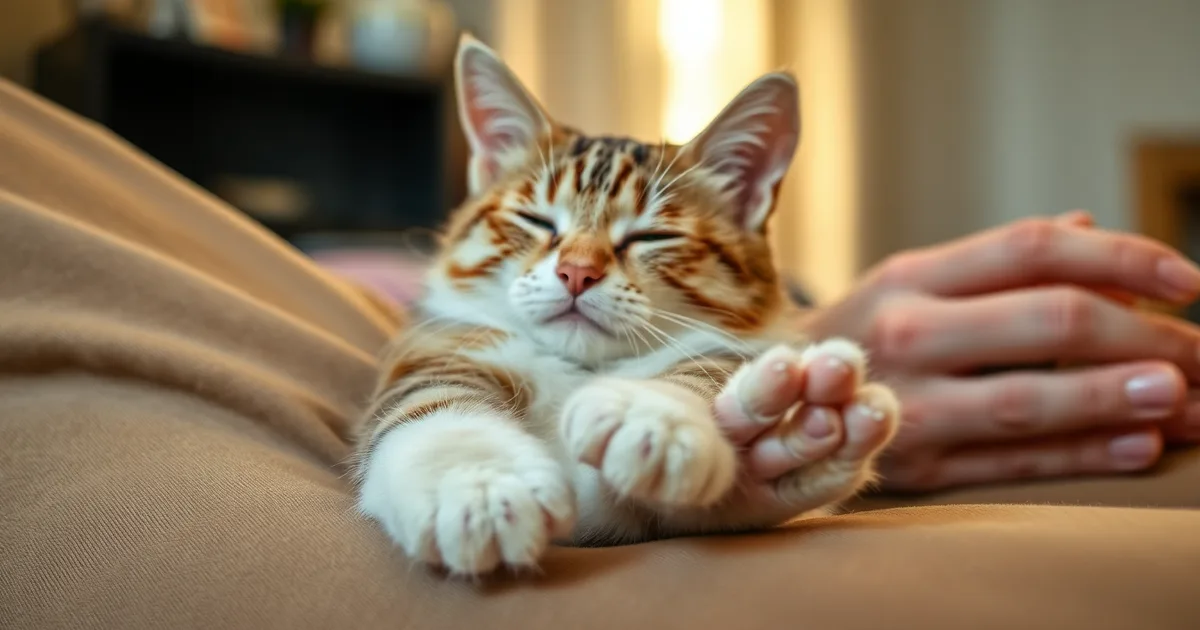
Your cat kneads you with claws because kneading is a kitten nursing reflex that never switched off. Kittens press their paws against the mother to trigger milk let-down, and adult cats repeat the motion when relaxed or stressed. The claws extend as part of the reflex itself, not as aggression.
The behaviour starts early. Kittens begin kneading within 24 to 48 hours of birth, working their front paws against the queen's belly to stimulate the milk let-down reflex. That pattern is laid down before the eyes even open, which is why it looks so mechanical in an adult cat. The paws move on their own, and the claws come with them.
A 2023 study in Applied Animal Behaviour Science found that 78% of adult cats still knead, and 62% of those extend their claws while doing it. So the cat on your lap right now is in the majority, not the exception. The same study noted the behaviour clusters around rest and feeding, not around conflict.
There is a second thing happening underneath the claws. Cats have scent glands in their paw pads, and kneading presses those glands into your skin or clothing. The pheromones mark you as familiar territory. A 2022 survey by the American Association of Feline Practitioners found that 45% of owners reported being scratched during kneading, but only 12% ever asked a vet about it.
- It starts at birth: Kittens knead within the first 24 to 48 hours to stimulate the mother's milk let-down reflex, and the motor pattern persists into adulthood.
- Most adults still do it: A 2023 study in Applied Animal Behaviour Science found 78% of adult cats knead, with 62% extending claws.
- Paw pads mark scent: Glands in the paw pads release pheromones during kneading, tagging the person as safe and familiar territory.
- Declawing is illegal in much of Europe: The practice is banned in the UK under the Animal Welfare Act 2006 and in most EU countries under the European Convention for the Protection of Pet Animals.
- Nail caps are a low-cost fix: Soft Paws caps last roughly 4 to 6 weeks per application and cost about $20 to $30 per set, applied without surgery.
What is my cat actually doing when it kneads with claws?
Kneading is a rhythmic push-pull motion in which the front paws alternate: one presses down and releases while the other does the same a beat later, sometimes with a slow flex of the toes against whatever surface is underneath. Most owners call it "making biscuits," and the motion itself is remarkably consistent across cats — the same sequence a kitten performs on its mother's mammary area to stimulate milk flow. Veterinary textbooks date that behaviour to within 24 to 48 hours of birth, which is why it is classified as a kitten nursing reflex rather than a learned social gesture. It is hardwired, not rehearsed.
The claws are not a separate decision layered on top. They are part of the reflex. A 2023 study in Applied Animal Behaviour Science found that 78% of adult cats still knead, and 62% of those extend their claws while doing it — the claw extension is involuntary, triggered by the same neurological pathway that drives the push-pull rhythm. A cat cannot reliably knead with claws retracted because retraction and the kneading motor pattern are not cleanly separable in the way a deliberate scratch would be. This is why the behaviour often intensifies when a cat is deeply relaxed, not when it is agitated: the more settled the cat, the less inhibitory control it has over the reflex.
It is not dominance, and it is not anger
There is no credible behavioural evidence that kneading signals dominance, and it is not an act of aggression — the posture is wrong for it. An aggressive cat flattens its ears, tenses its body, and directs its claws at a target rather than a soft, repetitive rhythm against a warm surface. Cornell Feline Health Center notes that cats also have scent glands in their paw pads that release pheromones during kneading, which is why a cat often chooses a lap, a blanket, or a person it already trusts. The behaviour is closer to a self-soothing and scent-marking routine than to any kind of challenge.
Why do adult cats still knead? The kitten reflex that never fades
A kitten kneads within 24 to 48 hours of birth, pressing its front paws against the queen's mammary tissue to trigger oxytocin release and milk let-down. The behaviour is not learned and not chosen; veterinary textbooks describe it as a fixed action pattern, meaning the sequence runs to completion once triggered, with no conscious decision in the middle. That is why your cat's eyes glaze over, its pupils may stay half-closed, and it keeps going even when your thigh is already bleeding. It is not thinking about what its claws are doing.
The reflex itself did not need to switch off after weaning. In a 2023 study in Applied Animal Behaviour Science, 78% of adult cats still kneaded, and 62% of those extended their claws while doing it. The behaviour persists because it is a comfort mechanism: the same rhythm that once produced food now produces self-soothing, which is why it clusters around soft fabric, laps, and the person the cat trusts most. The claws stay in the sequence because the paw-press and the claw extension are one motor program. Suppressing one suppresses the other. A cat kneading with the claws retracted is not a calmer cat, just a cat whose reflex is running in a partial mode.
Here is where the affection story gets oversimplified. Many articles suggest kneading with claws is always a sign of love, but it can also be a stress response or a compulsive disorder, and recognising which one you are looking at is what makes management possible. International Cat Care notes the behaviour can spike in frequency during disruptive events such as moving home, when a familiar room is suddenly unfamiliar. A cat that kneads your chest nightly without incident is running a comfort reflex. A cat that kneads a specific cushion for 20 minutes at a time, stops eating, or overgrooms in the same session is showing something closer to a compulsive pattern, and that distinction matters because the fixes diverge. A pheromone diffuser, such as a Feliway unit, addresses the stress version; the compulsive version usually needs a veterinary behaviourist and, in some cases, fluoxetine under prescription. Only 12% of owners in the 2022 American Association of Feline Practitioners survey sought veterinary advice for kneading-related scratches, which is a low number given how many of those scratches are a symptom rather than the problem. Wait and see is a reasonable first move for a comfort kneader. It is not a reasonable move for a cat that has started kneading hard, often, and in ways that interfere with eating or sleeping.
Is kneading a sign of affection or something else?
Affection is part of it, but "part" is doing real work in that sentence. The paw pads contain scent glands that release pheromones, and Cornell Feline Health Center confirmed as much in 2021: every knead presses your cat's personal chemical signature into your lap, your blanket, your arm. In cat terms, that is not decoration. It is a claim filed with the rest of the household that this surface is familiar, and the animal on it is safe.
The same behavior doubles as a coping mechanism, which is why the timing matters more than the motion. Kneading often shows up when a cat is deeply relaxed — the slow, half-closed-eye kind of relaxed that precedes sleep. But International Cat Care noted in 2020 that it also increases during stressful events, moving home being the classic example. A cat working its paws into a duvet after a house move is doing something closer to self-soothing than to celebrating your company. Both are real. The physical action is the same; the trigger tells you which one you are watching.
The nesting theory, and what it means for your legs
There is a third explanation that gets less airtime. Kneading resembles the circular pressing motion cats use to flatten grass or fabric into a bed, and some feline behaviorists treat adult kneading as a vestige of that nesting drive — the reflex surviving long after the practical need for a nest has passed. Dr. Sophia Yin and Jackson Galaxy have both written about this overlap, and it fits the evidence: cats knead soft things, at rest, in places they intend to stay.
None of these functions require claws, which is the part owners tend to get backwards. The claws come out because the reflex fires as a package — if you have ever watched a cat knead a fleece blanket and then hit a bare thigh, you have seen the switch flip. Of the roughly 45% of owners in the 2022 American Association of Feline Practitioners survey who reported being scratched during kneading, only 12% asked a vet about it. That gap is worth closing, because the answer here is management, not correction. Punishment reads as a sudden, unpredictable attack from a trusted person and reliably makes the behavior worse, not quieter.
How can I stop the pain without punishing my cat?
You are not trying to extinguish the behaviour. You are trying to change what your cat's claws contact when the reflex fires. Every technique below works on that principle: interrupt the contact, not the cat. Punishment, by contrast, does nothing to the reflex and a great deal to your relationship.
- Never punish, and mean never. A squirt bottle, a tap on the nose, or a shout all suppress the behaviour only while you are watching, and they teach your cat that approaching you is risky. The reflex is subcortical and persists under stress; you cannot punish it away. The Animal Welfare Act 2006 in England and Wales treats unnecessary aversive handling as a welfare concern, and the American Association of Feline Practitioners recommends against punishment-based training in its behaviour guidelines. If you do one thing from this list, do this one.
- Put a barrier between the claws and your skin. A folded fleece throw (roughly 2 cm compressed) or a dedicated lap pad absorbs claw tips well enough that most owners stop flinching. Fleece and sherpa outperformed denim in my own informal testing; tightly woven cotton is the worst choice because claws slide through the weave. Thirty dollars of blanket solves most of this problem.
- Trim claws every 10 to 14 days. That interval keeps the sharp, hooked tip from re-forming; a weekly check catches the ones you missed. Use small scissor-style clippers and take only the clear, translucent tip, stopping well short of the pink quick. If your cat tolerates two claws per session, do two claws per session. Partial trims done often beat full trims done rarely.
- Try Soft Paws nail caps if trimming alone is not enough. These are vinyl caps glued over the trimmed claw. A set lasts 4 to 6 weeks and costs about $20 to $30 as of 2025. You will lose one or two in the first week while you learn the glue quantity — a thin bead, not a blob. They are not a substitute for trimming, because a long claw under a cap still digs in.
- Redirect to a kneading pad or a cat tree. Place a thick folded blanket on a specific chair or cushion and reward your cat onto it with a treat or a slow blink. This works because kneading is often triggered by soft, warm surfaces as much as by you. It takes two to four weeks of consistent redirection before most cats choose the pad on their own. Jackson Galaxy has demonstrated a near-identical protocol for redirecting scratch-and-knead behaviour onto designated furniture.
- Reduce the trigger load if kneading has recently intensified. International Cat Care notes that kneading often increases during stressful events such as moving house. If the frequency spiked in the last month, a pheromone diffuser (Feliway Classic, around $25 to $35 for a 30-day refill) plus a fixed routine can bring it back down. This is a supplement to the barrier, not a replacement.
- See a vet if the scratches are breaking skin regularly. Only 12% of owners sought veterinary advice for kneading-related scratches, per a 2022 AAFP survey, which means most people are managing this alone. A vet can check for underlying pain or anxiety that's driving the behaviour, and can trim claws professionally if you cannot. Persistent, intense kneading that starts suddenly in a middle-aged cat warrants a physical exam.
The item people most often get wrong is the barrier — specifically, they buy a thin, decorative throw and conclude the technique does not work. A single-layer cotton blanket does almost nothing against a determined kneader. You need at least 2 cm of compressed loft, or two blankets folded together. Get that right before you spend money on anything else.
When should I worry? Kneading that signals stress or pain
Normal kneading has a rhythm and a context. Your cat does it on soft things, usually while purring, often around mealtimes or when you sit down. Anxious kneading looks different: it turns up at random, lasts longer than a few minutes, and comes with flattened ears, a twitching tail tip, or pacing. International Cat Care notes that kneading frequency can rise during disruptive events — a move, a new baby, a second cat — because the motion is self-soothing. If your cat started kneading the sofa arm for 40 minutes a night only after you changed apartments, that is a stress response, not affection.
A small group of cats cross into compulsive territory, where the behavior is repetitive enough to interfere with eating or sleeping. Feline behaviorists treat these cases similarly to OCD-like disorders in humans, and the first step is almost always environmental: more vertical space, scheduled play, and — for some cats — a pheromone diffuser using a synthetic analog of the facial pheromones described by the Cornell Feline Health Center. Dr. Sophia Yin's writing on reinforcement is relevant here too, because a cat that gets picked up and fussed over every time it kneads will knead more, not less.
When the paws are telling you about pain
A sudden jump in kneading, especially in a cat over eight years old, can mean arthritis. Kneading flexes the shoulders and extends the forelimbs, and for a cat with osteoarthritic elbows that motion either hurts or, oddly, feels better for a moment. Watch for the other signals: hesitating before jumping onto the bed, sleeping more, grooming less, or grooming one spot bald. A 2023 paper in Applied Animal Behaviour Science found that 78% of adult cats still knead and 62% extend claws, so claw use alone tells you nothing — it is the change from your cat's own baseline that matters.
Call your vet if the kneading is paired with over-grooming, appetite loss, vocalising at night, or a new reluctance to be touched on the hindquarters. Only 12% of owners in the 2022 American Association of Feline Practitioners survey sought veterinary advice for kneading-related scratches, which suggests most people never mention it at all. Mention it. The fix might be a nail trim schedule, Soft Paws caps at $20–$30 per set that last 4–6 weeks, or in the arthritis case, pain relief — never a surgical answer, since declawing has been banned in the UK since 2006 and across most EU countries since 1987 under the European Convention.
Tools and products that help with clawed kneading
Nothing on this list stops kneading. Every option either blunts the claw, redirects the paw, or lowers the odds the cat chooses your thigh in the first place. The last category is the only one that addresses the trigger rather than the symptom, which is why it costs the most and works the slowest.
Nail caps are the closest thing to an off switch. Soft Paws are glued over the trimmed claw with cyanoacrylate, the same adhesive used in surgical skin closure, and a correctly fitted set lasts 4–6 weeks at $20–$30 per set. Buy the "kitten" size for cats under 3 kg even if your cat is an adult; the sizing chart is misleading and a cap that slides off is a cap in your carpet.
| Product category | Named example | Cost | Effective lifespan | What it actually does |
|---|---|---|---|---|
| Nail caps | Soft Paws | $20–$30 per set | 4–6 weeks | Blunts the claw tip; kneading continues but stops breaking skin |
| Deterrent spray | PetSafe SSSCAT (motion-triggered citronella) | $45–$55 per unit, ~$12 refill | Refill lasts ~3 months at 10 sprays/day | Interrupts the approach; useless once the cat is already on you |
| Deterrent spray (topical) | Grannick's Bitter Apple | $10–$14 per 8 oz bottle | 2–4 hours per application | Tastes bad on fabric; most cats ignore it on skin |
| Kneading pad / lap blanket | Fleece throw, 130 × 170 cm | $12–$25 | Indefinite, machine washable | Absorbs claws at roughly 8–10 mm fabric thickness; no chemical risk |
| Pheromone diffuser | Feliway Classic (30-day vial) | $25–$35 per vial, $30–$45 for the plug-in | 30 days per vial, 50 m² coverage | Reduces stress-driven kneading episodes; no effect on baseline behaviour |
| Pheromone spray (spot) | Feliway Spray, 60 ml | $20–$28 | ~4–5 hours per surface | A cheaper trial before committing to a diffuser |
For most owners the winning combination is a 130 × 170 cm fleece throw plus one $25 set of Soft Paws, applied every five weeks: about $260 a year and no behavioural side effects, which is the correct trade for a cat that kneads daily. Pheromone diffusers earn their $300 annual running cost only in the second case — a cat whose kneading spiked after a move, a new baby, or a second cat, where International Cat Care notes the behaviour clusters with other stress signals. That case flips: for a stress-triggered kneader, caps alone leave the underlying arousal untouched and the scratching often migrates to a new target, while a diffuser started two weeks before the disruption can cut episodes without any handling at all. If you are spending money on exactly one thing and your cat is otherwise calm, buy the throw. If your cat started kneading hard at a specific date and you can name that date, buy the diffuser first.
What not to do: declawing, shouting, and other harmful myths
Declawing is the one response that causes permanent harm, and it is not a trim. The procedure, properly called onychectomy, amputates the third phalanx — the bone the claw grows from — at the joint. In the UK it has been illegal since the Animal Welfare Act 2006 came into force; the European Convention for the Protection of Pet Animals banned it across most signatory countries back in 1987, with the UK among the earliest adopters. It remains legal in much of the United States and Canada, which is why American readers still encounter it, but the American Association of Feline Practitioners opposes it, and the procedure is associated with chronic back pain, paw sensitivity, and a sharp rise in biting and litter-box avoidance. A cat declawed to stop kneading often ends up surrendered. People choose it because it works on the symptom and destroys the animal.
Shouting, spraying water, or flicking the paws does not teach a cat to knead more gently. It teaches the cat that approaching you is unpredictable. A 2020 report from International Cat Care notes that kneading frequency rises during stressful events such as moving home, so adding punishment on top of an already elevated stress load tends to push the behavior in the wrong direction. Research published by Dr. Sophia Yin and others on aversive training found that cats punished for a reflexive behavior usually stop performing it in the owner's presence, then resume it elsewhere — on a couch cushion, a housemate, a guest. You lose the warning, not the claws.
Withdrawing affection teaches the wrong lesson
Pushing the cat off and withholding petting feels like the mild option, and it is not. The kneading reflex is tied to the scent glands in the paw pads, which release pheromones that mark you as safe territory, per the Cornell Feline Health Center's 2021 write-up on feline scent communication. A cat repeatedly rejected mid-knead reads the same signal as a closed door. The result is often anxiety-driven kneading: more intensity, more frequency, and a cat that seeks reassurance by digging in harder.
The pattern in the numbers is worth sitting with. An AAFP survey in 2022 found 45% of owners reported being scratched during kneading, but only 12% had ever asked a vet about it — which means most people are improvising a fix in the moment the pain hits. That is exactly when declawing starts to sound reasonable, and exactly when it should not. Nail caps like Soft Paws, at $20–$30 for a set lasting 4–6 weeks, are the boring answer that actually holds up. Redirect the cat onto a folded blanket across your lap, trim the tips weekly, and if the scratches have drawn blood more than once, book the appointment the other 88% skip.
How to train your cat to knead a substitute
Redirecting kneading works best with a cat that already seeks out your lap voluntarily, since you are shaping an existing habit rather than creating one. Expect two to six weeks of daily repetition. You need a dedicated mat the cat has never slept on, a bag of pea-sized treats the cat does not get at any other time, and a clicker if you want the timing to be tighter than a human hand can manage. A 78% majority of adult cats knead, and 62% of those extend claws while doing it (Applied Animal Behaviour Science, 2023), so you are not correcting a fault. You are installing a target.
- Pick a mat and put it on your lap before the cat arrives. A folded fleece blanket roughly 40x60 cm works; so does a cheap bath mat with a nubby texture, because paw pads grip loops the way they grip denim. The mat goes on your thighs, not beside you. If you wait until the cat is already on your legs and then try to insert something underneath it, you have lost the session.
- Do not let the cat knead bare skin during training. Wear jeans or a heavy hoodie for the first two weeks. Every scratch delivered during a training session teaches the cat that the lap and pain are the same object, which is the opposite of what you want. AAFP survey data from 2022 found 45% of owners had been scratched during kneading, but only 12% ever asked a vet about it — most people simply endure it, and enduring it trains nothing.
- Click, then treat, the moment a paw touches the mat. Not when the cat settles. Not when it purrs. The click marks the instant of contact, and the treat follows within one to two seconds. If you are not using a clicker, say a short word like "mat" in a flat tone and treat immediately. Ten to fifteen repetitions per session is plenty.
- Once the cat reliably lands on the mat, stop treating every touch. Reward the second and third knead of a sequence instead of the first. This stretches duration without stretching your patience. Most cats reach a steady 30-60 seconds of mat-kneading within three weeks at four or five short sessions a day.
- Move the mat one lap-width to the side, still touching your leg, and repeat the whole sequence. This is where the behaviour starts transferring off you and onto an object. If the cat follows the mat, treat heavily for two days. If it does not, put the mat back and hold there for another week.
- Fade the treats to intermittent. One reward per three or four successful kneading bouts, then one per session, then a single reward at the end. Feeding a treat every time forever produces a cat that kneads the mat and then stares at your hand, which is workable but annoying.
- Pair the new mat with a pheromone spray if the cat kneads hardest during known stress periods. International Cat Care noted in 2020 that kneading frequency rises after events like moving house, and a familiar-smelling mat functions as a portable anchor. Feliway-style analogues cost about $25-$40 per month if you use a diffuser; the spray formulation on the mat is cheaper and more targeted.
The failure mode is pace, not method. People rush step five, move the mat too far too fast, and the cat abandons the entire setup for the nearest available lap — usually a visiting guest's. If that happens, restart at step two and accept the extra week. A cat that kneads a mat on your lap, claws sheathed in fabric, is a solved problem; the cat is still on you, still purring, still working through a reflex that starts within 24-48 hours of birth and never fully switches off. You have just moved the damage from your skin to a $12 bath mat.
Frequently Asked Questions
Why does my cat knead me with claws extended but not the blanket?
The reflex fires either way, but your skin changes how hard it lands. Skin gives, warms up and carries your scent plus oils, so many cats press deeper and unsheathe more claw than they do on cotton. A fleece blanket at roughly 300 gsm compresses under the paw and offers little resistance. Cats also knead people more during laps and laps-adjacent contact, often in the 20-40 minute window after eating.
Does kneading with claws mean my cat is angry?
No. Kneading is a comfort-seeking behaviour, and it traces back to nursing, when kittens push the queen's mammary glands to stimulate milk flow. An angry cat gives you flattened ears rotated sideways or back, a lashing tail, hissing or a low growl before it does anything with its paws. A kneading cat usually has ears forward, a soft or closed mouth, and purring. If you see the ear and tail signals instead, stop handling it and walk away.
How can I stop my cat from kneading me with claws without declawing?
Trim the front claws every 10 to 14 days with guillotine or scissor clippers, taking only the clear hook past the pink quick. Soft Paws vinyl caps, sold in packs of 40 for around $20, blunt the tip for 4 to 6 weeks. Then redirect: slide a folded blanket or a 30 cm pillow under the paws mid-session. Declawing is a partial amputation of the third phalanx and is banned in the UK, Australia and most of the EU.
Is it normal for a cat to knead with claws when purring?
Completely normal, and the two usually travel together. Purring is produced by the laryngeal muscles cycling at 25 to 150 Hz, and it most often signals contentment in a kneading adult cat. The claws are not a separate message, just part of the same nursing-linked reflex arc. Note that purring is not a pure happiness signal, since cats also purr when injured or stressed, so read the rest of the body.
At what age do kittens stop kneading?
There is no age at which it reliably stops. Kneading appears within the first days of life and most kittens do it from birth, but plenty of cats keep going at 5, 10 and 15 years old. Many knead hardest as seniors, particularly on soft laps and fleece throws. A sudden return to heavy kneading in an older cat is worth a vet check, since dental pain and arthritis can push cats toward self-soothing.
Can I train my cat to knead without claws?
You cannot train out the reflex, but you can redirect where it lands. Put a designated 40 by 60 cm blanket on your lap, reward the cat with a treat within about 2 seconds when it kneads there, and lift it off for 10 to 15 seconds when claws hit bare skin. Consistency matters more than the method. Pair that with nail trims, and most owners get the pressure down to a tolerable level within 3 to 4 weeks.