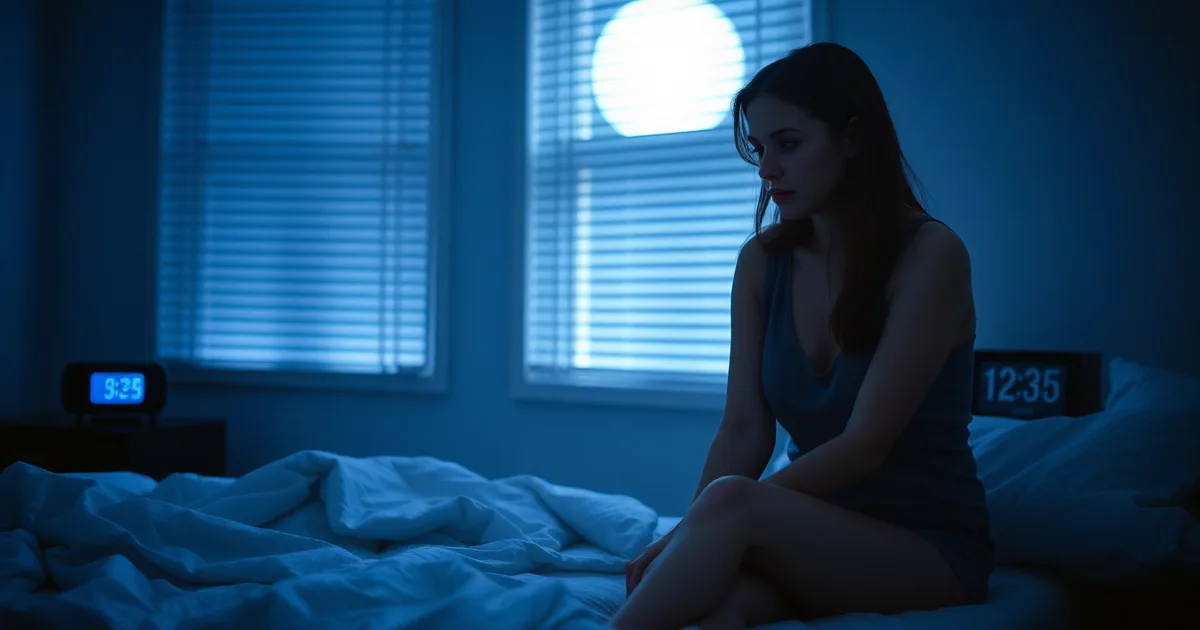
Waking at 3 a.m. is usually your brain surfacing out of deep sleep as cortisol starts its natural climb, sometimes sharpened by a blood-sugar dip or an undetected apnea event. Fix the two triggers almost nobody checks: alcohol timing and sleep apnea screening. Most cases resolve once you do.
The pattern is not random. Cortisol begins rising around 2–3 a.m. and climbs 50–100% above midnight levels by the time you wake, which means 3 a.m. sits right at the point where your sleep architecture is already thin and easy to break. Add a drink at 9 p.m. and you have handed the arousal system a second reason to fire.
A 2023 study in Sleep found that drinking alcohol within three hours of bedtime raises nighttime awakenings by 20–30%. The sedative effect wears off mid-cycle, right when the cortisol curve is turning upward. It is the single most common self-inflicted cause, and it hides behind the belief that a nightcap helps you fall asleep.
Apnea is the one people miss for years. It affects 1 in 4 adults, and roughly 80% of cases are undiagnosed, according to the American Academy of Sleep Medicine. The 3 a.m. wake-up is often the brain jolting you out of an airway obstruction you never remember.
- Cortisol timing: Cortisol starts rising at 2–3 a.m. and peaks at 6–8 a.m., a 50–100% increase over midnight levels.
- Alcohol window: Drinking within 3 hours of bedtime increases nighttime awakenings by 20–30%, per a 2023 Sleep study.
- Blood sugar: Nocturnal glucose below 70 mg/dL triggers adrenaline release, fragmenting sleep in the second half of the night.
- Apnea prevalence: Sleep apnea affects 1 in 4 adults, with about 80% of cases undiagnosed (American Academy of Sleep Medicine, 2023).
- Light penalty: Melatonin drops sharply after 2 a.m., and light exposure at 3 a.m. can suppress it by 50% within 30 minutes.
What is actually happening in your body at 3 a.m.?
Sleep is not one continuous state. It cycles roughly every 90 minutes through light sleep, deep slow-wave sleep, and REM, and a full night contains four to five of those cycles. Deep sleep clusters in the first half of the night; the back half is dominated by lighter stages and REM. Around 3 a.m., if you went to bed near 11 p.m., you are landing in one of those lighter transitions — a window where a noise, a temperature shift, or a full bladder is enough to pull you to the surface. Waking briefly at these boundaries is normal. Remembering it, and failing to fall back asleep, is not.
Two hormonal curves explain why that particular hour is so load-bearing. Cortisol is not a stress hormone in the way the internet presents it; it follows a daily rhythm set by the hypothalamic-pituitary-adrenal (HPA) axis. Levels climb 50–100% between midnight and 6 a.m. as part of the cortisol awakening response, with the steepest rise starting around 2–3 a.m. and the peak landing at 6–8 a.m. That rise is meant to prepare you for waking. It also raises arousal. In the same window, melatonin — the signal that holds sleep pressure high — begins falling after roughly 2 a.m. So at 3 a.m. you have rising cortisol, falling melatonin, and shallow sleep. Three separate systems all pointing the same direction.
Where the architecture stops being the whole story
If 3 a.m. waking were purely circadian, it would happen to everyone equally and resolve on its own. It does not. Two maintenance triggers amplify that hormonal window, and both are commonly missed. The first is alcohol. A drink at 9 p.m. is largely metabolised by 1–2 a.m., and as blood alcohol falls, the rebound produces sympathetic nervous system activation and fragmented REM. Alcohol within three hours of bedtime raises the number of night awakenings by 20–30%, which is why the "nightcap" produces a fast descent into sleep and a 3 a.m. wake-up forty minutes later. The second is sleep apnea. Roughly 1 in 4 adults has it, and around 80% are undiagnosed. An apnea event drops blood oxygen, the brain fires a micro-arousal to reopen the airway, and you surface — often at the same point in each cycle, which is why the timing can feel eerily consistent.
A third contributor sits underneath both: the nocturnal blood-sugar dip. If you ate a high-carb dinner at 7 p.m., the reactive insulin response can push glucose below 70 mg/dL in the early hours, which triggers adrenaline and cortisol release as a counter-regulatory response. That is the same adrenaline surge that wakes you with a racing heart and a mind that starts solving problems at 3:14 a.m. It is not anxiety causing the wake-up; the wake-up is causing the anxiety.
The cortisol rhythm: why your alarm clock is inside your head
Cortisol is not a stress hormone that shows up when things go wrong. It runs on a schedule set by the hypothalamic-pituitary-adrenal (HPA) axis, and between midnight and 6 a.m. it climbs by 50–100% in a healthy sleeper, peaking shortly after you open your eyes. That overnight rise is supposed to be gradual and mostly invisible. Under sustained stress, the curve flattens early and fires hard, so the largest jump lands somewhere around 3 or 4 a.m. instead of 6 or 7. You wake up wired because the signal that normally preps you for morning arrived two hours ahead of the morning.
The mechanism gets a name once you're awake: the cortisol awakening response (CAR), a 50–100% bump that occurs within 30–45 minutes of getting up. A well-shaped CAR depends on the preceding hours being quiet. When it's dysregulated — blunted in some people with burnout, exaggerated in others with chronic anxiety — the awakenings tend to happen in the back third of the night, when sleep is lightest and a small cortisol pulse is enough to pull you into consciousness. This is why the 3 a.m. wake-up so often tracks with a stressful quarter at work rather than anything you did the night before.
You can measure it. Salivary cortisol sampled at fixed intervals across the evening and next morning, or a serum draw, will show whether your curve is misaligned. But routine testing isn't recommended, and the Endocrine Society doesn't endorse it for ordinary insomnia. The numbers are noisy, single-day samples vary widely, and a shifted curve is nearly always a marker of the stress load rather than an independent disease. Treat the cause, not the assay.
Here is the part most articles skip. A cortisol spike at 3 a.m. has three common upstream drivers, and stress is only one of them. The other two — evening alcohol and unrecognised sleep apnea — are the ones people never check, and both mimic a cortisol problem closely enough to fool you for months. Alcohol within three hours of bedtime raises nighttime awakenings by 20–30%, largely because the metabolite acetaldehyde fragments the second half of the night as it clears. Sleep apnea affects roughly 1 in 4 adults and sits undiagnosed in about 80% of them, according to the American Academy of Sleep Medicine; each apnea-hypopnea event dumps adrenaline and jolts you toward wakefulness. Until you rule out apnea with polysomnography or a validated home test and shift your last drink to four hours before bed, meditation, blackout curtains and magnesium will not hold the 3 a.m. line. Get those two things handled first, then work on the HPA axis.
Could a blood sugar dip be jolting you awake?
When blood glucose falls below roughly 70 mg/dL, the body treats it as an emergency. The Endocrine Society's 2022 guidance identifies that threshold as the point where counter-regulatory hormones fire: glucagon first, then adrenaline and cortisol. Adrenaline is the one you feel. It raises heart rate, dilates pupils, and produces the vague sense of alertness and unease that has you staring at the ceiling at 3:14 a.m. wondering what woke you. You did not wake up because you were done sleeping. You woke up because your liver ran short and your sympathetic nervous system intervened.
Who runs short is fairly predictable. People with prediabetes or type 2 diabetes are the obvious group, particularly those on insulin or sulfonylureas, where a dose that is slightly too high relative to the evening meal can drive a 2 a.m. or 3 a.m. nadir. A high-carb dinner is the less obvious trigger. A large pasta or rice meal produces a steep postprandial spike around 8 p.m., an oversized insulin response, and then an overshoot downward four to six hours later — which lands squarely in the early-morning window. Eating that same meal at 6 p.m. versus 9 p.m. shifts the whole curve. So does alcohol, which suppresses hepatic glucose output overnight; the 2023 Sleep data showing a 20–30% increase in awakenings for drinks consumed within three hours of bedtime is partly a blood-sugar effect, not just a sedative rebound.
How to confirm it rather than guess
A continuous glucose monitor turns this from a hypothesis into a data point. The Dexcom G6, worn for ten days, samples interstitial glucose every five minutes and produces a nightly trace you can overlay against your waking times. If you are waking at 3 a.m. and the trace shows 62 mg/dL at 2:50, you have your answer. If the trace is flat at 95 all night, you can rule hypoglycemia out and look harder at apnea or alcohol timing. Two caveats worth knowing before you buy one: interstitial glucose lags fingerstick blood glucose by 5–15 minutes, and pressure on the sensor while side-sleeping can produce false low readings — a phenomenon called a compression low, which is common enough that Dexcom documents it. Look for a dip that persists across two or three nights and is not confined to the arm you sleep on.
The correction depends on which pattern you see. For a genuine 3 a.m. dip, a small protein-and-fat snack before bed — a tablespoon of nut butter, some full-fat Greek yogurt — blunts the overnight decline without spiking insulin. For a compression low, you need a different sensor site, not a snack. And if your CGM is clean but you are still waking, that is useful information too: it points away from glucose and toward the two other suspects, evening alcohol and undiagnosed apnea, the latter affecting roughly 1 in 4 adults according to the American Academy of Sleep Medicine, with about 80% never diagnosed.
The two maintenance-insomnia triggers you probably haven't checked
Most people who wake at 3 a.m. for weeks have already done the easy part: blackout curtains, caffeine before noon, phone out of the bedroom. If that hasn't worked, the cause is usually not a hygiene failure. It is one of two specific mechanisms that a sleep diary will never surface on its own, and both are common enough that a decent clinician should ask about them in the first ten minutes.
- Alcohol inside the three-hour window. A 2023 study in Sleep found that drinking within three hours of bedtime raises the number of night awakenings by 20 to 30 percent. The mechanism is rebound: as ethanol clears, the sedative effect reverses and the sympathetic nervous system swings back the other way, producing a lighter, more fragmented second half of the night. Two glasses of wine at 6 p.m. behave very differently from the same two glasses at 9:30 p.m., even though the total alcohol is identical.
- The 3 a.m. wake-up that arrives like clockwork. Regularity is a clue. Alcohol-related awakenings tend to cluster 3 to 5 hours after the last drink, which is why a 9 p.m. glass of wine wakes you near 2 a.m. and a 10 p.m. one wakes you near 3. If the time shifts when your drinking time shifts, you have your answer without a sleep study.
- Obstructive sleep apnea, which affects roughly 1 in 4 adults. The American Academy of Sleep Medicine puts the undiagnosed share at about 80 percent as of 2023. Many of those people are not overweight, do not snore loudly, and have no idea anything is wrong. They just wake up at 3 a.m. and feel unrefreshed at 7.
- Apnea arousals cluster in REM. Muscle tone drops in REM sleep, the airway collapses more easily, and breathing pauses lengthen. Because REM periods get longer toward morning, micro-arousals concentrate in the last third of the night. That is the physiological reason your awakenings land at 3 or 4 rather than 1.
- Home testing is now genuinely viable. WatchPAT and similar FDA-cleared home sleep apnea tests measure the Apnea-Hypopnea Index (AHI) without a lab. Full polysomnography (PSG) remains the gold standard, and a home test will underestimate AHI in some mild cases, but it costs a fraction of a lab night and typically returns results in under a week.
- Treatment options go beyond the mask. Continuous positive airway pressure (CPAP) is still first-line for moderate to severe apnea. For people who cannot tolerate it, the Inspire implant — a hypoglossal nerve stimulator — had surpassed 50,000 implanted patients worldwide as of 2025, per Inspire Medical Systems. It is not a fix for everyone; eligibility depends on AHI range and airway anatomy.
- An AHI under 5 is considered normal. Between 5 and 15 is mild, 15 to 30 is moderate, and above 30 is severe. If your test comes back at 8, you will be told it is mild, and you may still be waking five times a night. Mild apnea is worth treating when symptoms are present, not just when the number looks bad on paper.
The item people most often get wrong is alcohol. They cut it out entirely for a week, sleep better, then conclude the problem was alcohol in general rather than alcohol timing — and go back to a glass with dinner at 6 p.m., which for most people is fine. The variable that matters is the gap between last drink and lights out, not the weekly total. Give it three hours minimum, four if you are over 45 or on any sedating medication.
How do sleep cycles and age change your 3 a.m. wake-up risk?
Sleep is not a flat state you fall into and leave eight hours later. It runs in roughly 90-minute cycles, each one moving through light sleep (N1 and N2), deep slow-wave sleep (N3), and REM. The trick is what sits at the front of the night versus the back: deep sleep dominates the first two or three cycles, while REM expands in the final cycles before dawn. That means by 3 a.m. — cycle four or five for someone who went to bed at 11 p.m. — you have almost no slow-wave sleep left to hold you down. You are parked in light, easily-aroused sleep for the rest of the night.
Age moves that fulcrum. The National Sleep Foundation's 2023 Sleep in America poll found adults over 40 reporting a steady decline in deep sleep and a matching rise in lighter stages, which lines up with the polysomnography literature: slow-wave sleep drops sharply from the late 30s onward, and the number of brief arousals per night climbs with it. The table below distils those patterns by decade.
| Age group | Deep sleep (N3) % | REM sleep % | Typical awakenings per night |
|---|---|---|---|
| 20–29 | 18–20% | 20–22% | 1–2 |
| 30–39 | 14–17% | 20–22% | 2–3 |
| 40–49 | 10–13% | 20–23% | 3–4 |
| 50–59 | 7–10% | 19–22% | 4–5 |
| 60–69 | 5–8% | 18–21% | 5–6 |
Read the 40–49 row carefully: 10–13% deep sleep, 3–4 awakenings. That is the decade where the architecture itself starts working against you, and it is why a 44-year-old who slept fine at 32 now surfaces at 3 a.m. even with a dark room and no caffeine. The 20–29 row is the outlier for a reason — deep sleep still anchors the second half of the night enough to suppress most arousals. The flip case is anyone with undiagnosed sleep apnea, where the awakening count can hit 15–30 per hour regardless of age, making the table irrelevant until a polysomnography study or an at-home Apnea-Hypopnea Index reading rules it out.
What fixes actually work for 3 a.m. awakenings?
This protocol is for the person who has already done the easy stuff. Blackout curtains, a 65–68°F bedroom, caffeine cut off by noon, a consistent wake time. If you have held those steady for two weeks and still surface at 3 a.m. three or more nights a week, the problem is likely one of the two maintenance triggers below, not your sleep hygiene. Budget one week and roughly $150–$250 to run steps one through three properly. Steps four and five cost more in time than money.
- Track sleep and glucose together for one week. Wear whatever you already own that logs sleep staging (an Oura Ring, an Apple Watch, a Whoop) and, more importantly, get a continuous glucose monitor. A Dexcom G6 or Stelo runs about $100–$200 for a two-week supply. The point is not the absolute glucose number. It is the timestamp. If your 3:12 a.m. wake-up lines up with a glucose reading that fell below 70 mg/dL in the preceding 30 minutes, you have your answer and you can skip to step five. If glucose is flat and stable at the moment you wake, you are almost certainly looking at a respiratory or behavioural trigger instead. Do not interpret a single night. You want three or more matching events across the week.
- Audit your last drink against your bedtime, not against dinner. Alcohol within three hours of lights-out raises night awakenings by 20–30% (Sleep, 2023), because the first half of the night is sedation and the second half is rebound. A glass of wine at 9 p.m. for an 11 p.m. bedtime is inside the window. Move it before 7 p.m. or cut it entirely for two weeks and log the result. Expect the first three nights to be worse, not better. This is normal and it is why most people quit the experiment before it produces data.
- Get screened for sleep apnea if you snore, wake with a dry mouth, or feel wrecked by 2 p.m. One in four adults has it and roughly 80% are undiagnosed (AASM, 2023). This step is the one people botch, because a home sleep test that comes back mild gets filed away and forgotten. Do not accept a negative result on a home test if your symptoms are strong — home devices underestimate the Apnea-Hypopnea Index, sometimes by half. Ask for in-lab polysomnography (PSG) if the home study is inconclusive. Diagnosis and a CPAP trial typically take four to eight weeks through a sleep physician and usually land under insurance. If CPAP fails after a genuine three-month trial, the Inspire implant — a hypoglossal nerve stimulator with more than 50,000 patients implanted worldwide as of 2025 — is worth discussing, though it requires surgery and a specific airway anatomy.
- Take the Pittsburgh Sleep Quality Index before you start any intervention. Twenty minutes, free online, and it gives you a baseline score to compare against in six weeks. Without a baseline you will misremember how bad it was.
- Start CBT-I if steps one through three came back clean. Cognitive Behavioral Therapy for Insomnia reduces night awakenings by 40–50% (Sleep Medicine Reviews, 2024), which beats every over-the-counter option on the market. It runs five to eight sessions, is delivered by an accredited clinician or through a validated app like Sleepio or Somryst, and costs anywhere from $0 through an employer programme to roughly $1,200 out of pocket with a private psychologist. Sleep restriction — the core component most people find hardest — involves spending less time in bed, not more, for the first two weeks.
- Keep the bedroom at 65–68°F and keep light under 5 lux if you do wake. A 100-lux source for 30 minutes at 3 a.m. suppresses melatonin by 50% (Journal of Pineal Research, 2021), which turns a brief awakening into a 90-minute one. That means no phone screen, no bathroom light on full, no checking the clock. If you must check the time, turn the display face-down before bed.
- Reassess at six weeks, not six days. Use the PSQI again and compare your awakening count against the week-one log. If nothing has moved and you have completed all of the above, the next step is a referral to a sleep physician for PSG and a review of any medications — SSRIs, beta blockers and diuretics all shift awakening patterns.
The failure mode is doing all seven steps at once, changing four variables in week one, sleeping badly because of the disruption, and abandoning the whole thing. Change one variable. Hold it for two weeks. Log the result. The alcohol step in particular produces a genuine worsening before it produces an improvement, and people routinely stop there and conclude alcohol helps them sleep.
When should you see a doctor about waking at 3 a.m.?
Most 3 a.m. awakenings are behavioural or circadian, and the fixes in the previous section handle them. A minority are the visible edge of something that needs a sleep study, a cardiology workup, or a psychiatrist. The list below is not a screening questionnaire — it is a set of findings that, on their own, move you out of the self-help lane and into a referral. If two or more apply to you, book the appointment rather than experimenting for another month.
- You wake gasping, choking, or snorting. This is the single most specific symptom of obstructive sleep apnea, and it means your airway closed long enough to drop your oxygen saturation and trigger a sympathetic surge. Loud snoring that a partner can hear through a closed door counts too, as does a witnessed pause in breathing followed by a gasp. Roughly 1 in 4 adults has sleep apnea and about 80% are undiagnosed, according to the American Academy of Sleep Medicine — so a negative home screening test is not the end of the story if the symptoms are convincing.
- You are sleepy during the day, not just tired. Tired is wanting a nap. Sleepy is fighting microsleeps at a red light or losing the thread of a meeting you are running. A score above 10 on the Epworth Sleepiness Scale is generally the threshold for clinical concern, and any dozing at the wheel is an immediate stop — do not drive until you have been assessed. Daytime impairment is also what separates insomnia disorder from the ordinary bad night, per the DSM-5-TR criteria.
- You wake drenched, with a racing heart, or in a panic. Night sweats that soak through a shirt, palpitations that wake you, or a surge of dread at the same clock time each night can point to several directions: nocturnal panic attacks, hyperthyroidism, cardiac arrhythmia such as atrial fibrillation, or — in women 45–55 — perimenopausal vasomotor symptoms. Get thyroid function, a basic metabolic panel, and an ECG before assuming it is anxiety.
- Your insomnia has run past three months. The clinical line for chronic insomnia disorder is symptoms on three or more nights a week for at least three months, with daytime consequences. At that point sleep hygiene alone has a poor track record, and the first-line treatment is Cognitive Behavioral Therapy for Insomnia (CBT-I), not a hypnotic. Meta-analyses in Sleep Medicine Reviews (2024) put CBT-I at a 40–50% reduction in night awakenings — better than most medications at six months and with no dependence risk.
- You are pregnant, postpartum, or on a new medication. Third-trimester women wake for reflux, fetal movement, and nocturia; postpartum waking is expected and only becomes a problem when it persists past six months or comes with intrusive thoughts. Separately, SSRIs, beta-blockers, corticosteroids, and alcohol-withdrawal states can all fragment the second half of the night. Bring a full medication list — including supplements and cannabis — to the appointment.
- Your bed partner has moved to another room. This is a soft flag but a real one. It usually means snoring, thrashing, or both have been severe for a while and you have normalised it. Ask them directly what they hear and see; their description is often more useful than anything you can report about yourself.
- You have gained weight around the neck or waist in the past year. A neck circumference above 17 inches in men or 16 inches in women raises apnea risk substantially, and a 10% body-weight gain roughly multiplies the odds. This is not a reason to delay assessment until you lose the weight — the diagnostic study comes first, and treatment often makes weight loss easier because you are no longer exhausted.
The item people most often get wrong is the first one. They do not have apneas they can recall, so they assume their airway is fine, and they treat the 3 a.m. waking as a cortisol or blood-sugar problem for years. What actually happens is that most apneic events end in a brief arousal you never remember — the brain wakes you just enough to reopen the airway, you drop back down, and the only evidence is the pattern of waking and the daytime fog. That is what polysomnography (PSG) or a validated home sleep apnea test is for: it reports the Apnea-Hypopnea Index (AHI), the number of events per hour, and an AHI of 5–15 is mild, 15–30 moderate, above 30 severe. If you are diagnosed, CPAP remains the standard, but it is not the only option — the Inspire hypoglossal nerve stimulator has treated more than 50,000 patients worldwide as of 2025 and is approved for moderate-to-severe cases where CPAP fails. The mistake is assuming that a normal PSQI score, a good Oura Ring readiness number, or a clean Dexcom trace overnight rules apnea out. None of them measure airflow. Only a sleep study does.
Frequently Asked Questions
Why do I wake up at 3am every night and can't go back to sleep?
Three causes explain most 3am awakenings: the natural cortisol rise that starts around 2–3am, a blood sugar dip below roughly 70 mg/dL, and sleep apnea fragmenting REM sleep in the second half of the night. If you wake and then stay awake, the driver is usually conditioned arousal. Your brain has learned that 3am is a wakeful time, and anxiety about being awake keeps it that way. Cognitive behavioural therapy for insomnia (CBT-I) is the first-line treatment here, and it outperforms sleeping pills after 12 months.
Is waking up at 3am a sign of liver problems?
No. There is no scientific evidence that waking at 3am indicates liver disease. Traditional Chinese medicine's organ clock assigns 1–3am to the liver and 3–5am to the lungs, but modern medicine finds no direct link between liver function and the timing of night waking. Liver disease does disturb sleep when it causes pruritus, encephalopathy or altered melatonin metabolism, but those produce generalised insomnia, not a specific 3am pattern.
Does low blood sugar wake you up at night?
Yes. When blood glucose falls below about 70 mg/dL during sleep, the body releases adrenaline and cortisol to correct it, and that surge often wakes you. Typical signs are night sweats, a racing heart and a jolt of anxiety rather than hunger. People on insulin or sulfonylureas are at highest risk, and a fasting glucose above 100 mg/dL or an HbA1c above 5.7% suggests the pattern is worth investigating with a continuous glucose monitor.
How do I stop waking up at 3am?
Work through the causes in order. Stop alcohol within three hours of bed (it suppresses REM early and rebounds it after 3am), screen for sleep apnea if you snore or wake gasping, and stabilise blood sugar with protein at dinner rather than a late carb-heavy meal. Set one fixed wake time seven days a week and keep the bedroom at 65–68°F. If those fail, CBT-I has roughly a 70–80% response rate and is the treatment most sleep clinics reach for first.
Can stress cause waking up at 3am?
Yes. Chronic stress keeps the hypothalamic-pituitary-adrenal (HPA) axis switched on, so cortisol stays elevated into the evening instead of dropping. That flattens the normal cortisol curve and produces a spike at 2–3am that fragments sleep. The result is a wake-up that feels abrupt and alert rather than groggy. Salivary cortisol testing can show the pattern, though a raised evening cortisol alongside a 3am awakening is common enough that most clinicians treat it without testing.
What is the 3am cortisol spike?
It is the ordinary rise in cortisol that begins around 2–3am as part of the circadian rhythm, roughly two to three hours before waking. Cortisol climbs from its nightly low toward a peak at about 8am, which is what helps you surface from sleep. Problems start when that rise is exaggerated, happens too early, or lands on a brain already primed by stress or low blood sugar. The spike itself is normal; the awakening it triggers is not.