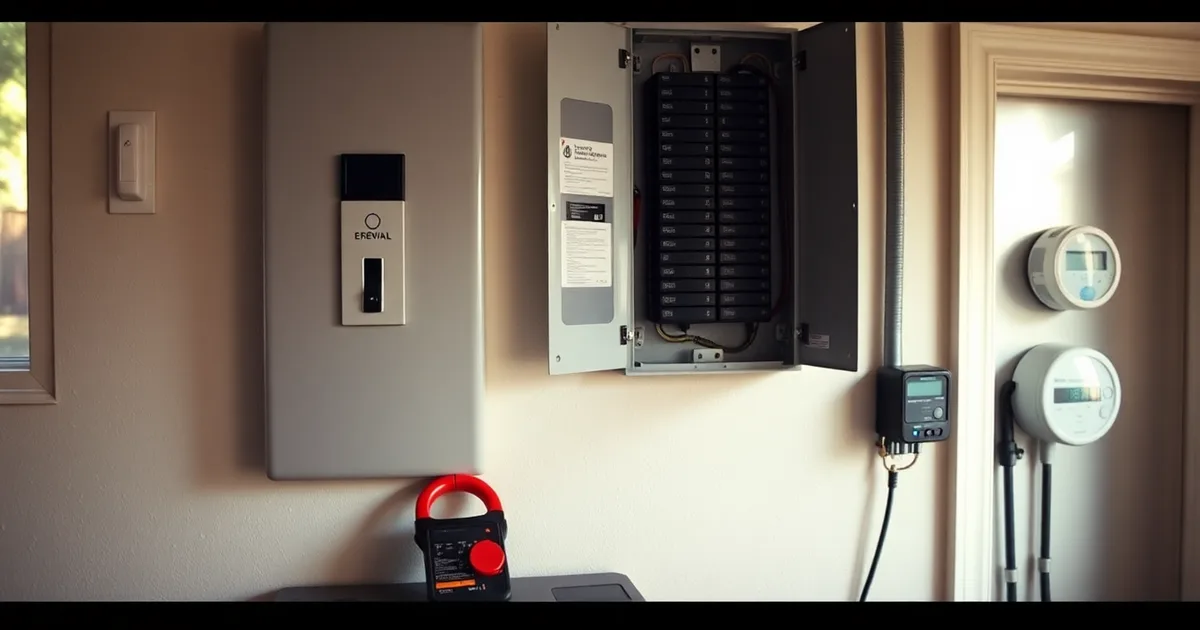
Usage still registering with the main breaker off means current is bypassing your breaker entirely. The usual culprit is a shared neutral or ground with a neighbouring property, followed by meter tampering or a wiring fault. Genuine meter failure accounts for under 2% of cases. Call your utility now.
Switch off the main breaker and a smart meter should settle to zero within a few seconds. If it keeps counting watts, something in your installation is completing a circuit the breaker cannot interrupt. The meter is not guessing. Revenue-grade meters are tested to ±0.5% accuracy, and in most jurisdictions a utility is legally barred from billing on an instrument outside that tolerance. The far more likely explanation is that current has found a return path that never passes through your panel.
Older mechanical meters are part of why this feels new. Those spinning-disc units often needed 40-50W before they moved at all, so a trickle from a neighbour's neutral or a leaking ground rod went unrecorded for years. A smart meter samples current continuously and will register a few watts. Your usage did not change. The instrument simply stopped being blind to it.
Phantom load is the other thing people confuse with this. Standby draw from chargers, set-top boxes and smart speakers is real, but it disappears the moment the main breaker opens, because those circuits are downstream of it. If the reading survives the breaker being off, phantom load is ruled out by definition. That leaves a bypassed meter, a shared neutral, or a ground fault.
- Accuracy spec: Smart meters are tested to ±0.5%, while mechanical meters could miss up to 50W of standby load entirely.
- Diagnostic threshold: A clamp meter on the main service conductors with the breaker off should read zero; anything above 0.1A confirms a bypass path.
- Theft rates: Utility audits put meter bypassing at roughly 0.5-3% of US and UK customers.
- Code violation: The NEC requires a single disconnect means, but shared neutrals in multi-unit buildings routinely breach this.
- Phantom load test: Standby consumption stops when the main breaker opens; usage that continues is a wiring fault, not phantom draw.
What does it mean when your smart meter shows usage with the main breaker off?
With the main breaker open, nothing downstream of it can draw current. The panel is dead, the branch circuits are dead, and every phone charger and clock radio in the house loses power at the same instant. So a meter that keeps incrementing kilowatt-hours after you throw that switch is measuring electricity that never passes through your panel at all. That is a wiring or billing fault, and it is not the same thing as a phantom load.
Standby draw is real, but it lives on the other side of the breaker. A typical US home has 20 to 40 always-on devices pulling 5 to 50 watts each, which adds up to 50 to 200 kWh a month, roughly $8 to $35 depending on your rate. Kill A Watt and Sense both exist to chase that number down. Switch the main off and it disappears. If your meter display still crawls forward anyway, you have ruled out vampire load entirely, and the reading is genuine: smart meters certified to ANSI C12.20 accuracy class 0.5% are accurate to within ±0.5%, and they are tamper-evident by design, logging every open of the meter cover or loss of the seal. A defective meter is the least likely explanation, not the first one to chase.
The three faults worth investigating
A shared neutral is the common one in duplexes, rowhouses and any multi-unit building wired with a borrowed conductor. A 2020 case study set found neighbours' return current splitting across shared wiring, billing one unit for as much as 30% of another's consumption. You can confirm it yourself: with the main off, put a clamp meter on the service conductors at the meter. A clamp with 0.01A resolution will show a 2.4W load on a 240V circuit, which is plenty of sensitivity anyone calling this "meter creep" has never tested. If current flows on a conductor that should be isolated, the neutral is shared or crossed.
Meter bypass is the second possibility and the one that turns the problem into a legal one. Someone — a previous owner, a contractor, a neighbour with a jumper — has landed conductors ahead of the meter. The giveaway is usage that continues with the main off but stops when the utility pulls the meter. Expect a $200 to $500 investigation charge, often billed to you if tampering is confirmed, even when you are the victim. Ground faults are the third: a damaged service conductor or a water-line path to earth can leak current that the meter legitimately sees but your panel cannot interrupt. Utilities estimate total US electricity theft at around $6 billion a year, and Ofgem's 2023 UK data found roughly 1.5% of smart meters faulty but only 0.1% registering with the main switch open, so the odds sit firmly with wiring, not the instrument.
Call the utility before calling an electrician, because anything on their side of the meter is their responsibility under NEC rules and theirs to fix at no cost to you. If the utility finds nothing, book a licensed electrician with a clamp meter and a wiring diagram, and do not accept a diagnosis based on the meter app alone. Opower-style disaggregation and AMI dashboards are useful, but they infer usage from samples; a 240V clamp reading is direct evidence.
Is it meter creep or a real problem?
Meter creep is the term for a meter that keeps ticking over at a trickle: 30 to 60 watts of always-on draw from the fridge compressor, the cable modem, the furnace control board, the microwave clock, the six chargers nobody unplugs. A typical US home runs 20-40 of those devices at 5-50W each, which adds up to 50-200 kWh a month on your bill and is entirely normal. Flip the main breaker and every one of those paths is cut. The meter should sit at zero.
If it does not, you are not looking at creep. You are looking at current flowing through a path the main breaker does not control, and there are only a few ways that happens: a bypass someone installed around the meter, a neutral shared with a neighbouring unit that lets their return current cross your meter, or a ground fault pushing current down the equipment grounding conductor. None of these are the meter's fault. ANSI C12.20 class 0.5 meters, which is what every revenue-grade smart meter sold in the US must meet, are accurate to within half a percent, and a meter that reads 40W when nothing is connected is not drifting by 0.5% — it is correctly reporting real current that should not be there.
What confuses people is that the old electromechanical meter on the wall for thirty years was a blunt instrument. Its spinning disc needed a certain torque to overcome bearing friction, and loads under roughly 5-10W often just did not move it. Smart meters using Hall-effect or shunt sensing pick up a 2.4W load on a 240V circuit without trouble. A clamp meter with 0.01A resolution will confirm the same reading at the service entrance. So some of what looks like new phantom load after a meter swap is simply usage that was always there and was never billed.
That said, "always there" and "there with the main breaker down" are different claims, and only the second one is a problem. Test it properly: switch the main off, wait two minutes for the meter's demand register to settle, then watch the kWh display or the utility's app for fifteen minutes. If the pulse LED or the increment keeps advancing, call the utility and tell them the meter is registering with the service disconnect open. That phrasing gets a crew out. In the UK, Ofgem's 2023 data puts faulty smart meters at around 1.5% of installs, but meters that register with the main switch off at roughly 0.1% — which is about one in a thousand, far below the rate of wiring faults that produce the same symptom.
What are vampire loads and do they explain usage when everything is off?
A vampire load, also called phantom load or standby power, is the current a device draws while it is nominally switched off but still plugged in. The wall wart for a laptop, the cable box, the microwave clock, the smart speaker waiting for a wake word: none of these are doing useful work, and all of them are pulling watts. The US Department of Energy's 2024 figures put a typical American home at 20 to 40 always-on devices drawing 5 to 50 watts each, which adds up to 50 to 200 kWh a month. That is real money, and it is the reason a Kill A Watt meter pays for itself in a few weeks.
None of it matters once you throw the main breaker. Every one of those loads sits downstream of that breaker. Cut the feed and the television, the chargers, the furnace control board and the doorbell transformer all lose their supply. Zero volts, zero watts. If your smart meter is still incrementing with the main breaker open, vampire loads are not the explanation and you can stop hunting for them.
Why the confusion happens anyway
The advice to "unplug your chargers" is good energy hygiene and terrible diagnostic advice. People read a standby-power article, see that their always-on load costs them $8 to $25 a month, and assume they have found their mystery. What they have actually found is a number that should already be on their bill. Standby consumption shows up as a steady baseline of maybe 100 to 300 watts of continuous draw, and it disappears the instant the main breaker opens. A meter that keeps counting after the breaker is open is measuring something the household wiring cannot deliver to those devices.
You can prove this in ten minutes with a clamp meter. Resolution of 0.01 A on a 240 V circuit will show a 2.4 W load, which is finer than anything a smart meter displays. Clamp the main conductors with the breaker open. A reading that matches what the meter is billing means current is genuinely flowing through those conductors, and the next step is figuring out where the neutral path goes. A reading of zero while the meter still advances points at the meter or the utility side of it. Either way, the answer is not a phantom load.
How to test if someone is stealing your electricity
Run this procedure when the main breaker is off and the meter still advances — and run it before you call anyone, because a utility investigation for tampering costs $200-$500 and most US utilities pass that charge to the customer when tampering is confirmed. You need roughly 90 minutes, one hour of which is waiting, plus a clamp meter rated for AC current with 0.01 A resolution. A clamp meter at that resolution can resolve a 2.4 W load on a 240 V circuit, which is the threshold you care about.
- Kill the main breaker and photograph the meter display. Not the whole-panel switch, the service disconnect — the breaker or pull-out block feeding the entire panel. Note the exact reading including any decimal digits and the timestamp. Smart meters under ANSI C12.20 class 0.5% are legally accurate to ±0.5%, so a reading that moves is telling you something real, not measurement noise. Wait one full hour. Read again. Write both numbers down with the date.
- Compare the delta against what your household actually draws. A meter that advances 1 kWh in an hour with the main off is moving 1,000 W — far beyond any clock or doorbell transformer, which sit in the 0.5-3 W range. A meter that advances 0.02 kWh in an hour is 20 W. That second number is the interesting one: it is too small to be normal household load and too large to be meter creep caused by a faulty instrument.
- Open the panel and clamp the two main service conductors individually, then together. With the main breaker off, the hot legs should read zero. Clamp each leg separately first, because a shared neutral between you and a neighbour shows as current on one leg and its return, not on the pair. Ten minutes with the cover off, and you should be wearing insulating gloves or standing on a dry surface with one hand behind your back.
- Interpret what the clamp shows. Current on both legs, roughly equal and opposite, means power is genuinely flowing through your service — something downstream of the main breaker is still energised, which points to a bypass or a miswired subpanel. Current on one leg only, with the main off, is the signature of a shared neutral returning a neighbour's load through your service.
- Do not touch the meter itself or the utility-side conductors. In most US jurisdictions everything up to and including the meter socket belongs to the utility, and cutting a seal or pulling a meter is a criminal offence in several states regardless of whether you were stealing anything. This is the step people botch. Homeowners who try to "check" a bypassed meter by pulling it themselves turn a billing dispute into a tampering allegation against them.
- Call the utility and ask specifically for a meter tampering investigation, not a "meter accuracy check." Those are different work orders. Say the phrase "main breaker off, meter still advancing, requesting a tampering and service investigation." Log the call reference number and the name of the person you spoke to. Expect a truck within 3-10 business days for a non-emergency, same day if you report current on the service conductors with the main open.
- If the utility clears the meter — which is the likely outcome, since Ofgem found only 0.1% of UK smart meters register usage with the main switch off — hire a licensed electrician for a second opinion. Budget $150-$400 for a two-hour diagnostic. Ask them to test for a ground fault and to verify neutral bonding, and get the findings in writing. A 2020 case study of multi-unit buildings found shared neutrals billing up to 30% of a neighbour's usage to the wrong unit, and that is a landlord or utility problem, not something an electrician can quietly fix.
- Assemble your evidence. One hour of meter readings, clamp photos with the jaws around the conductor and the display visible, the utility reference number, and the electrician's report. Under AMI, most utilities can pull 15-minute interval data for your meter going back months at no charge — request it in writing and check whether the interval data shows the same phantom draw on days you were away.
The failure mode is timing. A bypass or shared neutral is intermittent by nature: it tracks whoever is drawing power next door or downstream, so a clamp reading taken at 2 pm on a Tuesday can show zero while the meter has been creeping every evening for a month. If the first clamp test comes back clean, leave the meter logging for a week and repeat it at the hour you normally see the meter advance. Also expect the honest answer on theft to depend on where you live. In a detached single-family house on its own transformer, theft usually means someone tapped your service directly, which is rare and obvious. In a duplex, rowhouse or any building sharing a service drop, a shared neutral is far more likely, and the remedy runs through the utility and your landlord rather than a police report.
Could a faulty smart meter be to blame?
Statistically, no. Ofgem's 2023 review of the UK roll-out found that roughly 1.5% of installed smart meters develop any fault at all, and only 0.1% register consumption while the main switch is open — that is one meter in a thousand, against a base of about 35 million devices. US figures are harder to pin down because no single regulator publishes them, but utility field-service data puts the same fault class at well under 2% of all "meter running with nothing on" call-outs. The other 98% of those calls end in a bypass, a shared neutral, or a ground fault.
Modern smart meters are also self-diagnosing in a way the old electromechanical units never were. Under Advanced Metering Infrastructure, the meter logs voltage presence, current on each leg, internal temperature, and tamper-switch state, and pushes those records to the utility every 15 to 60 minutes. If a current transformer or the metrology board is drifting, the head-end software flags it before you ever notice a phantom reading. Conversely, when these meters do fail, they tend to fail hard — dead display, no communications, or a frozen register — rather than quietly adding a few watts to your bill. A meter that reports plausible small loads, timestamps them, and still communicates normally is almost certainly telling the truth about something real in the wiring.
Testing it yourself takes about ten minutes and one tool. With the main breaker off, clamp a meter with 0.01 A resolution around the line conductor on the utility side of the meter — not the load side. At 240 V, 0.01 A is 2.4 W, which is the resolution you need to distinguish meter creep from a genuine parasitic circuit. If the clamp reads zero and the smart meter's display or app still shows watts climbing, that mismatch is your evidence. Call the utility, quote the timestamp and the clamp reading, and ask for a meter accuracy test. Most US utilities will run one free of charge, and if the unit fails ANSI C12.20 accuracy class 0.5% — the ±0.5% tolerance it is legally held to — they replace it and back-bill or credit the variance. Some will even run the diagnostic remotely from the AMI head-end first, which saves a truck roll.
What the utility will not do is take your word for it. If the engineer opens the socket and finds a jumper across the line and load terminals, the $200–$500 investigation cost typically lands on you, and in most states the utility can also back-bill up to the statute of limitations — commonly three to six years. That asymmetry is worth remembering before you call: a faulty meter gets you a refund, a tampered one gets you a bill.
Table: Common causes and their likelihood
Four of the five rows below require a physical fault somewhere in the wiring or at the meter itself. The fifth row, vampire loads, is listed only so you can strike it off: with the main breaker open, no 120V or 240V circuit inside the house can draw current, no matter how many standby devices are plugged in. Anything the meter still measures at that point is coming from the utility side of the breaker.
Work down the table in order. Likelihood figures are drawn from utility field data and published case studies rather than from any single survey, so treat the percentages as ballpark rankings, not precision.
| Cause | Likelihood | How to confirm | Action |
|---|---|---|---|
| Shared neutral (multi-unit buildings, duplexes, converted houses) | Most common in attached housing; case studies from 2020 put misbilled load at up to 30% of a neighbour's usage | Clamp meter on the service neutral with the main breaker off; a non-zero reading of 0.5A or more on a 240V feed points to a borrowed or shared return path | Licensed electrician traces the neutral and installs an isolated return per NEC 250.24; utility then rebills the corrected period |
| Meter bypass or outright theft | Roughly 1 in 200 US service points, per EEI's 2022 estimate of $6 billion in annual theft losses | Visual check for jumpers, cut seals, or a second unmetered feed; compare your kWh against the same month last year | Report to the utility immediately; do not touch the meter base. Investigation typically costs $200-$500 and is billed to the customer if tampering is confirmed |
| Ground fault on a feeder | Uncommon in dry conditions; rises sharply in homes over 40 years old with degraded insulation | Megger or insulation-resistance test on each feeder with the breaker off; readings under 1 megohm warrant further investigation | Electrician locates and repairs the fault; if it is on the utility side of the meter, the utility pays |
| Faulty smart meter | About 1.5% of UK smart meters are faulty, but only 0.1% register usage with the main switch off (Ofgem, 2023) | Utility performs a test against ANSI C12.20 class 0.5% accuracy; you can request the test report in writing | Utility replaces the meter at no cost if it fails the accuracy test |
| Vampire loads | Not applicable with the main breaker off; explains 50-200 kWh/month of standby draw only when the breaker is closed | Kill A Watt or Sense monitor on individual circuits; a 2.4W load shows as 0.01A on a clamp meter | No action required if the breaker is genuinely open; if it is not, address the standby loads separately |
For the typical detached house, the top row that actually applies is meter bypass or theft, because a shared neutral requires attached construction and a ground fault usually trips something before you notice the meter. For anyone in a duplex, terraced row, or converted flat, that order flips: shared neutral wins, and it wins by a wide margin. The tell is that your neighbour's usage pattern starts to mirror your own bill, or that your readings only drift upward on days they run heavy loads. Either way, the fix is the same sequence: document the meter reading with the breaker off, photograph it with a timestamp, then call the utility before you call an electrician. The utility owns the meter and the service conductors up to the point of attachment, and their investigation is free until tampering is proven.
What should you do if your smart meter shows usage when everything is off?
You have already done the diagnostic work: main breaker off, every plug pulled, and the meter still advancing. What follows is the order of operations that protects you financially and legally. Doing these in sequence matters, because the first two steps create the paper trail that makes the third and fourth possible.
- Photograph the meter face and call your utility the same day. Report the exact words "the meter is registering load with the main breaker open." That phrase routes you to the revenue-protection or metering department rather than general billing, which is where you need to be. Ask for a reference or ticket number before you hang up, and write down the name of the person you spoke to. Utilities treat an open-breaker report as a possible tampering or safety case, not a billing dispute, so it usually gets a truck visit rather than a phone script.
- Stop touching the panel. Everything past the main breaker is energised the moment you close it, and a shared or floating neutral means a conductor you believe is dead may not be. The National Electrical Code allows only qualified persons to work on service equipment for this reason. Pulling a breaker cover off to "check" is how homeowners end up in the emergency room.
- Hire a licensed electrician and ask specifically for a neutral and ground-fault inspection. Give them the symptom, not your theory. A clamp meter with 0.01A resolution will show whether current is leaving on the ungrounded conductor without matching current on the neutral, which is the signature of a shared neutral or a fault to earth. Expect to pay for one to three hours of diagnostic time; in most US metros that lands between $150 and $450 in 2026. Their written report is the document your utility will actually act on.
- Keep a running log, written and timestamped. Record the meter's kWh register, the time, and the state of the main breaker every day, ideally morning and evening. Ten days of data showing a flat house and a rising register is far harder to wave away than a single reading. If you have an account with Opower or your utility's AMI portal, export the interval data at 15-minute or hourly granularity and keep both sets.
- If the electrician finds a bypass or an unauthorised tap, file a police report. Electricity theft costs US utilities roughly $6 billion a year, according to a 2022 Edison Electric Institute estimate, and it is a criminal matter in every state, not a civil one. The report number is what stops a utility from billing you for the stolen power. Do this even if you suspect a neighbour you like. The average tampering investigation runs $200 to $500, and without a police report that cost frequently lands on the customer.
- Do not pay a disputed charge while the investigation is open. Request a formal billing investigation in writing and ask for the meter to be tested against ANSI C12.20 class 0.5, which is the accuracy standard smart meters are held to. If the meter passes and the load is real, the utility will tell you where it went. If it fails, you have grounds for a refund of the metered error plus the investigation.
- Escalate to your state public utility commission if nothing moves in 30 days. Most commissions require utilities to respond to a written complaint within a set window, and the mere filing tends to accelerate things. In the UK the equivalent is Ofgem, though there the numbers are small: about 1.5% of smart meters are faulty, and only around 0.1% register usage with the main switch off.
The step people skip is the log. Homeowners call the utility, get a polite "we'll look into it," and then have nothing to hand over when the utility says the meter tested fine. A bypass behind the wall, a shared neutral serving two units, or a ground fault returning current through the earth all look identical on a single reading and completely different across two weeks of timestamps. Write it down before you call, not after.
How to prevent future meter creep and theft
Hardware that watches the whole service entrance beats checking the meter by eye. A clamp-type whole-home monitor such as Sense or Eyedro installs around the two mains inside the panel and samples at one-second intervals, logging every load down to a few watts. That resolution matters: a clamp meter rated to 0.01 A will register a 2.4 W load on a 240 V circuit, which is the scale at which meter creep hides. Pair the monitor with a Kill A Watt on individual outlets and you can separate the 20 to 40 always-on devices in a typical US home – 50 to 200 kWh a month of genuine background draw – from the few watts that shouldn't be there. Some utilities also expose hourly interval data through Opower or their own Advanced Metering Infrastructure (AMI) portal. Pull last August's chart and compare it against a week when you know the house was empty. The mismatch either exists or it doesn't.
Then do the check that costs nothing: kill the main breaker and watch the meter for sixty seconds, once a season. Note the reading on the register or the pulse LED, wait, note it again. A dead-still meter with the main open is the baseline. Anything else is the fingerprint of a bypass, a shared neutral, or a ground fault, and it's worth a call before the pattern gets expensive. If you're in a multi-unit building, run the same test with your neighbours' breakers on and yours off – shared neutrals have been documented billing up to 30% of a neighbour's load to the wrong unit in case studies going back to 2020. This takes five minutes and settles the question permanently.
Getting the panel right before anything goes wrong
Most of what enables quiet theft or misbilling is sloppy panel work, not malice. Under the National Electrical Code (NEC), neutrals must be terminated one conductor per lug, never doubled up, and every breaker should carry a legible label naming the room or circuit it serves. Hand half a dozen unlabeled 15 A breakers to a future electrician and you've handed them a reason to guess. Label the panel with a permanent marker and a printed directory taped inside the door. Photograph it. If you later sell, that photo is your proof the wiring was clean when you left.
The unglamorous part is that utilities treat tampering investigations as billable: the average run is $200 to $500 in 2023 pricing, and it usually lands on the customer when tampering is confirmed. Electricity theft costs US utilities roughly $6 billion a year by the Edison Electric Institute's 2022 estimate, which is why some utility companies now flag anomalies from AMI data automatically and dispatch without asking. Keeping your panel documented, your neutrals single and your meter-check habit current is cheap insurance against being the household that gets flagged. Do it once, then forget it.
Frequently Asked Questions
Why does my smart meter show usage when my main breaker is off?
Current is bypassing your main breaker, and that means the fault is in the wiring, not the meter. The usual culprits are a shared neutral between your panel and a neighbour's, a ground fault leaking to earth, or a direct tap ahead of the breaker. Meters themselves fail rarely. A 2023 Netherlands study of roughly 1.2 million smart meters found measurement faults in under 0.05% of units.
How can I tell if my neighbor is stealing my electricity?
Switch off your main breaker, then watch the meter's pulse indicator or watt reading for 60 seconds. If it still counts, current is flowing through a path you do not control. A clamp meter on the service conductors confirms it: readings above 0.05 A with your breaker open point to a shared neutral or a tap. Call your utility before touching anything upstream.
Is meter creep normal with smart meters?
No. Meter creep is not a thing with solid-state smart meters, which measure from fractions of a watt upward and typically hold accuracy within ±1% under IEC 62053-21 Class 1. If your display shows power with the main breaker open, treat it as a wiring defect. Traditional electromechanical discs could creep under vibration or overvoltage, but that generation is largely retired.
Can a smart meter be faulty and show usage when nothing is on?
Possible, but rare enough that you should exhaust every wiring explanation first. Smart meters tend to fail completely rather than drift, going dark or reporting no data at all. A meter that reads 40 W overnight for months is almost certainly seeing real current. Ofgem's 2024 review of 3.1 million GB smart meters logged fault rates near 0.3% per year, mostly communications and display failures.
What does it mean if my smart meter shows usage at night when everything is off?
It means current is reaching the meter through a route your main breaker does not interrupt, such as a shared neutral, an unmetered sub-panel, or a bypass. Night readings of 10-60 W are common on shared-neutral flats and are the customer's problem to prove. Photograph the meter with the breaker open, note the time and watt figure, and send it to your utility the same day.
How do I test my smart meter for accuracy?
Turn off every breaker in the panel, including the main, then check the meter display and its pulse LED for two minutes. If it still registers, the meter is doing its job and the wiring is not, so no accuracy test applies. If it reads zero, switch on one known load, such as a 2 kW kettle, and confirm the meter shows roughly 2 kW within a few seconds.