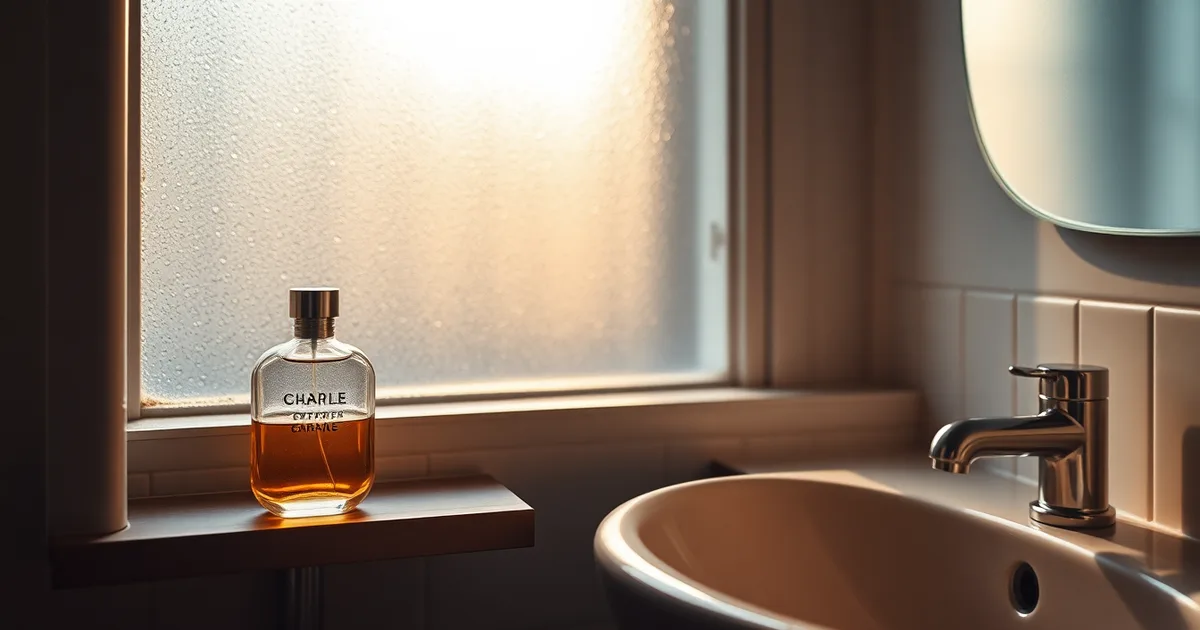
Perfume has no fixed expiry date, but a hot, humid bathroom can degrade it in 6–12 months. Heat above 24°C (75°F) and humidity over 60% strip the top notes first, giving a sharp, alcoholic opening. If the base smells sour or inky, it has turned.
A bathroom shelf is close to the worst place you can keep a bottle, short of a windowsill. The heat from a shower pushes the air past 24°C within minutes, and a sealed room holds humidity well above 60% for the rest of the morning. Every 10°C (18°F) of extra warmth roughly doubles the rate at which the aromatic compounds oxidise, so a bottle that would have held for three years on a bedroom shelf can start tasting thin in one.
Splash bottles and any decant with a loose cap are the real risk. Above 60% humidity, water vapour gets into the juice, and where the alcohol concentration drops, bacteria can take hold. That produces the sour, slightly mouldy note people describe as "gone off" — usually within 3–6 months, and it does not wash out.
The saving detail is that damage is often only skin-deep. Citrus, bergamot and light florals sit at the top of the pyramid and are the first to break, while the woods, resins and musks underneath can hold for 3–5 years even in bad conditions. Spray it on skin, wait, and see what is left after the opening burns off. Fifteen minutes is the test: a fragrance that settles into something recognisable was shocked by temperature, not destroyed. A bottle left in direct sun through a bathroom window is a different case — UV can fade the whole composition in as little as 4 weeks.
- Heat doubles decay: every 10°C (18°F) above 24°C roughly doubles the rate of chemical degradation in perfume.
- Humidity invites water: above 60% relative humidity, splash bottles can take on water and grow bacteria, producing a sour smell in 3–6 months.
- Top notes go first: citrus and light florals degrade within 6–12 months in a hot bathroom, while base notes of woods and resins last 3–5 years.
- Sunlight is faster: UV through a bathroom window can fade a fragrance in as little as 4 weeks.
- Settling is the test: if the harsh opening fades within 15 minutes on skin, the perfume is shocked rather than turned.
How does bathroom heat and humidity actually affect perfume?
Perfume is a solution of aromatic molecules in ethanol, usually 60–90% alcohol by volume, plus a little water and a fixative base. That formula is stable at 15–18°C (59–65°F). A bathroom during a hot shower sits well above 24°C (75°F), and the cabinet above the sink swings roughly 10°C (18°F) between your morning shower and your evening one. Every one of those swings is a small chemical event.
Heat is the main driver. Warmer liquid holds more dissolved oxygen, and oxidation reactions roughly double in rate for every 10°C rise, so the aldehydes and citrus terpenes that carry top notes go first. A 2019 study in the Journal of Cosmetic Science put numbers on it: citrus top notes lost 40% of their intensity after eight weeks held at 30°C (86°F). The signature opening of Dior Sauvage or Chanel No. 5 flattens or turns waxy long before the base notes move. Ethanol itself oxidises to acetaldehyde and acetic acid, which is where a sharp, vinegar-adjacent edge comes from in a bottle that has sat too long.
Water and pressure do the rest
Humidity is the quieter problem. Relative humidity in a bathroom after a shower reaches 90–100%, against the 50–60% generally recommended for storage, and a perfume bottle is not sealed against vapour. Water migrates in through the crimp or the sprayer collar. Once inside, it drives hydrolysis of the ester compounds that form much of a modern formula's heart, splitting them into an acid and an alcohol. Esters smell fruity and floral; the acid left behind smells sour. That sourness is the single clearest sign of humidity damage, and it is not reversible.
The third mechanism is mechanical. Alcohol and water expand and contract at different rates as the bottle warms and cools, and the air gap at the top of a partly used bottle breathes in and out through the seal. Fragrantica's 2024 survey found 62% of respondents kept perfume in the bathroom and 45% reported a scent change within a year. That matches the physical picture: an unopened bottle carries a PAO of 24–36 months, but the same bottle on a bathroom shelf is realistically good for 6–12 months. It matters most on the expensive stuff. A 100ml Creed Aventus at $435 is a poor candidate for a shelf above the bath; a $25 rollerball is not a tragedy either way.
Which notes go first: top, middle, or base?
A fragrance is built as a pyramid, and the pyramid collapses from the top down. Citrus, bergamot, grapefruit, light fruits and fresh herbs are the smallest, most volatile molecules in the formula, which is why they hit your nose first and why they are the first to go. A 2019 study in the Journal of Cosmetic Science measured citrus top notes losing 40% of their intensity after just 8 weeks held at 30°C (86°F). A bathroom shelf swings 10°C (18°F) between the morning and evening showers, and every one of those cycles pushes the reaction further.
Middle notes are next. Florals, spices, and the softer heart of a composition like Chanel No. 5 lose their brightness rather than disappearing outright — you get a flatter, slightly muddled version of what the perfumer intended. Base notes are the last to fall. Woods, musk, amber and resins are heavy molecules, and they can hold for years in conditions that would have already stripped a lemon note to nothing. That asymmetry is the whole reason a "turned" bottle is so often misdiagnosed.
Why the order matters for diagnosis
If your bottle smells sharp, thin, or vaguely of nothing on the opening spray but settles into something recognisable after ten or fifteen minutes, you are almost certainly dealing with top-note shock, not death. Move it to a cupboard at 15–18°C (59–65°F) and 50–60% relative humidity and give it a few weeks. This is the case most enthusiasts are actually in, and it is the one every "is my perfume expired?" article gets wrong by declaring the bottle finished. Molecule 01 by Escentric Molecules, which is basically one heavy woody molecule, will outlast almost anything built on a bright citrus opening — same shelf, different outcome.
The real ending is in the base. When the dry-down turns sour, inky, or aggressively powdery, or when a bottle that once read as warm woods now smells like a wet basement, the heavy molecules have oxidised past recovery and no amount of cool storage will bring them back. That is the line. Top notes fading is a cold, not a funeral; a sour base is the funeral. Frustratingly, you cannot test this without spraying, so a bottle you have been hoarding for three years is not "safe" just because it looks untouched.
Signs your perfume has turned (and what it's not)
Fragrance degradation is rarely a single dramatic event. It is a slow drift that most people only notice when they compare a current bottle against a memory of how it used to smell, or against a decant they made two years ago. The distinction that matters is between a liquid that has chemically broken down and one that is merely reacting to being warm right now. One of those is permanent, the other often reverses itself within twenty minutes.
Work through these in order. The first three point to actual spoilage; the last few describe things that are commonly mistaken for it.
- Sour, rancid, or acetone-like opening. A turned perfume does not just smell "harsher" or more alcoholic — it smells wrong in a specific chemical way. Nail polish remover (acetone), vinegar, or a stale cooking-oil note means aldehydes and citrus terpenes have oxidised past the point of recovery. This is the one signal that reliably means the bottle is done.
- Darkening liquid or visible sediment. Compare the juice against a fresh sample of the same fragrance if you have one. A pale yellow turning amber or brown is oxidation, driven by heat and light exposure to the dyes and naturals in the formula. Fine particles or a cloudy film at the bottom of the bottle are the same process made visible. Dior Sauvage's cool blue tint, for instance, can shift noticeably toward grey-brown after a year in a humid bathroom.
- A base that has gone inky or metallic. The drydown is the diagnostic zone. Top notes fade naturally even in a well-kept bottle — a 2019 study in the Journal of Cosmetic Science found citrus top notes lost 40% of their intensity after 8 weeks at 30°C (86°F). But when the base itself turns bitter, inky, or metallic, the fixatives and heavier molecules have degraded. That is not recoverable. Chanel No. 5 kept in a hot bathroom for two summers tends to lose the sandalwood warmth and pick up a faint varnish note in the tail.
- Not spoilage: a sharp, boozy blast in the first 30 seconds. Nearly every fragrance smells more alcoholic immediately after spraying from a warm bottle. Ethanol is more volatile at higher temperatures, and a bottle sitting at 26°C (79°F) will flash off faster than one at 17°C (63°F). This is temperature shock, not decomposition.
- Not spoilage: top notes that reappear after 15 minutes. Spray on skin and wait. If a fragrance that smelled flat or thin on paper opens up into recognizable citrus, bergamot, or green notes within a quarter hour, the top notes are intact — they were just suppressed by the warmth of the liquid in the bottle. A genuinely turned perfume does not improve with time on skin. It gets worse, or stays sour throughout.
- Not spoilage: a slightly different smell in humid weather. Ambient relative humidity shifts how a fragrance projects. A bathroom that hits 90–100% humidity after a shower changes skin moisture and evaporation rates, so the same juice smells louder or thinner on a muggy morning. This is your nose reading the environment, not the bottle failing.
- Not spoilage: colour loss without a smell change. Some molecules, particularly the iso E super and ambroxan in minimalist compositions like Escentric Molecules Molecule 01 or Le Labo's lighter releases, are almost colourless to begin with and stay that way. No visual change does not mean no change, and visible change does not always mean the scent is compromised.
The one people get wrong most often is the 15-minute test. Spraying on a card or a wrist while the bottle is still warm from the bathroom shelf will give you a distorted first impression, and most enthusiasts conclude the fragrance is finished before giving it time to settle. Let it sit on skin, away from the steamy room, for a full quarter hour before you decide. If it opens anew, decant 10ml into a small atomiser and move the original to a cool cupboard — you have time. If it stays sour or inky from first spray to drydown, the bottle is past saving, and no amount of refrigeration will bring the base notes back.
How to test if your perfume is still good: a step-by-step
This procedure applies to any bottle that has lived in a bathroom for more than a few months, or any bottle whose smell you no longer trust. You need the suspect bottle, a paper blotter or your own clean wrist, and ideally one reference point: a fresh decant of the same fragrance, a sample vial, or a well-reviewed description you can compare against. Ten minutes and zero dollars. If the bottle is a Creed Aventus at $435 for 100ml, the test is worth doing before you bin it.
- Shake nothing and spray only after a two-pump purge. The liquid in the dip tube has been sitting against the plastic and metal longest, so those first sprays are not representative. Fire two pumps into the air or a tissue, then take your actual sample. Skipping this step is the most common way people wrongly conclude a bottle is dead.
- Spray once onto a clean paper blotter, or if you have no blotters, onto the inside of your forearm rather than your wrist. Wrists get washed, rubbed on sleeves, and warmed unevenly, all of which distort the dry-down. Blotters from Sephora or Ulta Beauty are free at the counter if you ask.
- Wait 15 minutes before judging. Not two minutes. Top notes are volatile by design and are supposed to flash off; a citrus opening that smells thin at minute two tells you almost nothing. Set a timer.
- Compare side by side against a known-good sample of the same scent if you have one. Spray the reference on a second blotter, label both with a pen, and smell them alternately rather than back to back. If you have no reference, compare against the first hour of wear you remember from when the bottle was new.
- Check the colour against a fresh bottle, or against product images on Fragrantica or Basenotes. A Chanel No. 5 that was pale straw and is now amber has oxidised. Darkening is not automatically fatal; vanillin and some musks darken with age and still smell fine. A green or grey cast is a worse sign.
- Smell the nozzle and the cap separately, away from the juice. The cap holds stale residue and can smell sour even when the juice is fine, so treat cap odour as weak evidence. Nozzle odour is stronger evidence: if the sprayer itself smells inky or of nail polish remover, the top of the bottle has turned.
- Give the mid and base notes a full two hours on skin. This is where the real verdict lives. If the heart and base still bloom after the opening has gone flat, you are dealing with the damage described in the citrus study from the Journal of Cosmetic Science in 2019, where top notes lost 40% of their intensity after 8 weeks at 30°C. Salvageable.
- Write the date on the bottle with a paint pen and move it out of the bathroom. Check the PAO symbol on the base: an opened bottle typically runs 24–36 months, and a retired bottle in a cupboard will hold far better than one sitting at 90% relative humidity.
The failure mode here is testing your bottle after a hot shower, in the same steamy room, with your nose already primed by shampoo and soap. Bathroom humidity after a shower hits 90–100%, and your sense of smell adapts within about 90 seconds of continuous exposure. Spray in a dry room, on a cool day, before you have eaten anything strongly flavoured. If you test badly, you will throw out a bottle that had years left.
The 6-month rule: when bathroom storage becomes risky
Six months is the working threshold for a bathroom that gets used daily. Leave a bottle on a shelf through a summer of hot showers and a study published in the Journal of Cosmetic Science in 2019 gives you a rough sense of the pace: citrus top notes lost 40% of their intensity after eight weeks at a constant 30°C. A bathroom climbs past that during every shower, and swings as much as 10°C between a morning and an evening rinse, so the cumulative exposure over 26 weeks is worse than a steady 30°C bench test.
Ventilation and baseline temperature buy you time. If the room is genuinely cool and the window or extractor fan actually clears the steam — under 22°C, humidity settling back under 60% within twenty minutes — you can push to around 12 months before the top notes start to flatten. That is the ceiling, not the target. The ideal range is 15–18°C at 50–60% relative humidity, and a post-shower bathroom hits 90–100% humidity, so you are always working against the room rather than with it.
Why a bottle you use weekly holds up better — and worse
A bottle you spray most days fares better than one you forget about, but not for the reason people assume. Each use pulls alcohol out of the headspace and lets fresh air in, and the liquid stays mixed rather than stratifying into separated layers. The trade-off is that every one of those air exchanges is oxygen, which is what actually drives oxidation of the base. So a daily-worn bottle like Dior Sauvage sits in a kind of equilibrium — actively used, constantly oxygenated, but rarely left long enough to go sour. A $435 bottle of Creed Aventus opened twice a year in the same bathroom is the worse case, because it does both: it oxidises slowly and then sits.
If you are going to keep anything in there, keep the cheap, frequently used bottle and move the expensive or rarely worn one. The PAO symbol on the box — typically 24–36 months for an opened fragrance — assumes reasonable storage, and a hot bathroom cuts that to 6–12 months in practice. A Fragrantica survey in 2024 found 62% of respondents stored perfume in the bathroom and 45% reported a scent change within a year, which lines up almost exactly with the 12-month ceiling for a well-ventilated room.
Can you rescue a heat-damaged perfume?
Sometimes. The dividing line is where the damage sits in the pyramid. If your bottle now opens with a sharp, alcoholic blast or a screechy lemon peel that wasn't there before, but settles into something recognisable after twenty minutes, the base is intact and the top notes have simply taken the hit. A 2019 study in the Journal of Cosmetic Science found citrus top notes lost 40% of their intensity after 8 weeks at 30°C (86°F), which tells you the fragile molecules go first and go fast. They are also the cheapest part of the formula.
Give it a rest. Move the bottle to a cupboard that stays between 15–18°C (59–65°F), keep it out of light, and leave it alone for two to four weeks. Oxidation reactions partly reverse when the driving heat is removed, and the alcohol-water balance in the juice can re-equilibrate. This works often enough to be worth trying before you bin a $435 bottle of Creed Aventus. It does not work on a bottle that has been sitting on a bathroom shelf through two summers of 90–100% humidity, and it will never fix a sour, inky, or vinegar-like drydown. Once the base notes turn, the damage is irreversible — those are heavier molecules that have genuinely decomposed, and no amount of resting brings them back.
When it's gone, where it can still go
A turned bottle still works as a room or linen spray, and plenty of people keep one by the sofa for exactly that. Spray it on curtains, upholstery, or a cotton throw rather than on skin. If you get redness, itching, or a rash at the application site, stop — oxidised fragrance materials are a recognised contact-irritation trigger, and IFRA restricts several of them in leave-on products for that reason. Fabric is a safer target because it doesn't react, though test on a hidden corner first: some turned juices leave a faint oily mark on pale linen.
Layering is the other salvage route, with limits. Pairing a top-note-damaged bottle under a fresh, citrus-forward companion can mask the opening, and it's a common trick on Basenotes and Fragrantica for bottles people can't bear to throw out. It won't hide a sour base. If your Chanel No. 5 or Le Labo has gone inky, no amount of layering will pull it back, and wearing it risks the reaction described above. Run the test from the previous section on paper first. If the strip smells wrong at hour two, it's a room spray.
Storage myths vs. best practices: where should perfume live?
Two storage myths refuse to die. The first is that the bathroom cabinet is safe because it is dark; darkness does nothing about the 90–100% relative humidity that hangs in the air for 20 minutes after a hot shower, or the 10°C swing between a morning rinse and an evening soak. The second is that the refrigerator is the connoisseur's move. Domestic fridges sit at 3–5°C, cold enough to force the alcohol-water-essential oil mixture toward separation and to condense moisture inside a half-empty bottle every time you pull it out.
The number that matters most is not temperature alone but stability. Fragrance compounds are happiest at 15–18°C with 50–60% relative humidity, held there without fluctuation. A bathroom hits 24°C or higher during showers. A kitchen windowsill is worse in summer. What follows compares the realistic options against that target.
| Storage location | Typical temperature | Typical humidity | Light exposure | Expected lifespan of an opened bottle | Verdict |
|---|---|---|---|---|---|
| Bathroom shelf or cabinet | 24–30°C during showers | 90–100% after showering | Low if inside a cabinet | 6–12 months | Avoid |
| Bedroom drawer, interior wall | 18–22°C year-round in most homes | 40–55% | None | 24–36 months, the standard PAO | Best default |
| Kitchen refrigerator | 3–5°C | High; condensation on removal | Only when door opens | 12–24 months, with separation risk | Only for long-term sealed storage |
| Wine fridge set to 12–15°C | 12–15°C, stable to ±1°C | 50–65% | None; glass door blocks UV | 36 months or more | Best if you own one |
| Windowsill, even north-facing | 20–35°C seasonal swing | Ambient | Direct or indirect daily | 3–8 months | Worst option |
The bedroom drawer wins for almost everyone, and it costs nothing. A $150 bottle of Dior Sauvage or a $435 Creed Aventus kept there will run its full 24–36 month PAO; the same bottle on a bathroom shelf can taste sour inside a year, based on the 62% of Fragrantica respondents in 2024 who stored in the bathroom and the 45% of those who reported a scent change within twelve months. The flip case is the collector with a rotation too large to finish before oxidation sets in. If you own more than roughly 20 bottles and use each a few times a year, a wine fridge at 12–15°C is the only setup that buys you the extra decade — and a domestic refrigerator at 3–5°C is not a substitute, because the separation and condensation risk outweighs the temperature benefit.
What the fragrance industry says about expiration dates
There is no legally mandated expiry date on a bottle of perfume anywhere in the major markets, and that surprises people who assume the cosmetic rules that govern mascara also govern fragrance. In the EU, Regulation (EC) No 1223/2009 requires a Period After Opening symbol, the little open-jar pictogram, on any cosmetic with a minimum shelf life of 30 months or less. Unopened fragrance usually clears that bar, so what you get instead is a PAO number inside the jar: 24M, 36M, occasionally 60M. That number is a manufacturer's estimate of safe, stable use after first spraying, not a hard chemical deadline. It also assumes reasonable storage, which the regulation never defines.
The Fragrance Foundation, the US trade body whose membership includes the houses behind Chanel No. 5 and Guerlain's classics, recommends holding finished product at 15–18°C (59–65°F) and around 50% humidity. Compare that to your bathroom: 24°C and above during a hot shower, and relative humidity that climbs to 90–100% in the minutes after one. Every major PAO figure on the market, whether it is the 36M on a Le Labo bottle or the 24M on a Sephora house brand, was arrived at under conditions closer to the Foundation's numbers than to yours. That is the whole reason a bathroom-stored bottle can degrade in a year while the box promised three.
IFRA, the International Fragrance Association, is often cited as if it certifies how long a perfume lasts. It doesn't. IFRA sets standards for ingredient safety, purity and, in some cases, stability of individual raw materials, and it does not test finished juice in a retail bottle. The same goes for an artisan house like Escentric Molecules, whose Molecule 01 is essentially one aromachemical in alcohol, and for a mass prestige line like Dior Sauvage, which is a complex multi-material accord. The chemistry and the packaging differ enormously; both are sold without any requirement to state how long the contents will hold up.
The practical upshot: treat the PAO as a ceiling for good conditions, not a warranty. A 100ml bottle of Creed Aventus at $435 carries a 36M mark and the same obligation-free storage advice as a $60 bottle, so the financial stakes of ignoring the temperature guidance are entirely on you.
Frequently Asked Questions
Does perfume expire if stored in a hot bathroom?
Perfume has no fixed expiry date, but a hot bathroom shortens its useful life dramatically. Fragrance houses typically quote three to five years unopened, and the 1986 IFRA guidance still used by many brands treats two years as a conservative shelf life once air hits the juice. Bathroom heat above 30°C plus steam from showers attacks the top notes first, so noticeable degradation usually appears within 6–12 months.
How can I tell if my perfume has turned or just needs to settle?
Spray once on skin and wait. If the opening is harsh, sharp or smells like straight ethanol but the familiar scent returns within 15 minutes, that is temperature shock, not spoilage, and the perfume is fine. If the dry-down 30 minutes later is sour, vinegary or smells of nail polish remover, the base notes have oxidised and it has turned.
Can I still use perfume that smells off?
If only the top notes have gone flat, moving the bottle to a cool dark cupboard for two to three weeks often restores enough of it to wear. If the base notes are sour, it is gone. Skin contact with oxidised fragrance can irritate, so repurpose it as a room or linen spray rather than wearing it. Never decant the remainder into a smaller bottle; the extra oxygen exposure finishes the job.
What is the ideal place to store perfume?
A cool, dark, dry cupboard away from windows, radiators and the shower, holding a stable 15–18°C (59–65°F) with humidity under 60%. Bedroom wardrobes and hallway drawers meet that easily. Keep bottles in their original box; the cardboard blocks light, which degrades citrus and floral accords faster than heat does. A bathroom shelf above the toilet fails all three conditions at once.
How long does perfume last in a bathroom?
In a hot, humid bathroom with poor ventilation, noticeable degradation can appear in as little as 6 months. A cool, well-ventilated bathroom extends that to roughly 12 months before the top notes shift. Either way, that is well short of the three to five years the same bottle would survive in a bedroom cupboard, so treat a bathroom as temporary storage only.
Is it okay to keep perfume in the fridge?
Only a wine fridge or drinks cooler held at 12–15°C, and only for bottles you use regularly. A standard kitchen fridge runs at 2–4°C, which is cold enough to cause condensation inside the bottle each time you take it out, and the water can separate the oils from the alcohol. Frequent temperature swings do more harm than steady warmth.