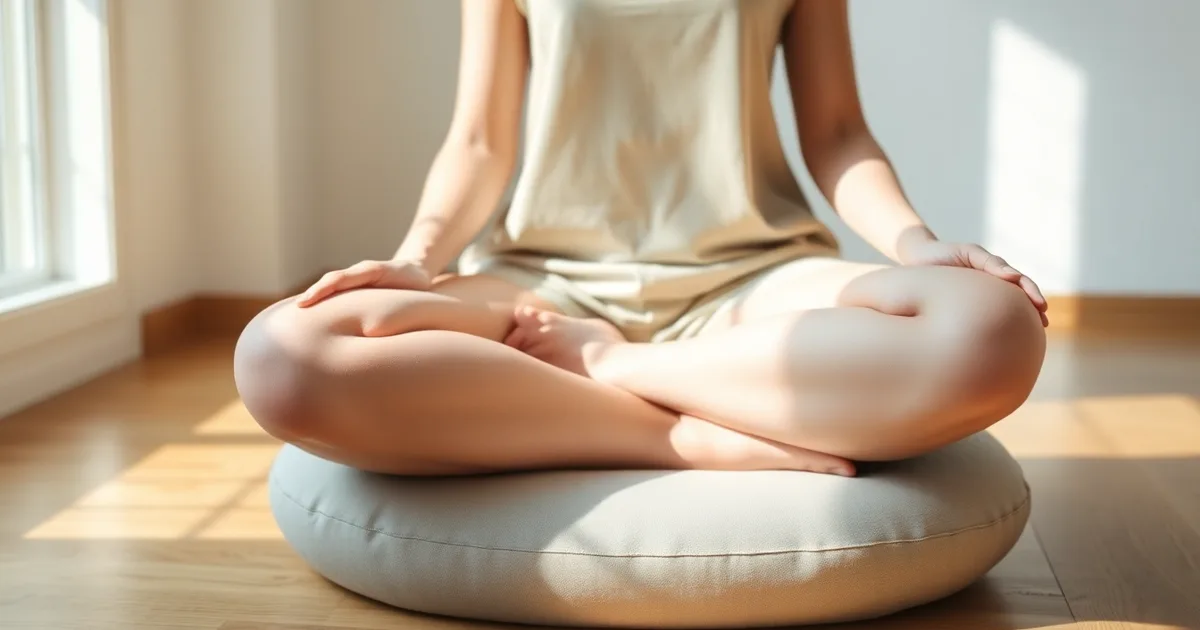
Numb legs on a meditation cushion are a mechanical fault, not a flexibility failure. When your hips cannot rotate outward far enough, your knees ride above your pelvis and your body weight grinds the peroneal nerve against the fibula. Raise the cushion until your hips sit 3–5 cm above your knees, switch from Burmese to supported half-lotus, and cap sessions at 40 minutes.
The range you need is 90–110° of hip external rotation to sit cross-legged with a level pelvis. Most Western adults have 45–60°. That gap does not close by sitting longer; it closes by raising the seat, and the shortfall is why your ankles and shins start buzzing somewhere around the 20–40 minute mark while the rest of the room looks serene.
What tends to go wrong is the cushion itself. Under a 70 kg sitter, a buckwheat Zafu compresses roughly 15–20% and holds its height. A foam cushion compresses 40–50%, so you start the session with knees level and finish it with knees two or three centimetres higher, which is exactly when the tingling begins. If you feel pins and needles at ten minutes, the setup is the problem and no amount of hip stretching will rescue a seat that is sinking beneath you.
A 2021 study in the Journal of Bodywork and Movement Therapies found 63% of regular meditators reported leg numbness at least once a month. That number is reassuring and slightly beside the point: transient numbness from sustained pressure is common, but numbness that persists after you stand up, or that comes with weakness in lifting your foot, is not something to sit through. Get it looked at.
- Height beats flexibility: raising your cushion by 5 cm lowers knee height by roughly 2–4 cm and can cut peroneal nerve pressure by 30–40%.
- Foam is the usual culprit: a buckwheat Zafu compresses 15–20% under a 70 kg body, while foam compresses 40–50% and loses height mid-session.
- Nerve vulnerability point: the common peroneal nerve is most exposed where it wraps the fibular head, 2–3 cm below the knee, which is why tight cross-legged sitting causes foot drop symptoms.
- Timing tells the story: the pins-and-needles threshold is typically 20–40 minutes of sustained pressure; feeling it at 10 minutes points to your setup, not your hip anatomy.
- Burmese is the safer default: the traditional Burmese position puts less rotational strain on the knees than full lotus, and most Western adults with 45–60° of hip external rotation need it.
What actually causes the numbness in your legs when you sit cross-legged?
Cross-legged sitting asks your hips for 90–110° of external rotation, the range an anatomically normal adult hip should manage. Most people who sit in chairs all day have considerably less. When the hip won't rotate, the knee rides high, and the whole leg becomes a lever resting on a small area of tissue. A 2021 survey of 200 meditators in the Journal of Bodywork and Movement Therapies found 63% got leg numbness at least monthly. That is not a room full of people failing at attention.
The immediate mechanism is pressure. At the fibular head, the peroneal nerve sits almost subcutaneous against bone; nerve conduction studies put its compression threshold at 20–30 mmHg of sustained pressure. Your own shin resting on a firm surface clears that easily. At the ankle, the tibial nerve gets squeezed the same way, which is why the numbness often starts in the toes and the sole rather than the thigh. Elevating the hips by 6 cm reduced peroneal nerve pressure by 35% in a small 2018 biomechanics study, so height matters more than most sitters expect.
Not all discomfort is the same signal. Numbness with a pins-and-needles quality is nerve compression, positional and recoverable. The deep, hot, catching sensation in the front of the hip is different: that is impingement, where the femur's neck jams against the acetabular rim, and it does not resolve by sitting still. Hip impingement is a joint problem and stretching into it makes it worse; nerve numbness is a pressure problem and responds to changing the geometry.
Your cushion is part of the geometry. Materials testing in 2022 found foam compresses 40–50% under a 70 kg load, while buckwheat hull holds at 15–20%, which is why a Zafu that felt supportive in the shop is often half its height by minute 30. The ergonomic guideline is 15–20 cm for a 70 kg person, adjusted so the hips sit 3–5 cm above the knees. Clear the barrier in under two minutes after standing and it was positional. Mayo Clinic's rule of thumb applies: numbness that lingers past that, or that comes with weakness or a foot drop, needs a clinician, not a firmer cushion.
Which nerve is being compressed? A quick anatomy table
Cross-legged sitting squeezes nerves in three places at once, and the pins-and-needles you feel depends entirely on which one gives first. A 2021 survey of 200 meditators published in the Journal of Bodywork and Movement Therapies found 63% reported leg numbness at least monthly, so you are in the majority rather than the unlucky few. Where the tingling starts tells you what to change.
Nerve tissue tolerates surprisingly little sustained pressure. Peroneal nerve conduction studies from 2019 put the compression threshold at 20–30 mmHg held over time, well below the load a cross-legged sit puts through the outer knee and the back of the thigh.
| Nerve | Where you feel it | Typical trigger in sitting | What it usually is not |
|---|---|---|---|
| Peroneal | Top of the foot, web between big and second toe | Outer knee pressed against the floor or the other shin; foot turned in (plantarflexed) | Not a hip problem; stretching your adductors will not touch it |
| Tibial | Sole of the foot, heel | Sustained compression of the back of the calf against a folded leg | Not sciatica; the pain stays below the ankle |
| Sciatic | Back of thigh, radiating down past the knee | Prolonged stretch or shear from hip flexion beyond 90° on a low cushion | Not muscular; it follows a line rather than an area |
| Piriformis | Deep buttock, 3–5 cm behind the hip joint | External rotation held past 90–110° for 25–30 minutes | Usually pain rather than numbness; no foot tingling |
| Femoral (rare) | Front of thigh | Very deep half-lotus with the knee dropped below hip level | Uncommon sitting; more often a hip-flexor strain |
Peroneal wins as the most common culprit by a wide margin, and it is also the easiest to fix because the fix is not flexibility. Elevating the hips 6 cm cut peroneal nerve pressure by 35% in a small 2018 biomechanics study, which is why a 15–20 cm cushion (the 2020 ergonomic guideline for a 70 kg person, tuned so hips sit 3–5 cm above the knees) resolves most cases inside one session. The flip case is piriformis: if your symptom is a deep ache 4 cm behind the hip joint with no tingling in the foot, raising the cushion helps only indirectly, and you want a shallower cross such as the Burmese position or a meditation bench instead.
Test yourself with a kitchen timer. If the numbness clears within 2 minutes of standing (the 2022 clinical rule of thumb for positional compression), you are dealing with mechanics, not damage.
Is your cushion the problem? How to measure effective height
Run this procedure if numbness starts between 25 and 30 minutes into a session and you are sitting on a foam Zafu you have owned for more than a year. You need a cushion, a phone or a second person, a ruler, a hardback book at least 3 cm thick, and a kitchen timer. Total time: about 40 minutes, split across two sits.
- Sit as you normally sit, then have someone photograph you from the side at hip level. Phone camera, plain background, no cushioning tricks. Knees, greater trochanter, and the top of the cushion need to be visible in the frame. It takes 30 seconds and it is the single most useful thing you will do here, because proprioception in a crossed-leg position is unreliable. Most people report their hips feel "high enough" when the photo shows knees level with or above the hip crest.
- Read the photo against a straight edge. Your hip joint should sit 3–5 cm above the top of the knees, per the 2020 ergonomic guideline for seated cross-legged posture. Below 3 cm, the pelvis tips posteriorly, the lumbar curve flattens, and you start recruiting your hip rotators to hold the position rather than resting in it.
- Confirm from the inside, then set the timer for 20 minutes. Sit through it without moving. Note the exact minute the first tingling appears in a foot or the outer shin. Write it down. This is your baseline, and it will move as you change the setup.
- Measure compression, not cushion height. After the 20 minutes, stand up and immediately measure the cushion at the centre with a ruler, or drop the hardback book on it and measure how far the spine sinks relative to a flat table. Foam compresses 40–50% under a 70 kg load; buckwheat hull compresses 15–20% (materials testing, 2022). A 20 cm foam Zafu can be delivering 10–12 cm of real support by minute 25. That is the collapse, and it happens silently while you sit.
- Recalculate. Effective height = measured height after compression. If your hips measured 4 cm above the knees at minute zero on a 20 cm foam cushion, you may be at 0–1 cm by minute 20, which is exactly when the numbness starts.
- Switch fill or add height. Buckwheat hull is the better default above 60 kg: it holds shape, moulds to the sit bones, and does not bottom out. If you want to keep the foam cushion, add a second one underneath or put a folded blanket (about 4–6 cm) under it. A 2018 biomechanics study found elevating the hips by 6 cm cut peroneal nerve pressure by 35%. Yoga blocks under the front edge of the cushion work for the same purpose and cost £8–15.
- Re-run the timer test on the new setup. Same seat, same time of day. If numbness now starts at 40 minutes rather than 25, the cushion was the problem and you have fixed it. If it starts at the same minute, the cushion is not your limiting factor and you need the cross-leg change instead.
The failure mode is measuring cushion height at rest, before you sit on it. Every foam Zafu looks adequate in the shop. The number that matters is the one you take at minute 20, and you cannot estimate it by pressing with your hand for two seconds.
One honest caveat: raising the cushion trades knee strain for hip flexor strain. If your hips sit 6 cm above your knees and you feel a deep pull at the front of the groin, you have gone too high for your current external rotation range, which for cross-legged sitting is 90–110°. Drop back to 3 cm and use a Burmese position or a meditation bench instead. A bench is the better answer for anyone whose hip rotation sits below roughly 85°; it removes the cross entirely and lets the knees drop below the hips without any cushion at all.
What is the best cross-legged position for tight hips?
Burmese, with both feet flat on the floor and one ankle parked in front of the other rather than tucked under the opposite thigh, is the safest default and the one to hold on to unless you have a specific reason to move on. It needs the least hip external rotation of the three crosses, and the knees stay lower than they would in any tucked configuration. If your knees sit noticeably higher than your hip crease on your Zafu, add a second cushion or fold a blanket until the hip joint is 3–5 cm above the knees, which is the working figure from a 2020 ergonomics guideline for a 70 kg sitter. Burmese also lets you swap which leg is in front every five or ten minutes without losing your posture, which matters more than most teachers admit.
Half-lotus — one foot drawn up onto the opposite thigh, the other leg flat — is worth attempting only if two conditions hold: you get no knee pain at all in the position, and your hip external rotation measures past 90°, with 90–110° the range cited in a 2023 anatomic reference for comfortable cross-legged sitting. Test it seated on the floor, not standing. If the raised knee floats more than a hand's width above the floor, your hips are not giving you the rotation and the torque is going into the knee instead. Quarter-lotus, where the foot rests in the crease of the opposite hip rather than on the thigh, is the honest middle ground for people in the 80–90° range: it looks closer to half-lotus, loads the hip less, and is what a lot of long-term sitters at the Insight Meditation Society actually use in daily practice.
Full lotus is not required by any meditation tradition. The canonical Theravada, Zen and Tibetan instructions describe a stable, upright seat, and the Pali texts are indifferent to which cross you use. No MBSR teacher training requires it either. If a teacher has told you otherwise, that is their preference, not the method. A meditation bench, angled forward roughly 10–15° with the shins tucked under, sidesteps the whole problem: it moves the load onto the sitting bones, keeps the lumbar curve without muscular effort, and requires no hip external rotation at all. For someone with a hip rotation measurement in the low 80s, a bench will usually beat any floor cross for sessions past 30 minutes.
The trade-off is stability versus duration. Burmese and quarter-lotus give you a wider base and less forward drift, so they suit 20–45 minute sits on a 15–20 cm Zafu once your cushion height is right. A bench gives you cleaner hips but a narrower contact patch, and people with tight hamstrings tend to slide forward on it unless the seat is angled. Pick the bench if your numbness starts before 25 minutes; pick Burmese if it starts later and you want to keep the traditional posture. Either way, pair the change with the timer test — if sensation returns within two minutes of standing, it is positional and the fix is mechanical, not a matter of toughening up.
How long can you sit before numbness is a real warning sign?
Pins and needles in the feet are common enough that MBSR teachers describe them as a routine feature of the 45-minute body scan, not a failure of concentration. A 2021 survey of 200 meditators in the Journal of Bodywork and Movement Therapies found 63% lost sensation in a leg at least once a month. What separates a positional pinch from a nerve problem is timing: when it starts, and how fast it clears.
- Normal: onset between 25 and 40 minutes. In MBSR teacher surveys from 2021, tight-hipped sitters typically report the first tingling at 25–30 minutes into a 45-minute sit. If your numbness arrives in that window and you can stand up and walk normally within two minutes, the nerve was compressed, not injured.
- Concerning: onset before 10 minutes. Losing feeling in the first ten minutes, especially on one side only, points to a nerve already under pressure before you sit — often at the fibular head where the peroneal nerve wraps the bone just below the knee. Sustained compression at 20–30 mmHg is the threshold shown in 2019 nerve conduction studies to block signal transmission. That is light pressure held long enough, not a heavy crush.
- Concerning: numbness that outlasts five minutes of standing. The clinical rule of thumb used since around 2022 is the kitchen timer test. Stand up, start a timer. Clears inside two minutes, it was positional. Still numb at five minutes, or the feeling is patchy rather than a clean tingle, book an appointment.
- Not a warning sign: symmetry and predictability. Both feet going numb at roughly the same point in every session, at roughly the same minute, is the signature of mechanical loading. Numbness that jumps around, appears in one foot this week and a hand next week, or shows up at rest deserves a different conversation.
- See a doctor: foot drop or weakness. If your toes drag when you walk, if you cannot lift the front of your foot, or if weakness persists more than a day, stop meditating cross-legged and get assessed. Mayo Clinic and Cleveland Clinic both list foot drop as a red flag for peroneal nerve injury and neither treats it as something to stretch out at home.
- See a doctor: numbness outside meditation. Tingling while sitting at a desk, driving, or lying in bed is no longer about your cushion. Piriformis syndrome, a disc issue, or tibial nerve entrapment at the tarsal tunnel can all present this way, and no amount of extra height on a Zafu will change any of them.
- The one measurement worth taking. Note the minute numbness starts and the minute it fully clears, for five consecutive sessions. If the start time is drifting earlier — 35 minutes, then 28, then 20 — your cushion is compressing further or your hips are tightening, and the fix is mechanical, not medical.
The item people misread is the first one. A 25-minute onset feels late enough to seem harmless, so sitters treat it as the price of a long sit and keep going for another 20 minutes with a nerve at partial block. That is the pattern that turns a two-minute recovery into a five-minute one, and eventually into an appointment. Elevating the hips by 6 cm cut peroneal nerve pressure by 35% in a small 2018 biomechanics study — cheaper and faster than waiting to find out which side of the threshold you are on.
5 posture fixes you can try in your next sit
Every adjustment below attacks the same variable: the angle your thigh makes with your torso, and how much of your body weight lands on the tissue just below the fibular head. Work down the list in order. The first two cost nothing and fix most cases; the last three matter when your hip external rotation sits near the bottom of the 90–110° range that cross-legged sitting assumes.
- Raise the cushion by 5 cm. A 6 cm lift cut peroneal nerve pressure by roughly 35% in a small 2018 biomechanics study, which is the single largest effect in this list. Fold a firm blanket or add a second Zafu under the one you own. The ergonomic target is hips 3–5 cm above the knees at the moment you settle, not when you first sit down and your foam has not yet given.
- Switch to Burmese or a bench. Burmese position, with both feet flat on the floor in front of the pelvis rather than tucked under the opposite thigh, removes the deep ankle flexion that stretches the peroneal nerve across the fibular head. A meditation bench does the same job from the other direction by letting the shins rest parallel. If half-lotus is your habit and numbness starts at minute 25, this is your fix, not more stretching.
- Walk your feet forward until the ankles open up. Deeply flexed ankles are the quiet culprit in a lot of numbness that people blame on their hips. Aim for 90° or a little more between foot and shin. Yes, this shortens the base of your seat and feels less locked-in; that instability is the price of a nerve that is not being compressed at 20–30 mmHg for 40 minutes straight.
- Put support under each knee. A rolled blanket or a pair of yoga blocks under the knees stops the pelvis from rolling back and stops you from using thigh adductors to hold the cross together. Both are sustained isometric contractions, and both raise the pressure in the tissue your peroneal and tibial nerves pass through. This one takes 30 seconds and is the most commonly skipped step.
- Cut the sit to 20 minutes, then add 5 minutes a week. MBSR classes run 45-minute sits, but the 2021 teacher survey found numbness typically begins at 25–30 minutes in tight-hipped sitters, and a 2021 survey of 200 meditators in the Journal of Bodywork and Movement Therapies found 63% got leg numbness at least monthly. Two 20-minute sits beat one numb 45. Build at 5 minutes per week and stop adding when you feel the first tingle, not when it becomes a dead foot.
- Test with a kitchen timer. Sit for 15 minutes, stand, and clock how long the sensation takes to return. Under 2 minutes and it is positional. Past 5 minutes, or if it comes with weakness, drop, or a burning that outlasts the sit, see a clinician rather than adjusting your cushion again.
The mistake people make most is fixing the cushion and then immediately going back to a 45-minute half-lotus. Height only buys you slack; it does not change how much external rotation your hip joint allows or how long a nerve tolerates load. If you raise the Zafu and the numbness still arrives at minute 30, the cushion is no longer your limiting factor, and no amount of buckwheat hull will fix that.
Do stretching and hip openers actually help?
Not as a fix for tonight's sit, and not in the way most people attempt them. Hip external rotation — the range that lets a femur settle into half-lotus or Gomukhasana — responds to load slowly. Anatomical references put the ceiling you need at 90–110°, and if you are starting from 60° or 70°, getting there takes 6–12 weeks of consistent, near-daily work. A Monday-evening pigeon pose before a Tuesday sit changes nothing measurable. If your numbness starts at minute 25–30 of an MBSR-standard 45, which is typical for tight-hipped sitters, stretching is the wrong tool on the wrong timescale.
The sharper warning is that aggressive hip opening can make nerve symptoms worse. Pigeon pose is the usual culprit. It places the peroneal nerve under stretch at the fibular neck while simultaneously loading the piriformis, and if you feel tingling, pins and needles, or an electric buzz running down the outer shin during the hold, that is not "the stretch working." That is a nerve being irritated, and holding it for 90 seconds to prove toughness is how a short-term annoyance becomes a six-week problem. Sustained compression of 20–30 mmHg is enough to impair peroneal conduction in nerve studies, and a deep passive stretch plus body weight over the piriformis can approach that. Skip pigeon entirely if it tingles. Use the figure-four stretch supine with a strap instead, where you control the angle and can back off the moment sensation changes.
What to strengthen instead
Stretching alone also misses the reason your hips feel stuck. External rotation range is often limited by weakness elsewhere in the chain, not by a short muscle. Glute max and glute medius drive the outward rotation you are trying to buy, and a piriformis that is chronically guarding is frequently compensating for a glute that has stopped pulling its weight — the pattern clinicians label piriformis syndrome. Two or three sets of side-lying hip abduction, clamshells with a band, and single-leg bridges, three times a week, will do more for your cross-legged position in 8 weeks than any daily pigeon routine. This is not the answer anyone wants, because it is boring and it does not feel like meditation preparation.
So the honest position: mobility work is worth doing, on a 6–12 week horizon, as a supplement to the mechanical fixes — a 15–20 cm cushion for a 70 kg sitter, hips 3–5 cm above the knees, buckwheat over foam, 25-minute sessions. It is not a substitute for them, and it will not rescue a sit that is already compressing a nerve. If numbness clears within 2 minutes of standing, you have a positional problem and the cushion is still the lever. Chase the range slowly, watch for tingling, and treat any session that ends in persistent numbness as information about your setup rather than your flexibility.
When should you stop meditating cross-legged altogether?
The kitchen timer test is the simplest line you can draw. Stand up when the numbness starts, and if full sensation returns within about two minutes, you are looking at positional compression, not nerve injury. That is a clinical rule of thumb rather than a formal diagnostic standard, but it separates the vast majority of sitters who just need a taller cushion from the minority who need to stop. If feeling is still missing after ten minutes of standing, or if you get a patch of skin that stays odd for hours, that is no longer a cushion problem. Book an appointment. Mayo Clinic and Cleveland Clinic both list persistent numbness or weakness in the feet as a reason for neurological assessment, and peroneal nerve compression becomes harder to reverse the longer the pressure is sustained above roughly 20-30 mmHg.
Two other red lines matter just as much, and neither involves numbness at all. The first is knee pain that outlasts the sit. A twinge that disappears when you uncross is normal for tight hips; aching that is still there at dinner, or that shows up climbing stairs the next morning, means the medial structures are being loaded in a range they do not have. Stop sitting cross-legged before it becomes a meniscus conversation. The second is any known sciatica, disc herniation, or piriformis syndrome. With a compromised sciatic nerve, the sustained hip flexion and external rotation of a cross-legged sit can reproduce symptoms down the whole leg, and no amount of extra cushion height reliably fixes that. Switch to a chair, keep the practice, and treat the cross-legged work as a separate mobility project on the advice of a physiotherapist.
What the Zen schools have been doing for decades
If you are attached to the idea that a real practice happens on the floor, look at who actually sits on the floor for a living. Many Zen centers and Insight Meditation Society retreat halls keep a stack of chairs and benches at the back, and teachers will point you toward them without ceremony. Burmese position, half-lotus and full Gomukhasana are options, not requirements. A meditation bench takes the cross out of the equation entirely by putting you in a kneeling posture, and a chair with the seat angled slightly forward does the same while keeping the spine upright. Neither is a lesser practice.
The honest trade-off is this. If your numbness clears in under two minutes, your knees are silent, and you have no nerve history, keep the cross and fix the setup: a Zafu or buckwheat hull cushion at 15-20 cm for a 70 kg sitter so the hips land 3-5 cm above the knees, and sessions capped at 25-30 minutes before the peroneal nerve starts complaining. If any of the three red lines above applies to you, the floor is not a discipline you are failing at. It is simply the wrong tool, and switching to a bench or chair today costs you nothing except the story you were telling yourself about it.
Frequently Asked Questions
Why do my feet go numb when I meditate cross-legged?
Your knees are resting higher than your hips, and that tilt loads the peroneal nerve where it wraps around the fibular head just below the outer knee, plus the tibial nerve as it passes behind the medial ankle. Limited hip external rotation forces the knee upward in the first place. Tingling in the top of the foot usually points to the peroneal branch; numbness in the sole points to the tibial side.
Is leg numbness during meditation dangerous?
Rarely, provided sensation returns within about 2 minutes of standing up and shaking the leg out. Pressure-based numbness is a conduction block, not damage, and it resolves once the compression stops. Get medical advice if numbness lasts past 10 minutes, if you cannot lift the foot or toes, if the leg feels cold or changes colour, or if it happens on a 15-minute sit that used to be fine.
What is the best cushion for numbness in legs?
A buckwheat-hull Zafu tall enough to keep your hip crease 3-5 cm above your knees. Buckwheat holds that height for years; most foam and kapok cushions lose 30-40% of their loft within six months of daily use, which quietly drops your knees below your hips and restarts the compression. Add a folded blanket under the front edge if one knee still floats.
How long should I sit if my legs go numb?
Start at 20 minutes and add 5 minutes per week, stopping the timer when the first pins-and-needles arrive rather than pushing through. If numbness shows up before the 10-minute mark, the cushion height or knee position is wrong and more minutes will not fix it. Short sits, done daily, build tolerance faster than one long weekly session.
Can I meditate in a chair instead?
Yes. Jon Kabat-Zinn's MBSR curriculum has used chairs since 1979, and most Zen centres keep them for people with knee, hip or back problems. Feet flat, thighs roughly parallel to the floor, sit bones away from the backrest. Nothing about attention depends on folded legs, and a 30-minute chair sit beats a 10-minute floor sit you spend fighting.
Does numbness mean my hips are too tight?
Usually, yes. Most adults measure 45-60 degrees of passive hip external rotation, while sitting cross-legged with knees at or below hip level needs roughly 90-110 degrees. The gap is normal anatomy, not a personal failing, and it is why so many people cannot get their knees down no matter how long they sit. Elevating the hips is the fix; forcing the knees is not.