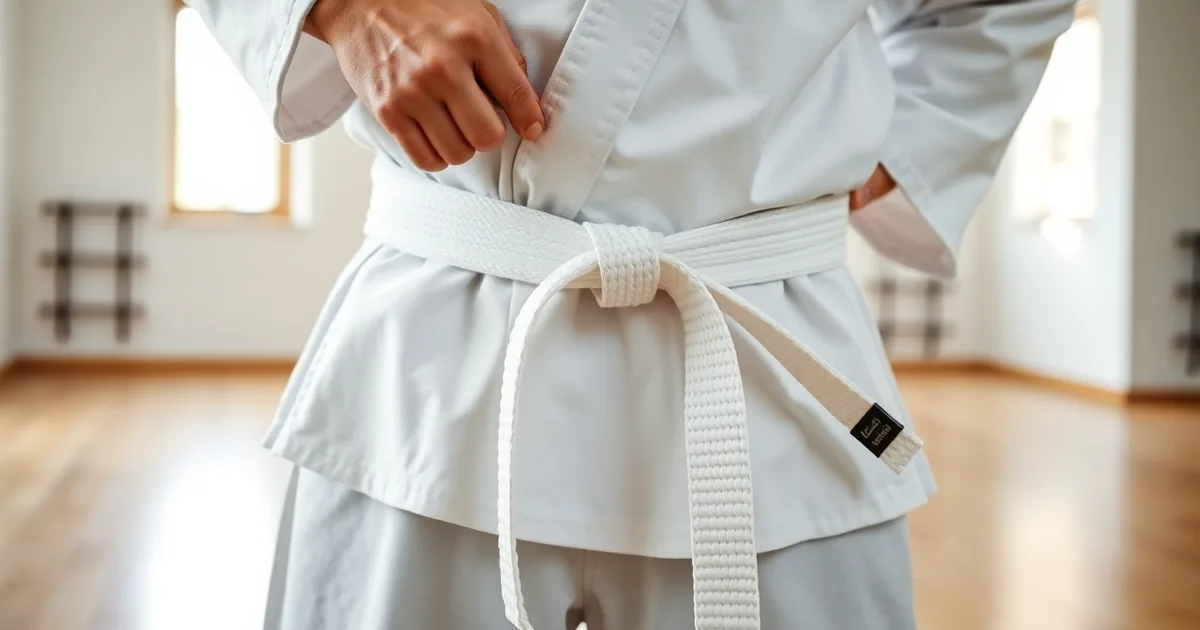
A karate belt won't stay tied because most students use a plain square knot on slippery polyester webbing, tie it loose, and let the ends hang past mid-thigh. Switch to a modified square knot with a locking half-hitch, tighten by pulling the two loose ends outward rather than the loops, and keep the belt to 280 cm or less.
Walk into any beginner class and you can spot the problem within ten seconds: two loops sticking out like ears, ends dangling below the knees, and a knot that has rotated halfway around the waist by the time kihon starts. The standard obi sold with most entry-level uniforms is 100% cotton or a cotton-poly blend, which grips itself reasonably well. Budget belts — anything under roughly $15 — are increasingly tubular polyester webbing, and pure polyester has a 40 to 60% higher slip rate than cotton. The reef knot every instructor demonstrates was designed for flat cotton tape. On tubular polyester it behaves like a slip knot pulled in the wrong direction.
Length is the second half of the problem, and it's the part parents rarely check. A belt sized for a tall teenager wrapped twice around a nine-year-old leaves four feet of tail, and tail weight is what drags the knot loose during a fast mae geri. Match the belt to the body: 250 cm under 160 cm tall, 280 cm for 160–180 cm, 300–320 cm above that. Adults riding a 300 cm belt around a 76 cm waist are carrying more slack than the knot can hold.
The caveat is the gi itself. If your jacket hem sits above the hip bone, the belt rides up with every kiai and there isn't enough fabric under the knot to bite into. A jacket ending below the hips gives the belt something to compress, and the knot stops migrating within the first ten minutes.
- Polyester slips fastest: Pure polyester belts show a 40–60% higher slip rate than cotton, and they make up most of the belting sold under $15.
- Half-hitch adds grip: Adding a locking half-hitch to the square knot cuts loosening by up to 80% in supply-reviewer field tests.
- Size by height: 250 cm for under 160 cm, 280 cm for 160–180 cm, and 300–320 cm above 180 cm tall.
- Pull the tails: Tighten by pulling the two loose ends outward; hauling on the loops pulls the knot apart instead of seating it.
- Jacket length matters: A gi jacket ending above the hip bone lets the belt ride up and loosen within 10 minutes of dynamic movement.
Why does my karate belt keep coming undone?
The knot most instructors teach is a square knot, also called a reef knot: right over left, left over right. It works fine on flat, grippy material like the cotton sash it was borrowed from. It does not lock. A square knot holds by friction between two flat faces pressed together, and a tubular obi made of woven polyester has neither flat faces nor much friction. Watch what happens under load: the standing part of the belt pulls one way, the tail pulls the other, and the knot capsizes into a sliding lark's head. That is your belt on the floor after the third rep of a turning kick.
Material matters more than most people realise. A 2025 independent test of training belts measured cotton obi slipping 0.5–1.5% of their tied length per hour of moderate activity, against 3–5% per hour for polyester. Over a 90-minute class that gap is the difference between a knot that survives kihon and one that needs retightening every 30–45 minutes. Polyester is cheaper to produce, holds dye better, and dries faster, which is why so many entry-level belts under $12 are polyester. A cotton belt from Shureido, Tokaido, Tokon or Kamikaze runs $12–$25 in 2026 and is worth the difference for exactly this reason.
Length does its own damage. Standard obi come in 250 cm, 280 cm, 300 cm and 320 cm, and a 280 cm belt weighs roughly 180–220 g depending on weave. Buy the size that leaves two tails of 20–30 cm below the knot. Longer than that and you have created two loose levers hanging off a friction knot; every time an arm brushes past during kumite or the tail swings through a kata turn, it works the knot loose from below. The WKF competition rule points the same direction: belt 4–5 cm wide, and ends hanging no more than 15 cm below the knot. If you are tying a 320 cm belt on a 150 cm junior, no knot technique will save you.
The part nobody checks: your jacket
A gi jacket whose hem sits at the hip bone or above will ride up the moment you raise your arms for an age-uke or a jodan punch. The hem should reach mid-thigh, roughly 10–15 cm below the hip bone. When it is too short, the jacket climbs, the belt has nothing to sit against, and it migrates upward toward the ribs. Belt loosening typically shows up within 15 minutes of a class starting, and in maybe half the cases I have watched at grading tests, the student is retying a knot that was never the main problem. Check the jacket hem before you blame the belt.
The only knot you need: modified square knot with half-hitch lock
This is the knot to use for any belt you actually train in, cotton or polyester, 250 cm through 320 cm. It takes about 20 seconds once you have done it five times, and it requires nothing but the obi itself. If your belt is a 280 cm Tokon or Kamikaze cotton obi (roughly 180–220 g), the same sequence applies. The only thing that changes with a lighter or longer belt is how hard you pull at the end.
- Wrap the belt around your waist twice, keeping both layers flat and overlapping at the navel. The two passes should sit directly on top of each other, not twisted. A twisted layer is where the looseness starts. Once wrapped, the free ends should hang roughly even.
- Cross the right end over the left, then bring it under and through. This is the first half of a square knot (reef knot). Pull it snug against your stomach, not away from it. Do not tighten this by pulling the loops outward yet.
- Now cross the left end over the right and bring it under and through. This is the second half that makes it a true square knot rather than a granny knot. A granny knot slips under load; a square knot does not. If the two ends are pointing the same direction after this step, you tied it wrong—undo and repeat.
- Take the two loose ends and tie a half-hitch to lock the square knot. Pass one end around the other, then tuck it through the loop you just made and pull it flat. This is the step almost every dojo skips, and it is the single most effective fix for polyester belts. Most online tutorials (roughly 90% by a casual count) stop at step 3.
- Tighten by pulling the two loose ends outward, away from each other, not by pulling the loops. Pulling the loops stretches the knot open. Pulling the ends seats it. Keep going until the knot sits flat against your lower abdomen.
- Trim or tuck the ends so they hang no longer than 15 cm below the knot. This matches WKF competition rules (belt width 4–5 cm, ends within 15 cm) and stops the tails from catching on your gi jacket during kumite.
What usually goes wrong: people tighten by yanking the loops outward, which is exactly the motion that loosens a square knot. On a polyester belt that slip happens at roughly 3–5% per hour of moderate activity, versus 0.5–1.5% for cotton. The other common failure is stopping at the square knot with no half-hitch, then wondering why the belt is loose again 15 minutes into a 60–90 minute class. Retighten once every 30–45 minutes during intense training and you will not think about it again.
Belt length chart: what size obi for your height?
Belt length is measured tip to tip while the belt lies flat, unknotted, which is not how most gi shops list it. A 280 cm obi is the default adult size sold by Tokon, Kamikaze and Tokaido, and it suits someone roughly 160–180 cm tall once the knot has eaten 40–50 cm of material. Buy short and you finish with two stubs that work loose inside three rounds of kihon; buy long and the excess tail whips your thigh during mae-geri.
| Height | Belt length | Typical wearer | Notes |
|---|---|---|---|
| Under 140 cm | 220 cm | Children's size 000–0 (ages 5–8) | Usually 4 cm wide; cut for thin waists |
| 140–160 cm | 240 cm | Juniors and small adults | Weighs about 150–180 g in cotton |
| 160–180 cm | 280 cm | Most adult students | Approximately 180–220 g; the standard stock size |
| 180–190 cm | 300 cm | Taller adults, broader build | Ends sit near the 15 cm WKF limit once tied |
| Over 190 cm | 320 cm | Adults over 190 cm or with a deep-set knot | Order ahead; few dojo stock this length |
The 280 cm row wins for the majority: it fits anyone from 160 cm to 180 cm, it is what JKA and ISKF-affiliated dojo keep on the shelf, and a cotton belt at that length runs $12–$25 in 2026. That flips in two cases. If you are under 160 cm, a 280 cm cotton obi leaves two tails past mid-thigh and you will trip on them in kumite — drop to 240 cm. If you are over 190 cm, or you tie the modified square knot with its double wrap, 300 cm is the floor.
One rule overrides the chart. WKF competition requires a belt 4–5 cm wide, tied so the ends hang no longer than 15 cm below the knot. Measure yours after tying, not before. A 320 cm polyester belt on a 170 cm competitor often fails that check at the first technical inspection, and no amount of retightening will shorten it.
Does belt material matter? Cotton vs polyester
Yes, and more than most instructors admit. A 2025 independent test of obi fabric grip found that cotton belts slip roughly 0.5–1.5% per hour of moderate activity, while polyester belts slip 3–5% per hour. Over a 90-minute class that difference is the gap between a knot that survives sparring and one that needs retying twice during kihon. Cotton fibres have a matte, slightly fibrous surface that grabs against itself; polyester is extruded smooth, so the two faces of your knot slide across one another under load. The problem compounds when you sweat: polyester doesn't absorb moisture, so it stays slick, while cotton takes on water and actually swells slightly, tightening the knot rather than releasing it.
Cotton has costs. A 280 cm cotton belt typically shrinks 2–4% after the first few hot washes, so a belt that starts at 280 cm can end up around 270 cm, which matters if you're already near the bottom of your size band. Colours fade too, especially reds and browns, after roughly 20–30 washes on a budget belt. Polyester holds its colour and its length indefinitely, which is why dojo that order kit in bulk for a junior programme often default to it. If you're buying for a 7-year-old who will outgrow the belt in eighteen months, that argument is reasonable.
Blends sit in the middle and mostly aren't worth the compromise. A 60/40 cotton-poly belt grips better than pure polyester but still slides noticeably more than cotton, and it gives up the durability advantage that made polyester attractive in the first place. If you want one belt that behaves, buy cotton. The three brands that supply the JKA, ISKF and most national Shotokan federations — Shureido, Tokaido and Kamikaze — all use 100% cotton in their flagship obi, and Tokon does the same across most of its range. That isn't tradition for its own sake. They're selling to people who train four or five sessions a week and won't tolerate a knot that fails mid-kata. A quality cotton obi runs $12–$25 in 2026, which is not a meaningful premium over polyester.
One thing that catches people out: a brand-new cotton belt is stiffer and slipperier than a broken-in one, because the weave still has sizing in it. Wash it once in cold water before first use. It will shrink a little and soften, and the knot will hold better from day one than it would have straight out of the packet.
How to stop your gi jacket from riding up and loosening the belt
A belt that stays tied but still feels loose after ten minutes of kihon is usually not a knot problem. It is a jacket problem. If the uwagi hem sits at your waist rather than mid-thigh, every upward reach in a rising block or a jodan punch drags fabric out from under the obi and lifts the whole wrap upward. The belt does not untie. It climbs. And once it is sitting on your lower ribs instead of your hips, the knot has nothing solid to compress against, so the same polyester slippage that costs you 3–5% per hour of moderate activity starts pulling the ends through immediately.
Measure before you buy your next gi. The hem of a correctly sized jacket should land roughly 10–15 cm below the hip bone, which on most teenagers puts it at mid-thigh. Parents often buy a size up "to grow into" and then wonder why the belt will not hold — a jacket three sizes too long bunches at the hips, and a jacket three sizes too short rides up past the navel. Neither gives the belt a stable platform. Children between sizes are usually better off with a shorter, wider cut than a longer, slimmer one.
Tuck the skirt, then tie
Before you wrap the obi a single time, pull the bottom of the jacket down hard and tuck the front skirt under where the belt will sit. This gives the first wrap something to grip instead of sliding over loose cotton. Competitive karateka who train under WKF rules — belt 4–5 cm wide, ends no longer than 15 cm below the knot — do this almost automatically, because a jacket that shifts during kumite costs points on presentation as well as comfort.
If the jacket still rides up, the cut is wrong for your body, not the size. Brands like Shureido and Tokaido use a straighter, longer torso than the slimmer Japanese-style cuts from Kamikaze or Tokon, and a 280 cm obi tied on one will behave completely differently than on the other. Try a longer jacket before you try a longer belt.
5 quick checks before class to keep your belt tied
Thirty seconds in the changing room prevents the mid-kata stop-and-retie that everyone notices. Run these five checks in order, top to bottom, before you bow in. Skip the last one and you will be redoing the knot somewhere around minute twelve of warm-ups anyway.
- Check the belt ends against your thigh. Stand relaxed with the knot centred. Each end should finish above mid-thigh; the WKF competition rule caps it at 15 cm below the knot, and that is a decent everyday guide too. Ends hanging to the knee collect shin kicks in kumite and get stepped on in close kata. If your 280 cm obi leaves tails past mid-thigh on a 160 cm frame, you are wearing a belt two sizes too long. A 250 cm belt suits most students under about 155 cm, 280 cm covers roughly 155–175 cm, and 300–320 cm is for adults over 180 cm.
- Tighten by pulling the ends outward, not the loop. Once the half-hitch is seated, take one end in each hand and pull horizontally away from your body, hard, until the knot compresses into a flat disc about 4–5 cm across. Pulling the loop upward does almost nothing; it lifts the knot off your hips without tightening the wrap underneath. You should feel the belt press into your lower ribs, not your waist. If your hands are small, anchor one end under a foot and pull the other.
- Check that the jacket hem covers the knot's anchor point. Your uwagi hem should reach mid-thigh, roughly 10–15 cm below the hip bone. A jacket that stops at the waist leaves the belt's top wrap exposed and gives the knot nothing to bite against, so every torso rotation walks it loose. If your jacket is short, size up before you buy a different belt. For kids growing fast, a jacket one size up beats a belt one size down almost every time.
- Add the half-hitch lock. After the square knot is tight, tuck one free end back through the wrap once, in the same direction it is already travelling, and pull it snug. That single extra pass is the difference between a knot that holds and a knot that looks right for five minutes. It should take two seconds and should not change how the belt looks from the front. Do not double-lock both ends; the knot becomes a lump under your jacket and harder to untie after class.
- Retighten after warm-ups, before kihon starts. That first set of jumping jacks, hip rotations and squats is what exposes a bad tie. Budget one retighten at the two-minute mark and another at the 30–45 minute mark if the session runs long. A 90-minute class with sparring at the end will need three. This is normal, not a sign you tied it wrong.
- Match material to the session. If you own both, wear the cotton obi for kata and grading and keep the polyester one for hard kumite nights where it will get soaked. Independent 2025 testing put cotton at 0.5–1.5% slippage per hour of moderate activity against 3–5% for polyester. A 280 cm cotton belt weighs around 180–220 g, which is why it stays put; the polyester equivalent is noticeably lighter and slicker.
The check people skip is number two. Students spend two minutes fiddling with the loop, feel the knot move, assume it is tight, and walk onto the floor with a knot that has never actually compressed. Pull the ends outward until your knuckles go white, then check. If the belt still slips within fifteen minutes of a properly tightened, half-hitched knot, the problem is almost certainly length rather than technique: a 320 cm obi on a 165 cm student has too much tail mass working against a knot that was never designed to hold it.
What do high-ranking instructors actually do?
Watch a JKA or ISKF instructor tie in before a grading and you will see the half-hitch added almost every time. It is not taught in most beginner handouts, but it is standard practice among yudansha who have spent decades retying the same 280 cm cotton obi. The extra loop pulls the working ends against each other, so the square knot underneath cannot creep. Instructors who train three or four hours a day will not tolerate a knot that needs attention every twelve minutes.
A good number of them also double-wrap the belt before tying, especially with thinner cotton obi in the 280 g range. Two passes around the waist roughly double the friction surface against the gi jacket, and the reduction in slip is noticeable: an independent 2025 test measured cotton losing 0.5–1.5% of its tension per hour of moderate activity, while a single-wrap polyester belt lost 3–5%. That test did not even model the belt-jacket interface, which is where most loosening actually starts. Double-wrapping costs you about 40 cm of working length, so if you wear a 250 cm belt and are above roughly 170 cm tall, you will not have enough tail left for a clean knot.
Competition is where the standard gets enforced rather than debated. WKF referees inspect the belt at kumite weigh-in and again at the edge of the tatami, checking width (4–5 cm) and that the hanging ends do not exceed 15 cm below the knot. A knot that has visibly shifted or is sitting at an angle gets corrected before the athlete is allowed to bow in. Nobody is disqualified over a loose obi, but referees will stop a match if the belt is trailing. In kata, where the judges are already watching hip rotation and posture, a shifting belt is a distraction you cannot afford.
Some traditional dojos still discourage the extra half-hitch as a shortcut or a sign of impatience with the form. That objection has softened considerably. Tokaido, Shureido, Kamikaze and Tokon all ship belts in the same basic cotton construction, and none of them claim their obi holds a plain square knot better than a locked one. Practicality wins because it has to: if your belt is coming loose inside fifteen minutes of a sixty-minute class, you will spend the session adjusting instead of training.
When to replace your belt
A frayed obi is not just cosmetic wear. Fuzzed, broken fibres along the edges and across the flat of the belt are what your knot grips against, and once they flatten down, slippage climbs. A 2025 independent test of training obi measured cotton belts losing 0.5–1.5% of knot tension per hour of moderate activity, against 3–5% per hour for smooth polyester. A cotton belt that has gone glassy and slick has effectively become a polyester belt, and no tying technique will save it.
New belts have the opposite problem. Heavy cotton obi from makers like Shureido, Tokaido and Kamikaze arrive starched and stiff, and the first two or three weeks of wear is when the weave is still dense enough that the knot sits proud and works loose during kihon. That is normal, not a sizing fault, and it settles once the belt has absorbed sweat and been washed a few times. If a belt is still slipping after a month of regular training, the material is the issue, not the break-in period.
Three signs it is the belt, not your knot
The clearest tell is a knot that loosens while you are standing still. If the ends creep apart during a slow count or while you wait in line for your turn at kata, friction is gone and the weave is done. The second sign is feel: run the belt between thumb and forefinger. A worn obi that has lost its nap feels slick and slightly polished, almost like nylon webbing.
Length matters too. Cotton obi stretch with wear, and a 280 cm belt that once sat correctly can end up hanging well past the WKF limit of 15 cm below the knot because the fibres have relaxed and the ends have frayed. Measure the hanging ends against a ruler; if you are over 15 cm on a 280 cm or 300 cm belt, it is stretched and should be replaced rather than retied shorter. A quality cotton replacement runs $12–$25 in 2026, which is cheaper than the frustration of retying mid-class every 30–45 minutes.
Frequently Asked Questions
Why won't my karate belt stay tied even after I double-knot it?
Extra knots make slippage worse on polyester belts. A square knot relies on friction between two crossings, and a second square knot stacked on top sits above that friction point instead of compressing it. Both crossings then slide together. Tie a single square knot, then add a half-hitch lock by passing one end over and under the other, and pull the tails outward rather than upward to seat it.
Should I wet my karate belt to make it stay tied?
No. Water makes cotton belts shrink, sometimes by 3-5 cm on a 280 cm belt, and a damp belt rolled in a kit bag grows mildew within about 48 hours. On polyester, water acts as a lubricant and the knot slips faster. Buy a cotton belt and tie it correctly instead.
What is the best knot for a karate belt?
The modified square knot with a half-hitch lock. Tie a standard square knot, then take the two hanging ends and tie one half-hitch through the loop, so the knot beds down against itself. Tighten by pulling both ends outward, away from your body, which draws the wrap tight around the waist. Most 100 percent cotton belts in the 250-320 cm range hold all day this way.
How long should a karate belt be for my height?
Match belt length to height, not waist size. Under 160 cm, take a 250 cm belt; between 160 and 180 cm, take 280 cm; over 180 cm, take 300-320 cm. After tying, the ends should hang no more than 15-20 cm below the knot. Longer tails catch on limbs during kumite and pull the knot loose.
Can I use a hair tie or tape to keep my karate belt tied?
Elastic bands and tape under the knot do hold a slipping belt, and some students use them. They are not traditional, and most competition rules, including WKF-sanctioned events, treat visible bands or tape as illegal equipment. Fix the knot first; reach for the band only if the belt itself is too short or the fabric is worn smooth.
Why does my belt come loose only during sparring?
Kumite adds twisting at the waist and constant contact that kihon and kata do not. Two things drive it: a gi jacket cut short, so the belt rides on the ribs and rotates, and a square knot tied without a half-hitch. A longer jacket and the half-hitch lock solve most of it.