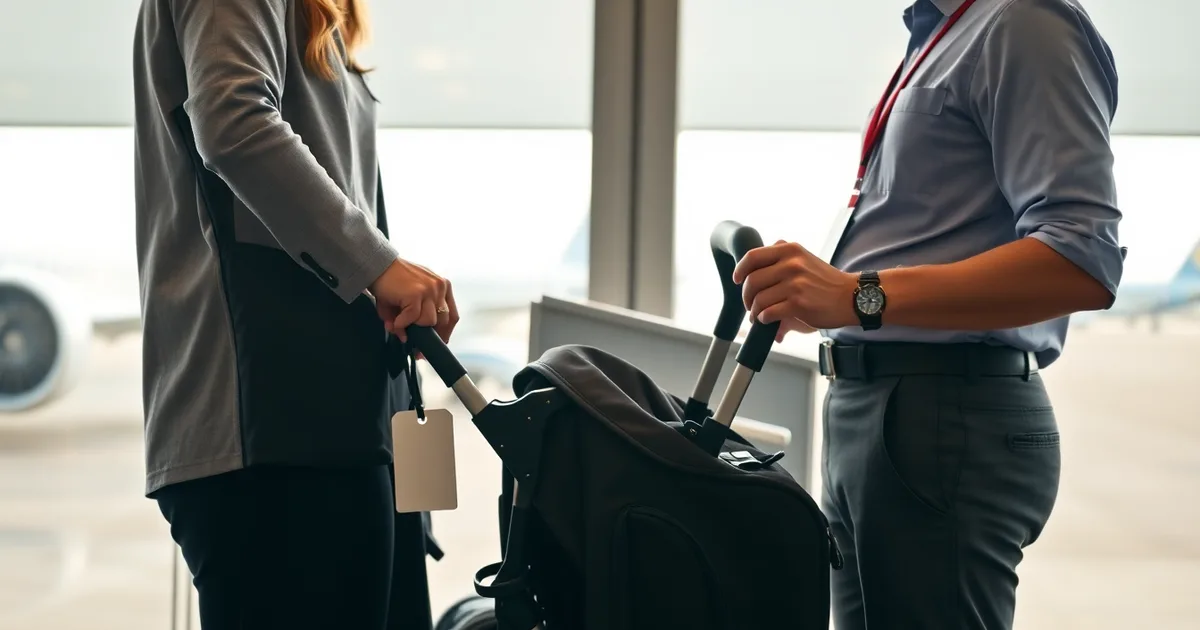
Yes, you can push a stroller all the way to the jet bridge and gate-check it there, and most airlines hand it back planeside when you land. The catch is connections: make sure the gate agent tags it to your final destination, not the layover city, or you will have to collect it and re-check it mid-trip.
Gate-checking is free on all four big U.S. carriers. American, Delta, United and Southwest each allow one stroller plus one car seat per child at no charge, and the stroller stays with you through security and down the jet bridge. Counter-checking it instead means it rides in the cargo hold with your luggage and reappears on the baggage carousel, which defeats the entire point for anyone whose toddler needs a seat between flights.
The number that catches parents off guard is 20 inches. A stroller folded to roughly 20 inches or less can sometimes go in the overhead bin, but most full-size models exceed that and must be gate-checked whether you like it or not. TSA screens strollers like any other carry-on: fold it, put it on the X-ray belt, and send it through.
Delta runs a loaner stroller program at a handful of airports if yours goes missing or shows up damaged, so ask the gate agent before you leave the arrivals area. Damage claims get much harder once you have left the airport.
- Free on major airlines: American, Delta, United and Southwest each gate-check one stroller and one car seat at no cost.
- Tag to final destination: A stroller tagged only to your layover must be picked up and re-checked, so confirm the tag with the gate agent before boarding.
- 20-inch folding limit: Strollers folded larger than roughly 20 inches generally will not fit an overhead bin and have to be gate-checked.
- Security handling: TSA requires strollers to be folded and placed on the X-ray belt at the checkpoint.
- Delta loaner service: Delta offers loaner strollers at select airports when a gate-checked stroller is delayed or damaged.
Can you bring a stroller through security and to the gate?
TSA treats a stroller the same way it treats a car seat or a diaper bag: you carry it to the checkpoint, fold it down, and send it through the X-ray on the belt. It comes out the other side, you unfold it, and you keep walking. The rule that trips people up is the fold. A stroller that will not collapse flat has to be inspected by hand, and on a busy Monday morning at O'Hare or Atlanta that hand inspection can add 10 to 15 minutes. Practice the fold at home until you can do it one-handed, because at the checkpoint you will be doing it while holding a baby.
From security to the boarding door, the stroller is yours. You can push it down the concourse, park it at the gate, and use it right up until the agent starts scanning boarding passes. Southwest, American Airlines, Delta Air Lines and United Airlines all allow one stroller and one car seat per ticketed child at no charge, and as of 2026 that gate-check fee is $0 on every major U.S. carrier. If your stroller fits the 2024 carry-on standard of roughly 22 x 14 x 9 inches folded, some crews will let you take it into the cabin and stow it in the overhead bin instead. A full-size stroller will not fit that envelope. A compact travel stroller usually will.
The reason to bring it to the gate rather than surrender it at the ticket counter is simple: a checked stroller rides with the bags and lands at baggage claim, which means you clear the airport, walk to the carousel, and wait for it while carrying both the child and everything else. A gate-checked stroller is tagged at the jet bridge, loaded last, and returned to you planeside on the jetway or just inside the arrival door, typically 5 to 15 minutes after you deplane. Industry estimates put gate-check damage at under 1%, which is low enough that a $30 stroller bag is optional rather than essential, though a bag does keep the fabric clean and the wheels out of other people's suitcases.
One check before you hand it over: confirm the agent has written or printed your final destination on the tag, not just the next city. Connecting flights are where this goes wrong. Of every 200 strollers that move through a connection, roughly one gets mishandled, and the usual cause is a tag that reads the layover airport because that was the segment on the boarding pass in the agent's hand. Say the final airport code out loud when you hand the stroller across. Southwest uses a two-part tag with the passenger name and destination on both halves, which is a decent model for what you want to see on any carrier.
How does gate-checking a stroller actually work?
Gate-checking applies once you have cleared security with the stroller and reached your departure gate. It costs nothing on American Airlines, Delta Air Lines, United Airlines or Southwest Airlines as of 2026, and the stroller stays in your hands until you are about to walk onto the aircraft. What the procedure needs from you is ten minutes of attention at the gate and one hard question at the counter if your itinerary has a layover.
- Ask the gate agent for a gate-check tag before boarding is called. Do not wait for the announcement. Agents start tagging roughly 40 minutes before departure on domestic flights and often stop once the queue forms. Southwest uses a two-part tag carrying your name and destination; most other carriers use a single tag with a tear-off claim stub. Both are free.
- Write your name, mobile number and final airport code on the tag in the space provided. A tag with only a first name is the single most common reason a stroller sits unclaimed on a jet bridge at the wrong airport.
- Attach the tag to the stroller frame, not the canopy and not the cup holder. Loop it through the handlebar hinge or the folding mechanism. If you are using a stroller bag, tag the bag itself and write the same details on a card inside.
- Fold the stroller at the gate area, not at the aircraft door, if the airline asks you to. Some carriers hand you a plastic bag for it; Delta keeps loaner strollers at more than 20 U.S. airports in 2025, which tells you how routine the handoff has become.
- Leave the folded stroller on the jet bridge or jetway just before you step through the aircraft door. This is the step people botch. Do not hand it to a Skycap, do not leave it at the top of the ramp unattended where a cleaner might move it, and do not try to bring it aboard unless it folds to roughly 22 x 14 x 9 inches, the 2024 carry-on standard, and fits in the overhead bin. Leave it upright against the wall where the agent indicated.
- Board and take your seat. The stroller is now in the airline's hands, not the cargo hold, until landing.
- At your destination, wait for the plane to empty rather than pushing into the aisle. Retrieve the stroller on the jet bridge or at the aircraft door, usually within 5 to 15 minutes of deplaning.
- If you have a connection, confirm the tag reads your final destination before you walk off the first jet bridge. Otherwise collect the stroller there and re-tag it at the next gate.
Damage rates are lower than most parents expect. Industry estimates put strollers damaged during gate-check at under 1% in 2025, and mishandling across connections at roughly 1 in 200 based on 2024 airline data. The dominant failure is not damage at all, it is misrouting: a tag reading the connecting airport instead of the final one puts the stroller on the wrong jet bridge, and you land at your destination with a toddler, no wheels, and a claim that takes days to resolve.
What happens to your stroller on a connecting flight?
Gate-check tags are routing documents, and the routing is whatever you say at the counter. If you are flying Southwest from Nashville to Sacramento with a change in Denver, the two-part tag the agent writes should read SAC, not DEN. Say the city pair out loud: "Onto Sacramento, please, we connect through Denver." On Delta and American, the tag prints from your record locator, so the correct final destination is usually automatic — but the agent still scans the stroller separately from your boarding pass, and a mis-keyed three-letter code is the most common way this goes wrong. Founded in 1971 and still writing tags by hand at many gates, Southwest is where you should be most deliberate about confirming the printed destination.
If the tag ends up reading your layover airport, the stroller gets delivered to the jet bridge there and you have to carry it off, walk it to the next gate, and gate-check it a second time. That is survivable on a 70-minute connection with a 22-pound toddler and a diaper bag. It is not survivable on a 40-minute connection in Charlotte. Ask to see the tag before you hand the stroller over. It takes four seconds and it is the entire fix.
When it transfers automatically, and when it does not
On most large U.S. carriers the stroller is transferred between aircraft by ground staff and reappears at your final jet bridge without you touching it. On regional partners operating under a mainline brand — American Eagle, United Express, Delta Connection — the handoff is between two different ground crews, and that is where the 1-in-200 mishandling rate for connecting itineraries comes from, per 2024 airline data. Less than 1% of gate-checked strollers are damaged, an industry estimate from 2025, but "damaged" and "delayed to baggage claim" are different failure modes, and the second one is more common on connections than the first.
Confirm with the gate agent at the first departure, not the second. By the time you land in Denver, the first crew is gone and the second crew has no record of your stroller beyond what the tag says. If you are told it will transfer automatically, get the agent to write your final destination on the tag anyway — a duplicate tag costs nothing and the stroller bag, if you use one, should carry a luggage tag with your name, mobile number and the same three-letter code. Gate-checking remains free on all major U.S. airlines as of 2026, so there is no fee incentive to check the stroller at the ticket counter instead, and every reason not to.
Which airlines allow gate-checking and what are their rules?
All four large U.S. carriers allow it, and none of them charge for it. That is the short version. The longer version matters because the rules diverge on exactly two things: what counts as a stroller you can take to the gate versus one that must be checked at the counter, and what happens when the stroller is bigger than a folding umbrella model.
American, Delta, United and Southwest all permit one stroller plus one car seat per ticketed infant or child, checked free at the gate. Small folding strollers that meet the roughly 22 x 14 x 9 inch carry-on envelope can sometimes go in the overhead bin instead, but only if the bin is not already full — and on a full flight it usually is.
| Airline | Gate-check cost | Allowance per child | Size limit at gate | Loaner strollers | Tag type |
|---|---|---|---|---|---|
| American Airlines | $0 | 1 stroller + 1 car seat | No hard limit; oversize goes to baggage claim | No | Single destination tag to final airport |
| Delta Air Lines | $0 | 1 stroller + 1 car seat | Folds to ~22 x 14 x 9 in for overhead bin | Yes, at 20+ U.S. airports (2025) | Two-part tag, destination printed |
| United Airlines | $0 | 1 stroller + 1 car seat | No hard limit; large joggers go to baggage claim | No | Single destination tag to final airport |
| Southwest Airlines | $0 | 1 stroller + 1 car seat | No hard limit; returned at jet bridge | No | Two-part tag with passenger name and destination |
| Carry-on alternative (any carrier) | $0 | Counts as your carry-on item | ~22 x 14 x 9 in folded (2024 standard) | n/a | None — stays with you |
Southwest wins on documentation. Its two-part tag carries both your name and your destination, which is the single most useful thing you can have when a stroller goes missing at a layover — mishandling runs at roughly 1 in 200 connecting itineraries, and an unlabelled stroller in a jet bridge pile is a stroller nobody can trace. Delta wins on the recovery path, because a loaner at more than 20 U.S. airports means you are not carrying a 22-pound toddler through Concourse B while your own stroller is somewhere in the system.
The flip case is the traveller flying a single leg on American or United with a full-size jogger. Both carriers set no hard gate size limit, but on a full flight a large stroller can be redirected to baggage claim rather than returned planeside, and that decision is made by the gate agent in the moment, not by policy. If your stroller genuinely does not fold under 22 x 14 x 9 inches and you are not flying Southwest or Delta, plan on waiting at the carousel. Damage rates for gate-checked strollers stay under 1% by industry estimate, so the risk is not destruction — it is a 5-to-15-minute wait after deplaning, or a misplaced tag on a connection.
Is it safe to gate-check a stroller?
Gate-checking is the lowest-risk way to fly with a stroller, but "lowest-risk" is not "no-risk." Industry estimates put stroller damage during gate-check at under 1% of items handled, and airline data from 2024 shows mishandling on connecting itineraries at roughly 1 in 200. Those are good odds. They are also the kind of odds that stop feeling abstract the first time you watch a Bugaboo come up the jet bridge with a cracked frame, so a little preparation is worth the ten minutes it costs.
- Use a stroller bag. A padded bag keeps grit, de-icing fluid and belt grease off the fabric and absorbs the kind of corner impacts that crack plastic hinges. The $30-$60 nylon bags sold by UPPAbaby, Joolz and generic Amazon brands are not armored, but they reliably prevent the scuffed-canopy and torn-basket damage that makes up most claims. If your stroller folds past roughly 22 x 14 x 9 inches, check the bag dimensions before buying, because an oversize bag will not fit the jet bridge tag rack.
- Strip everything before you hand it over. Cup holders, phone mounts, clip-on fans, snack trays and any aftermarket accessories come off at the gate. Airlines tag the stroller, not your Gear+ cup holder, and small attachments are the single most common thing that goes missing between the jetway and baggage claim.
- Empty the basket and any pockets. Diapers, wipes, your wallet, passports, a spare pacifier, a $400 tablet in the under-seat pocket: none of it is covered if the stroller is lost or delayed. Delta and American treat gate-checked items as limited-liability property, and that liability covers the stroller itself, not its contents.
- Photograph the stroller at the gate. Two or three phone photos, including a close-up of the brand plate and serial number, cost nothing and give you documentation if you file a claim. Take them before you hand it to the agent, not after you notice the damage.
- Report damage before you leave the airport. Go to the airline's baggage service office inside the terminal, not the gate agent who is already boarding the next flight. Most carriers require a written report within 24 hours; American and United both have kiosks or counters airside at hub airports. Once you walk out with the stroller, your claim gets much harder to win.
- Know the liability cap. On U.S. domestic flights, the Montreal Convention does not apply, and carriers set their own limits. Delta's domestic liability for gate-checked strollers is capped at $3,800 per passenger as of 2026, American at $3,800, United at $3,800. International itineraries fall under Montreal Convention rules at roughly 1,288 SDR (about $1,700 USD, fluctuating with exchange rates). A $1,500 travel-system stroller may not be fully covered on an international leg.
- Consider a loaner if yours is damaged. Delta keeps loaner strollers at 20+ U.S. airports, including Atlanta, Detroit, Minneapolis and Salt Lake City, available at the baggage service office. It is a basic umbrella model, not a substitute for your own, but it gets you out of the terminal with a tired toddler while you sort out the claim.
The thing parents get wrong most often is reporting damage to the gate agent. The agent is focused on turning the aircraft, cannot open a claim file, and will usually tell you to "call customer service." That call, made from home two days later, is where claims die. Walk to the baggage service desk in the arrivals hall or the airside service counter before you exit security, get a printed damage report with a reference number, and keep the stroller until the claim is resolved. Airlines will sometimes ask to keep the damaged item for inspection; you are entitled to photographs and a receipt before handing it over, and you should insist on both.
Can you take a stroller on the plane instead of gate-checking?
Sometimes, yes, but the stroller has to be small enough to pass as a carry-on. The practical ceiling is roughly 22 x 14 x 9 inches folded, the standard overhead-bin limit that has held steady since the 2020s. A handful of strollers actually clear that bar: the GB Pockit, the Babyzen Yoyo2 with the newborn pack removed, the Joolz Aer. Fold one of those and it drops into the bin the same way a hard-shell roller does.
Anything bigger gets gate-checked, and that is not the gate agent being difficult. Airlines treat full-size strollers, double strollers, joggers with 16-inch wheels and most travel systems as oversized items, because a Bugaboo Fox folded is still 26 inches long and will not fit any bin on a 737 or A320. If you show up at the door with one, you will be asked to leave it on the jet bridge whether you planned to or not.
The FAA does not certify strollers for the cabin
There is no stroller equivalent of the FAA approval that car seats carry for use in flight. A car seat with a "FAA-approved for use in aircraft" label can be strapped into a passenger seat; a stroller has no such pathway, so no airline is obliged to let one stay with you in the cabin, and none publishes a rule saying you can. What you get instead is a size judgement made by the gate agent, which is why the same stroller can board fine on a regional jet one week and get tagged at the door the next.
If the stroller does fit, keep it collapsed and stowed from the moment you board, not balanced in the aisle while you settle a toddler. Flight attendants will ask you to put it away, and on a full flight they will hand it back to the jet bridge if there is no bin space left.
What if your stroller is lost or damaged?
Say nothing at the plane and file the claim before you leave the terminal. The baggage service office — sometimes signed as "Baggage Claim" or "Central Baggage Services," and reachable by asking any Skycap or gate agent for the closest one — is where the paper trail starts, and a report filed from your kitchen two days later is a much weaker document. Do it at the airport even if the damage looks cosmetic, because airlines routinely deny claims submitted after you have taken the item home. Under U.S. Department of Transportation rules, a domestic carrier's liability ceiling is $3,800 per passenger as of 2026, adjusted periodically for inflation. That figure covers the whole journey, not each bag, so a damaged stroller and a lost car seat draw from the same pot.
What you actually recover is almost never $3,800. Airlines settle on depreciated value: a 2019 UppaBaby Vista bought for $900 might come back as $300–$400, and a $180 umbrella stroller as $60. Push back with evidence. Keep the original receipt in your phone's photo library, photograph the stroller before you fly — folded, tagged, on the jetway — and photograph the damage on arrival before you leave the baggage office. A written follow-up within 24 hours, quoting the file reference number, moves things faster than phone calls, and if the airline stalls past 30 days you can escalate to the DOT's Aviation Consumer Protection Division. Delta has been the outlier on goodwill: since 2025 it keeps loaner strollers at more than 20 U.S. airports, so you can leave with something usable while the claim is processed.
The odds of needing any of this are low. Industry estimates put gate-check damage at under 1% of strollers, and mishandling that separates a stroller from its owner happens on roughly 1 in 200 connecting itineraries. Almost all of those failures trace back to a tag printed with the wrong airport code — the reason the earlier rule about confirming your final destination on the tag matters more than any insurance policy. A stroller bag is worth the $25–$40 if you fly more than a few times a year; it will not prevent a crushed frame, but it stops the fabric damage and missing cup holders that make up most claims. If your stroller is genuinely irreplaceable, a special declaration of interest at check-in raises the liability limit, though it costs extra and most agents will tell you it is not offered for gate-checked items.
Tips for a smooth gate-check experience
Gate-checking is mostly a logistics problem, not a policy problem. The rules across American, Delta, United and Southwest are close enough that the same handful of habits work everywhere. What follows is the order of operations that keeps a stroller out of baggage claim and out of the lost-and-found bin.
- Get the tag at the gate, not the ticket counter. If an agent asks "checking anything today?" while you are still in the departures hall, say no. A counter-checked stroller rides in the cargo hold and comes back at the carousel, which defeats the entire point. Ask for the gate-check tag from the gate agent, usually 40-60 minutes before boarding, and keep the stroller with you until then. Southwest issues a two-part tag with your name and destination on it, and you keep the stub.
- Put your name and mobile number on the stroller itself. Not just on the tag. Tags tear off jet bridges with some regularity. A strip of masking tape on the frame with a phone number in permanent marker costs nothing and is the single thing that gets a misrouted stroller back to you. If you have ever watched a stroller come up the jetway and not recognised it as yours, you understand why this matters.
- On a connecting itinerary, read the tag before you hand over the stroller. It must show your final destination airport code, not the layover. A stroller tagged to Denver on a Denver-to-Boise trip lands in Denver, and you will not see it again until you file a claim. If the tag lists the first leg only, ask the agent to reissue it. Industry data from 2024 put mishandling on connecting itineraries at roughly 1 in 200 strollers, and most of those are tag errors rather than handling errors.
- Arrive early enough that the gate is not a fire drill. The tag-and-handover takes about two minutes, but it competes with pre-boarding, wheelchair assistance and the general chaos of a full flight. At a busy hub on a Monday morning, arriving 90 minutes before departure rather than 45 buys you the margin to fix a wrong tag. TSA will let you through with formula and breast milk above the 3.4-ounce liquid limit under the medically necessary exemption, but that screening takes longer, so build it into the same buffer.
- Fold it last and keep it upright on the jet bridge. Hand the stroller over already folded, wheels down, with nothing loose in the basket. A changing bag left in the under-seat storage is the most common thing to go missing, because it is not attached to the stroller and nobody thinks to look for it. Empty the basket at the gate.
- Ask for a stroller bag if the airline stocks them. Some carriers hand out plastic gate-check bags; Delta keeps loaner strollers at 20-plus U.S. airports if yours arrives broken or does not arrive at all. Less than 1% of gate-checked strollers are damaged in a given year by industry estimate, but the ones that are tend to be lightweight umbrella models with exposed plastic joints.
- Know where to wait on arrival. You will usually get the stroller back on the jet bridge, 5-15 minutes after deplaning, sometimes before the first checked bags hit the belt. Do not walk to baggage claim assuming it will meet you there. If it does not appear within 15 minutes, find the gate agent before they leave the podium, because that is when you have the most leverage and the least paperwork.
The one people get wrong most often is the connecting tag. It looks correct, it has your name on it, and nobody reads the airport code until the stroller is already in the wrong city. Read it out loud at the gate: "This says Boise, right?" It takes four seconds.
Frequently Asked Questions
Can you gate check a double stroller?
Yes. American, Delta, United, Southwest and JetBlue all accept double strollers at the jet bridge, and none of them count it against your carry-on or checked baggage allowance. The stroller has to be folded flat before you hand it over, so side-by-side doubles wider than about 30 inches folded can be refused at the door.
Do you have to pay to gate check a stroller?
No. Gate-checking a stroller is free on every major U.S. carrier, including American, Delta, United, Southwest, Alaska and JetBlue, and it has been since well before the 2016 FAA reauthorization that pushed airlines to formalize stroller policies. You pay nothing at the counter or the jet bridge. The only cost appears if you check the stroller as regular luggage and it pushes you over your airline's bag limit.
Will my stroller be brought to the gate at my layover?
Usually not. A stroller tagged to your final destination goes straight there, so on a connection you land without it and pick it up at the arrival gate of the last flight. If you need it during a layover, tell the gate agent before boarding and ask for a tag to the connecting city, then re-check it on the next leg.
Can you bring a stroller on a plane if it doesn't fold?
No. A stroller that will not fold cannot go in the cabin, full stop. It has to be gate-checked or checked at the ticket counter, and anything over roughly 20 pounds or longer than 32 inches folded may be sent to the cargo hold instead of the jet bridge. Full-size travel systems and jogging strollers with fixed front wheels are the usual offenders.
What is the best stroller for airplane travel?
Light and one-hand folding wins. The GB Pockit, at 9.5 pounds and small enough to fit under a seat when folded, and the Baby Jogger City Mini, around 17 pounds with a single-pull fold, are the two most commonly recommended for gate-checking. Both collapse in under five seconds, which matters when the gate agent is already calling your zone.
Does TSA require you to take your baby out of the stroller?
Yes. At every U.S. checkpoint you must remove the child and carry them through the metal detector or body scanner while the stroller goes on the X-ray belt, folded if it fits. Since the 2013 change, children under 12 no longer remove their shoes, but the stroller itself still gets screened like any other carry-on item.