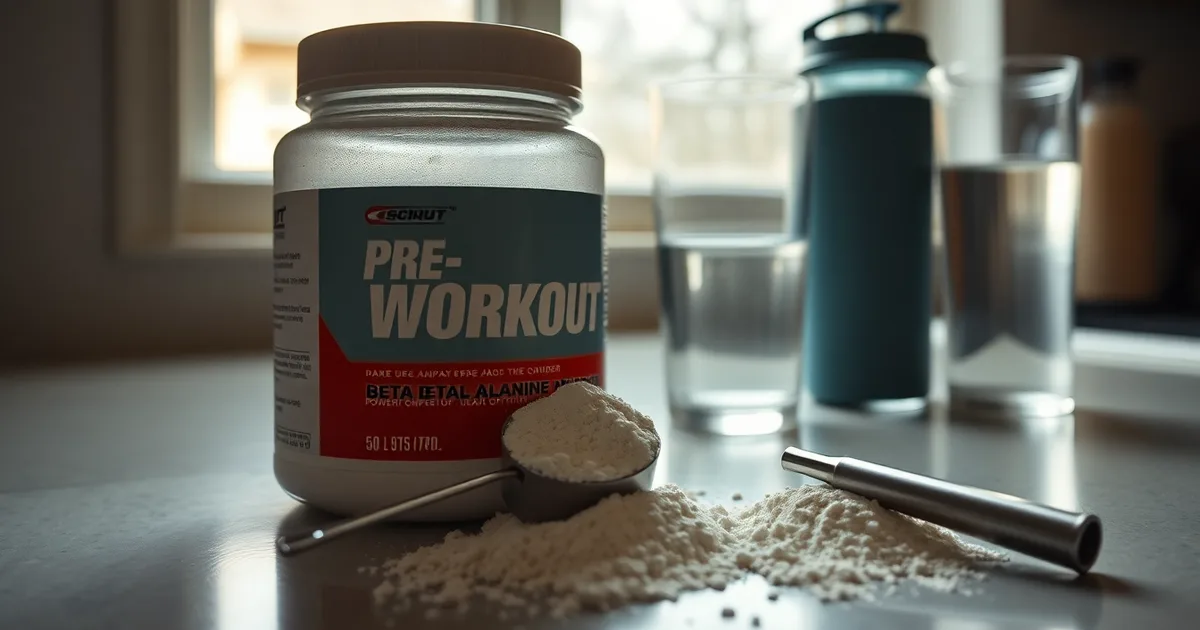
Most expired pre-workout is still drinkable. Caffeine in a sealed dry tub loses only about 5–10% potency by month 24, and beta-alanine just cakes because it pulls moisture from the air. If it smells normal and pours as powder, the sickness risk is your scoop size, not the date stamp.
That 2024 tub at the back of the cupboard is probably fine. A 400g container kept below 25°C and under 60% relative humidity is typically still fit at 24 months past manufacture, which is why the date on the bottom is a quality marker, not a safety cutoff. Under US FDA 21 CFR 111 and the EU's Directive 2002/46/EC, supplement expiry dates work like a "best before" on crisps.
Here is the number that catches people out. Caffeine degrades so slowly in dry powder that you cannot taste a 15% loss. Your usual scoop now delivers less stimulant, you feel nothing at 25 minutes, so you add a second scoop. That is how a stale tub turns into a racing heart and a flushing face at the gym, and it looks nothing like food poisoning.
Clumping on its own means very little. Beta-alanine is hygroscopic and will brick up in a humid bathroom cabinet within weeks of opening. Only when the tub is clumped and smells sour, musty or fishy has it actually taken on enough water to grow mould or bacteria. That is the one case where you bin it.
- Caffeine barely decays: sealed dry powder holds 90–95% of its potency at 24 months, per 2024 stability data, so a two-year-old scoop is not a weak scoop.
- Clumps are not spoilage: beta-alanine is hygroscopic and absorbs airborne water, so caking alone tells you nothing about whether the tub is safe.
- Smell decides it: clumped plus sour, musty or fishy means moisture has fed mould or bacteria — throw the tub out.
- Timing points to dose: flushing, tingling or a racing heart 30–60 minutes after scooping is niacin or too much caffeine, not bacterial contamination.
- Labels are quality dates: under FDA 21 CFR 111 and EU Directive 2002/46/EC, supplement expiry dates mark best-before quality, not a safety threshold.
What does the expiry date on pre-workout actually mean?
The date stamped on the bottom of your tub of C4 Original or Myprotein The Pre-Workout is a quality marker, not a safety deadline. In the United States, the FDA does not require supplement manufacturers to put a safety-based expiry date on the label. Under 21 CFR Part 111, current Good Manufacturing Practice for dietary supplements, a firm that chooses to print a "best by" date must be able to show the product still meets its identity and strength specs on that date. That is a shelf-life claim, not a toxicity threshold. The EU framework is even blunter: Directive 2002/46/EC permits a "best before" date on shelf-stable supplement powders but does not allow "use by", because these are not classified as highly perishable foods.
What the printed date assumes is that nobody has opened the tub. Once the foil seal breaks, the clock stops being about manufacture and starts being about moisture. Pre-workout blends are hygroscopic — they pull water out of the air — and a scoop in and out of a humid kitchen cupboard is a very different storage envelope from a nitrogen-flushed, sealed foil pouch. A 2022 ingredient test found beta-alanine holds its structure for at least 36 months sealed, but an open tub picked up 2–4% moisture over a comparable window, enough to drive clumping without necessarily degrading anything active. Caffeine is more stubborn than people think: a 2023 stability study in the Journal of Dietary Supplements tracked roughly 5–10% loss over 24 months in sealed, dry powder held at 25°C. That is a signal loss, not a dose that disappears.
Which is why the honest answer to "is my 2024-expiry tub safe" is usually yes, and the honest answer to "will it still work the same" is no. Sealed shelf life on pre-workout runs 18–24 months from the manufacture date, not from the day you bought it, and that date is printed on the base or the sidewall. A tub with a 2024 best-by sitting in a 2026 cupboard is somewhere between four and twenty months past that point depending on when it was made. The chemistry is boring. The behaviour it triggers is not, and that is the part worth talking about.
Which ingredients in pre-workout actually degrade?
Caffeine anhydrous is the most durable thing in the tub. A 2023 stability study in the Journal of Dietary Supplements put loss at 5–10% over 24 months in sealed, dry powder held at 25°C. That is a 300 mg scoop landing somewhere between 270 mg and 285 mg. You cannot taste that difference, which is exactly how people get into trouble — the label stays the same, so the brain quietly adds a second half-scoop and the next thing you know your resting pulse is 100 and your hands are shaking.
Beta-alanine sits at the other extreme. It is stable for at least 36 months and does not spoil — the tingling you feel is the ingredient working, not a sign of decay. What it does do is pull water out of the air. A 2022 ingredient test found open tubs picking up 2–4% moisture, and that is why your 2024 tub looks like wet sand. Clumping is a texture problem, not a safety problem. Creatine monohydrate is the one worth watching more closely: in humid conditions it cyclises into creatinine, and potency drops 10–20% over two years. Creatinine is not toxic at these quantities, but it is useless as a performance aid, so a clumped creatine blend is money already spent.
| Ingredient | Decay over 24 months | What it actually does | Safety concern? |
|---|---|---|---|
| Caffeine anhydrous | 5–10% loss (sealed, 25°C) | Loses potency invisibly; taste unchanged | No — 270–285 mg from a 300 mg scoop |
| Beta-alanine | 0% potency loss; 2–4% moisture gain | Clumps in open tubs | No — hygroscopic, not spoilage |
| Creatine monohydrate | 10–20% converted to creatinine | Becomes performance-useless | No — creatinine is inert at these doses |
| L-citrulline | Under 5% loss as dry powder | Degrades fast once dissolved in liquid | No — drink it within 24 hours of mixing |
| Niacin and B vitamins | 10–15% loss after 18 months | Sub-clinical shortfall on the niacin flush | No — well below any toxicity threshold |
Caffeine wins the durability contest and beta-alanine wins the safety one, which is the opposite of how most people think about it. The ingredient most likely to make you sick is also the one least likely to degrade, because caffeine's problem is not decomposition — it is dose drift. A 24-year-old who sleeps badly and doubles up on a six-month-old tub kept in a garage at 32°C has a much worse night ahead than someone finishing a sealed 2023 tub from a cool cupboard. Caffeine's LD50 sits at roughly 150–200 mg/kg body weight, so even a fully degraded 300 mg scoop is nowhere near toxic. The one case where the table flips: if your tub smells sour, musty, or faintly of ammonia, stop. That is not decay of the actives — that is mould, typically Aspergillus, which starts showing above 65% relative humidity and can carry mycotoxins that no dose adjustment fixes.
Does clumping mean bacteria?
No. Beta-alanine and creatine monohydrate are hygroscopic: they pull water vapour out of the air inside the tub and stick to each other. That is chemistry, not biology. A 2022 ingredient test found beta-alanine stable for at least 36 months but picking up 2–4% moisture in an opened container, which is plenty to turn a free-flowing powder into a brick. Nothing has grown in there. The lumps are the same molecules you paid for, just arranged worse.
Contamination looks and smells different. Mould needs sustained humidity above roughly 65% relative humidity before it becomes visible on protein or pre-workout powder (2021 food science data), and the species you would actually encounter — Aspergillus, various Penicillium — announce themselves. Sour, musty, or a fishy note that was not there when you opened it. Grey or green tint where the powder used to be uniform. Those are the tells, and they are not subtle if you actually sniff the scoop instead of dry-scooping out of habit. Mycotoxins are the reason to take this seriously rather than just picking out the lumps: they survive in the powder and are not destroyed by the water you mix it with.
If it is clumped and it smells off, bin it. Do not break it up, do not run it through a blender, do not convince yourself the flavour masks it. A 400g tub runs £25–£40 in the UK and $30–$50 in the US in 2026, which is a bad afternoon compared to a weekend of gastrointestinal misery. If it is clumped and smells exactly as you remember, keep going — that is a moisture problem, and the next section is about why the dose you scoop out of it has quietly changed.
How to tell if the caffeine is gone
You cannot measure caffeine at home. What you can do is build a rough signal out of three cheap observations: how it tastes, what the scoop weighs, and what your body does 45 minutes after you take it. None of these is a lab assay, and none of them will tell you the difference between a 6% loss and a 9% loss. They will tell you roughly whether you are dealing with a tub that has shed a fifth of its caffeine or one that is basically fine.
- Taste it dry, on the tip of your tongue. Caffeine anhydrous is aggressively bitter — the kind of bitter that lingers at the back of the throat. A tub that has degraded past roughly 20% tastes flat and chalky, more like cornflour than coffee. This test is directional only. Flavouring agents, sweeteners and the citric acid in fruit flavours all mask bitterness to varying degrees, so a weakly flavoured tub can taste dull even when the caffeine is intact.
- Weigh one level scoop on a kitchen scale. This is the test almost nobody runs and the one that actually matters. Pre-workout is hygroscopic — it pulls water out of the air — and a 2022 ingredient test found beta-alanine picking up 2–4% moisture in an open tub over a few months. Moisture means mass. If your scoop used to weigh 10g and now weighs 11g, you have not lost caffeine, you are taking 10% more of it per scoop. The scale costs £10–£15 and settles the question in ten seconds.
- Check the scoop against the label serving size. A 2026 label survey of mainstream pre-workouts put caffeine at 150–300 mg per scoop, with C4 Original and BSN NO-Xplode sitting near the lower and middle of that band respectively. If you have been eyeballing a heaped scoop for a year, you may have been running at 400 mg without noticing, which flips the whole problem: your tolerance went up, not your caffeine down.
- Give it 45 minutes, then be honest about what happened. If a dose that used to feel like a slap produces nothing at all after 45 minutes, assume more than 20% degradation and stop relying on that tub for training days. The 2023 stability study in the Journal of Dietary Supplements measured only 5–10% loss over 24 months in sealed, dry powder at 25°C, so a genuinely dead-feeling tub is usually a storage problem, not normal ageing.
- Rule out the boring explanations first. Slept seven hours instead of five. Trained fasted when you normally eat. Took it on top of a big meal. Any of these will flatten the perceived effect of a perfectly good 200 mg dose, and they are far more common than real degradation.
- Do not double-scoop to compensate. This is the actual injury mechanism. A 2020 toxicology review put caffeine's LD50 at roughly 150–200 mg/kg body weight, so a 300 mg scoop is nowhere near lethal even badly degraded — but 500–600 mg in one go in a 70 kg person who has not built tolerance produces genuine palpitations, tremor and a bad hour on the bathroom floor. Two scoops of a degraded tub can easily beat one scoop of a fresh one.
- Cross-check with the rest of the tub. Caffeine and beta-alanine do not decay on the same clock. Beta-alanine is stable for at least 36 months, so tingling that still shows up while the energy does not is a useful split signal: the paresthesia is intact, the stimulant is not.
The step people skip is the scale, and it is the one that changes the answer. A tub stored in a bathroom cupboard through a humid summer can gain enough water weight to push each scoop 5–10% over its labelled dose, which means an old tub may hit harder than a new one right up until it does not. Weigh the scoop before you decide anything.
Can an expired tub make you sick?
Almost certainly not from the powder itself. The symptoms people describe after a scoop of old pre-workout — racing heart, flushed face and neck, tingling scalp, a jittery feeling behind the eyes — are the standard signature of too much caffeine and a niacin (vitamin B3) flush, not of degraded ingredients turning toxic. Caffeine anhydrous does not break down into anything harmful; a 2023 stability study in the Journal of Dietary Supplements found only 5–10% loss over 24 months in sealed, dry powder stored at 25°C. For context, the LD50 for caffeine sits around 150–200 mg/kg body weight, so a 300 mg scoop — even a fully intact one — is nowhere near a toxic dose for an adult. What you are feeling is a dose problem, and it started the moment you looked at the old tub and thought "better use a bit more, this stuff is probably weak."
The genuinely dangerous scenario is moisture, and it looks different. Pre-workout powders are hygroscopic — they pull water out of the air, and once a tub is open, that process is running every time you leave the lid cracked or dip a wet scoop in. Above roughly 65% relative humidity, mould growth becomes visible, and the usual culprits are Aspergillus species, some of which produce mycotoxins. That is the pathway to actually being sick: GI upset, cramping, nausea, sometimes within a few hours of drinking it. If the powder smells musty or sour — not just "chemically," which is normal — or you can see discoloured patches rather than uniform clumps, that is spoilage, and it is a bin-it-on-sight situation. Clumping alone is not. Beta-alanine and citrulline pick up 2–4% moisture in an open tub without becoming unsafe, and a hard clump that breaks apart under a spoon is usually just humidity, not biology.
When the answer changes
Two groups should not gamble on an expired tub at all. If you have a mould allergy, asthma with a fungal trigger, or any immunocompromising condition, the risk calculus flips entirely — you are not the average 24–38-year-old lifter, and a colony you cannot see yet is still a colony. Bin it. The same goes for anyone who has already opened the tub and left it somewhere warm and damp, like a bathroom shelf or a garage, for more than a few months past its date. Everywhere else, the honest verdict is this: if it is clumped and off-smelling, throw it out; if it is just clumped, or just old, weigh your scoop properly and treat it as a weaker product, not a poisoned one.
One number worth knowing before you decide: shelf life on a sealed tub is 18–24 months from the manufacture date, not from the day you bought it, per brand lab data from 2026. That 2024-expiry tub was probably made in 2022. It has been sitting for four years. On a £25–£40 (or $30–$50) replacement, you are quibbling over the price of two coffees to remove an entire category of doubt. If you are already feeling off, that is your answer.
When should you throw it away?
This procedure applies to any tub of powdered pre-workout you have found past its date, whether that date is two months or three years old. You need the tub itself, a reasonably bright light, and about ninety seconds. Do it before you mix a scoop, not after — you cannot un-drink it, and the cost of being wrong is an afternoon of palpitations rather than a hospital visit.
- Smell the powder, not the scoop. Open the lid and put your nose near the surface. You are looking for sour, musty, or fishy notes. A faint sweet or chalky smell is fine and normal for a flavoured blend. Anything that makes you pull your head back is a bin. Takes five seconds.
- Look at the colour under a bright light. Off-white powders that have gone beige, pink, or greyish have oxidised. Then look for actual mould: it appears as fuzzy patches, usually white, green, or black, and tends to form at the edges and under the lid rim rather than in the middle. Mould growth on powder usually needs humidity above 65% to become visible, so if you see it, the tub has been wet for a while.
- Check the manufacture date, not the "best by" date. Sealed pre-workout is good for 18–24 months from manufacture, and brands often print a batch code instead of a plain date. If you cannot decode it and the tub is clearly older than three years, bin it. At that point caffeine has typically shed 5–10% (measured over 24 months at 25°C in a sealed, dry powder, Journal of Dietary Supplements, 2023) and you have no way to know what else happened to it.
- Ask where it has been living. This is the step people botch. A tub that spent two summers in a car boot or three years next to a shower has been cycling through heat and humidity cycles the whole time. The FDA requires a "best by" date under 21 CFR 111.70 but does not mandate a safety expiry, so the date tells you nothing about storage damage. Hot car or bathroom shelf: bin it. Kitchen cupboard, sealed, dry: carry on.
- Poke the powder with a dry spoon. Caking that breaks apart under light pressure is cosmetic. Powder that has fused into a brick, or that holds a dent when you press it, has absorbed moisture. An open tub picks up 2–4% moisture over time (2022 ingredient test data), and beta-alanine and creatine monohydrate are both hygroscopic enough to soak up more.
- If it passes steps 1–5, weigh your scoop rather than eyeballing it. A 400g tub costs £25–£40 in the UK or $30–$50 in the US, and typical scoop caffeine sits at 150–300 mg. If your usual serving tastes weaker than you remember, resist the urge to add a second scoop.
- Taste a small amount and spit it out if you want a final check. Bitterness that was not there before can mean degradation. A flat, chalky, slightly stale flavour is normal for old powder and is not a reason to bin on its own.
- When in doubt, replace it. A new tub is cheaper than a bad afternoon, and the arithmetic is not close.
The failure mode is the double-scoop. A 15% caffeine loss is undetectable by taste, so the tub feels weak, you add a second scoop, and you land 300–500 mg of caffeine in one go — well below the caffeine LD50 of roughly 150–200 mg/kg body weight, but comfortably enough to cause jitteriness, a racing pulse, and a sleepless night in someone who normally takes 200 mg. You have not been poisoned by old powder. You have dosed yourself twice.
What about beta-alanine tingling and flushing?
The two sensations people most often blame on an old tub show up on day one with a fresh one. Beta-alanine causes paresthesia, a prickling under the skin of the face, neck, hands and forearms, usually 15 to 20 minutes after a scoop and gone within an hour. It comes from the amino acid binding to sensory nerve receptors, not from anything growing in the powder. Beta-alanine is one of the more stable ingredients in the formula, holding up for at least 36 months in testing, so a 2024 tub is not producing more tingle than a 2026 one. If anything, an open container that has picked up 2 to 4% moisture weighs slightly heavier per scoop and delivers marginally more, not less.
Niacin, listed as vitamin B3 on the panel, is the other culprit. It triggers a flush: redness across the chest, ears and cheeks, warmth, sometimes itching or a prickling that feels like a mild sunburn. That is a pharmacological effect of nicotinic acid on blood vessels, and it is dose-dependent, not age-dependent. C4 Original and BSN NO-Xplode both carried enough niacin in older formulations that users reported flushing at half a scoop.
So when you feel your face heat up and your hands prickle, the ingredient did it. Degradation works the other way — a 5 to 10% caffeine loss over 24 months, some moisture pickup, maybe a flavour that has gone flat. None of those produce tingling. What can produce a genuine bad reaction is dose, and that is the trap: you cannot taste a small loss of caffeine, so you add a second scoop, and now you have 450 to 600 mg of caffeine and a real reason to feel shaky and wired. The tingle tells you the tub is working. It is not a warning sign that it has spoiled.
How to store pre-workout so it lasts
Everything you have read so far describes what happens to powder that was stored badly. Storage is the variable you control, and it moves the useful life of a tub by months. The rules below are cheap, boring, and about 90% of the reason one person's 2024 tub still scoops clean while another's turned into gravel by Christmas.
- Keep the lid sealed and keep the silica gel packet in the tub. That little sachet is not packing material, it is the moisture buffer. Brands running typical GMP lines size it for an 18–24 month sealed shelf life, and once you bin it you have removed the only thing absorbing the water your powder pulls from the air every time you open it. Leave it sitting on top of the powder, not buried, so it does not get scooped out.
- Store it cool and dark, below 25°C. A kitchen cupboard away from the oven, not the shelf above the kettle. The 2023 Journal of Dietary Supplements stability work found caffeine anhydrous loses roughly 5–10% over 24 months in sealed, dry powder held at 25°C; push the temperature up and that rate climbs. Direct sunlight does the same thing more slowly than heat but it does it, and the label on the tub fades before the powder does, which is a decent early warning you have picked a bad spot.
- Do not put it in the fridge or freezer. This is the advice people get wrong because it sounds like the advice for everything else. A cold tub is a condensation trap: every time you open it in a warm kitchen, moist room air hits cold powder and drops its water onto the surface. Repeat that twice a day for a month and you have manufactured the exact clumping you were trying to avoid. Cold storage only works for sealed, never-opened containers.
- Use a dry spoon, and never a wet hand. A scoop that has been sitting in a shaker with residue on it carries a few hundred milligrams of water into the tub each time. Over a year of daily use that is measurable. Keep one scoop in the tub and wash and fully dry the shaker separately — a dedicated scoop costs about £2 and removes the whole failure mode.
- Do not scoop over a running tap, a steaming kettle, or an open shaker. Beta-alanine is hygroscopic and picks up 2–4% moisture in an open tub according to 2022 ingredient testing; that moisture is what turns free-flowing powder into the brick you are now chipping at with a fork. Twenty centimetres of distance between the scoop and any water source is enough.
- Keep the original tub and its label. Decanting into a clear jar looks tidy and costs you three things: the light barrier, the silica packet's home, and the batch and best-by information you need if you ever do react badly. The FDA under 21 CFR 111.70 requires a best-by date on the label but no safety expiry, so that printed date is your only record of when the tub was made.
- Take what you need and close it immediately. An open tub sitting out while you train, shower and eat is an open tub for an hour. Relative humidity above roughly 65% is where mould growth on powdered supplements typically becomes visible, so a bathroom shelf or a garage in a humid climate is the worst place in the house for a £25–£40 tub.
The one people get wrong is the fridge. It feels like the careful choice, and for a sealed, unopened tub it genuinely is not harmful. For the tub you are scooping from daily it is the single fastest way to wreck the powder, because the damage happens in the thirty seconds the lid is off, not in the hours it sits cold. Cool cupboard, lid on, dry scoop. That is the whole method.
Is it worth using expired pre-workout for the caffeine?
If your 2024 tub passes the smell test and pours reasonably free, drink it. Just dose it like it is 10% weaker than the label says and stop there. Caffeine anhydrous loses roughly 5–10% over 24 months in a sealed, dry powder held at 25°C, according to a 2023 stability study in the Journal of Dietary Supplements. That is a 15–30 mg shortfall on a typical 150–300 mg scoop — below the threshold most people can taste or feel, which is exactly what makes the arithmetic dangerous. A 15% perceived weakness becomes a second scoop, and a second scoop is 300–600 mg in one go. Caffeine's LD50 sits around 150–200 mg/kg body weight, so poisoning is not the story; a resting heart rate of 110 and a bad afternoon at your desk is.
Competitive athletes under WADA testing should replace the tub rather than extend it. Degradation products and moisture-driven changes in an opened container are uncharacterised, and an anti-doping adverse finding from a supplement you cannot even prove was fresh is an unwinnable argument. Everyone else, weigh £25–£40 in the UK or $30–$50 in the US against a few days of GI upset. If you have already felt off after your last two servings, that decision has been made for you.
The honest split
Recreational lifter, tub kept in a cool cupboard, smells like the original flavour: use it, finish it within six weeks, take half a scoop first to confirm you tolerate it. Anything else — clumped hard, smells sour or like damp cardboard, stored in a car or a humid bathroom — bin it. Mould on powder typically becomes visible above 65% relative humidity, and by the time you can see it you have already been breathing the spores. A fresh tub is cheap. 21 CFR Part 111 requires a "best by" date but not a safety expiry, so that printed date tells you about quality, not about whether the contents are still food.
Frequently Asked Questions
Can expired pre-workout make you sick?
Only if the powder has absorbed moisture and grown mould or bacteria. Otherwise the ingredients themselves are not toxic after expiry; the realistic risk is dose-related effects such as caffeine jitters, a racing heart, or nausea from a 300 mg caffeine hit. Check the tub for clumps, discolouration or an off smell before you scoop.
How long after expiry is pre-workout still good?
Sealed and stored somewhere cool and dry, most pre-workout stays usable for up to 12 months past the best-by date, losing only a little potency. Past roughly two years, replace it. The best-by date is a quality marker, not a safety cutoff, but a 2021 tub sitting in a hot garage is a different proposition from one kept in a cupboard.
Does pre-workout lose potency over time?
Caffeine degrades slowly, losing roughly 5-10% of its potency over two years under normal storage. Beta-alanine and creatine are chemically stable, though creatine gradually converts to creatinine in the presence of moisture, which is why old tubs clump rather than turn dangerous. Expect a slightly weaker kick, not a dead formula.
Can clumpy pre-workout kill you?
No. Clumping is a moisture and texture problem, not a toxicity problem, and hardened powder cannot poison you. What matters is what caused the clumps. If they come with a musty or sour smell, mould is a real possibility, and mouldy powder can cause food poisoning. Bin that tub rather than risk it.
Why does old pre-workout smell bad?
Two things happen. The flavouring and aromatic compounds oxidise over time, which dulls or sours the scent, and moisture ingress lets mould or bacteria grow. A faint stale smell from oxidised flavouring is usually harmless. A sour, musty or rotten smell means microbial growth, and the tub should go in the bin.
Is it safe to take expired pre-workout before a workout?
Yes, if it looks and smells normal and the powder is still free-flowing. Two caveats: caffeine may be noticeably weaker after 18-24 months, so your usual scoop might underdeliver, and clumps mean uneven dosing, so one scoop could carry more beta-alanine or caffeine than the label states. Start with a half scoop.