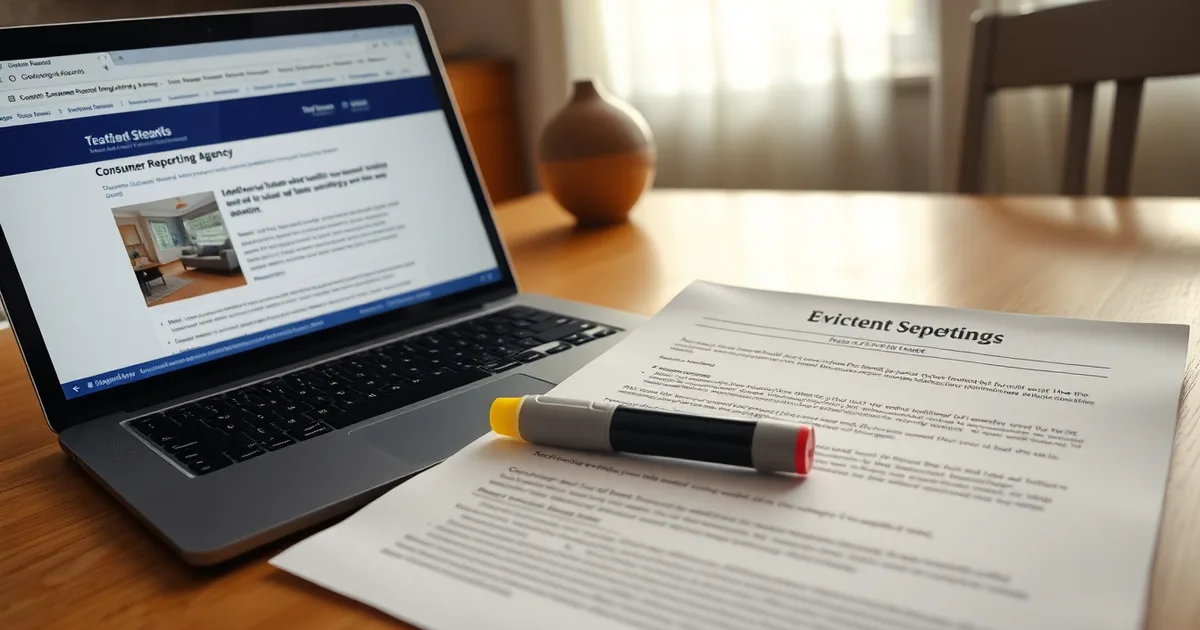
The eviction on your tenant screening report was likely never filed in court. Companies like TransUnion SmartMove and Experian RentBureau buy bulk courthouse data and often skip verification. Under the Fair Credit Reporting Act, you can dispute it directly with them, and they must investigate and correct or delete it within 30 days.
That adverse action letter you just got is the trigger. Under the FCRA, a landlord who denies you based on a consumer report has to tell you which company supplied it and give you a free copy of the report. That letter is your paper trail, and it names the agency you now dispute with. Keep it.
Here is the number that should not be possible but is: a 2021 study by the Public Housing Authorities Directors Association found that 1 in 3 eviction records sitting in tenant screening databases had errors or belonged to a completely different person. Not a typo in a middle initial. Someone else's case, attached to your name.
The reason is structural. These databases compile records from bulk courthouse runners — people paid to pull docket sheets in volume — and they frequently fail to check whether a case was actually filed, whether it was dismissed, or whether the person named is you. Courts in Cook County, Illinois, for example, automatically seal eviction records when a case is dismissed or the tenant wins. The screening database may not reflect that for months.
- 30-day reinvestigation rule: Under the FCRA (15 U.S.C. § 1681i), a consumer reporting agency must conduct a reasonable reinvestigation of your dispute and correct or delete the record within 30 days.
- 1 in 3 records wrong: A 2021 Public Housing Authorities Directors Association study found that roughly a third of eviction records in tenant screening databases contained errors or belonged to a different person entirely.
- Dispute the database, not the court: TransUnion SmartMove, Experian RentBureau and CoreLogic SafeRent are private consumer reporting agencies, so your FCRA dispute goes to them directly — there is no court case to vacate.
- CFPB portal forces a reply: Filing through the Consumer Financial Protection Bureau's complaint portal routes your dispute to the screening company and requires a response within 15 days.
- California adds statutory damages: The CCRAA allows $2,500 per violation for willful noncompliance, plus attorney's fees — a lever that exists in some states but not all.
How do tenant screening databases get eviction records that were never filed?
Most eviction data in a tenant screening report never passes through a judge. It enters the file through a supply chain: courthouse runners who physically visit a clerk's office and copy case indexes onto a laptop, bulk data purchases from county courts that sell their electronic dockets, and aggregators like LexisNexis Risk Solutions and CoreLogic SafeRent that resell those compiled feeds to consumer reporting agencies such as TransUnion SmartMove, Experian RentBureau and Equifax. Screening Reports, Inc. and RentPrep buy from the same pipelines. That first hop is where the discipline ends. A court docket entry means only that a case was filed. It says nothing about whether the tenant answered, whether the case was dismissed, whether the landlord dropped it, or whether the person named ever lived at the address. The Eviction Lab at Princeton University estimates roughly 70% of eviction filings never produce a judgment, so an index pulled straight from a clerk's terminal is a list of accusations, not outcomes.
Nothing in federal law requires these companies to call the court back and confirm that a record is real, complete, or attached to the right human being. The FCRA obliges them to follow reasonable procedures to assure maximum possible accuracy under 15 U.S.C. § 1681e(b), but a bulk purchase from a data broker is treated as satisfying that duty. Combine that with name matching done on software that has no mandatory minimum accuracy threshold and the errors compound in predictable ways. A 2021 study by the Public Housing Authorities Directors Association found that about 1 in 3 eviction records in tenant screening databases contained errors or misidentified the tenant. The usual causes are common ones: John Smith matched to a different John Smith in the same ZIP code, a thin-file applicant whose file gets merged with a relative's because three of four Social Security digits line up, or an old address that was once occupied by someone with a similar surname. When Cook County Circuit Court sealed or expunged a case, the aggregator that copied the docket two years earlier often never receives the update, so the record persists.
What this means for the letter you just received
That is why the adverse action letter in your hand cites a screening company rather than a court case number you can look up. Pull the disclosure the landlord was required to give you and identify which agency furnished the report. If the entry is not a court judgment, it is a commercial data entry, and the FCRA gives you the right to dispute it directly with that agency. The agency then has 30 days to investigate, and a furnisher must notify the agency of a correction within 5 business days under § 1681s-2(b). If the investigation confirms the record was never filed, dismissed, or belongs to a different person, the entry must be deleted or corrected. California residents have an additional lever: the Consumer Credit Reporting Agencies Act allows statutory damages of $2,500 per violation for willful noncompliance. A parallel complaint to the Consumer Financial Protection Bureau, which forwards to the company and requires a response within 15 days, frequently speeds things up. What goes wrong most often is consumers disputing with the landlord instead of the screening agency; the landlord is a user of the report, not the furnisher, and has no power to remove the entry.
Why a dismissed eviction still shows up on your record
A court filing is a public record the moment it is stamped, and that is the entire problem. The complaint gets indexed, and commercial screeners harvest it long before a judge rules on anything. Eviction Lab's 2023 research found roughly 70% of eviction filings never produce a judgment, which means the typical entry in a screening database describes a case the landlord lost, abandoned, or settled. Dismissal does not delete the filing. It just changes how the case ended.
Then nobody updates the record. When a Cook County Circuit Court case is dismissed, sealed, or expunged, the court corrects its own docket. TransUnion SmartMove, CoreLogic SafeRent, Experian RentBureau, and LexisNexis Risk Solutions each maintain separate copies, and there is no automatic sync back. A statewide sealing order in Illinois or Washington does not push a deletion into a database hosted in another state. A 2021 study by the Public Housing Authorities Directors Association put the error and misidentification rate in tenant screening databases near one in three, and stale dismissals are a large part of that number.
Here is the part most guides skip: disputing this with Equifax, Experian, and TransUnion often accomplishes nothing, because the credit bureaus are not the primary holders of eviction data. Specialty tenant screening companies are, and they sit under far thinner scrutiny. When a landlord rejects you, the adverse action letter names the actual source. Look at that name. If it reads SafeRent, SmartMove, RentPrep, MyRental, or Screening Reports, Inc., that is the furnisher you dispute with, and you should send the dispute directly to them even if you also file with the bureaus.
Your timeline is enforceable. Under the Fair Credit Reporting Act, once you dispute, the consumer reporting agency has a maximum of 30 days to investigate and correct or delete the item, and the furnisher must notify the CRA of any correction within 5 business days under FCRA § 1681s-2(b). Send it in writing, with the case number, the dismissal date, and a certified copy of the court docket. If the company stalls, a CFPB complaint gets a response within 15 days. California residents can stack the CCRAA on top, which carries $2,500 per violation for willful noncompliance. Sealing law compliance is genuinely spotty, so do not assume a state statute did the work for you.
It's not you: how name matching errors happen
A tenant screening report is assembled by a matching algorithm, not by a clerk who knows you. That algorithm takes the identifiers your landlord submitted — a name, maybe a date of birth, sometimes a Social Security number, often just the last four digits — and asks a database for anyone who looks similar. Most of the time it lands on the right person. When it doesn't, you inherit a stranger's court history, and the burden of proving it isn't yours falls on you.
The mechanics of those false matches are predictable enough to list. Here is what actually drives them.
- Common names collide. A search for "John Smith," "Maria Garcia," or "David Lee" returns a pool of hundreds of filings across a metro area. CoreLogic SafeRent and TransUnion SmartMove both score candidates rather than confirm them, so a name plus a rough age band can be enough for a hit. The rarer your name, the lower your risk — roughly, a top-100 surname raises your exposure by an order of magnitude over a unique one.
- Partial or missing SSN matching. Many landlords submit only the last four digits of a Social Security number, and some submit none at all. Four digits repeat constantly across a population of millions, so a "match" on last-four plus a shared ZIP code can pull in a record that belongs to someone else entirely.
- Address history creates ghosts. If you lived at 1420 Elm Street in 2019 and a different tenant was evicted at the same address in 2021, a record keyed to the address rather than the person will attach to you. Large apartment complexes with high turnover are the worst offenders because the same unit number appears in dozens of filings.
- Nicknames and maiden names aren't reconciled consistently. "Katherine" and "Kathy," or a name changed at marriage, may resolve to two separate identities — or the wrong one. Screener matching logic is not standardized across vendors, so RentPrep, MyRental, and Screening Reports, Inc. can each return a different candidate for identical input.
- Data furnishers resell without re-verifying. LexisNexis Risk Solutions, Experian RentBureau, and Equifax ingest bulk files from aggregators who scraped court dockets. Those files often contain filings with no disposition — the case was filed and then dropped, or the defendant won. About 70% of eviction records are filed but never produce a judgment, according to the Eviction Lab at Princeton University (2023), so a huge share of what's sitting in these databases is not an eviction at all.
- Error rates are high, not exceptional. A 2021 study by the Public Housing Authorities Directors Association found roughly 1 in 3 tenant screening records contained errors or misidentified the tenant. That is not a fringe failure mode; it is a third of the file.
- Identity theft and record merging compound it. If someone used your SSN or a similar one, and the tenant screening vendor merges records by proximity rather than exact match, their history becomes yours. This is the hardest category to untangle because the underlying filing is real — it just isn't about you.
The item people most often get wrong is the address match. Renters assume that if a record shows a street they never lived on, the dispute is open-and-shut. It often isn't, because the screener's response is "the name matched." You need to attack the identifier the algorithm actually relied on, which means demanding the file they used and the matching logic behind it — a right you have under the Fair Credit Reporting Act. That request starts a 30-day clock for the consumer reporting agency to investigate, and a 5-business-day clock for the furnisher to correct the record once the dispute is resolved (FCRA § 1681s-2(b)). If the agency stalls, the Consumer Financial Protection Bureau gives companies 15 days to respond to a complaint filed through its portal. In California, willful noncompliance can trigger $2,500 in statutory damages per violation under the CCRAA. The National Consumer Law Center maintains a running list of vendors that have been sued for exactly this pattern; it is worth checking whether yours is on it before you draft anything.
Your rights under the FCRA: dispute and demand correction
The FCRA dispute process is the only lever that reliably clears a phantom eviction, and it works whether the record came from Cook County Circuit Court or from a data broker that never saw a courtroom. It applies to any consumer reporting agency that assembles tenant files, which is a broader category than most renters assume: TransUnion SmartMove, Experian RentBureau, CoreLogic SafeRent, LexisNexis Risk Solutions, RentPrep, MyRental and Screening Reports, Inc. all qualify. What you need before you start: your government photo ID, a copy of the adverse action notice the landlord gave you, and a mailing address for the screening company. You do not need a lawyer to file a dispute. You may want one if the record reappears after deletion.
- Pull the full file, not the summary. The adverse action letter names the company and gives you a toll-free number and often a web address. Under FCRA § 1681g, that company must send you the complete file, free, if you ask within 60 days of the adverse action. Ask for everything: the record itself, the source of the record, the date it was reported, and who has pulled your file in the past 12 months. The free "tenant report" some sites hand you is a marketing extract and omits the fields you need to attack.
- Read the record for the four fields that identify it. Case number, court name, filing date, plaintiff. A real eviction judgment carries all four. If the entry lists "Cook County" with no case number, or a filing date with no disposition, you are disputing a database artifact rather than a court finding. Write those gaps down. They become the spine of your argument in step three.
- File a written dispute citing FCRA § 611. Send it by certified mail, return receipt, to the screening agency's dispute address, not its customer service address. State the specific item, state that it is inaccurate, and state why: "No eviction was ever filed against me in Cook County Circuit Court; the referenced case number does not exist." § 611 gives the agency 30 days from receipt to investigate and respond, extendable to 45 if you send additional documentation mid-investigation. The clock starts on delivery, not on the day you drop the envelope, so the return receipt is your evidence.
- Attach the counter-evidence, not just your denial. If the record claims a filing but no judgment, request a case search from the court clerk and send the "no records found" response. Roughly 70% of eviction records in the Eviction Lab's 2023 analysis were filed but never produced a judgment, which makes an empty judgment field a strong, checkable claim. A clerk's letter costs you a stamp and a few days. It carries more weight than any statement you write yourself.
- Dispute the furnisher separately. The company that submitted the record, often a property management platform or a data broker, has its own duties. Under FCRA § 1681s-2(b), once a furnisher receives notice of a dispute, it has 5 business days to notify the credit reporting agency of any correction. Send the same letter to the furnisher. Many renters skip this and wonder why the record reappears six weeks later.
- File with the CFPB the same week. The Consumer Financial Protection Bureau accepts complaints at consumerfinance.gov and forwards them to the company. Companies have 15 days to respond to a CFPB complaint, which is faster than the § 611 clock and creates a second paper trail. Do this in parallel, not after the 30 days run out. Attach the same documents you mailed.
- Copy your state attorney general. State AGs in California, New York, Illinois and Washington have active tenant screening enforcement. California's CCRAA allows statutory damages of $2,500 per violation for willful noncompliance, and California also caps eviction reporting at 7 years from the filing date, which matters if you are near that window. The National Consumer Law Center publishes a state-by-state summary of tenant screening statutes that is worth the read before you compose this letter.
- Demand deletion in writing, and set a follow-up date. When the agency responds, it must either delete the item or explain why it stands. If it deletes, ask for written confirmation and a corrected copy of your file. Diary the date 60 days out and pull the report again. If the item returns, that is a new violation and the basis for a claim under § 1681n or § 1681o, with attorney's fees available to a prevailing plaintiff.
The failure mode is treating the dispute as a phone call. Phone disputes to a screening agency's call center routinely end with a verbal "we'll look into it" and no record. The 30-day § 611 clock only starts on written notice, and only a certified letter or an uploaded dispute through a portal that timestamps receipt proves you sent one. Renters who call, wait, call again, and finally mail on day 45 have burned their leverage. Mail first. Call second. Keep the receipt.
A second, quieter failure: disputing the eviction as "not mine" without specifying why. The agency runs your name against its record, finds a match, and closes the dispute as verified. Name matching is where a third of these errors originate, and a bare denial does not break the match. You need a stated reason the record cannot be accurate, and the strongest reason available is a court clerk's letter saying the case does not exist.
How to seal or expunge an eviction record in 2026
Sealing and expunging are not the same thing, and landlords' screens treat them differently. Expungement destroys the record or returns the file to the parties; sealing keeps the case file intact but hides it from public view. Most states that have moved on this issue in the last three years have settled on sealing, because it preserves the court's own archive while closing the public terminal. Where your case sits depends on two things: the state where the filing happened, and whether the case ended in a judgment or was dismissed, settled, or never served.
California and Illinois are the two states where you may not need to file anything at all. California's AB 2819, effective 1 January 2025, requires courts to seal eviction records automatically when the case is dismissed, when the tenant wins, or when the parties settle before judgment. Illinois took a similar route through the Illinois Supreme Court's 2023 amendments to Rule 364, which direct circuit clerks to seal cases that end without a judgment against the tenant. If your eviction was dismissed in either state, the sealing may already have happened. That does not mean it is gone. Cook County Circuit Court seals the docket, but the commercial screeners that scraped the filing in 2023 still hold their copy.
Elsewhere you petition the court that heard the case, and you usually have to do it yourself. Filing fees run $50 in smaller jurisdictions and up to roughly $300 in busy metropolitan courts, and a handful of states waive the fee if you attach an affidavit of indigency. Some courts, including several in Ohio and Texas, will consider a motion to seal only if the case was dismissed, vacated, or resolved in your favor, so a judgment against you can be permanent without a settlement or a separate motion to vacate. New York's 2024 sealing statute, by contrast, covers cases that ended in the tenant's favor and allows a tenant who prevailed at trial to petition even years later. Expect the filing to be a one-page motion and a proposed order; judges in housing court see these routinely.
Sealing the court file is half the job
A sealed docket means the next landlord who runs a fresh search will not find it. It does nothing to the copy sitting inside TransUnion SmartMove, Experian RentBureau, LexisNexis Risk Solutions, or CoreLogic SafeRent, which pulled the data before the seal and have no obligation to re-check the courthouse. You have to file a dispute directly with each company, citing the seal order. Under FCRA § 1681s-2(b), once a furnisher receives notice of a dispute, it has 5 business days from completing its investigation to notify the consumer reporting agency of any correction. The agency itself has a maximum of 30 days to investigate your dispute. If the company confirms the record is now sealed or was never a judgment in the first place, deletion is the only correct outcome, and the 2021 PHADA study finding that roughly one in three eviction records in tenant screening databases is erroneous or misidentifies the tenant is the reason you should not take "updated" for an answer — an updated record that still reports the case has not been corrected.
If a company refuses to delete a sealed record, escalate. The Consumer Financial Protection Bureau accepts complaints at consumerfinance.gov and companies have 15 days to respond. California's CCRAA allows statutory damages of $2,500 per willful violation on top of actual damages, and the National Consumer Law Center maintains a state-by-state list of which screening companies have been sued and under what statute. Keep the certified mail receipts and the seal order in the same folder. The 7-year reporting window on an eviction starts from the filing date in California and from disposition in most other states, so a sealed 2019 case that keeps resurfacing in 2026 is past the line in either reading.
Which tenant screening companies are the worst offenders?
A 2021 study by the Public Housing Authorities Directors Association found that roughly 1 in 3 eviction records in tenant screening databases contained errors or misidentified the tenant entirely. That number is not evenly distributed across vendors. Some databases are compiled from court scrapers and updated weekly; others are fed by landlord self-reporting, which means nobody at the company ever confirmed the filing existed.
Dispute responsiveness is the sharper dividing line. Under FCRA § 1681s-2(b), a furnisher has 5 business days to notify the consumer reporting agency of a correction once a dispute is resolved. The maximum investigation window for the CRA itself is 30 days. The table below reflects publicly documented records, litigation, and regulatory filings as of September 2026.
| Company | Approximate records | Dispute turnaround (reported) | Notable legal history |
|---|---|---|---|
| CoreLogic SafeRent | ~85 million tenant records | 30-45 days typical | Class action filed 2020 in Massachusetts for failing to correct eviction errors; settled 2022 |
| TransUnion SmartMove | ~40 million rental records | 30 days (FCRA maximum) | Named in multiple CFPB complaints; no major class settlement as of 2026 |
| Experian RentBureau | ~30 million rental records | 30-60 days reported | Subject to 2022 CFPB supervisory review; no public enforcement action |
| LexisNexis Risk Solutions | ~50 million public records | 30 days | 2019 FTC consent order over inaccurate public records; $5.8 million civil penalty |
| RentPrep | ~5 million screenings per year | 21-30 days | No major class action as of 2026; not a database owner — resells other sources |
RentPrep is the least dangerous row here for one reason: it does not maintain its own eviction database, so its errors trace back to whichever upstream source it queried, which makes disputes traceable. LexisNexis has the worst documented track record — a 2019 FTC consent order and a $5.8 million penalty for precisely the problem described in this article. If you have to pick a vendor to dispute first, start with whichever one your landlord's adverse action letter names. That letter is your roadmap. If the letter cites TransUnion SmartMove, dispute with SmartMove directly and copy the CFPB. The 15-day CFPB response window applies to the complaint, not the dispute, but a CFPB complaint on file tends to move a 30-day investigation to the front of the queue. The flip case: if your landlord used RentPrep, disputing with RentPrep will get you a polite note pointing to CoreLogic or LexisNexis. Go there first.
What to do if a landlord denies you based on a false eviction
Start with the paper the landlord already owes you. Under the FCRA, an adverse action notice must identify the consumer reporting agency that supplied the report and give you its address, phone number, and a statement of your right to a free copy of that report within 60 days. If you got a verbal denial or a vague email instead, ask in writing: "Please send the adverse action letter and the name of the screening company you used." Most landlords use TransUnion SmartMove, Experian RentBureau, CoreLogic SafeRent, or LexisNexis Risk Solutions. Pull the free report, then read the eviction entry line by line — the court name, the case number, the filing date, the plaintiff. If the case number does not exist in that court's docket, you now have the single most valuable piece of evidence in this entire process.
File a written dispute with the screening company, not just the landlord. Send it by certified mail with return receipt, or use the CRA's online portal and then mail a paper copy anyway. State plainly: "I dispute the following item as inaccurate. No such eviction was ever filed against me. I have never resided at the address listed. Please reinvestigate and delete." Under FCRA § 1681i, the agency has 30 days to investigate — 45 if you send additional documents during the window — and it must forward your dispute to the furnisher of the data. That furnisher then has 5 business days under § 1681s-2(b) to notify the CRA of any correction. Ask the landlord in a separate, short email to hold your application open pending the dispute. Some will; many will not, and that is not a legal wrong on their part. Parallel to this, file a complaint with the CFPB at consumerfinance.gov. Companies generally answer CFPB complaints within 15 days because the response is public and tracked.
If the dispute comes back "verified"
Verified is not the same as accurate, and it is where most people give up. A 2021 study by the Public Housing Authorities Directors Association found that roughly 1 in 3 eviction records in tenant screening databases contained errors or misidentified the tenant; the Eviction Lab at Princeton puts the share of filed evictions that never produce a judgment at around 70%. If the CRA responds with a form letter confirming the entry without producing the court record it supposedly verified against, that is the fact pattern the National Consumer Law Center cites in FCRA litigation. Actual damages here are concrete: application fees paid, higher deposits, a motel month, a storage unit, a lease you lost. Document every one with a receipt.
Willful noncompliance opens the door to statutory and punitive damages plus attorney's fees, which is why these cases are routinely taken on contingency. The math depends on your state. In California, the CCRAA allows $2,500 per violation for willful noncompliance; most other states fall back on the federal FCRA, which caps statutory damages at $1,000 but permits punitive damages with no ceiling if you can show the agency or furnisher acted with reckless disregard. Note the reporting clock, because it decides how much runway you have: eviction records typically stay on a tenant screening report for 7 years, and California limits reporting to 7 years from the filing date rather than from disposition. A 2026 filing that never happened still burns years of your housing search. Dispute it now, in writing, and keep the receipt.
How long does a false eviction stay on your record?
Under the Fair Credit Reporting Act, an eviction record can stay on a tenant screening report for seven years from the filing date, not the date of any judgment. A case filed in March 2019 and dismissed that June still ages off in March 2026. Some states cut that window shorter, and California is the clearest example: the California Consumer Credit Reporting Agencies Act bars consumer reporting agencies from reporting evictions older than seven years from the filing date, and California courts have read that limit strictly against TransUnion SmartMove, Experian RentBureau, and CoreLogic SafeRent when they pushed older records. A handful of other states impose similar caps, so the effective retention period often depends less on the FCRA than on which state's law the CRA has to follow for your file.
You don't have to wait it out. Filing a dispute under FCRA § 611 starts a clock: the consumer reporting agency has a maximum of 30 days to investigate and either verify the record or delete it. If the record came from a furnisher like LexisNexis Risk Solutions or Screening Reports, Inc., that furnisher has five business days after completing its own review to notify the CRA of any correction under § 1681s-2(b). In practice, agencies rarely verify eviction records against the actual court file, and a PHADA study found that roughly one in three eviction records in tenant screening databases contains errors or misidentifies the tenant. When the CRA can't confirm the record within 30 days, the FCRA requires deletion. That's the fastest route most renters have.
Sealing or expunging the underlying court case is a separate move and often a slower one. Cook County Circuit Court and a growing number of other jurisdictions allow sealing of eviction filings that never resulted in a judgment, which matters because the Eviction Lab at Princeton University estimates about 70% of eviction filings never produce one. But sealing the court file does not automatically scrub the commercial database entry. TransUnion SmartMove, Experian RentBureau, and Equifax each maintain their own copies, and they don't always re-check the court docket after a sealing order. You typically have to send the sealing order to each CRA and dispute the entry directly, then follow up if it reappears.
If the CRA stalls or refuses to correct an obviously wrong record, escalate. The Consumer Financial Protection Bureau forwards complaints to companies with a 15-day response window, and state attorneys general in California can pursue statutory damages of $2,500 per violation under the CCRAA for willful noncompliance. The National Consumer Law Center keeps a running list of which CRAs and furnishers have the worst dispute-resolution records, and that list is worth checking before you decide how hard to push.
Preventing future false evictions: proactive steps
Disputing a false eviction cleans up the damage already done. It does nothing about the next one. The records that get attached to your name are assembled by commercial databases that match you on partial identifiers, so the practical work is making yourself harder to confuse with someone else and catching errors before a landlord does. That means treating your tenant file the way you treat a credit report: something you inspect on a schedule, not after a denial.
- Pull your tenant screening report once a year from each of the big three — TransUnion SmartMove, Experian RentBureau and Equifax — and from LexisNexis Risk Solutions, which maintains a separate rental history file many people never think to check. Under the FCRA you are entitled to one free file disclosure every 12 months from each consumer reporting agency, the same as with credit. CoreLogic SafeRent, RentPrep, MyRental and Screening Reports, Inc. will also send you your file on request; a handful charge a small fee, usually under $20.
- Set a calendar reminder for the same month every year, and again three months before you plan to move. Errors surface on a rolling basis as courts and property managers push new data, so a report that was clean in 2024 tells you nothing about 2026. If you are in a state with a one-year lease cycle, tie the check to your renewal date so it becomes automatic.
- Apply under a consistent, distinctive name and never vary the spelling. If your legal name is common — Maria Garcia, David Chen, James Williams — add your middle name or initial on every application, and keep it there. Use a suffix (Jr., III) if you have one. The single largest source of mismatches is a screening algorithm deciding that Maria A. Garcia of Oak Park is Maria L. Garcia of Berwyn because both leased an apartment within 40 miles of each other in the same year.
- Freeze your file with the tenant screening agencies, not just the credit bureaus. A security freeze placed with Equifax, Experian and TransUnion does not automatically stop SmartMove or RentBureau from selling a rental history report, because those are separate product lines with their own files. You have to request a freeze or fraud alert directly with each screening company. They are generally free, and you can lift them temporarily when you are actively apartment hunting — a thaw usually takes one business day online.
- Keep documentation of every tenancy, in one folder, indefinitely. Your signed lease, move-in and move-out inspection photos with timestamps, the final ledger, and any email where a landlord confirmed you left in good standing. If a database reports an eviction from an address you lived at, this is what you send with the dispute. Under FCRA § 1681s-2(b), a furnisher has five business days to notify the consumer reporting agency of a correction once it confirms the error, so the faster you can hand over proof, the faster the fix propagates.
- Know the deletion clock in your state and check that old records are actually gone. Most tenant screening reports drop eviction data after seven years, counted from the filing date in states like California that cap it there, but the counting rule varies and some agencies let records sit longer than the law allows. If you see an entry past the limit, that is a separate dispute, and you should raise it in writing rather than assume the system will expire it on its own.
- If a screening company stonewalls you, file with the CFPB and your state attorney general the same week. The CFPB forwards complaints to the company, which has 15 days to respond. That deadline does more to move a file than a phone call to a call center, especially with smaller agencies that have no real dispute infrastructure. In California, the CCRAA also allows statutory damages of $2,500 per willful violation, which is worth naming explicitly in your complaint if you are a resident there.
The step people skip is the one that matters most in practice: checking the report before you need it. Renters who order a file only after an adverse action letter are disputing under time pressure, with a lease already lost, when the FCRA gives the consumer reporting agency up to 30 days to investigate and the landlord is not going to hold the unit. A false eviction you find in March is an afternoon of paperwork. The same false eviction discovered two days before a move-in date is a housing emergency. Order the reports, freeze what you can, and put the renewal reminder on your calendar today.
Frequently Asked Questions
Can a landlord see an eviction that was never filed?
Yes. Landlords typically run a tenant screening report through a consumer reporting agency such as TransUnion SmartMove, Experian RentBureau, or RealPage, and they see whatever that database returns, not the underlying court docket. If a data broker loaded a case against your name by mistake, the landlord sees an eviction that no clerk ever filed.
How do I remove a false eviction from my tenant screening report?
File a written dispute with the screening company and attach a certified statement from the court where the case supposedly happened showing no eviction exists against you. Under the Fair Credit Reporting Act, the agency has 30 days to reinvestigate. If the record cannot be verified, it must be deleted. Keep copies of everything you send.
What is the FCRA dispute process for eviction records?
Under FCRA § 611 (15 U.S.C. § 1681i), you send a written dispute to the consumer reporting agency, not the landlord, identifying the specific inaccurate entry and why it is wrong. The agency must conduct a reasonable reinvestigation within 30 days, extendable to 45 days if you supply additional information during the window, then correct or delete anything it cannot verify.
Can I sue a tenant screening company for a false eviction?
Yes, if the company violated the FCRA willfully or negligently. Willful violations under § 1681n allow actual damages plus statutory damages of $100 to $1,000 per violation, punitive damages, and attorney's fees. Negligent violations under § 1681o allow actual damages and fees but no statutory or punitive award. Consult a consumer law attorney about the 2-year or 5-year filing deadlines.
How long does an eviction stay on a tenant screening report?
Roughly seven years from the filing date, though the clock and start date vary. California Civil Code § 1786.18 limits reporting to seven years from the date of disposition, not filing, and dismissed cases can be removed sooner if you dispute them. Some states bar eviction reporting entirely once the case is sealed or expunged.
What if the eviction belongs to someone else with the same name?
Dispute it as mistaken identity, which is one of the most common sources of false eviction entries. Send the screening company your Social Security number, driver's license copy, and proof of current address so it can distinguish you from the other person. Once you show the mismatch, the agency must correct or delete the record under FCRA § 611.