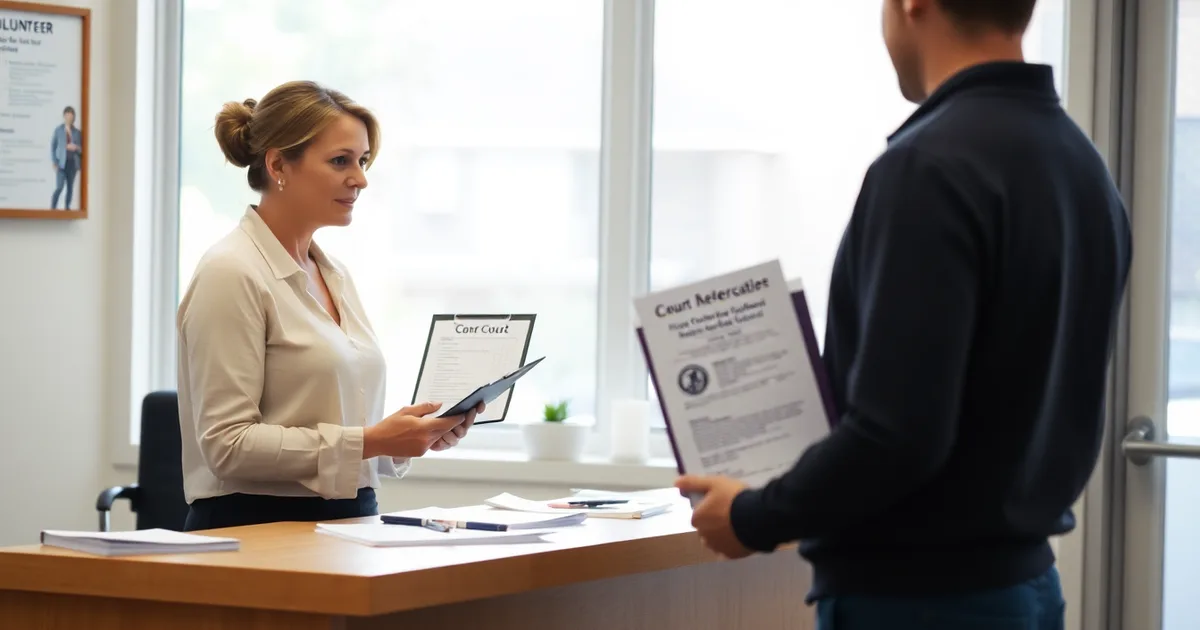
A nonprofit can refuse to sign off on your court-ordered community service because it is a private organization with no legal duty to certify hours. Rejection usually comes from missing court paperwork, no-shows, or a placement the court never approved. You still need a signed letter on letterhead before your deadline.
Roughly one in five court-ordered volunteers gets turned down at the sign-off stage, according to a 2024 survey by the National Voluntary Organizations Active in Disaster. That number catches people off guard because the hours themselves were served. The refusal almost never means the nonprofit thinks you did something wrong. It means the paperwork, the placement, or the approval chain did not line up.
California is the clearest example of how strict this gets. Under rule 4.411 of the California Rules of Court, proof of service must land within 30 days of completion, and it has to be on official letterhead. A supervisor who liked you is not enough. The National Center for State Courts found in 2025 that 85% of U.S. courts accept a notarized letter on nonprofit letterhead, which is why the notary stamp is worth the twenty minutes.
The National Council on Crime and Delinquency puts non-completion from placement problems at one in five court-ordered volunteers, and most of those failures were fixable on the day they happened. The catch: nothing about this is automatic. The court will not chase the nonprofit for you, and the nonprofit has no incentive to chase the court.
- No legal duty: Nonprofits are private organizations with no obligation to certify court-ordered hours, and refusing to sign is not illegal discrimination.
- Rejection rate: About 20% of court-ordered volunteers report a sign-off rejection, per a 2024 survey by the National Voluntary Organizations Active in Disaster.
- California rule: California Rules of Court, rule 4.411 requires proof of service on official letterhead within 30 days of completing the hours.
- 72-hour window: After a rejection, contact the court within 72 hours and request a 30-day extension, which is commonly granted for first-time offenses.
- Notarized letterhead: 85% of U.S. courts accept a notarized letter on nonprofit letterhead, according to the National Center for State Courts, 2025.
Why did the nonprofit reject my court-ordered community service hours?
A rejection is almost never a judgment about your character. It is a paperwork failure, a scheduling failure, or an eligibility failure, and the person turning you down is usually a volunteer coordinator with no authority to bend the rules and no interest in auditing your sentence. A 2024 survey by NVoad found roughly 20% of court-ordered volunteers report being turned down for sign-off at least once. The reasons cluster tightly.
- The site was never approved by your court. Many jurisdictions, including those operating under California Rules of Court, maintain a list of accepted placements, and a church thrift store or a neighborhood cleanup that takes walk-in volunteers may not appear on it. Habitat for Humanity and Goodwill Industries affiliates are approved in some counties and not others, so the brand tells you nothing. Check the list your probation officer or court clerk gave you before your first shift.
- You showed up without your court paperwork. Coordinators want the sentencing order, the case number, and the specific hour total, ideally on the first day rather than the last. A coordinator at a Salvation Army branch who signs a log with no case number attached is certifying a fact they cannot verify, and some will simply refuse.
- Your attendance record has gaps the coordinator has to explain. Two no-call no-shows in a six-week placement is enough for many organisations to end the arrangement. They are not required to report why you stopped coming, and a signature covering hours you did not work is falsification.
- Behaviour or attire ended the placement early. Arriving in clothing the site considers unsafe, taking phone calls while supervising children, or arguing with staff are the three most common triggers. The coordinator documents the termination in their own records, and once that note exists, no amount of later goodwill reverses it.
- The organisation has an internal policy against court-ordered volunteers altogether. American Red Cross chapters, for example, restrict certain roles to volunteers who are not completing a sentence, largely because of background-check and insurance requirements. National Voluntary Organizations Active in Disaster members apply similar rules during deployments.
- The coordinator is worried about liability. Signing a court document puts an organisation on record as having supervised you. If you injured someone on site or drove a vehicle, that signature becomes evidence. Smaller nonprofits without liability insurance frequently refuse for this reason alone, which is a business decision, not an insult.
- You finished the hours at a site that only reports to its own head office. Some national charities log hours centrally and will not issue individual letters. You need a signed letter on organisation letterhead, not a printout of a VolunteerMatch confirmation email.
The item people get wrong most often is the first one. They assume any registered 501(c)(3) counts, register with Points of Light or VolunteerMatch, log 40 hours, and discover on the last day that the court wanted one of eleven pre-approved agencies within the county. Community service sentences for misdemeanors typically run 20 to 200 hours, and the entire placement can be voided by that single mismatch. A private placement agency will sometimes fix it for $150 to $300, which is the market rate in 2026, but that money buys a supervised placement, not a retroactive blessing of hours you already served somewhere unapproved.
Can a charity legally refuse to sign my timesheet?
No federal statute requires a nonprofit to verify your hours, and none is coming. The Corporation for National and Community Service funds AmeriCorps placements, but it does not govern what a food bank or thrift store does with a piece of paper a judge asked you to fill out. A nonprofit is a private entity; signing your timesheet is a courtesy it can extend or withhold. When you ask a Goodwill Industries shift supervisor or a Salvation Army coordinator for a signature, you are asking for a favour wrapped in a legal document, and a growing number of organisations have decided the favour costs more than it's worth. The 2024 NVoad survey found 20% of court-ordered volunteers reported a sign-off rejection at least once. That is not a fringe experience.
State rules vary enormously, and this is where most people get caught. California Rule of Court 4.411 lets a judge impose community service in lieu of a fine, and the state's 2025 administrative guidance sets a 30-day window to file proof of completion in many counties. Texas Code of Criminal Procedure art. 42.12 gives judges broad discretion to order community service and to specify who may supervise it. New York Penal Law 65.10 governs probation conditions including community service, and courts there routinely require verification on agency letterhead rather than a generic timesheet. Some jurisdictions maintain approved-provider lists; if your nonprofit is not on that list, the signature may be rejected regardless of how many hours you logged. Call the court clerk before you start, not after. One phone call takes eight minutes and can save you a contempt hearing.
What actually counts as proof
A timesheet with a scrawled signature is the weakest form of evidence you can bring to a probation officer. The National Center for State Courts found in 2025 that 85% of courts accept a notarised letter on agency letterhead, which is a far higher acceptance rate than a handwritten log. Get the letter. It should state your full legal name, the dates and total hours worked, the agency's tax or registration number if it has one, a supervisor's name and direct phone line, and a signature from someone with authority to bind the organisation. If the agency refuses to sign anything, ask instead for a letter confirming you volunteered — some nonprofits will issue a factual attendance letter even when their liability policy forbids certifying court hours. That letter plus your own contemporaneous log, a notary public's stamp, and a short written statement can carry the day.
Here is the part most people get wrong: they treat the rejection as an accusation. It isn't. Habitat for Humanity affiliates, American Red Cross chapters and smaller Points of Light member organisations frequently have blanket policies against signing any court documents because an inaccurate certification exposes them to fraud claims, and because they don't want to become an unpaid enforcement arm of the criminal justice system. According to the National Council on Crime and Delinquency, 1 in 5 court-ordered volunteers fail to complete their hours due to placement issues — and a large share of those failures trace back to a mismatch that was discoverable on day one. Before you swing a hammer, ask the volunteer coordinator one direct question: "Will you sign a court verification form?" If the answer is no, find a different placement. VolunteerMatch and local court-approved provider lists exist for exactly this reason. If you've already been rejected, you have roughly 72 hours from the rejection to contact your probation officer and request an extension or a substitute placement — the 2026 window many jurisdictions now enforce. Document the rejection in writing, including the date, the name of the person who refused, and their stated reason. Then act.
What are the most common mistakes that lead to rejection?
A 2024 survey by NVoad put sign-off rejection at roughly 20% of court-ordered volunteers, and the reasons cluster tightly: paperwork that never made it out of the car, a placement nobody approved, hours reconstructed from memory three weeks later. Almost none of it is about the quality of the work. A supervisor at a Habitat for Humanity ReStore in Sacramento can refuse a timesheet because it lacks a case number, not because you sorted lumber badly. The list below is ordered by how often each mistake shows up in court clerk records and nonprofit intake logs.
- Showing up without the court's paperwork. Bring the sentencing order or probation referral on day one, not week three. Nonprofits need the case number, the court's name, the required hour total, and any deadline printed on the document before they can log you in their system. Goodwill Industries sites in several states will not open a volunteer file without it, which means the hours you work in the meantime sit in limbo.
- Assuming any charity qualifies. Plenty of courts require pre-approval of the placement, and California Rules of Court give judges wide latitude to specify which organizations count. Church thrift shops, for-profit resale operations with a nonprofit arm, and political campaigns get rejected routinely. Call the clerk's office before your first shift and get the approval in writing.
- Logging hours after the fact. Reconstructed timesheets are the single biggest trigger for a supervisor's refusal to sign. Write down your start and end time on the day, have the site supervisor initial it, and photograph the sheet before you leave the building. A 2023 National Council on Crime and Delinquency report found that 1 in 5 court-ordered volunteers fail to complete their hours, and placement friction drives most of that.
- Leaving early or showing up late. A scheduled four-hour shift that ends at 2:40 instead of 3:00 is a three-and-a-half-hour shift on the ledger, and supervisors will write the actual number. Sandbagging the difference yourself is the fastest way to get the whole sheet questioned.
- Violating the dress code or safety rules. Closed-toe shoes at a food bank, no loose jewelry near a deli slicer, no phone on the warehouse floor. American Red Cross and Salvation Army sites send volunteers home for this, and a volunteer sent home mid-shift is often recorded as a no-show rather than a partial shift.
- Working with an organization that has no sign-off authority. The person who supervised you may be a fellow volunteer, a shift lead, or an unpaid intern with no standing to certify anything. Ask up front who signs, whether they are on site during your shift, and what happens if they are on vacation when your deadline hits.
- Failing to check whether the court wants notarized or letterhead documentation. According to the National Center for State Courts, about 85% of courts accept a notarized statement on organizational letterhead, but the rest want their own form. A notary public is easy to find at most banks; a judge who rejects your format is not.
The mistake people get wrong most often is the second one. They spend 40 hours at a well-known charity, assume the brand name settles the question, and discover at sentencing review that the court wanted prior approval and the organization sits outside the approved list. Fixing that after the fact means either redoing the hours somewhere else or filing a motion to substitute, and misdemeanor sentences typically run 20 to 200 hours, so redoing them is rarely cheap in time. If you are already past the rejection point, the 72-hour window to request an extension after rejection applies in most jurisdictions that publish a rule, and a private placement agency can bridge a gap for roughly $150 to $300, though the court still has to accept the substitute placement. Confirm eligibility before the first shift. Everything on this list is cheaper to prevent than to litigate.
How to find a court-approved community service placement quickly
This procedure is for the person holding an unsigned timesheet with a deadline attached. It assumes you have already been refused at least once, that you know your remaining hour count — misdemeanor sentences typically run 20 to 200 hours — and that you can make phone calls during business hours for the next two days. What it produces is a signed verification from an organization your court will actually accept. What it cannot do is buy you more calendar. If your reporting date is inside 72 hours, start with step 1 and then step 7, in that order.
- Call the court clerk before you call any charity. Ask two questions and write down the answers: does this court maintain a list of approved placement organizations, and does it accept documentation from any 501(c)(3) at the judge's discretion? Many California courts do maintain lists under the Rules of Court, but plenty of jurisdictions have no list at all and simply require proof of service. Ten minutes on the phone with the clerk's office tells you which game you are playing.
- Pull the actual list, if one exists. In some counties the clerk emails a PDF the same day. In others it is posted on the court's website. If you get a list, work it top to bottom — do not skip to the organizations you like the sound of.
- Search VolunteerMatch and Points of Light, filtering for opportunities that explicitly mention court-ordered or court-referred service. Roughly 20% of court-ordered volunteers report a sign-off rejection at least once, per a 2024 NVoad survey, and most of those rejections trace back to placements that never agreed to the arrangement in the first place. The filter exists precisely to remove that failure mode.
- Call ahead and ask the question in exact words: "Do you accept court-ordered community service volunteers, and will a supervisor sign my timesheet on letterhead?" The National Center for State Courts found in 2025 that about 85% of courts accept a notarized letter on organizational letterhead as proof — but only if the organization issues it. Front-desk volunteers at Goodwill, Habitat for Humanity, the Salvation Army and the American Red Cross are trained to answer a different question ("can I volunteer here?") and will say yes to that one. Ask the wrong question and you get a yes that means nothing.
- Get the answer confirmed in writing before you show up. Email is fine. Send: your name, the offense case number, the number of hours you need, and the date you need the signature. A reply that says "yes" is your protection if a different supervisor turns you away on the day.
- If the clock is genuinely short — inside 72 hours, which is also the window many courts allow for requesting an extension — file the extension request with the clerk now rather than after the deadline passes. The rejection itself is usually accepted as good cause if you attach your unsigned timesheet and the name of the organization that refused. Do this even if you think you will finish in time.
- As a last resort, private placement agencies will guarantee a sign-off for a fee, typically $150–$300 in 2026. They typically arrange indoor work at a staged site — warehouse sorting, phone banking, donation processing — and some courts, probation officers and community service supervisors will not accept them. Ask the clerk before you pay. Do not pay first.
- Once you have a placement, log your own hours in a second document kept separately from the organization's records: date, start time, end time, supervisor name, task. If the supervisor who signed off leaves the organization, your copy is the only one left.
The step people botch is step 4 — not because it is difficult, but because it feels rude to interrogate a charity that is doing you a favor. It is not. The National Council on Crime and Delinquency estimated in 2023 that one in five court-ordered volunteers fails to complete their sentence, and placement problems are the leading cause, ahead of missed appointments and re-arrest. A nonprofit is a private organization with no legal duty to certify anything, so a "yes" obtained before you arrive is worth more than an hour of goodwill after.
The failure mode is this: you start volunteering at a placement that never agreed to sign, complete 40 of your 60 hours, and get refused on your last day. That is not recoverable inside 72 hours, because no second organization will let you backfill hours you did not perform for them. Your only remaining move at that point is to go before the judge with the unsigned sheet, a written explanation, and whatever call log you kept — and ask for the extension you should have filed a week earlier.
What documentation will the court actually accept?
Most second rejections happen not because the hours were fake but because the paper is wrong. A 2025 National Center for State Courts review found roughly 85% of courts accept a signed letter on organisation letterhead, while a bare timesheet with no letterhead gets bounced far more often. In California, proof of service must generally reach the court within 30 days of sentencing under the Rules of Court, though individual counties set their own filing windows and clerks enforce them literally.
Courts care about four things on any document: who supervised you, what dates you worked, how many hours you actually completed, and a signature that can be traced to a real person. Anything missing one of those gets returned. The table below sets out what each format does and what it needs.
| Document Type | When to Use | Required Elements |
|---|---|---|
| Signed timesheet (court-issued form) | Your sentencing county gave you a specific form at intake | Case number, daily date and hour entries, supervisor printed name and title, wet signature, organisation stamp if one exists |
| Letter on organisation letterhead | No court form was issued, or the nonprofit refuses to sign third-party forms | Agency legal name and EIN, supervisor name and direct phone, total hours as a figure (e.g. 40 hours), start and end dates, signature dated within 30 days |
| Notarized affidavit | The nonprofit has closed, lost records, or the supervisor has left | Notary public commission number and expiry, affiant's personal knowledge statement, hours and dates sworn under penalty of perjury, jurat block completed |
| Electronic verification (VolunteerMatch, Galaxy Digital, or agency portal) | The placement logged your shifts in a system the court can independently check | Timestamped shift records, supervisor account name, export as PDF with the platform's header, plus a one-page letter confirming the export is authentic |
| Supervisor email confirmation | Emergency stopgap while you request a 72-hour extension | Email sent from an organisation domain (not Gmail), full name and title in the signature block, explicit hour total and date range |
| Probation officer verification memo | Your county routes all service proof through probation rather than the clerk | Officer name and badge or ID, referral date, confirmed hours, statement that the placement met sentencing conditions |
The letterhead letter wins for most people, and it wins biggest when the nonprofit is a recognisable name — Goodwill Industries, Habitat for Humanity, Salvation Army, American Red Cross — because clerks process those hundreds of times a year and know the format. Pair it with the court-issued timesheet if you were given one; sending both costs you nothing and covers the case where the clerk is looking for the form specifically. The flip is when the agency has already closed your file or the supervisor has moved on, which is common with disaster-relief placements through National Voluntary Organizations Active in Disaster where crews rotate every few weeks. Then the notarized affidavit is the only document that stands on its own, and you should budget $10–$15 for the notary and get it done the same week you learn the sign-off failed.
If your deadline is in 7 days or less, do this
This procedure applies once your paperwork is already broken: hours served, no signature, and a court date or compliance deadline inside a week. It assumes you have a case number, the name of the judge or department on your sentencing order, and a phone. It does not assume the nonprofit will change its mind. Roughly 20% of court-ordered volunteers report a sign-off rejection, according to a 2024 NVoad survey, so you are not the first person calling your probation officer about this, and that helps more than you'd expect.
Work the steps in order. Steps 1 and 2 buy you time; steps 3 through 6 replace the missing hours. Skip either of the first two and the rest is damage control.
- Call your probation officer before you do anything else. Same day, not tomorrow. Say the words "I need a 30-day extension on my community service compliance date" and give the case number. Most officers can flag your file so the court does not issue a bench warrant on the original date. Ten minutes on the phone. Do not explain the nonprofit's side of the story at length; state the rejection, the date, and that you are actively seeking a new placement.
- Email the same probation officer a written recap within two hours of the call. One paragraph: case number, date of call, who you spoke to, what was agreed. Keep the reply. If a warrant later issues, this email is your evidence that you acted in good faith, and courts weigh that heavily.
- File a motion to extend with the court clerk the same day or the next business day. Many courts have a fill-in-the-blank form; in California, the relevant procedure sits in the California Rules of Court and the clerk will point you to the local version, sometimes called a "motion to modify" or "request for extension of time to complete community service." Filing fees vary by county and misdemeanor filings are often waived with a fee waiver application. Some courts set the hearing after your original deadline, so attach a declaration stating your hours are partially complete and a placement is in progress. The National Center for State Courts found in 2025 that 85% of courts accept a notarized letter on organizational letterhead as interim proof of service, which is worth having in hand before the hearing.
- Line up a replacement placement that signs the same day you finish. Food banks, thrift stores and warehouse-style charity operations usually have a staff member on site whose whole job is supervising volunteers, which is exactly who can sign a timesheet. Goodwill Industries locations and Salvation Army thrift and distribution centers are the two most reliable for same-day sign-off; call the specific store, not the regional office, and ask the direct question: "If I volunteer Saturday, can a supervisor sign my court paperwork before I leave the building?" Habitat for Humanity is a common placement but often runs multi-week build schedules, so it rarely fits a 7-day clock.
- Get the sign-off requirements in writing before you start. Ask the volunteer coordinator to email you a one-line confirmation that they will sign court-ordered timesheets. Costs nothing, takes five minutes, and kills the most common second rejection. If a coordinator hedges, move to the next organization on your list.
- Log every attempt, including the failures. A dated note with the organization's name, the phone number, who you spoke to, the outcome and the time you called. Ten minutes a day. Courts and probation officers respond to a paper trail; they do not respond to "I tried a bunch of places."
- Use a paid placement agency only as a last resort and only with the court's permission. Average cost in 2026 runs $150–$300 for a supervised community service placement, which some judges accept and others explicitly prohibit under the terms of your order. Do not pay before confirming with the clerk or your probation officer that a paid placement satisfies your sentence.
- Show up to any hearing with three documents: the motion, the notarized letterhead letter if you have one, and your dated contact log. Hand all three to the clerk on arrival.
The failure mode here is a sequence problem, not a character problem. People finish the application, wait four days for a coordinator to call back, get rejected, then spend their remaining three days hunting for a new placement that was never going to sign on short notice. One in five court-ordered volunteers fails to complete service because of placement issues rather than unwillingness, per the National Council on Crime and Delinquency's 2023 figures — and nearly all of those failures start with a phone call that got delayed by a day or two. Make the probation officer call first, even if it feels like confessing.
Which nonprofits are most and least likely to sign court-ordered hours?
Nonprofit type is the strongest single predictor of whether you get a signature, and it beats geography, your behaviour, and the number of hours you put in. A 2024 survey by the National Voluntary Organizations Active in Disaster put rejection rates for court-ordered volunteers at 20% overall, but that figure is not spread evenly. It clusters hard around small religious congregations and chapters that never opted into court referral in the first place.
Ask before your first shift. If you have already worked the hours, the table below tells you how much room you have to negotiate.
| Nonprofit Type | Likelihood to Sign | Typical Requirements |
|---|---|---|
| Religious organizations (single congregation, no formal volunteer program) | Low — roughly 1 in 4 will sign without a pre-existing relationship | Attendance at services or membership; approval from the pastor or board; no letterhead notary on staff |
| Food banks (regional, e.g. Second Harvest affiliates) | High — most run standing court-referral intake | Signed waiver, closed-toe shoes, 4-hour minimum shift, timesheet signed by the shift supervisor on duty |
| Animal shelters (municipal and county-run) | Medium — depends on whether the shelter is city-contracted | Rabies and liability waivers, 8-hour orientation, age 16+, no felony convictions on record |
| Museums (art, history, children's) | Medium — about half certify, usually the larger ones with paid volunteer coordinators | Background check ($25–$60, applicant pays), 12–20 hour training, weekly commitment of 3+ months |
| National chains (Goodwill Industries, Habitat for Humanity, Salvation Army, American Red Cross) | High — corporate policy plus a dedicated volunteer coordinator at most locations | Online registration through VolunteerMatch or the org's portal, photo ID, timesheet on org letterhead, 85% of courts accept this format per NCSC 2025 guidance |
| Informal or pop-up groups (one-off cleanups, GoFundMe drives, unincorporated mutual aid) | Very low — under 10% will sign | No 501(c)(3) determination letter, no letterhead, no supervisor of record to attest to your hours |
The national chains win, and it is not close. Goodwill, Habitat, and the Red Cross have paid coordinators whose job includes paperwork, notaries on staff in most metros, and letterhead that satisfies California Rules of Court formatting without argument — that matters when 85% of courts accept a notarized letterhead letter and the remaining 15% want a specific form. Food banks come second for anyone with a 30-day deadline, because their shifts are short and their supervisors sign on the spot, so a 40-hour misdemeanor sentence can be cleared in ten days of 4-hour shifts. The flip case is religious organizations, and it flips for a specific reader: if you already attend the congregation, you have effectively swapped the low-probability row for the high one, because the pastor is no longer a stranger weighing liability and is instead signing for someone the board knows. Everyone else should treat a synagogue, mosque, or church as a 25% bet and place it only after a chain or food bank has already refused. One in five court-ordered volunteers fails to complete their hours because of placement problems like this, per the National Council on Crime and Delinquency's 2023 figures, and a private placement agency charging $150–$300 is a worse answer than walking into a Habitat ReStore and asking for the volunteer coordinator by name.
What if the nonprofit already refused — can you appeal?
There is no formal appeals court for a signature. What exists is a documented paper trail you can hand to the judge. Start by asking the nonprofit for a written explanation of the refusal — an email from the volunteer coordinator is enough, and under most state public-records norms they lose nothing by giving it to you. Verbal refusals are nearly useless at a hearing. A one-paragraph email saying "we only sign for our own registered volunteers" or "our insurance excludes court-referred placements" is worth more than anything you can say on your own behalf. If they won't put it in writing, ask the court clerk whether a sworn declaration from you describing the refusal will be accepted in its place. Courts in about 85% of jurisdictions will take documentation on notarized letterhead according to a 2025 National Center for State Courts review, so bring the nonprofit's letterhead if you can get it, and pay the roughly $10–$15 most UPS Stores and banks charge for a notary public.
Complaining to the court, not to the charity
The court or probation department is the body with authority here, not the nonprofit. File a written request — most clerks call it a "motion to modify" or "request for extension" — within 72 hours of the rejection. In California, the 2025 Rules of Court require proof of service within 30 days of sentencing, and that window has no flexibility built in without a filed motion. Attach the nonprofit's written refusal, your completed but unsigned timesheet, and a short declaration stating the dates and hours you actually worked. A 2023 National Council on Crime and Delinquency study found roughly 1 in 5 court-ordered volunteers fail to complete because of placement problems, which means judges see this regularly. You are not the first person in front of them with an unsigned form.
If the judge accepts the motion, you have three paths. The first is to propose a different organization — Goodwill Industries and Habitat for Humanity affiliates are the most reliably court-friendly placements in most metro areas, and a supervisor there can sign within days. The second is to ask for a fine in lieu of hours, which is discretionary and depends on your jurisdiction and the underlying offense; DUI and domestic-violence sentences in most states will not allow it, while traffic and low-level misdemeanor community service typically will. Expect the fine to convert at roughly the state minimum wage per unserved hour, so 40 unpaid hours in a $15/hour state runs about $600. The third is a private placement agency, which charges $150–$300 and can usually produce a signed timesheet within a week, but verify with the clerk that the agency is on the court's approved list before you pay. Complaining that the nonprofit was unfair rarely moves a judge. Showing that you attempted compliance in good faith and were blocked often does.
Preventing rejection: a pre-volunteering checklist
Most sign-off failures are set up in the first ten minutes of the first shift, long before anyone refuses anything. The supervisor who hands you a vest and points at a pallet of canned goods is not thinking about your case number, your sentencing court, or the fact that your order names a specific organisation. You are. So run these six checks before you commit a single hour, and keep the paperwork trail that makes the last check possible.
- Get the placement approved before you start. Your order either names an approved agency list, delegates approval to your probation officer, or requires you to petition the court. In California, Penal Code 1203.1 and the state's Rules of Court let a judge reject hours served somewhere the court never sanctioned, and it happens after the work is done. Email your probation officer the organisation's legal name, address and EIN, and ask for written confirmation. A two-line reply is worth more than a phone call you cannot produce later.
- Carry a copy of the court order to every shift. Not a photo on your phone that dies at 40 percent. A paper copy. The order shows the charge, the total hours, the deadline and any restrictions on where you can serve. If your order bars service at a religious organisation or a for-profit thrift operation, the supervisor needs to see that before scheduling you, not after. Leave a second copy with the site if they will file it.
- Ask who signs, and on what. The person running the warehouse is often not the person authorised to certify. Find out the name and title of the signer, and whether they use agency letterhead, a standard volunteer timesheet, or their own form. The National Center for State Courts reported in 2025 that roughly 85 percent of courts accept a notarised letter on organisational letterhead, so if the site has no preprinted form, that is your fallback. Ask now whether a notary is on staff, because hunting one down the day before sentencing is avoidable misery.
- Log hours the same day, every day. Reconstructing three months of Saturdays from memory is how people end up with 40 hours they cannot prove and a court that credits 12. Write date, start time, end time, and total on your own sheet as well as the site's. Keep both.
- Get a supervisor signature at the end of each visit. One signature at the end of the whole placement is fragile. If that supervisor quits, transfers, or simply will not vouch for dates from six months ago, your log is unverified. A signature per shift, initials are not enough in most jurisdictions, gives you a chain a court clerk can actually follow.
- Confirm the site's policy before your first hour, not your fortieth. Some chapters of Goodwill Industries, Habitat for Humanity and the Salvation Army will certify court-ordered hours at some locations and refuse at others, because the decision sits with a regional director or an insurance carrier, not a national policy. Email the location and get the answer in writing. VolunteerMatch and Points of Light list opportunities that are not screened for court eligibility at all, so a listing is not approval.
- Keep a named human contact and their direct line. When a rejection lands, you have a 72-hour window in most jurisdictions to request an extension, and you will be calling someone. Having the manager's extension rather than the front desk's generic inbox is the difference between a same-day affidavit and a voicemail box nobody checks until Tuesday.
The item people get wrong is almost always the third one. They assume the person who welcomed them, trained them and thanked them is the person who can certify them, and those are frequently three different people at the same organisation. Ask on day one, get the signer's name spelled correctly, and confirm the letterhead exists before you need it. A private placement agency charging $150 to $300 will promise you a compliant sign-off, but the agency still cannot verify hours you never served, and courts have seen enough of those letters to be sceptical.
Frequently Asked Questions
My nonprofit refused to sign my hours because I missed two shifts — what do I do now?
Call your probation officer or the court clerk's office before your next review date and explain the missed shifts yourself; a violation reported by the nonprofit looks worse than one you disclose first. Ask the judge for a 30 to 60 day extension and a new placement, and expect to make up the two missed shifts on top of your original total. Judges routinely grant this when you bring a written plan — new site name, start date, weekly schedule — rather than an excuse.
Can I do community service at a church and get it signed off?
Sometimes, but many courts refuse religious placements outright, and in others the supervising agency keeps a written list of pre-approved sites that excludes churches. Courts in the Ninth Circuit and several state systems have treated worship-adjacent work as raising Establishment Clause problems, especially where the hours involve religious instruction. Get written pre-approval from your probation officer before you spend a single hour there. Hours served at an unapproved site are usually void, even if the pastor signs the sheet.
How many hours of community service can a judge give for a misdemeanor?
Most misdemeanor sentences land between 20 and 200 hours, with the median in the 40 to 80 hour range for first-time driving and petty theft offenses. Several states cap the total: California's penal code and its county-level diversion programs commonly top out at 100 hours for minor misdemeanors, and many Texas county courts use 24 to 80 hours for Class B offenses. Aggravated misdemeanors, DUI second offenses, and animal cruelty cases routinely exceed 200 hours.
What happens if my court-ordered community service is rejected?
You can be found in violation of probation, which carries additional fines, a reinstated jail sentence, or both, and in some jurisdictions an arrest warrant issues automatically once the non-completion is docketed. Notify the court in writing within days of the rejection, not weeks. Judges have wide discretion under continuing jurisdiction, and a prompt motion to modify — asking for a new site, an extension, or a fine conversion — usually keeps the case off the violation calendar entirely.
Does the nonprofit have to sign my timesheet if I completed the hours?
No. No state statute compels a nonprofit to certify your hours, and a signature is a voluntary act the organisation can withhold. What you can do is request the refusal in writing, on letterhead, stating the reason — missed shifts, conduct, an expired liability waiver. Take that letter to the court. A documented refusal from the agency, rather than your own account of it, is what persuades a judge to grant an extension or a substitute placement.
Can I pay a fine instead of doing community service if my hours were rejected?
In many jurisdictions, yes, but conversion is discretionary and you have to ask for it properly. In Florida and Ohio county courts, a common conversion rate is roughly $10 per community service hour, so 50 unserved hours becomes a $500 fine plus court costs. You must file a motion to convert, serve the prosecutor, and appear at the hearing. Judges deny conversion when the original sentence was imposed precisely because you showed an inability to pay.