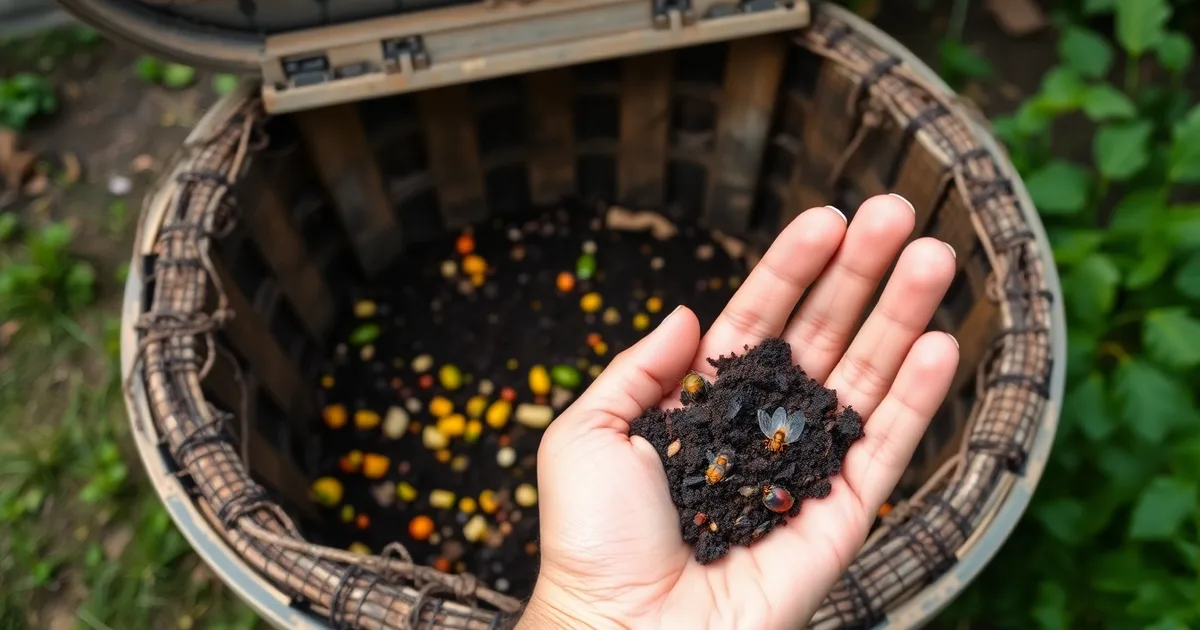
Flies without maggots means your compost surface is too dry for larvae to survive, even though it is still exposed and sugary. Mix 2 parts shredded browns to 1 part greens, water to 50–60% moisture using the wrung-sponge test, and bury scraps 10 cm deep. Larvae then establish in 5–7 days at 20–30°C.
Black soldier fly larvae need 60–90% moisture to survive. Below 40% they desiccate within 24–48 hours, so a dry crust on top of the pile kills them before they can grow large enough to see. The adults keep arriving because they smell the sugars in fruit scraps, but the eggs that hatch on that surface simply do not make it.
That is why adding a bag of dry leaves once and walking away does nothing useful. Dry browns on their own pull the pile further below 40%, which is the opposite of the fix. You need moisture and carbon together: for a 5-gallon bucket of kitchen scraps, 10–15 gallons of shredded leaves or cardboard by volume, wetted as you layer.
Fruit flies (Drosophila melanogaster) run a full generation in 7–10 days at 25°C; house flies take 7–14 days. If you bury scraps 10 cm under browns today, you break that cycle at the point where it matters, and a pile that holds 55°C for 3 consecutive days will finish off most fly eggs and larvae on its own.
- Larvae need moisture: Black soldier fly larvae require 60–90% moisture and desiccate within 24–48 hours below 40%.
- Target the top layer: Ideal compost moisture is 50–60%, confirmed when a squeezed handful releases one drop.
- Carbon ratio by volume: Keep greens to browns at 1:2 to 1:3 by volume, so a 5-gallon bucket of scraps gets 10–15 gallons of shredded leaves or cardboard.
- Bury scraps deep: Food scraps buried at least 10 cm (4 inches) under browns block adult flies from laying on them.
- Heat kills eggs: Holding the pile above 55°C (131°F) for 3 consecutive days kills most fly eggs and larvae.
What does it mean when you see flies but no maggots in compost?
Adult flies and their larvae have different water requirements, and that gap explains almost every "flies but no maggots" pile. A grown fruit fly (Drosophila melanogaster) can sit on an exposed banana peel and feed on surface sugars and fermenting juice for weeks — lab data at 25°C puts its lifespan at 40–50 days, with females laying up to 500 eggs in that window. Larvae cannot do that. They breathe and feed through a wet film on their food, and below roughly 40% moisture they desiccate and die; the 2024 horticulture extension figure puts the survival floor at 40% with 50–60% as optimal. So a dry crust on top of your pile kills the next generation while leaving the parents alive to keep laying.
The numbers matter more than the appearance. If the top 5 cm reads dry — crumbly, pale, no clumping when you squeeze it — eggs may still hatch after a day or two, but neonate larvae die within hours. That is why you see hovering adults and no writhing mass. Your pile can be perfectly wet 20 cm down and still produce this outcome, because the flies are working the surface, not the core. Test it properly: dig a handful from 10 cm deep and squeeze. It should hold like a wrung-out sponge. If the top layer fails that test and the layer below passes it, you have your answer.
Which fly you have tells you which moisture problem you have
Small flies drifting slowly around the lid, roughly 3 mm long, are fruit flies. They signal exposed sugary scraps and a dry, acidic surface — the classic result of burying nothing and topping up with fresh vegetable peelings. Large black flies, 15–20 mm, noisy in flight and often resting on the rim, are black soldier flies (Hermetia illucens). Their presence usually means the opposite problem: a wet, anaerobic, protein-heavy layer, often from too many grass clippings or food scraps at a green-to-brown volume closer to 5:1 than the 1:2 or 1:3 that the Rodale Institute recommends. House flies (Musca domestica) are the third case and the one to take seriously, since they breed readily in manure and rotting meat and carry a genuine sanitation concern. If you have those, the fix is burial, not moisture adjustment.
Either way, the correction is local. You already tried adding dry leaves once, and that failed because a thin scattering on top does not rehydrate the zone where the eggs are sitting — it just makes the surface drier and more acidic while the problem layer stays put. Turn the top 15 cm into the pile instead, mix in shredded cardboard or coffee grounds to pull the carbon-to-nitrogen ratio back toward 25–30:1, and wet it as you go until the wrung-sponge test passes. Then bury new scraps at least 10 cm down, the depth most municipal compost programs specify. That single change removes the exposed surface the adults are feeding on.
Why is my compost bin full of fruit flies and not maggots?
Fruit flies are not composting your scraps. They are drinking them. Drosophila melanogaster lays eggs on exposed fermenting sugars — banana peel, melon rind, a tomato that split in the caddy — and at 25°C a female can put down 500 eggs in a lifespan of 40–50 days, with a generation turning over every 7–10 days. You see adults because the surface is a food source. You don't see larvae because the layer they hatched onto dried out.
That's the whole mechanism. Fly larvae need at least 40% moisture to survive, and they do best at 50–60% (2024 horticulture extension data). Your top layer, the part that meets air and sun, is probably sitting below 40%. It has the texture of dry cereal and the colour of grey cardboard. Eggs laid there hatch into larvae that desiccate within hours. Adults, which fly, just leave and come back to lay again. So you get turnover in the standing population and nothing in the way of visible grubs.
Adding more dry leaves — which is what most fly advice tells you to do — makes this worse. Shredded cardboard and dead leaves push surface moisture down further and dry the pile out faster. The problem was never too much nitrogen on the surface; it was too little water on the surface. Stop adding browns. Instead, dig a 10 cm (4 inch) trench into the top of the pile, drop the kitchen scraps in, and close it over so no fermenting sugar is exposed. Then rebuild the top 15 cm: mix in enough water to hit 50–60% moisture, checking with the wrung-sponge test — squeeze a handful and you want a few drops, not a stream, not nothing. Hold that with a loose carbon cap of shredded cardboard or straw no more than 5 cm deep, enough to cover, not enough to wick water upward.
If you want to break the cycle faster, get the pile core to 55°C (131°F) for three consecutive days (2023 UC Davis study). That kills most fly eggs and larvae outright. It requires a real green:brown balance — 1 part greens to 2–3 parts browns by volume, targeting a carbon-to-nitrogen ratio of 25:1 to 30:1 (2022 Cornell composting guide, 2024 Rodale Institute) — and a pile at least 1 m³. Most backyard bins never reach that. If yours won't, the burial-and-rehydrate fix above is enough; you'll still see flies, but you'll stop seeing fresh adults every week. Pesticides are a waste of money here. They kill adults on contact, do nothing to the eggs already in the pile, and contaminate the compost you're going to spread on your vegetables.
Black soldier flies vs house flies: which one do you have?
Get the species right before you change anything in the bin, because the three flies that show up in home compost want opposite conditions and two of them are telling you something useful. Hermetia illucens, the black soldier fly, is the one people panic about and the one you should mostly leave alone. Musca domestica is the one that actually signals a problem. Drosophila melanogaster and its relatives sit in the middle: annoying, harmless, and a reliable indicator that your top layer is fermenting rather than rotting.
Size is the fastest way to sort them. Hold a ruler against the lid next time you open it. A soldier fly adult runs 15–20 mm with smoky black wings folded flat over the body; a house fly is 6–7 mm, grey, with four dark stripes running down the thorax. Fruit flies are 2–3 mm and you will mostly notice the red eyes, not the body.
| Species | Adult appearance | Larvae present? | Moisture preference | Action needed |
|---|---|---|---|---|
| Black soldier fly (Hermetia illucens) | Black, 15–20 mm, smoky wings folded flat | Beige, 20–25 mm, segmented, visible on the surface | Wet: 60–80% moisture, will not breed below about 40% | Add 2–3 parts shredded cardboard per 1 part wet scraps; no need to remove larvae |
| House fly (Musca domestica) | Grey, 6–7 mm, four dark stripes on thorax | White, 3–9 mm, buried in the top 5–10 cm | Moist but not sodden, 50–70%, on exposed food waste | Bury all scraps 10 cm deep and rebalance to 25:1–30:1 C:N |
| Fruit fly (Drosophila melanogaster) | Tan, 2–3 mm, red eyes | White, 1–2 mm, near fermenting fruit and skins | Surface film of moisture on sugary scraps; 50–60% optimal | Stop adding fruit for 7–10 days; top up with browns to 2–3 parts by volume |
| Fungus gnat | Black, 2–4 mm, long legs, mosquito-like | Clear to white, 3–5 mm, in wet surface mulch | Wet surface only; 60%+ at the top 2 cm | Turn the top 15 cm to dry it; gnats do not survive below 40% moisture |
| Vinegar fly swarm (any Drosophila species) | Tan to brown, 2–4 mm; adults live 40–50 days at 25°C | Rarely visible; females lay up to 500 eggs each | Fermenting sugars; generation time 7–10 days at 25°C | Remove fermenting material, cap the pile, and expect 2–3 weeks to clear |
If the table puts you in the soldier fly row, you have the best problem in composting and should not treat it as one: those beige 20–25 mm larvae are eating your scraps faster than any worm bin and leaving a residue that finishes in weeks, so the fix is only to dry the surface with shredded cardboard at 2–3 parts brown to 1 part green by volume. That flips only if the larvae are absent and you are seeing adults alone, which points to a surface too dry and acidic for eggs to hatch, not a soldier fly colony at all. House flies are the row that demands action regardless: bury everything 10 cm deep, get the pile to 55°C for three days if volume allows, and the population collapses within one generation.
The green:brown ratio that stops fly outbreaks
Ratios sound like gardening folklore until you watch what happens when you get them wrong. Too many greens and the surface turns into a wet, acidic mat that adult Drosophila melanogaster can smell from 50 metres and larvae cannot survive in. Too many browns and the pile dries past the 40% moisture floor where eggs simply desiccate. The Rodale Institute's 2024 field guidance puts the workable zone at 1 part greens to 2–3 parts browns by volume, and that is the number to aim for, not 1:1 as most beginner guides suggest.
- Count by volume, not by feel. One part kitchen scraps or grass clippings to 2–3 parts shredded leaves, cardboard or sawdust. A 2022 Cornell composting guide frames the same target as a carbon-to-nitrogen ratio of 25:1 to 30:1 for active composting; drift to 15:1 and you have a fly nursery.
- Match every scrap addition with browns immediately. If you tip in 1 gallon of vegetable peelings, 2–3 gallons of shredded cardboard go in at the same time, not the next morning. Fruit fly females lay up to 500 eggs in a 40–50 day lifespan at 25°C, so a single overnight window is enough to seed the next generation.
- Turn only the top 15 cm. This is the fly zone. Mixing browns into that band drops surface moisture, raises the carbon fraction and buries exposed scraps past the 10 cm depth most municipal programs recommend. Leave the lower pile alone unless it is waterlogged.
- Keep a browns bucket next to the bin. A 10-litre caddy of shredded cardboard or paper shreddings within arm's reach removes the excuse to "add browns later". The failure mode is almost never ignorance of the ratio, it is friction between you and the browns pile.
- Cap exposure at 2 hours. Fresh scraps should never sit on the surface longer than that. If you cannot cover them within the window, hold them in a sealed container until you can.
- Push for 55°C if the pile allows. A 2023 UC Davis study found 3 consecutive days at 55°C (131°F) eliminates most fly eggs. Reaching that needs a cubic metre of material and a full Berkeley-method rebuild, which most backyard bins never achieve, so treat it as a bonus rather than the plan.
- Confirm with the wrung-sponge test. Squeeze a handful from 15 cm down. One or two drops should come out. Nothing means add water, a stream means add more browns, and either way you adjust the top layer rather than the whole pile.
The step people skip is the immediate part of "add browns immediately". They add a bag of leaves on Saturday, feel virtuous, then tip a litre of melon rind onto the top on Wednesday and leave it uncovered until Friday. That single exposed addition undoes a week of moisture correction, because the surface film of sugars and water is exactly what a gravid female fruit fly is hunting for. Browns added after the fact sit on top of the problem rather than mixed through it, which is why your earlier dry-leaves attempt did not work: you smothered the pile without turning the browns into the fly zone.
How to fix moisture: the wrung-sponge test
Run this procedure when the surface is visibly dry, when flies land on the pile the moment you lift the lid, and when a handful from the top 15 cm crumbles instead of holding together. You need a trowel or gloved hand, a watering can with a rose head, a bag of shredded cardboard or similar browns, and about 20 minutes. A compost thermometer helps but is not required for the moisture fix itself.
- Take a sample from 15 cm down, not from the surface. The top 2 cm is always drier than the rest and will give you a false reading. Push a trowel in vertically, lever out a handful, and let it fall onto your palm. Surface-only samples are the single most common reason people add water when the pile is already wet inside.
- Squeeze the handful hard for five seconds. One drop should form at the base of your fist and hang there. That is roughly 50–60% moisture, the band where larvae survive and the pile heats. No drop at all means you are under 40%, and Drosophila melanogaster larvae will not establish below that threshold, which is exactly why you are seeing adults and no maggots.
- If no drop forms, water slowly while turning. Pour 2–4 litres at a time onto the top 15 cm, fork it through, and re-test before adding more. Overwatering to fix dryness is easy and creates the opposite problem within a day. Budget 15–20 minutes for a 1 m³ pile.
- If the squeezed handful drips two or more drops, stop adding water entirely. Add shredded cardboard, torn newspaper or dry leaves at roughly 1 part greens to 2–3 parts browns by volume, which is the 2024 Rodale Institute ratio for keeping a pile aerobic. Mix it into the wet zone rather than layering it on top. Layering is what you already tried with dry leaves, and it fails because the dry material sits on the surface and never contacts the wet core.
- Bury new kitchen scraps at least 10 cm deep as you go, per the standard most municipal compost programs publish. Coffee grounds and fruit trimmings left on the surface at 25°C give Drosophila a 7–10 day generation time and females lay up to 500 eggs each. Ten centimetres of cover removes that food source without touching your moisture level.
- Measured across the whole pile, not just the top. After a full turn, take three samples: one from the centre, one from 20 cm inside the north face, one from the base. All three should produce that single drop. If the centre passes and the edges fail, you have a dry shell around a wet core and need to pull the outer material inward as you turn.
- Re-check every 3 days until adult fly counts drop. At 25°C you are looking at 7–10 days for one generation to complete, so give it two checks before concluding the fix has failed. Keep a note of what you added each time; the record is what tells you whether you are drifting dry or drifting wet.
- If the pile is over 1 m³ and stays under 55°C in the core, consider a hot method. Holding 55°C for three days eliminates most fly eggs and larvae, and the Berkeley method reaches that in 3–5 days with a 25:1 to 30:1 C:N ratio and a turn every second day. This is optional for moisture but it resets the fly population rather than just starving it.
The failure mode here is chasing moisture in the top layer only. You water the surface, the fly count drops for two days, then rebounds because the core is still dry or still anaerobic and the surface has dried again. Fix the moisture profile to 15 cm deep across the whole pile before you change anything else about the feedstocks. If flies persist past ten days of correct moisture and buried scraps, the problem has moved on to the greens-to-browns balance or a compacted, airless core, and moisture alone will not solve it.
Should you add lime or diatomaceous earth to a fly-infested compost bin?
Neither one fixes the problem, and diatomaceous earth is the worse of the two because it stops working the moment your pile is actually healthy. Garden lime raises surface pH toward neutral, which does make the pile less attractive to Drosophila melanogaster for a few days. But the adults you are seeing laid eggs because there was exposed, wet, sugar-rich food sitting on top of dry material, and lime does nothing about either of those. Scatter a handful on a banana peel and you have a peel with lime on it. The flies return by the following week, usually in the same numbers.
Diatomaceous earth kills insects by abrading the waxy cuticle, and it only does that when it is dry. Finished compost should sit at 50–60% moisture, with 40% as the floor for larvae survival according to 2024 horticulture extension data, so anything you apply to a working pile is a wet slurry within hours. Someone promoting DE for compost bins is either thinking of a dry grain store or selling something. The same logic rules out wood ash in quantity, which pushes pH past 8 and stalls the bacterial activity you are trying to encourage.
What actually works is boring and unglamorous. Scrape back the top 10 cm, drop your kitchen scraps into that hollow, and cover them with 10 cm of browns (shredded cardboard is the cheapest option and absorbs fast). Most municipal programs settled on that 10 cm burial depth for a reason: it puts the food below the range where adult flies are foraging. Then correct the top layer. If your greens-to-browns is running near 1:1, aim for the 1:2 to 1:3 by volume that the Rodale Institute recommends, which lands you near the 25:1 to 30:1 carbon-to-nitrogen target rather than the 15:1 or worse you get from an all-kitchen-scrap pile.
One caveat on lime: if your pile has gone genuinely anaerobic and smells like sour milk, a light dusting of garden lime will knock the acidity back enough for bacterial recovery, but that is a smell problem, not a fly problem, and it is not a routine treatment. Skip it unless you have the smell. Coffee grounds and grass clippings both feed the same over-acidic, over-wet top layer you are chasing, so hold the grounds for a week and let the cardboard do its job.
What temperature kills fly eggs in compost?
Sustained heat is the only reliable kill step. UC Davis work published in 2023 put the threshold at 55°C (131°F) held for three days, which eliminates most fly eggs and larvae across Drosophila melanogaster, Musca domestica and Hermetia illucens. Three days is the part people skip. A pile that spikes to 60°C on Saturday and sits at 35°C by Tuesday has pasteurised the outer shell and left the core untouched, because fly eggs are laid in the top 5-10 cm where the temperature gradient is steepest.
Getting there requires volume, not effort. The Berkeley method asks for a minimum of 1 m³ — roughly a cubic metre, which is a bin about a metre on each side, filled in one go rather than fed daily — and turning every two days to reintroduce oxygen. Below that volume the surface-to-mass ratio is too high and the pile sheds heat faster than microbes generate it. If you are running a 200-litre dalek bin in a suburban garden, you cannot hit 55°C in September no matter how many grass clippings you add. Aim for 25:1 to 30:1 carbon-to-nitrogen, keep the moisture at the wrung-sponge level (50-60%, with 40% as the floor for larvae survival), and turn on a two-day cycle. A $25 compost thermometer with a 50 cm probe tells you in ten seconds whether you are close.
When you cannot reach 55°C
Small piles, cold climates and Bokashi-fed systems rarely get there, and chasing the number usually means overloading greens — which drops you toward 15:1 and makes the fly problem worse, not better. The fallback is burial and moisture control. Most municipal compost programs in 2025 recommend burying food scraps at least 10 cm (4 inches) below the surface, and the practical version is deeper: 15 cm into the active layer, then cover with shredded cardboard and a handful of finished compost. Flies locate scraps by smell; at 15 cm the volatile cues are largely gone.
An honest trade-off here: hot composting kills eggs but demands space, feedstock and a turning schedule you will actually keep. Cold composting with disciplined burial does not kill eggs, but it stops the adults from finding a place to lay, which solves the visible problem in the bin. For a household producing under 20 litres of scraps a week, the second approach is almost always the better bet. Keep the top 15 cm at 50-60% moisture and 25:1 to 30:1, and the flies have nothing to work with.
How to prevent flies from coming back next week
The fix you already tried — one round of dry leaves — fails because it treats the whole pile instead of the surface where the flies are actually breeding. What keeps Drosophila melanogaster and Hermetia illucens from re-establishing is a routine you run every time you add scraps, not a one-off correction. The seven habits below take about four minutes a week.
- Keep a 5 cm carbon cap on top at all times. Shredded cardboard, torn paper, dry leaves or sawdust, spread across the full surface after every addition. Fruit flies need exposed moist substrate to lay, and a dry carbon layer denies them that. Refresh it whenever you can see green underneath — usually every second or third feed.
- Bury scraps 10 cm deep. That is the depth most municipal compost programmes recommend in their 2025 guidance, and it works because it puts the food below the depth where Drosophila will dig. Pull back the top layer with a trowel, drop the scraps, cover, then re-cap with browns.
- Never add meat, dairy, or oily food. These are the scraps that reliably recruit Musca domestica and, once they rot anaerobically, push the pile toward the 15:1 carbon-to-nitrogen ratio that smells and attracts. Cooked vegetables and grains are fine buried; a chicken bone is not.
- Freeze scraps for 24 hours before they go in. A domestic freezer at −18°C kills fruit fly eggs and first-instar larvae outright. This is the single cheapest intervention available, because a mated female can lay up to 500 eggs in her 40–50 day lifespan, and one missed batch is next week's swarm.
- Harvest from the bottom every 2–3 months and start a fresh pile. Old piles become permanently hospitable as the structure collapses and moisture pools. Pull finished compost from the base hatch, then begin a new heap rather than continuing to feed a two-year-old bin.
- Hold the green:brown volume ratio at 1 part greens to 2–3 parts browns. The 2024 Rodale Institute figure is the practical one for a backyard bin; aim for a carbon-to-nitrogen ratio of 25:1 to 30:1, and the surface stays dry enough that larvae never get established.
- Watch pile temperature if you want a hard reset. Sustained 55°C for three days eliminates most fly eggs, per a 2023 UC Davis study. That usually means the Berkeley method hot composting with a full turn every two days and a compost thermometer to prove it — not a casual weekly stir.
The step people skip is the carbon cap, and it is the one doing most of the work. If your pile is small or you add scraps daily, a single cap can be stripped within 24 hours, which is why the same flies return — 25°C gives Drosophila a 7–10 day generation time, so a re-infestation is visible within a week. If you cannot keep up with capping, switch to Bokashi fermentation for kitchen waste and add the fermented material to the pile once a fortnight instead.
Frequently Asked Questions
Why do I have flies but no maggots in my compost?
Your pile surface is too dry for eggs to develop. Fly larvae need roughly 40% moisture or higher to survive, so a crusty top layer lets adults feed on exposed fruit sugars while any eggs laid there desiccate and die. Scrape back the dry cap and check 15 cm down: if it crumbles instead of clumping, add water and mix.
Are black soldier flies bad for compost?
No. Black soldier fly larvae are among the fastest composters you can get, breaking down kitchen scraps in days and leaving castings high in calcium. Their presence does tell you the pile is too wet. Soldier flies favour 60%+ moisture, so mix in browns and pull the pile back toward 50–60% if you would rather not host them.
How do I get rid of fruit flies in my compost bin naturally?
Bury every scrap at least 10 cm below the surface and cap the pile with 5 cm of dry carbon — shredded paper, cardboard, or dead leaves. Keep moisture at 50–60% so the surface stays unappealing to egg-laying adults. No pesticide is needed, and sprays would kill the beneficial invertebrates doing the actual rotting.
What is the correct green to brown ratio for compost?
By volume, aim for 1 part greens to 2–3 parts browns. That lands you near the 25:1 to 30:1 carbon-to-nitrogen ratio most hot piles run on. Grass clippings and kitchen scraps count as greens; autumn leaves, straw, and unprinted cardboard count as browns. Too many greens is the usual cause of both flies and smell.
How wet should compost be to avoid flies?
Hold it between 50% and 60% moisture. The wrung-sponge test is the practical check: squeeze a handful and exactly one drop of water should run out. Wetter than that and you breed soldier flies and anaerobic stink; drier than 40% and you get the dry-surface fly problem instead.
Does turning the compost pile get rid of flies?
Not on its own. Turning buries the surface scraps that adults are laying on, but if moisture and carbon are not corrected, flies return within two or three days. Do all three at once: turn, bury fresh scraps 10 cm deep, and add browns until the pile passes the sponge test.