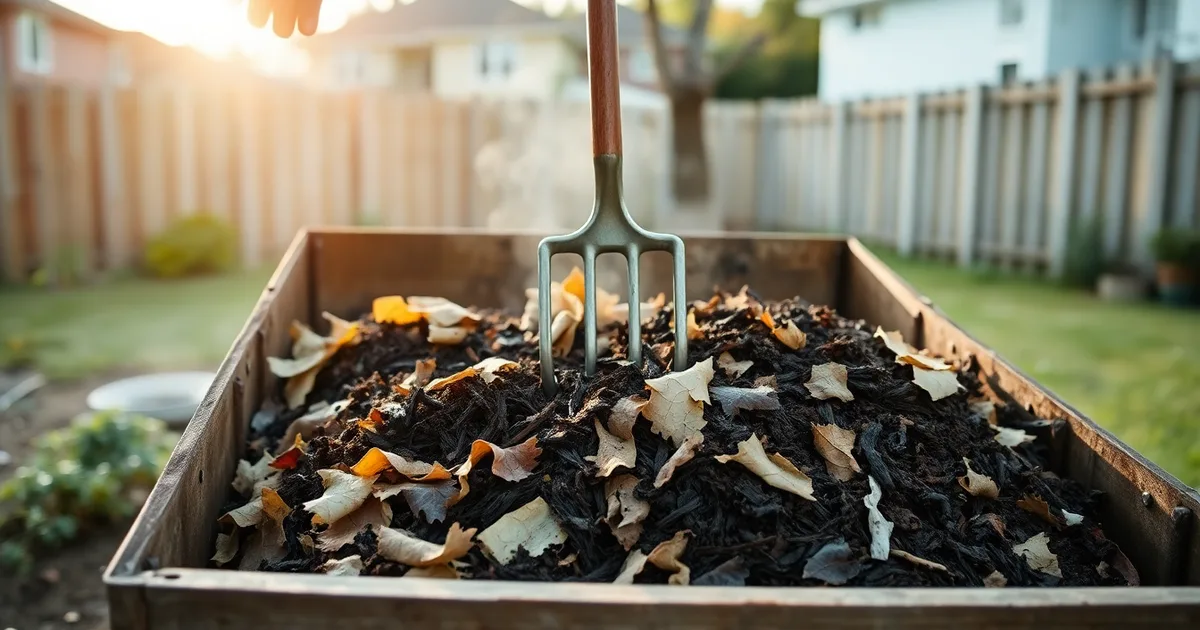
Ammonia means too much nitrogen and not enough carbon, usually with too little air. Add 2–3 parts shredded cardboard or dry leaves by volume for every 1 part smelly greens, turn the pile straight away, and aim for a C:N ratio between 25:1 and 30:1. Most piles clear in two to three days.
Compost stops smelling sweet somewhere below a 20:1 carbon-to-nitrogen ratio. That is the threshold where ammonia (NH3) starts to escape rather than stay bound in the pile, and it is why a bin that behaved for three months can turn on you in a week: one too many bags of grass clippings or a heavy run of kitchen scraps is enough to blow past it. The smell is nitrogen you paid for leaving as gas.
Temperature matters more than most people expect. Ammonia volatilises readily once pH climbs above 7.5 and the pile is warmer than 40°C (104°F) — conditions a well-fed tumbler hits easily in September. A pile sitting at 55°C and 70% moisture is working hard, not failing. Your nose is reading the exhaust.
One caveat before you empty half a bag of shredded paper into the bin: if the material is sloppy wet, carbon alone will not fix it. Squeeze a handful — it should feel like a wrung-out sponge, roughly 50–60% moisture. Soggier than that and you are feeding the anaerobic bacteria directly, so turn and mix as you add browns rather than layering them on top.
- Ammonia threshold: The smell appears when the C:N ratio falls below 20:1; the working target is 25:1 to 30:1.
- Browns dose: Add 2–3 volumes of shredded cardboard or dry leaves per volume of nitrogen-heavy greens.
- Turning schedule: Turn immediately after adding browns, then every 2–3 days until the smell goes.
- Chemistry trigger: NH3 escapes as gas above pH 7.5 and 40°C (104°F), which is why hot piles smell worse.
- Greens ceiling: Keep high-nitrogen material such as grass clippings and food scraps under 30% of pile volume.
What does ammonia smell in compost actually mean?
Ammonia (NH3) is what happens when nitrogen-rich material breaks down in a pile that has run out of carbon or oxygen. The bacteria doing the work switch from aerobic respiration to anaerobic fermentation, and the nitrogen they can no longer assimilate escapes as gas. Your nose is detecting volatilization: ammonia turns to vapor when pH climbs above roughly 7.5 and pile temperature passes 40°C (104°F), both of which are common in a hot bin fed too many grass clippings, coffee grounds, or kitchen scraps.
The smell itself is a data point, not a verdict. Healthy compost smells like damp forest floor — sweetish, fungal, faintly earthy. Early anaerobic decay smells sour or like vinegar, because organic acids form before nitrogen volatilizes. Ammonia is the later, sharper signal, and it means your carbon-to-nitrogen ratio has fallen below roughly 20:1 against an ideal of 25:1 to 30:1. Nothing has been ruined. The nitrogen that is escaping as gas is the same nitrogen you wanted in the finished product; you are losing it to the air at a rate you can stop within days.
Moisture usually travels with the problem. Above 60% water content, the pore spaces between particles fill with liquid, oxygen can't diffuse in, and anaerobic bacteria take over. A plastic tumbler makes this worse than an open pile because condensation collects and there is no passive airflow. That is why "just wait it out" so often fails: an enclosed, saturated, high-nitrogen pile will keep off-gassing ammonia until something physically changes.
The correction is mechanical and fast. Work 2–3 parts browns per 1 part greens by volume into the pile — shredded cardboard, dry leaves, or a handful of wood chips as a bulking agent — then turn it immediately to reintroduce oxygen. Odor typically drops within 48–72 hours, with full resolution in 2–5 days if you turn every 2–3 days for the first week or two. If the pile is already past 70°C (158°F), turn it now anyway; that heat is killing the microbes you need, not accelerating the process.
The role of carbon-to-nitrogen ratio in compost odor
The carbon-to-nitrogen ratio is the mass of carbon in your feedstock divided by the mass of nitrogen, and it governs almost everything that happens next. Bacteria and fungi building cells need roughly 30 parts carbon for every 1 part nitrogen; the carbon supplies energy, the nitrogen supplies protein. When the ratio sits around 25:1 to 30:1, microbes take up nitrogen as fast as it becomes available, and essentially none escapes as gas. Below about 20:1, they are drowning in nitrogen they cannot assimilate, and the surplus leaves the pile as ammonia (NH3).
That loss is not abstract chemistry. Each gram of nitrogen volatilized is fertilizer you paid for and then vented into the alley behind your bin. It also happens fastest precisely when your pile is healthiest in every other respect: ammonia volatilization picks up above pH 7.5 and above 40°C (104°F), both of which describe a hot, actively working pile fed too many greens. Grass clippings run roughly 17:1, kitchen scraps 15-20:1, and poultry manure closer to 10:1. Dry leaves land near 50:1, shredded cardboard 350-450:1, straw 80:1, and coffee grounds a misleading 20:1 that composts well because the nitrogen is bound in protein rather than free ammonium.
So the correction is arithmetic, not patience. Add 2-3 parts browns per 1 part greens by volume and turn the pile the same day, then every 2-3 days for one to two weeks. Shredded cardboard and dry leaves do the job; straw works but breaks down slowly unless chopped. If the mix squelches when you squeeze it, you are also above the 60% moisture ceiling where anaerobic bacteria take over and produce the sharper, more sulfurous notes that accompany ammonia. Aim for 50-60%, like a wrung-out sponge.
Ignore the advice you will find in older gardening books about sprinkling agricultural lime on a smelly pile. Lime raises pH, and ammonia volatilization accelerates as pH climbs past 7.5 — you would be converting bound nitrogen into gas faster and making the smell worse within hours. Wood ash has the same problem. Carbon and oxygen are the fix; pH adjustment never is. Odor normally resolves within 2-5 days of a proper correction.
Signs your compost is too wet or compacted (and why that makes ammonia worse)
Ammonia (NH3) is what happens when nitrogen has nowhere to go. In a well-aerated pile, microbes oxidise ammonium into nitrate and you smell nothing much at all. Seal off the oxygen and a different crew takes over — anaerobic bacteria that reduce nitrogen compounds to NH3 gas, which then escapes every time you open the lid. Moisture and compaction are the two things that seal it off. Here are the checks worth running before you add another bag of leaves.
- Squeeze test. Grab a fistful from 15–20 cm deep, not off the surface. It should feel like a wrung-out sponge and hold together loosely, with no more than a sheen of moisture on your palm. If liquid runs down your wrist, moisture content is above 60% and you are in anaerobic territory.
- Puddle and drain check. A compost tumbler with a solid base collects leachate. If you tip it and dark liquid pours from the vents or the seam, that is free water sitting in the lowest part of the drum, and the material down there is effectively submerged. No free liquid should ever come out of a healthy bin.
- Compaction test with a stick. Push a garden cane or a screwdriver into the pile. In loose compost it goes in with light pressure for its full length. If it stops halfway with a dull thud, you have a dense, matted layer — usually decomposed grass clippings or coffee grounds that have collapsed into a sludgy band. Those bands are where anaerobic pockets form, because gas cannot diffuse through them.
- Smell on turning. Turn the pile and wait 30 seconds. A sharp, sour, ammonia-and-sewage note that hits you as soon as the material is exposed means the anaerobic zone is deeper than the surface. A faint earthy smell with a brief ammonia edge usually means only the core has gone off.
- Temperature drop. A pile that was sitting in the thermophilic phase at 55–65°C (131–149°F) and has fallen to 30°C or below while still wet and warm to the touch has stalled. Anaerobic decomposition runs cooler than the thermophilic bacteria you want. Note that ammonia volatilization itself begins at pH above 7.5 and temperatures above 40°C (104°F), so a hot pile can lose nitrogen as gas even before it goes fully cold and sour.
- Add a bulking agent, not just browns. Wood chips, shredded cardboard, dry leaves and chopped twiggy prunings do two jobs: they raise the C:N ratio and they physically hold air spaces open. Aim for 2–3 parts browns to 1 part greens by volume, and make the chips 2–5 cm long. Sawdust is a poor choice here — it is fine enough to pack into the gaps it was meant to create.
- Turn immediately after correcting. For a bin that reeks, turn every 2–3 days for 1–2 weeks. Most people see the ammonia fade within 48–72 hours, and full odor resolution typically lands in 2–5 days. Do the moisture and structure fix first; turning wet, compacted material without adding carbon just spreads the problem through the whole batch.
The one people get wrong is the squeeze test. They take a handful from the top of the pile, where compost is always drier and always smells fine, and conclude the batch is healthy. The ammonia is coming from lower down. Dig the sample from the middle, and if you own a tumbler, take it from the end opposite the door you last loaded — that is where water and compacted greens collect. If you have already corrected the moisture and the smell is still sharp after five days, suspect the C:N ratio rather than the water; a pile below about 20:1 will keep generating ammonia no matter how well you aerate it.
How much carbon should you add to stop the smell?
This procedure applies once you have confirmed the pile is hot and nitrogen-heavy: a sharp ammonia (NH3) sting, a temperature reading above 40°C (104°F), and a C:N ratio that has drifted below 20:1. You need three things before you start — a carbon source you can shred or crumble by hand, a fork or tumbler handle, and about 20 minutes. If the pile is also dripping wet, read the moisture section first; adding browns to a saturated bin without draining it just makes papier-mâché.
- Measure what you have before you add anything. Estimate the volume of smelly material in the bin. A 200-litre tumbler filled to the halfway mark holds roughly 100 litres of greens. Write that number down, because every following step scales off it. Skipping this step is why most people either under-correct and smell ammonia again in three days, or dump in a whole bale of leaves and stall the pile for a month.
- Calculate the browns at 2–3 parts per 1 part greens by volume. For 100 litres of smelly material, that means 200–300 litres of loose, uncompacted carbon. Yes, that is more than the bin currently holds — browns compress hard once they are mixed in and wetted, so the finished volume typically lands 30–40% below the sum of the parts.
- Choose the carbon source. Shredded cardboard is the fastest-acting option and costs nothing; run corrugated board through a cross-cut shredder or tear it into strips no wider than 3 cm. Dry leaves are excellent but break down slower, so use them at the higher end of the range. Sawdust from untreated, unpainted wood works, though it mats easily — never use pressure-treated timber, MDF, or plywood, all of which carry binders and preservatives you do not want in soil you will grow food in. Grass clippings and coffee grounds are not browns; both sit near 20:1 and will make the problem worse.
- Mix, do not layer. This is the step people botch. Tipping browns on top of a reeking pile creates a dry crust that seals in the ammonia and leaves the anaerobic core untouched. Empty the bin onto a tarp if you have to, then rebuild it in alternating 10 cm layers, stirring each one into the last. Every green clump should be separated and coated. Budget 15–25 minutes for a 200-litre bin.
- Check moisture as you rebuild. Squeeze a handful: it should feel like a wrung-out sponge, which is the 50–60% target. Above 60%, pores fill with water and oxygen cannot reach the centre, which is exactly the condition that produced the ammonia in the first place. If it drips, add more dry cardboard and leave the lid off for a day.
- Turn again every 2–3 days for the next 1–2 weeks. Ammonia volatilization drops measurably within 48–72 hours of the first correction, but the pile needs repeated aeration to finish the job. A tumbler gets 10–15 full rotations; a static bin gets forked end to end. Expect the temperature to spike back into the thermophilic phase at 55–65°C (131–149°F), which is what you want. If it climbs past 70°C (158°F), turn immediately — that heat kills the microbes doing the work.
- Leave it alone between turns. Odor resolution typically takes 2–5 days. If the ammonia is still sharp on day five, your browns were too coarse or you did not mix thoroughly enough; add another 1 part shredded cardboard and turn again.
The failure mode here is adding browns without turning and then waiting. Carbon corrects the ratio on paper, but the ammonia is being produced in the oxygen-starved centre of the pile, and dry material sitting on the surface never reaches it. People who take this route usually report the smell fading for a day and then returning stronger, and they conclude the advice does not work when the real problem was aeration. Skip the odor neutralizers, the baking soda, and the commercial enzyme powders — none of them touch the C:N imbalance or the oxygen deficit underneath it.
Turning schedule: when and how often to aerate a smelly pile
The turn you do right after burying the browns matters more than every turn that follows it. Ammonia is volatile above pH 7.5 and 40°C (104°F), and microbial activity only builds while you leave the pile alone, so get the carbon worked in within the hour rather than at the weekend. Then treat the next two weeks as a short course of treatment, not a permanent habit: every 2–3 days, outer material into the middle, until the smell stops.
A tumbler changes the arithmetic. Five full rotations, wait sixty seconds, five more gives a better mix on a 200-litre plastic drum than twenty frantic spins, which mostly re-fluffs the same outer layer. Fork-and-pile heaps need the outside-to-centre move done properly: pull the crust down, build the new pile around it, don't just prod the top.
| Day | Action | Target moisture | Temperature (probe, 30 cm deep) | What to expect |
|---|---|---|---|---|
| 0 (immediately after adding browns) | Full turn, outer 15 cm moved to core; add 2–3 parts browns per 1 part greens by volume | 50–60% | 50–65°C (122–149°F) | Strongest NH3 release of the whole sequence, usually within 6–12 hours |
| 2 | Full turn, break up any matted clumps by hand | 50–60%; squeeze test yields 2–3 drops | 55–65°C (131–149°F) | Ammonia noticeably weaker; 48–72 hours after correction is the normal window for it to fade |
| 4 | Full turn; add a bulking agent (wood chip, 2–3 cm pieces) if the mix looks pasty | Recheck; add dry leaves if above 60% | 50–60°C (122–140°F) | Odour usually gone or reduced to a faint earthy note |
| 7 | Turn and probe twice, 15 cm and 45 cm deep | 50–55% | 45–55°C (113–131°F) | Falling temperature is the signal to start spacing turns out |
| 10–14 | Turn only if the probe still reads above 45°C (113°F) or you can still catch NH3 | 45–55% | 35–45°C (95–113°F) | Pile settling into mesophilic finish; stop turning from here |
The Day 0 and Day 2 turns do roughly 80% of the work, and for a 200-litre plastic tumbler that pair alone is usually enough — five rotations, sixty seconds, five more, twice in the first 72 hours. The row that flips is Day 10–14. Keep turning a pile that has already cooled below 45°C and you are not fixing anything, you are venting heat the thermophilic bacteria need to finish the job; above 70°C (158°C) you are killing them outright. One case does flip the whole table: grass clippings added in a layer more than 5 cm thick, or a week of rain with the lid off. Then Day 4 and Day 7 turns are not optional, because the mat that forms at 60%+ moisture will re-seal the pile and put you back at Day 0.
What not to add when your compost smells like ammonia
Every fix people reach for in the first hour of an ammonia smell is aimed at the symptom, not the chemistry. The list below is the short set of moves that reliably make it worse: they push the carbon-to-nitrogen ratio further below 20:1, drive moisture past 60%, or kill off the thermophilic bacteria you need to finish the job.
- More grass clippings. Fresh clippings run roughly 15:1 to 20:1 C:N and arrive at 75–85% moisture, so a single bucket can drop a bin that was holding at 30:1 straight under the threshold where ammonia (NH3) starts volatilizing. Bag them, spread them 2–3 cm deep on a lawn, and keep them out of the bin until the smell has been gone for a week.
- Food scraps, especially the wet ones. Coffee grounds are fine at 20:1 in small amounts — a 500 g café bag in a 200 L tumbler is not small. Melon rind, tomato, cooked rice and anything from a kitchen caddy adds nitrogen and water at the same time. Freeze it or hold it in a sealed bucket for the five days it takes the pile to recover.
- Manure, fresh or bagged. Poultry litter and horse manure commonly test 10:1 to 15:1 and carry enough moisture to trigger anaerobic bacteria within a day. If you were planning to add it as an activator, use finished compost instead.
- Garden lime, wood ash, or dolomite. Ammonia volatilization begins above pH 7.5, and lime pushes a pile in exactly that direction. The immediate effect is a sharper smell, not a milder one. Wood ash is worse: it is alkaline and adds potassium with no carbon.
- Commercial odor eliminators and "compost accelerators" sprays. Enzyme and fragrance products mask the NH3 for a few hours. The fragrance also kills your ability to judge whether the fix is working. Skip the whole category and buy a bag of shredded cardboard instead.
- Bokashi bran, yeast, or molasses "boosters". These are designed for sealed anaerobic fermentation, which is the opposite of what a smelly aerobic bin needs. Adding them selects for the bacteria already causing the problem.
- Compacting the pile. Do not step on a heap to make room, and do not jam a tumbler past about 80% of its drum volume. Overfilling a tumbler removes the air gap that lets it tumble rather than slide, and the inner core goes anaerobic within 24–48 hours. If your bin is full, stop adding and turn what is there.
- Water. When the smell is ammonia, the pile is almost always already too wet. Add 2–3 parts shredded cardboard or dry leaves per 1 part offending material by volume and check moisture by squeezing a fistful: one or two drops should come out, not a stream.
The one people get wrong most often is lime. It is the classic old gardening-book advice for smelly heaps, it is sold next to the compost bins, and it does the exact opposite of what you want: it raises pH into the 8–9 range where nearly all ammonium converts to gaseous NH3 and leaves the pile. That is why the smell is worse the day after you apply it. The other quiet failure is overfilling — a plastic tumbler or dalek bin stuffed to the lid cannot be turned properly, takes no air at the centre, and will keep generating ammonia no matter how many browns you tip in from the top. Empty a third of it into a second bin or a heap before you try anything else.
How fast will the ammonia smell go away?
If you got the browns in and turned the pile today, expect the sharpness to drop within 48 to 72 hours. That is the consistent figure across municipal composting guidance and university extension trials: odor intensity falls off noticeably by day three, even when the pile is still warm and still visibly active. What you are smelling is free ammonia (NH3) that has already volatilized out of the material. It does not get reabsorbed. Once the surface layer has off-gassed and fresh aerobic bacteria have colonized the new carbon you added, the source stops producing more of it.
The smell itself clears before the pile is finished recovering. Full resolution usually runs 3 to 5 days. A 60-litre plastic tumbler in cool September weather sits at the fast end of that; a 300-litre bin in a shaded corner, still sitting at 55-65°C in its thermophilic core, takes the longer end because the heat keeps driving volatilization. Turning frequency matters more than anything else in this window. Every 2 to 3 days for the first week to ten days, then back to your normal schedule.
What you will see while it recovers
Do not panic if the pile reheats on day two or three. That is the point. As aerobic microbes digest the shredded cardboard or dry leaves you mixed in, core temperature often climbs back toward 55-65°C, and you may see a fresh bloom of white fungal threads on the surface. That is a working pile. What you should not see is the temperature pushing past 70°C, which starts killing the same microbes doing the work.
If the ammonia is still sharp on day six, the correction did not take. The usual culprits, in order of likelihood: you added browns by eye instead of by volume and the C:N ratio is still under 20:1, the moisture content is still above 60% because the greens were wet when they went in, or the pile is compacted enough that turning only shifted the outer layer. Add another 2 parts browns per 1 part greens, break up any matted clumps by hand, and check that a squeezed handful does not drip. Waiting it out is the one thing that reliably does not work.
Preventing ammonia smell in the future
Balance by volume, not by weight, and aim for two to three parts browns to one part greens every time you add a bucket of kitchen scraps. Shredded cardboard, dry leaves and torn paper are the workhorses here; grass clippings and coffee grounds are the usual culprits because they are dense, wet and nitrogen-heavy. A 2026 review of home composting practice puts the problem threshold below a C:N ratio of 20:1, which is easy to hit with a few weeks of nothing but vegetable peelings and lawn clippings. If you keep a small lidded tub of shredded cardboard beside the bin, topping up becomes a reflex rather than a chore.
Moisture and aeration go together, and neither fixes the other on its own. Squeeze a handful of the mix: it should feel like a wrung-out sponge, roughly 50–60% moisture. Above 60%, the pore spaces fill with water, oxygen disappears, and anaerobic bacteria take over — that is the population producing the ammonia you have just spent a week chasing out. Turning is what restores oxygen, but a compacted or sodden pile will collapse back into itself within days unless you also add a bulking agent: a handful of wood chips, pine bark or chopped twigs creates the air channels that turning alone cannot.
Temperature is your early-warning system, and a $15 compost thermometer pays for itself here. The thermophilic phase runs at 55–65°C (131–149°F), which is exactly where you want to be. Push past 65°C and ammonia starts to volatilize more aggressively — remember that volatilization begins above 40°C (104°F) once pH climbs past 7.5. Above 70°C (158°F) you are killing the microbes doing the work. A tumbler left in full sun on a warm afternoon can hit these numbers faster than most people expect, so if your probe reads 66°C or higher, turn the pile to cool it and mix in another two parts shredded cardboard or dry leaves.
The honest trade-off: daily turning for the first fortnight after a fix is the fastest route back to a stable pile, but every turn costs you moisture and a little heat. If your bin is dry and hovering around 55°C, leave it alone and check again in two days. If it is wet, warm and compacted, turn it now and keep turning every second or third day until the smell is gone — typically two to five days after you correct the balance.
Frequently Asked Questions
Can I still use compost that smells like ammonia?
Yes, once the odor has gone and the pile has finished its heating cycle, the compost is safe to spread. Ammonia is a gas that escapes into the air; it does not leave toxic residues or salts behind in any meaningful quantity. Give it two to four weeks after the smell fades, confirm the pile has cooled to ambient temperature, and screen out anything unbroken before use.
What is the fastest way to get rid of ammonia smell in compost?
Add two to three parts shredded cardboard or dry autumn leaves by volume for every part of smelly material, then turn the pile the same day. Aim for a moisture level like a wrung-out sponge, roughly 50–60 percent water. Most heaps lose the ammonia tang within 3–7 days if the carbon dose is generous enough.
Shred the cardboard into pieces under 5 cm (2 in) so the nitrogen-hungry microbes can actually reach the carbon. Whole sheets mat down and slow the fix.
Will adding lime stop the ammonia smell?
No. Garden lime raises pH, and ammonia volatilizes faster as pH climbs above 7.5, so you would drive more gas off, not less. Agricultural lime also pushes the pile toward alkaline conditions that favor the wrong microbes. Use carbon, not lime. If you want a pH buffer for a genuinely acidic pile, wood ash at a light sprinkle does the same job with less risk of overcorrecting.
Why does my compost smell like ammonia and not rotten eggs?
Ammonia means excess nitrogen. When the carbon-to-nitrogen ratio drops below roughly 25:1, microbes break down protein and release ammonium, which converts to ammonia gas above pH 7.5. Rotten egg smell is hydrogen sulfide, produced when sulfur compounds are reduced under anaerobic conditions. The two odors point to different failures: one is a feed imbalance, the other is oxygen starvation.
How often should I turn compost that smells like ammonia?
Turn it immediately after adding browns, then every 2–3 days until the smell disappears. In a typical 1 m³ (1 cu yd) backyard heap that takes about a week; larger windrows can run 10–14 days. After the odor clears, drop back to a weekly turn.
Does ammonia smell mean my compost is too hot?
Not necessarily. Ammonia is released when pH exceeds 7.5 and pile temperature passes 40°C (104°F), but heat alone does not cause it. A 65°C pile with a balanced carbon-to-nitrogen ratio smells earthy. The primary drivers are too much nitrogen and too little oxygen; high temperature only accelerates the loss.