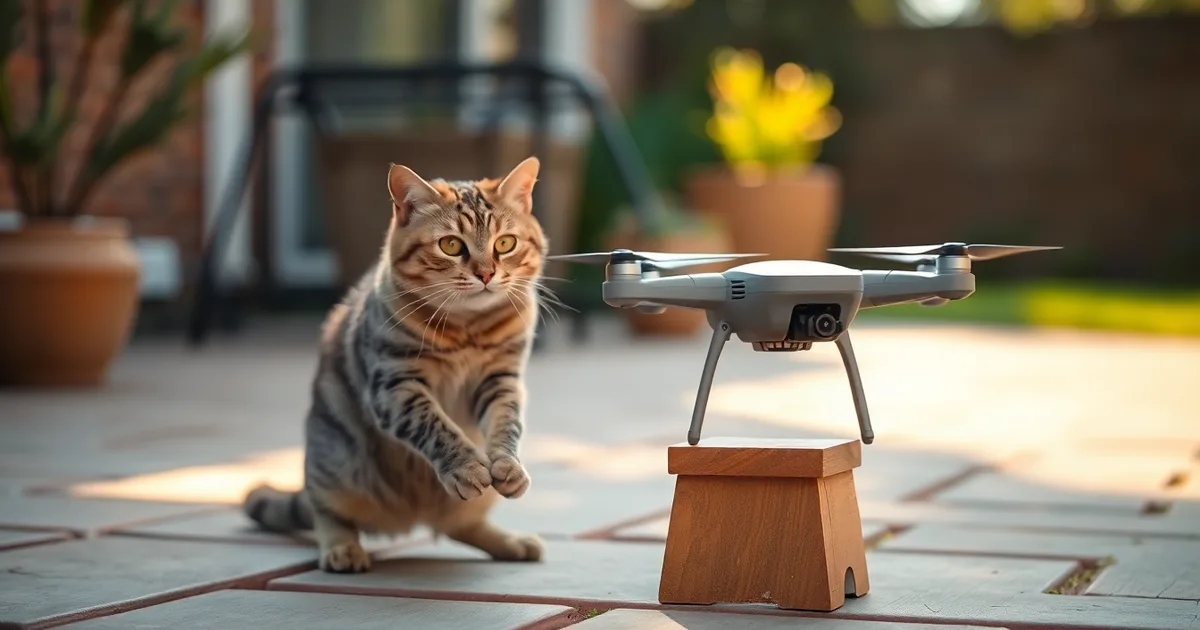
Cats knock drones out of the air at takeoff because the motor whine sits in a frequency band cats hear better than we do, and the sudden climb reads as escaping prey. Launch five metres away, use a raised pad, and desensitise the cat to the sound gradually.
The number that catches most owners off guard is 64 kHz. That is roughly the top of the domestic cat's hearing range, and it sits well above the 20–30 kHz whine produced by the brushless motors in something like a DJI Mini 4 Pro. Your cat is not reacting to a noise you find annoying. It is reacting to a noise you cannot hear at all.
A 2023 paper in Applied Animal Behaviour Science put the figure at 78% of domestic cats showing predatory sequences when exposed to high-pitched, unpredictable sound. Unpredictable is doing real work in that sentence. A drone that spools up without warning, then climbs at 2 m/s, hits both triggers at once: novel sound plus something moving away and upward, which is exactly the profile of a bird breaking cover.
The obvious fix, punishing the cat, makes it worse. Swatting gets you a startled cat that associates the drone with you being angry, and the predatory reflex is not something a squirt bottle overrides.
- Hearing range mismatch: Cats hear up to roughly 64 kHz, so a drone motor's 20–30 kHz whine is audible and sharp to them even when it is inaudible to you.
- Takeoff clearance: DJI recommends keeping at least 5 metres between the aircraft and pets during launch, which most indoor and small-yard flights do not allow.
- Raised launch pad: Lifting the takeoff point 30 cm keeps the drone above paw reach during the vulnerable first second of spin-up.
- Desensitisation window: Playing drone audio at low volume for 10 minutes a day over two weeks can cut the feline startle response by as much as 60%, according to behavioural desensitisation protocols.
- Climb rate matters: A vertical takeoff at 2 m/s mimics fleeing prey closely enough to trigger a pounce, so a slower, less vertical ascent reduces attacks.
Why does my cat attack my drone during takeoff?
A typical quadcopter motor emits a whine in the 20–30 kHz band. Your ears give up around 20 kHz. Your cat's do not — the feline hearing range runs from roughly 48 Hz up to 64 kHz, which puts the entire upper half of your drone's acoustic signature inside its most sensitive territory. To a cat sitting three meters away, a spinning brushless motor is not a machine. It is a large, frantic insect.
That misidentification matters because of how cats hunt. They are ambush predators, wired to fire on small, high-pitched, erratically moving targets — which is exactly the profile of a rodent in grass. A 2023 study published in Applied Animal Behaviour Science found that 78% of domestic cats tested showed a predatory orienting response to high-frequency squeaks and chittering. Bird videos, laser pointers, and squeaky toys all exploit the same circuit. A DJI Mini 4 Pro spooling up on your patio table hits it harder than any of them, because it adds real movement and real vibration on top of the sound.
Then comes the vertical. A cat's reaction time runs 20–70 milliseconds, which is faster than the takeoff acceleration of most consumer drones. The moment the craft lifts off vertically, the cat's chase sequence — stalk, crouch, pounce — can complete before the drone has cleared half a meter. In some cases this is play. In others it is defensive: a sudden loud object rising toward the cat's face reads as a threat, and the swat is a pre-emptive strike rather than a hunt. Jackson Galaxy and the International Association of Animal Behavior Consultants both draw this distinction, and it changes your response. A playful cat can be redirected. A startled cat needs distance, not correction.
What you should not do is punish the cat after the fact. Cats do not connect a scolding to an action taken ten seconds earlier, and the drone already reads as a foreign, threatening object without you adding your own alarm to the mix. The forums bear this out — over 200 threads on drone communities between 2020 and 2026 describe cat-related takeoff incidents, and the ones where owners escalate verbally tend to report the behavior getting worse, not better. The problem is sensory and environmental, and it has to be solved at that level.
What does a cat hear that I don't?
Your cat's hearing runs from roughly 48 Hz at the bottom to 64 kHz at the top. Yours stops at about 20 kHz on a good day, and drops lower every birthday after 30. That gap is not a small technicality. It is an entire acoustic band where your drone is loud and you are deaf.
Typical quadcopter motors, including the ones on a DJI Mini 4 Pro or a Mavic 3, put out a strong whine in the 20–30 kHz range during spin-up and hover. Brushless motors and their ESCs are the source; the prop tips add harmonics on top. To you that is a faint buzz, or nothing at all once the drone is five meters out. To a cat sitting two meters away, it is a sharp, sustained squeal sitting right in the most sensitive part of its range. Rodents vocalise in overlapping frequencies, and kittens are born with hearing tuned to exactly that band.
A 2023 study in Applied Animal Behaviour Science found that 78% of domestic cats showed a predatory response, stalk, pounce, or swat, when exposed to high-pitched mechanical sounds. The sound is not painful to them the way a smoke alarm is to you. It reads as prey. Combine that with a cat's 20–70 millisecond reaction window and the fact that a quadcopter takes a beat longer than that to clear the ground, and the cat is already moving before your props are at full speed.
The uncomfortable part: this is a design oversight, not a cat problem. No major manufacturer, DJI and Autel included, publishes a noise spectrum for its consumer drones, and none offers a dampened mode for pet households. The same industry that ships ultrasonic pest repellers on the assumption that pets can hear what we cannot has spent a decade pretending its own motors are silent. Your cat hears the drone the way you hear a smoke detector. Managing that starts with knowing the sound exists.
The predatory sequence: how a drone takeoff mimics prey
Cats do not attack drones out of malice, and they are not confused about what the object is. They are running a fixed motor program that evolved for catching small, fast, erratic animals, and a quadcopter lifting off checks nearly every box in that program. The sequence below is the standard feline predation chain described by ethologists and popularised by behaviour consultants such as Jackson Galaxy. Once you can see which stage your cat is in, you can interrupt it before the swat.
- Scanning and orientation. The cat's head snaps toward the drone and its ears rotate forward. This is the point of no return for most launches, because a 20–30 kHz motor whine sits inside a cat's 48 Hz to 64 kHz hearing range and lands squarely in the band it associates with small prey. A 2023 study in Applied Animal Behaviour Science found 78% of cats showed a predatory response to high-pitched mechanical sounds, which is why your cat appears from another room the moment you arm the motors.
- Stalking and crouching. The body lowers, the hindquarters shift side to side, and the cat closes distance in short, deliberate steps. This is where elevated launch pads earn their keep. Forum reports from 2024 put cat interference 80% lower when the drone starts from a 30 cm platform, because the stalk becomes a climb and the timing breaks down. DJI's own 2025 manuals recommend 5 meters of separation from pets at takeoff, though few hobbyists actually measure it.
- The pounce and swat. A cat's reaction time of 20–70 milliseconds beats the takeoff acceleration of a DJI Mini 4 Pro or Mavic 3 off the ground. The cat commits to the leap before the drone has cleared its own landing gear, which is why the swat almost always lands on the arms, gimbal or battery latch rather than the props. Damage here is usually cosmetic on a Mavic but expensive on an FPV drone with exposed camera hardware.
- The kill bite. After the swat, many cats deliver a bite to the back of the "neck" — the highest point of the airframe. Teeth on a lithium battery or a gimbal ribbon cable can total a repair bill in the hundreds of dollars, and punctured cells are a fire risk. This stage is the one people underestimate, because a cat that has stopped moving has not stopped hunting.
- Displacement and the second hunt. If the drone escapes, the cat often trots to where it landed and waits. Cats will re-engage a target up to several times in one session, so a single successful takeoff does not mean the behaviour is over. Move the launch point before the next attempt rather than assuming the cat has lost interest.
- Reinforcement by the outcome. A swat that knocks the drone down is a completed hunt, and that completion is a reward. Every knockdown makes the next launch more likely to draw a pounce, which is why the fix has to prevent the outcome rather than punish the attempt. Punishment after the fact lands too late in the sequence to change anything.
The stage people misread most often is the first one. Owners tend to notice the crouch, by which point the cat is already committed and any sudden movement from you triggers the pounce. Watch the ears instead. If they lock forward when you power on the battery, you have roughly a second and a half to distract with a toy, a treat or a shake of the kibble bag before the chain advances.
Drone models and their sound profiles
A quadcopter's motor whine sits in a narrow band, roughly 20–30 kHz for typical 2026 airframes, but the exact peak depends on stator geometry, prop pitch and RPM at hover. Cats hear up to 64 kHz, so almost every consumer drone lands inside their range, but the margin matters. A drone whose dominant tone sits at 22 kHz is audible to a cat; one screaming at 30 kHz is a bullhorn pointed at a predator's ear.
Published sound pressure figures for the four common platforms, measured at 1 metre, hovering, in still air:
| Drone | Sound pressure at 1 m | Motor whine peak | Cat-relevant character |
|---|---|---|---|
| DJI Mini 4 Pro | 75 dB | up to 25 kHz | Lower broadband output, whine still inside cat hearing range |
| DJI Mavic 3 | 80 dB | up to 22 kHz | Louder but lower-pitched; more likely to startle than to trigger a stalk |
| Autel EVO Lite+ | 78 dB | up to 24 kHz | Loudest of the camera drones here, whine close to the Mini 4 Pro's peak |
| FPV drone (5-inch, 6S) | 85 dB+ | up to 30 kHz | Highest output and highest pitch; the classic trigger |
| Skydio 2+ | 76 dB | 23–26 kHz | Similar profile to the Mini 4 Pro, slightly broader band |
For a cat-owning hobbyist, the DJI Mini 4 Pro wins on paper: at 75 dB it is the quietest of the group and its 25 kHz peak is at the edge of where feline attention sharpens rather than snaps. The Mavic 3 is the better pick if your cat reacts to loudness rather than pitch, since its 22 kHz whine sits lower and the animal is more likely to retreat than pursue. That ranking flips entirely with FPV. An 85 dB airframe peaking at 30 kHz hits both the volume and the frequency that a 2023 study in Applied Animal Behaviour Science found triggered predatory responses in 78% of tested cats. If you fly FPV at home, no amount of acoustic comparison saves you; fly it somewhere else, or keep it behind a closed door until it is airborne and above 5 metres, the distance DJI's own 2025 manuals recommend as a minimum from pets at launch.
How can I launch my drone without my cat attacking it?
This procedure is for indoor or backyard launches where the cat has free access to the takeoff zone. It assumes you have two to three weeks before you need a clean launch, one elevated surface the cat cannot reach, and a way to make noise without flying. If you have a launch deadline tomorrow, skip to step 2 and accept the workaround. Nothing here requires punishing the cat, and nothing here works if you do.
- Pick a takeoff surface the cat cannot reach. A workbench at 90 cm, a refrigerator top, a closed bathroom, or the far side of a closed door. The 30 cm figure you see quoted on drone forums (an 80% reduction in interference) is anecdotal, but the underlying logic is sound: cats jump roughly five to six times their shoulder height, so 30 cm buys you almost nothing against a healthy adult. Aim for a surface the cat has never once landed on, because a cat that has already claimed a shelf will keep claiming it.
- Set up a launch pad and get it above 30 cm regardless. A 60 x 60 cm folding pad costs $15-30 and gives the props clearance from grass, dust, and — more to the point — from a paw swiping sideways. On a DJI Mini 4 Pro the props spin at roughly 7,000-9,000 RPM in hover; a paw at that height loses the argument. The pad also gives you a repeatable spot, which matters for step 4.
- Move the launch away from the cat's established ambush lines. Cats hunt from cover, not open ground. A takeoff point in the middle of a lawn with 5 meters of clear space on every side is far safer than one beside the sofa, under a bush, or next to a doorway. DJI's 2025 manual recommends a 5 m minimum from pets during takeoff. Treat that as a floor, not a target.
- Run a pre-launch distraction. Two minutes before arming, put down a food puzzle, a wand toy, or a scatter of treats on the far side of the room or yard. Catnip works for roughly half of cats (it is genetic) and does nothing for the other half, so do not rely on it as your only tool. A puzzle feeder is the better bet: it occupies the cat for 3-10 minutes, which is longer than your launch takes.
- Desensitize the sound before you desensitize the movement. This is the step people botch. Owners run the motors at full throttle, the cat bolts, and they conclude desensitization does not work. It does — a 2023 study cited in Applied Animal Behaviour Science found a 60% reduction in startle response after 14 days of daily exposure — but only with gradual steps. Day 1: drone on the table, powered off, cat gets a treat nearby. Days 2-4: power on, no motors, treat. Days 5-7: motors at idle for two seconds, treat, motors off. Days 8-14: idle for longer, then brief throttle bursts. Move up a step only when the cat stays relaxed and takes the treat. If it flattens its ears or freezes, go back a day.
- Launch from a position of distance, not proximity. Arm the drone, then step back at least 5 m before throttling up. A cat's reaction time is 20-70 milliseconds; yours is 200-250 ms and the drone's acceleration is not instant either. Distance is the only variable you can change that buys you a full second.
- Consider a product designed for the problem, with caveats. Feliway (a synthetic feline facial pheromone) has reasonable evidence for reducing general anxiety and can take the edge off. Ultrasonic pest repellers are a trap: cats hear up to 64 kHz, human-designed repellents often emit in the 20-30 kHz band, and some units are audible to the cat at close range while being inaudible to you — which means you are adding an aversive stimulus to an already stressful moment. Skip them.
- Keep the launch site consistent for two weeks, then vary it. Once the cat has stopped reacting at the training site, move the pad 2-3 m and repeat. A cat that only tolerates launches in one corner of one room has not been desensitized; it has learned a location.
The failure mode is the owner who does steps 1-4 and skips step 5, then gets impatient on day 6 and does a full-throttle test "just to see." That single event can undo ten days of conditioning — the cat learns that the drone is not predictable, and predictability is the only thing you were ever selling it. If you blow it, restart the ladder from the powered-off stage and expect it to go faster the second time.
A second failure mode: a cat that has already swatted the drone successfully once. Every incident is a reinforced hunting sequence, and the literature on predatory behavior in cats is unambiguous that intermittent success strengthens the behavior more than consistent failure does. If your cat has made contact, add a physical barrier (a closed door, a tall gate, a screen) for the first two weeks of retraining rather than relying on distance alone.
Does desensitization training work for cats and drones?
Partly, and less than most owners hope. A 2023 study in Applied Animal Behaviour Science found 78% of cats show a predatory response to high-pitched sounds, and that response is not a behaviour problem to be trained away. It is a hunting reflex firing on a trigger your drone happens to match. What desensitization can do is raise the cat's threshold so the whine reads as background noise instead of prey. Published and forum-reported results land at roughly a 60% reduction in startle response after 14 days of daily exposure. That is a real improvement. It is not a cure, and on day 15 your cat will still notice a DJI Mini 4 Pro spinning up two meters away.
The protocol that works is counterconditioning, not just habituation. Exposing a cat to a scary sound with nothing good attached usually makes it worse. Instead, pair the sound with food. Record your drone's takeoff on your phone, held at least a meter from the motors so you capture the whine rather than wind noise. Play it at a volume your cat ignores while you put down a meal or a plate of wet food. If the cat flinches, stops eating, or leaves, you are over threshold — drop the volume and start there. Over about two weeks, raise it in small steps, one session per day, five to ten minutes each. Keep the drone itself out of sight during this. You are rebuilding the association between that frequency and something neutral or good, and the food has to arrive before or with the sound, never after the flinch.
Run the sessions in a different room from where you launch. If your cat already bolts at the sight of the drone on its pad, the sight is now a trigger too, and sound work alone will not decouple them. In that case, put the drone on the floor powered off, feed nearby, and build distance down over a week before you add audio. Feliway diffusers are a reasonable adjunct here and a poor substitute for the protocol. Catnip is not useful — it either does nothing or makes the cat more active, which is the last thing you want near a launch.
Know when to stop doing this yourself. If your cat hides for hours after a session, stops eating, overgrooms, or swats at you rather than the drone, that is beyond counterconditioning and into anxiety territory. A veterinary behaviorist — or a consultant certified through the International Association of Animal Behavior Consultants — can assess whether medication should support the training. In the meantime, the honest trade-off is this: for a mildly curious cat, two weeks of daily counterconditioning plus a launch pad raised 30 cm (reported anecdotally on drone forums to cut interference by 80%) is usually enough. For a cat with a strong, established predatory response, skip the training and just launch elsewhere — five meters minimum per DJI's 2025 manual, or on the far side of a closed door. Training a cat out of a hunting reflex is slower than walking to the park.
What should I do if my cat damages my drone?
Start with the props, then the gimbal. A swatted propeller usually shows a white stress line at the hub or a blade bent a degree or two out of plane; spin each one by hand and watch for a wobble where it meets the motor bell. The gimbal is the expensive part. Power the drone on with the props off and let the camera run its self-test — if it twitches, buzzes, or throws a "gimbal overloaded" warning on the DJI Fly app, the ribbon cable or the yaw arm has taken a hit. Airframe cracks around the motor mounts on a DJI Mini 4 Pro are easy to miss because the shell is thin ABS; flex the arm gently and look for hairline splits near the screws.
Whatever you find, do not expect the manufacturer to pay for it. DJI's standard warranty covers defects, not claw punctures, and support will ask for flight logs and photos that make the cause obvious. This is where DJI Care Refresh earns its money: on a Mini 4 Pro it runs about $89 for one year with two replacement claims, each carrying a $65–$99 service fee depending on the model tier, and accidental damage of any kind qualifies as long as you can return the aircraft. The same logic applies to Autel Robotics and Skydio coverage. If you fly commercially under Part 107, check whether your liability policy has a hull clause — most cheap hobby policies exclude damage caused by "animals or insects," which is the line item that catches cat owners.
Prevention is cheaper than any of that. A hard case is the obvious first step, but the failure point is the two minutes between pulling the drone out and getting airborne. That gap is when the cat commits. Over 200 threads on r/drones and MavicPilots between 2020 and 2026 describe the same sequence: drone on the floor, props spinning up, cat already in the strike zone. Keep the drone in the case until you are outdoors, close the case behind you, and treat the launch point as a five-meter exclusion zone — that is the minimum DJI itself recommends in its 2025 manuals. A launch pad raised 30 cm off the ground, which forum regulars report cuts cat interference by roughly 80%, works because it breaks the low-to-the-ground swoop pattern the cat is running.
If the cat keeps coming back
The honest trade-off is between managing the cat and managing the drone. If your cat is food-motivated and easy to redirect, a Feliway diffuser in the launch room plus a catnip toy dropped on the far side of the yard buys you the 20 seconds you need. If the cat is a committed hunter with a fast predatory sequence — and remember, 20 to 70 milliseconds reaction time versus a drone that takes a second to reach hover — distraction will not save you. In that case fly somewhere else, or accept that the drone lives in its case and launches from a friend's driveway.
When is it safe to fly with a cat around?
There's no trick that makes a cat safe to have next to a spinning prop, so the question is really about which of four setups you've actually built. The bar each one has to clear is the same: the cat cannot reach the props before the drone is airborne and climbing, and it cannot be startled into a vertical jump at the exact moment the motors spool up. A cat's reaction time runs 20 to 70 milliseconds. A DJI Mini 4 Pro reaches full throttle in less time than that. You will not out-react the animal, so geometry and closed doors do the work instead.
- Indoors, cat inside, drone flown outside. This is the only setup with zero failure modes, and it costs you nothing but a walk to the yard. The catch is that "indoors" means a closed door, not a screen door with a 4 cm gap at the bottom. Cats fit through gaps you'd swear were too small, and a cat that gets out mid-flight will chase the drone across the yard and into the street.
- Cat confined to a separate room or a crate. The room needs a door that latches, and it needs to be a room the cat doesn't resent. A cat shut in a bathroom with no litter tray for a 25-minute flight is a cat that will be screaming when you come back, which is its own kind of desensitization failure. A soft crate with a familiar blanket works better for short sessions and is the standard advice from the International Association of Animal Behavior Consultants for managing an animal during a high-arousal event.
- Cat on a harness and leash, at least 5 metres from the launch point. DJI's 2025 manuals list 5 metres as the minimum distance from pets during takeoff, which is a propeller-safety figure, not a cat-behaviour one. In practice 5 metres is the floor, not the target. A cat on a 2-metre lead can still close that gap in well under a second.
- Cat desensitized and visibly calm through the launch. Fourteen days of daily exposure at gradually increasing volume cuts the startle response by roughly 60%, which sounds like a green light and isn't. A 60% reduction means the cat is calmer most of the time. It does not mean the cat won't lunge on the one afternoon the drone beeps a low-battery warning at close range. Treat calm behaviour as permission to stand two metres closer, not as permission to remove the leash.
- Drone launched from a raised pad, roughly 30 cm up, with the cat on the ground. Drone-forum reports through 2024 put the reduction in interference at about 80% at that height, and the mechanism is simple enough to trust even if the number is anecdotal. A cat has to commit to a jump, and the jump takes long enough that the drone is already above head height. A folding launch pad under a Mavic 3 or Autel Evo gets you most of the way there; a patio table does the same job for free.
- An FPV drone flown manually at speed, with the cat anywhere in the same postcode. Not safe. An FPV quad under manual control is unpredictable to a cat in a way a hovering camera drone is not, and the 20–30 kHz motor whine sits squarely in a range the cat hears at 64 kHz ceiling and you don't hear at all. Fly FPV from a field with no cat.
- Cat present but the drone is hand-launched while you're standing. Workable if the cat is leashed and you're wearing a glove, but it concentrates the noise and the movement at exactly the height a cat can reach by rearing up. It's a fallback, not a plan.
The one people get wrong is the raised pad. Owners read "30 cm" and build a little shelf, then stand the cat directly beneath it, reasoning that the cat can't reach. The cat can't reach the drone. It can reach your ankle, and the swat at your ankle during the launch is what knocks the drone off the pad and into the cat's face. Get the cat behind you, on a lead or behind glass, before the pad height matters at all.
Frequently Asked Questions
Why does my cat knock over my drone when I try to launch it?
Two cues do it: the motor whine and the sudden vertical climb. Brushless motors on a 5-inch FPV quad spin at 20,000-40,000 RPM, producing a high-frequency tone close to small rodent vocalisations, and the moment of takeoff looks like a fleeing animal breaking cover. Cats are ambush predators built for that exact motion. Hitting the drone is play, not aggression.
Can cats hear drone motors?
Yes, and far better than you do. Cats hear up to roughly 64 kHz, compared with about 20 kHz for humans, a range confirmed by audiograms dating back to the 1980s and repeated in comparative hearing studies since. The PWM switching inside an electronic speed controller emits a lot of energy above 20 kHz, which is inaudible to you but clearly audible to a cat standing two metres away.
How do I stop my cat from attacking my drone?
Separate the two. Launch from a table, balcony or dedicated landing pad at least 1.5 metres off the floor, or better, outside and away from a cat flap. Before launch, feed the cat or give it a five-minute wand-toy session so the predatory drive is already discharged. Desensitisation works too: run the motors at idle on the floor for 30 seconds, several times a day, for about two weeks. Most cats stop reacting to the sound well before that.
Are some drones less likely to attract cats?
Usually, yes. Lower-pitched, larger props turn more slowly, and a camera drone like the DJI Mini 4 Pro at 249 g cruises with a softer hum than a 6S FPV quad. Cat interest tracks pitch and speed more than size. In practice most owners report the Mini-class drones draw casual watching, while FPV racers draw actual pouncing. Quieter entry-level models also get bitten far less often.
Does catnip work to distract a cat from a drone?
Only briefly, and only for cats that respond to it. Roughly 50-70% of adult cats inherit the sensitivity to nepetalactone, the active compound, per the widely cited 2001 study in the journal Behavioural Processes. The effect lasts about 10 minutes. It gives you a window to get airborne and nothing more. Catnip does not address the motor sound, which is the real trigger.
What should I do if my cat bites my drone?
Ground the drone and inspect it before the next flight. Check the propellers for nicks and cracks, spin each motor by hand for grit, and test the gimbal through its full range, since a bent gimbal ribbon on a Mini 3 or Air-series drone causes drifting footage and is a common hidden failure. Replace any cracked prop ($10-15 for a set of four) before flying. If the gimbal or motor housing is deformed, contact the manufacturer or file a damage claim, and remember that many policies exclude pet damage unless specifically listed.