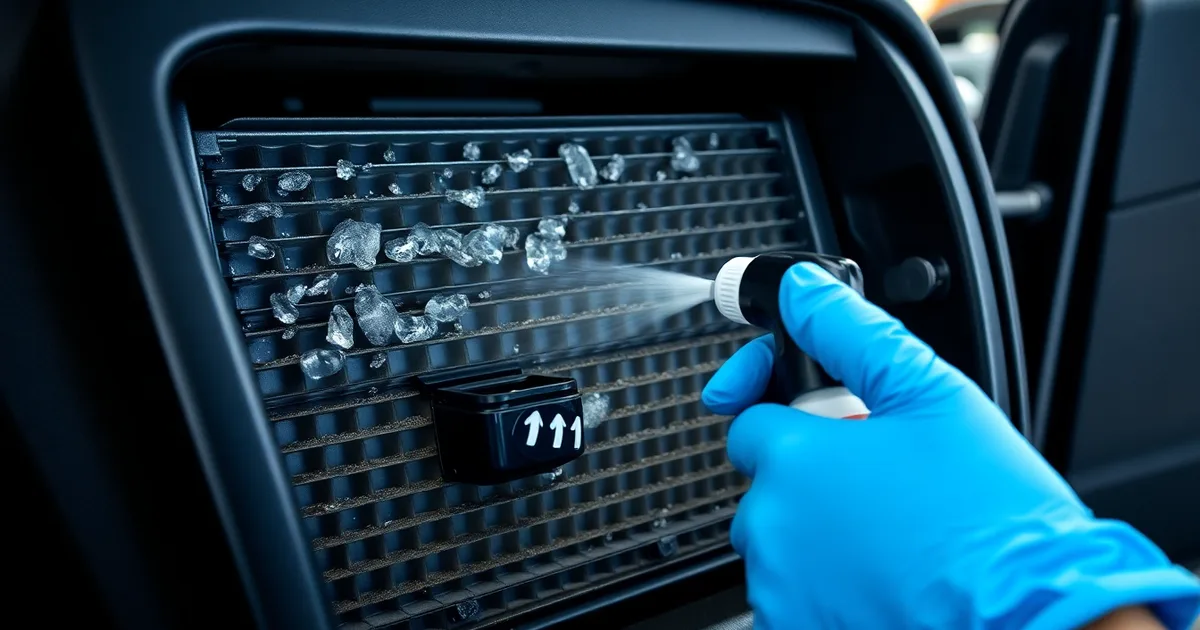
A vinegar smell from your car's AC almost always means microbial biofilm has colonised the evaporator core, not that the cabin filter is dirty. Clean the evaporator, clear the condensate drain, and replace the filter if needed—that sequence resolves over 90% of cases.
Replacing the cabin filter is the first thing most owners try, and it is usually wasted money. Service data from 2023 puts evaporator biofilm behind roughly 90% of sour or vinegary AC odours. The filter sits upstream of the evaporator and only traps dust and pollen; the mould that smells like vinegar grows on the cold, wet aluminium fins downstream of it. A clogged filter can make things worse by restricting airflow, but it is rarely the source.
The reason the evaporator grows anything at all is condensation. Refrigerant drops the core to around 3-5°C, and humidity in the incoming air condenses on the fins. That water is supposed to drain through a hose in the bulkhead and drip onto the road. When the hose clogs with leaf litter, dust or biofilm, water sits in the housing and the growth accelerates. Parking with recirculation on and the fan off makes it worse, because the evaporator stays damp for hours.
Leaking refrigerant oil is the one alternative cause worth ruling out, and it has a different smell—sweet and faintly oily, closer to burnt sugar than vinegar. If your nose says vinegar, treat it as microbial.
- Evaporator, not filter: Roughly 90% of vinegar AC odours trace to biofilm on the evaporator core, per 2023 service data, so filter swaps alone rarely fix it.
- Filter interval: Cabin filters are due every 12,000-15,000 miles or annually, and a clogged one worsens odour without being the root cause.
- Drain check: A blocked condensate drain hose pools water in the HVAC housing and feeds the smell; clear it with compressed air or a vacuum.
- Cost gap: A DIY evaporator cleaning kit runs $20-$50, while a shop doing the same job charges $150-$300.
- Refrigerant oil: A leaking oil charge smells sweet and oily rather than vinegary, so a true vinegar note points to microbes.
What does a vinegar smell in your car AC actually mean?
The smell is alive. Vinegar — acetic acid, specifically — is what a mixed community of bacteria and moulds leaves behind after digesting the organic film that collects on your evaporator core: skin flakes, pollen, dust, plasticiser from the dashboard, condensation residue. A 2022 industry survey of AC odour complaints put roughly 90% of them down to microbial growth rather than a mechanical fault, and refrigerant oil leaks account for under 5% of cases. So if your nose says salad dressing, you are almost certainly smelling metabolism, not chemistry.
The evaporator is the reason it keeps coming back. During normal operation its surface sits at 32–40°F (0–4°C), well below the dew point of the air passing over it, so moisture condenses there continuously. When you switch the engine off, that surface warms slowly and stays damp. A 2023 study found biofilm can establish within 48 hours of sustained moisture retention. The condensate drain hose — usually about 0.5 inch (12.7 mm) internal diameter, routed through the firewall — is meant to carry that water away, and when it clogs with leaf litter or debris, the evaporator case effectively becomes a pond. Same smell, faster timeline.
This is why changing the cabin air filter rarely fixes anything. The filter sits upstream of the evaporator and captures coarse debris; it does not host the colony producing the acid, and on most manufacturers' schedules it only needs replacing every 12,000–15,000 miles anyway. If you pulled a filter that was grey but not sodden and the smell persisted unchanged, you confirmed the diagnosis rather than failing to fix it.
The usual suspect: evaporator biofilm (and why cleaning it works)
The cabin filter gets blamed because it is the one part you can see, reach, and buy for $12 at any parts store. But a filter that smells like vinegar is usually just downstream of the problem. The evaporator core sits in the same housing, and it runs at 32–40°F (0–4°C) during normal AC operation in 2023 model-year vehicles—cold enough that the moisture it strips out of cabin air condenses on the fins and stays there long after you park. That wet, dark, slightly acidic surface is a growth medium. A 2023 study found biofilm can establish itself within 48 hours of sustained moisture retention on the evaporator. The film is mostly bacteria and mold excreting volatile organic acids, and acetic acid—the sharp part of vinegar—is one of them. So the smell is coming from the fins and the housing floor, not the pleated paper you pulled out last weekend.
Cleaning the evaporator is the fix, and you can do it in an afternoon for $20–$50 with a kit you order online. Locate the condensate drain hose under the car—usually a 0.5 inch (12.7 mm) rubber or plastic tube poking through the firewall or subframe near the passenger footwell. Disconnect it and confirm it is not clogged with leaves, dust, or slime; a blocked drain keeps the housing flooded, and no cleaner will hold if water keeps sitting in there. Working from the blower motor opening or the drain port depending on your car (on a 2015 Honda Civic the blower resistor sits right next to the evaporator, so you remove that access panel; on a 2016 Toyota Corolla you can go in through the drain tube with the long nozzle), spray an evaporator-specific foaming cleaner such as CRC AC Evaporator Cleaner or AC Pro's evaporator spray directly onto the fins. Use the straw, work in slow passes across the whole face, and let the foam dwell per the label—usually 10–15 minutes. Then flush with the kit's rinse nozzle, catch what drains out, and run the blower on high with the doors open for 10 minutes. Lysol spray through the exterior intake is a weak substitute that masks the smell for a few days; it does not remove the biofilm, and Ozium has the same limitation.
The precaution that matters most: evaporator fins are thin aluminum and bend if you touch them. Use a spray, never a brush, rag, or your fingers, and never a pressure washer—even a garden hose on a jet setting can flatten a row of fins. Stick to cleaners approved for aluminum evaporators and skip the internet tricks of pouring bleach or white vinegar down the drain hose; both corrode the core and turn a $30 job into a $900 dash-out. If the smell returns within a few weeks, the drain itself is the problem, not the cleaning—check that the hose runs downhill with no kink and no trap of standing water, and that the AC is being run on fresh-air mode periodically rather than recirculate-only, which traps the moisture in the first place. For roughly $150–$300 (2023 US average) a shop will pull the blower and clean the evaporator in place with a video scope to confirm the fins are actually clear. That is worth it if you have already cleaned once and the vinegar came back, or if the drain port on your car is buried behind the center console, as it is on several BMW and Ford models.
Is your cabin filter the culprit? Probably not—but check anyway
The cabin air filter sits upstream of the evaporator, trapping pollen, road dust, and leaf fragments before air reaches the cooling coil. It can smell musty, and a neglected one will make that mustiness worse. But a filter that smells sharply of vinegar is unusual. That specific sour, salad-dressing odor is acetic acid, and it comes from bacterial fermentation on a wet surface. Filters get damp, not wet enough to ferment at scale. Roughly 90% of AC odor complaints trace back to microbial growth, and almost all of that growth happens on the evaporator core, which runs at 32–40°F (0–4°C) and stays wet for hours after you park.
Pull the filter anyway. On most Toyota, Honda, and Ford models it lives behind the glovebox and takes five minutes to reach. Look for three things: trapped debris (leaves, seeds, insect casings), visible moisture, and dark mottled patches that suggest mold or bacterial film. If the filter is gray-brown and matted, replace it. If it is pale and dry, leave it. Manufacturers specify replacement every 12,000–15,000 miles, so if you are past that interval or genuinely cannot remember the last change, put in a new one. A basic pleated filter runs $10–$20; a carbon-activated version $15–$35.
Here is the trap. Replacing the filter when you smell vinegar feels productive and costs almost nothing, so people do it first and conclude the problem is solved. It is not. If the odor persists after a fresh filter—or if it hits you hardest in the first 30 seconds after startup—the biofilm is downstream on the evaporator, and no filter on the market will remove it. Before you spend money on parts, check one more thing in the same area: look for a wet passenger-side carpet or a damp filter housing. That points to a blocked condensate drain hose, typically 0.5 inch (12.7 mm) in diameter, and a clogged drain is what keeps the evaporator wet long enough for biofilm to establish—within 48 hours of sustained moisture retention, per a 2023 study. Clearing a drain takes ten minutes with compressed air or a length of trimmer line. Skipping that step and going straight to an evaporator cleaning kit ($20–$50 DIY, $150–$300 at a shop) means the smell returns in a few weeks.
When it's not microbial: refrigerant oil leaks and other rare causes
Start by smell. Refrigerant oil (PAG oil, the lubricant that circulates with R-134a or R-1234yf) has a sweet, slightly acrid odor, closer to burnt sugar or nail polish remover than to vinegar. If your nose says vinegar, you are almost certainly not smelling a refrigerant leak. Industry surveys put refrigerant oil leaks at under 5% of AC odor complaints, and the smell they cause does not read as vinegar to most people. Acetic acid, the compound behind vinegar, is a byproduct of microbial fermentation, not of refrigerant breakdown.
That said, a leak is worth ruling out because it is expensive to ignore. Look for oily residue on the AC line fittings, the compressor housing, and around the condenser. UV dye (sold in kits for $15-30, or available from any shop with an SAE J2788-compliant recovery machine) will fluoresce yellow-green under a blacklight at the leak point. If your system is low on refrigerant, the evaporator runs warmer than its normal 32-40°F (0-4°C), which actually makes biofilm growth harder, not easier, so a leak and a vinegar smell are usually unrelated problems that happened to appear in the same car.
The other rare causes worth a five-minute check
Dead rodents in the HVAC box or blower motor housing produce a smell that can be mistaken for vinegar in the early stages of decomposition, then turns unmistakably like ammonia or rot within a week or two. Pull the cabin filter and look into the blower motor cavity with a flashlight. Spilled liquids, especially milk or juice that soaked into carpet near the HVAC intake, can ferment and get drawn into the system. Mold in the ducts, as opposed to on the evaporator, is possible but uncommon; duct surfaces stay above the dew point most of the time, so they rarely sustain the 48-hour moisture window biofilm needs to form.
If you have already cleaned the evaporator, restored the condensate drain hose (0.5 inch, 12.7 mm, on most Toyota, Honda, and Ford models), and replaced the cabin filter within the 12,000-15,000 mile interval most manufacturers specify, and the vinegar smell persists, then it is time to look beyond the evaporator. A shop with a borescope can inspect the HVAC box for rodent nests or pooled liquid in under an hour. That diagnostic is cheaper than guessing, and it is the only way to rule out a problem that cleaning alone will not touch.
Diagnosis flowchart: from smell to source in 10 minutes
Run this only if the smell appears when you switch the AC on and fades when you switch it off, and if you have not already had the evaporator cleaned in the last two years. You need a screwdriver or two (most cabin filter doors are tool-free, some Toyotas and BMWs are not), a torch, a jug of water, and a driveway or garage you don't mind getting wet. Budget ten minutes and expect to spend five of them on your knees in the footwell.
- Pull the cabin air filter and smell it directly. It lives behind the glovebox on the vast majority of cars, under the bonnet near the wiper cowl on a few older Fords and Hondas. Note the part number and the mileage since it was last changed. Manufacturers spec 12,000–15,000 miles, but that interval assumes clean air; a car parked under trees in a wet climate can load a filter in half that. Hold it up to the light. Leaves, grit and grey matting mean replace it, roughly $12–$30. A faint vinegar note on the filter is normal — it sits downstream of the evaporator and absorbs whatever the core is off-gassing.
- Smell the filter housing itself, not just the element. This is the distinction that matters. If the filter smells sour but the plastic box behind it smells neutral, you have a filter problem. If the box smells like vinegar or old socks, the odour is coming from further upstream, which means the evaporator.
- Find the condensate drain and pour water down it. The drain is a 0.5 inch (12.7 mm) hose exiting the bulkhead, usually visible from underneath the car roughly below the passenger footwell, often hidden behind a heat shield. With the engine off, pour about 250 ml of water into the evaporator housing drain pan — or, if you cannot reach the pan, pour it slowly down the drain hose from the engine bay end if it is accessible. Water should hit the ground within a few seconds in a steady stream. Note the volume that actually comes out.
- Watch for the clog. A trickle, a drip, or nothing at all means the drain is blocked with biofilm, leaf litter or insect nests. This is common on cars parked outside and is the second most frequent cause of AC smells after the evaporator itself. Clear it with a length of stiff wire or a blast of low-pressure compressed air from the drain end, then re-test with water. Rinse the carpet and underlay under the passenger footwell afterwards — a partially blocked drain has often been weeping into the cabin for months.
- Check for refrigerant oil. Look for an oily, slightly sticky film on the evaporator fins or around the pipe joints, and check the compressor and hose fittings in the engine bay. A sweet, solvent-like edge to the smell, rather than straight vinegar, points this way. Refrigerant oil leaks account for under 5% of AC odour cases, so do not start here, but rule it out before you spend money on cleaning products. R-134a systems (pre-2017 for most US models) and R-1234yf systems both smell similar when oil is escaping.
- If the filter is clean and the drain runs freely, the evaporator is your source. Biofilm can establish on the core within 48 hours of retained moisture, and the core sits at 32–40°F (0–4°C) in normal operation — cold enough to condense heavily, then warm enough between drives to incubate. This is the diagnosis in roughly nine of ten AC odour complaints, per a 2022 industry survey that attributed 90% of cases to microbial growth.
- Clean the evaporator. A DIY foam kit — CRC, AC Pro and Lysol-branded aerosol products all make versions — costs $20–$50 and takes 30–60 minutes if you can reach the evaporator through the blower resistor opening or a dedicated access port. Applying through the cabin filter slot alone reaches the filter box, not the core, and will not fix a biofilm that has already formed on the fins. A shop charges $150–$300 and can also foam-clean the housing and re-check drainage properly.
- Reassemble, run the AC on recirculate for ten minutes with the windows down, then repeat the smell test. If the vinegar note returns within a fortnight, the evaporator was not the whole story and you are back at step 5.
The failure mode here is stopping at step 1. Replacing a $15 filter is satisfying, cheap, and fixes a genuine minority of cases — which is exactly why so many owners do it, smell vinegar again a week later, and conclude the AC is beyond saving. The other common mistake is cleaning the evaporator without clearing the drain first. If condensate cannot leave, the core stays wet and biofilm recolonises in two days flat, and you have paid $300 to reset the clock rather than stop it.
Fix order and costs: what to do first, second, and third
There are four levels of intervention here, and the correct order runs from cheapest and fastest to most expensive. Skipping ahead is what turns a $25 afternoon into a $280 shop visit. Work down the list and stop when the smell is gone.
- Replace the cabin air filter. $15–$30 for the part, 10 minutes, no tools on most Toyota, Honda and Ford models since roughly 2012. Manufacturers specify replacement every 12,000–15,000 miles, but a filter sitting in a damp HVAC box can smell before it is due. This rarely fixes vinegar on its own. Do it anyway, because a loaded filter keeps feeding the biofilm downstream.
- Clear the condensate drain hose. Free if you already own a length of trimmer line or a can of compressed air, 15 minutes. The hose is typically 0.5 inch (12.7 mm) internal diameter and exits under the passenger footwell or through the firewall. Push the line in gently until it stops, then withdraw and watch for a slug of water. Standing water in the evaporator housing gives biofilm everything it needs, and a study from 2023 found colonies establishing within 48 hours of sustained moisture retention.
- Clean the evaporator core with foam. $20–$50 in retail cleaner, roughly an hour of your own time. CRC and AC Pro both sell evaporator foams built for this. Access is through the blower motor resistor opening, a drilled port in the housing, or the drain hose depending on the car. Follow the dwell time on the can, usually 10–15 minutes, then let it drain and run the fan on high with the windows down for another 10. Work in a ventilated space; the foam is not pleasant to breathe.
- Clean or replace the cabin filter again after the foam treatment. $0–$30, 10 minutes. Foam loosens debris and pushes residue downstream, and a filter that caught it will smell like the problem you just solved. On BMW and many Honda models the filter sits behind the glovebox and takes longer than the first time because you now know how the clips work.
- Run the system hot and dry before you park. Free, 30–60 seconds of your routine. Switch off the compressor and run the fan on high for the last half mile of your drive. This raises evaporator surface temperature above the 32–40°F (0–4°C) range it sits at under normal operation and drives off the film of condensate the biofilm needs. It is the single cheapest thing on this list and the one most owners never try.
- Book a professional evaporator service if the smell returns. $150–$300 in the US as of 2023, usually half a day. A shop with a borescope can see whether the core is actually coated or whether you have a leak, and they can flush the drain properly rather than poking at it. Ask them to show you the camera footage. If they cannot, you are paying for a spray can with labour attached.
- Rule out a refrigerant oil leak before paying for a fourth cleaning. A 2023 figure puts oil leaks at under 5% of AC odour cases, so this is a last stop, not a first one. A system that needs recharging every season, or a smell that is more sweet and chemical than sour, points here instead. If the car uses R-134a or R-1234yf and the charge is dropping, the leak is the cause and cleaning the evaporator will do nothing. Any shop recovering refrigerant should be using SAE J2788-compliant equipment, which is the EPA standard for that job.
The step people get wrong is number three. They buy a $12 aerosol "AC bomb," set it off in the footwell with the recirculation button on, and call it done. That product treats the ductwork and the cabin air, not the evaporator face where the colony actually lives. It masks the smell for a week or two, which is worse than doing nothing because you conclude the core is fine. Foam is the only consumer product that reaches the surface, and it only works if the drain is already clear so the residue has somewhere to go. Clear the hose first.
Prevention: how to stop the vinegar smell from coming back
The evaporator runs at 32–40°F (0–4°C) whenever the compressor cycles, which means condensation is constant. That moisture is the whole problem: a 2023 study found biofilm can establish within 48 hours of sustained wetness on the core surface. So every prevention habit worth keeping comes down to one goal, drying the core before you walk away from the car.
Get in the habit of switching off the AC button two to three minutes before you park, leaving the blower running. The fan pushes ambient air across the still-cold fins and carries the standing water down the case to the drain. Rushing that step is the single most common reason a $200 cleaning is undone within a month. If your car has an "AC off, fan on" shortcut in the climate menu, set it; doing it manually every trip lasts about a week for most people.
Drainage and recirculation
Recirculation mode is fine in dry heat and a bad idea in humid weather. Recirculating pulls cabin air, which is already loaded with the moisture you exhale, back across the evaporator instead of drier outside air, so the core never fully sheds its film of water. On a damp morning in Houston or Seattle, run fresh-air mode and let the system work. Check the condensate drain hose, typically 0.5 inch (12.7 mm) at the outlet, at least twice a year—drip pan gunk or a spider nest at the tip backs water into the case, and no cleaning product will outrun a blocked drain.
In humid climates, budget an annual evaporator cleaning rather than waiting for the smell. A $20–$50 DIY foam kit through the drain or blower inlet handles most cars; a $150–$300 shop service with a borescope camera is worth it on vehicles where the core is buried under the dash. If your cabin air filter is coming out black at half the 12,000–15,000 mile interval, that is your signal the evaporator is collecting the same debris and needs attention sooner. One caveat: no amount of prevention fixes a system with a refrigerant oil leak, but those account for under 5% of odor cases.
Comparison of AC odor treatments: cleaner vs. bomb vs. ozone
Three products dominate the shelf at any auto parts store, and they do three different jobs. An evaporator cleaner is a foaming or liquid chemical — CRC's Evapo-Rust line and AC Pro's evaporator foam are the common retail versions — that you spray directly onto the evaporator fins, usually through the blower motor resistor opening or a drilled access hole. A fogger or "bomb" (Ozium, Lysol-branded AC bombs) releases an aerosol mist into the cabin with the system on recirculate, so it coats the ducts and whatever evaporator surface the airflow reaches. An ozone generator is a machine, not a can: it pumps O3 through the system for 30–60 minutes and oxidises anything organic it touches.
The gap in price is not the gap in results. Evaporator surface temperature sits at 32–40°F (0–4°C) during normal AC operation, which is exactly why a biofilm can establish itself within 48 hours of moisture retention — and exactly why a surface you never physically contact stays colonised no matter how many times you fog the cabin.
| Treatment | Typical cost (USD) | Time / effort | What it actually reaches | How long it lasts | Safety notes |
|---|---|---|---|---|---|
| Evaporator cleaner (DIY kit) | $20–$50 | 60–90 min | Evaporator fins directly | 6–18 months if drain is clear | Rinse drain hose; avoid electronics |
| AC bomb / fogger | $10–$20 | 15–20 min | Ducts and cabin air path | 2–6 weeks | Ventilate 15 min before driving |
| Ozone generator (pro shop) | $100–$250 | 1–3 hours | Airborne odour molecules only | Until biofilm regrows | No occupants during treatment; EPA-registered equipment only |
| Evaporator cleaning (shop) | $150–$300 | 1–2 hours | Evaporator + drain flush | 12–24 months | Shop handles refrigerant recovery if needed |
| Cabin filter replacement only | $15–$40 | 10 min | Air inlet upstream of evaporator | No odour fix period | Safe; does not address the smell source |
The evaporator cleaner row wins for almost everyone reading this: it is the only treatment in the table that reaches the biofilm at the source, costs less than a tank of fuel, and gives you the chance to check the condensate drain hose while you are in there. A fogger is a legitimate stopgap if you are selling the car next month or the smell only appears when a passenger gets in, but treat it as a 2–6 week patch, not a repair. Ozone flips into first place in exactly one scenario: the car was smoked in, flooded, or sat for a season with the windows down, and the vinegar note is layered on top of mould and tobacco odour throughout the interior — there the $100–$250 ozone run removes the ambient smell the evaporator cleaner cannot touch, and you still clean the evaporator afterwards. Skip ozone as a standalone vinegar fix. You will pay 3–10 times more than the cleaner for a treatment that does not remove the colony producing the acid in the first place.
Frequently Asked Questions
Why does my car AC smell like vinegar only when I first turn it on?
The evaporator core stays wet after you switch the engine off, and the film of condensation left on its fins feeds bacteria and mold. Air moving across that biofilm on startup lifts the volatile compounds responsible for the sharp, sour note. Once the surface dries, usually within 2-3 minutes of running the fan, the odor fades.
Can a dirty cabin filter cause a vinegar smell?
It can add a musty layer, but it is rarely the source of a true vinegar smell. A filter loaded with leaves and pollen — most manufacturers call for replacement every 12,000 to 15,000 miles, or annually — traps moisture and organic debris. Pull it out and sniff it. If the odor stays in the vents with the filter removed, the evaporator is the culprit.
How do I clean my car AC evaporator without removing the dash?
Foam cleaners reach the evaporator through the condensate drain hose under the car or through a dedicated port near the blower housing on many models. Feed the tube in, empty the can, and let it sit for the dwell time on the label — usually 10 to 15 minutes. Most products specify running the fan on high with the drain open afterward to flush residue. Follow the can, not the internet.
Is vinegar smell from AC dangerous to breathe?
The smell itself is not toxic, but the biofilm producing it is not benign. Mold and bacteria circulating through the cabin can trigger sneezing, itchy eyes, and asthma flare-ups in sensitive people, and the CDC treats indoor mold exposure as a respiratory irritant. Cleaning is worth doing for anyone with allergies or children in the car.
How much does it cost to fix a vinegar smell in car AC?
DIY runs about $20 to $50: $10 to $25 for a foam evaporator cleaner and $15 to $30 for a cabin filter. A shop doing a proper evaporator clean with a drain flush charges roughly $150 to $300, more if the blower housing must come apart. The Chevrolet Cruze and several VW models have known drain clogging that adds labor.
Can a refrigerant leak cause a vinegar smell?
No. Refrigerant itself is odorless, and the PAG oil that carries it has a faint sweet, sometimes chlorine-like smell when it leaks. A sour, vinegary odor points to microbial growth on the evaporator or in the drain pan, not to a refrigerant problem. If you smell something sweet, that is a leak.