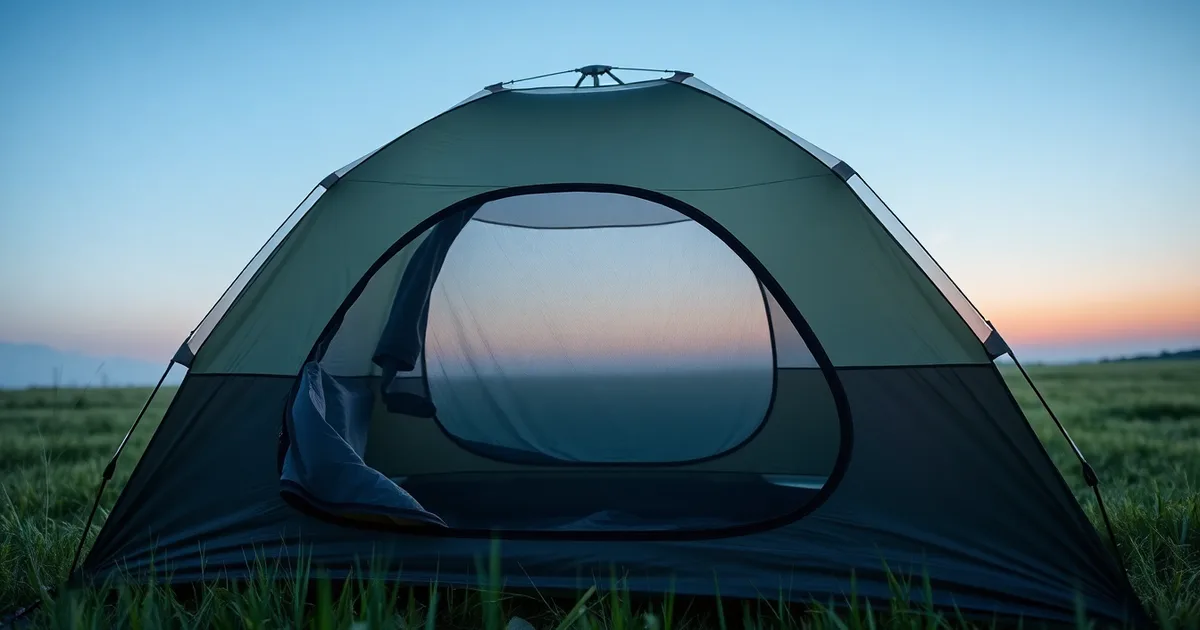
Condensation inside a tent is your own breath, not a manufacturing fault. An adult exhales roughly 300–400 g of water vapour overnight, and that vapour condenses on fly fabric cooled below the dew point by radiative heat loss to a clear sky. Fix it with a low vent, a high vent, and a partly open inner door.
Count the occupants and the arithmetic gets ugly fast. Two adults plus a wet dog can push 2–3 litres of water into a sealed double-wall tent between 22:00 and 07:00, and every gram of it has to land somewhere: the fly, the inner wall, the foot of your sleeping bag. The wettest mornings are almost always the clearest ones, because a cloudless sky pulls fabric 2–5 °C below ambient air temperature, and that is the whole mechanism.
Here is the part that catches people. A full-coverage fly on a double-wall tent is not a buffer unless both layers breathe. If the fly has no low opening and the inner door stays zipped, the gap between them becomes a humidity trap: the inner wall stays warm and wet on the inside, the fly stays cold and wet on the inside, and no amount of mesh in the inner tent helps.
Site selection is the underrated half of the fix. Hiding under trees blocks radiative cooling, which sounds helpful, but it also kills the breeze that would have carried your moisture away. In practice, a shaded but exposed pitch beats a sheltered one. You want moving air more than you want warm fabric.
- Breath is the source: An adult exhales about 300–400 g of water vapour per night, totalling roughly 1–2 litres per person across a full night's sleep.
- Clear nights are worst: Radiative heat loss to an open sky cools tent fabric 2–5 °C below air temperature, which is why condensation peaks on cloudless mornings.
- Two vents, minimum: One low intake plus one high exhaust, ideally on opposite sides, is the smallest pattern that clears moisture; single-vent tents will still condense.
- Flies can trap: A full-coverage fly creates a sealed air gap that becomes a humidity trap unless the fly and the inner both have openings.
- Down fails wet: A 650-fill down bag loses most of its insulating loft once its shell is wet, so damp inner walls are an urgent problem rather than a cosmetic one.
Why is the inside of my tent wall wet in the morning?
You exhale between 1 and 2 litres of water vapour per person per night, an estimate physiologists put together in 2026 for an adult at rest. In a closed double-wall tent, that vapour has nowhere to go. It saturates the air inside the inner, migrates outward by vapour pressure gradient, and then hits the fly, which is the coldest surface in the system. When that surface drops below the dew point of the air touching it, the vapour stops being a gas. It becomes liquid on your fly, on the inner wall where they touch, and eventually on the foot of your sleeping bag. The dew point is just the temperature at which air can no longer hold its moisture. Outdoor air at 10 °C and 80% relative humidity has a dew point of about 6.7 °C. Push that same air to 95% RH inside your tent and the dew point rises to 9.3 °C, just half a degree below ambient. Now any surface that cools even slightly below air temperature will sweat.
That is why clear nights are worse than cloudy ones. Tent fabric radiatively cools to the night sky and can sit 2–5 °C below ambient air temperature, based on 2025 field measurements. Cloud cover reflects some of that longwave radiation back down and keeps the fly warmer; a clear September night gives it a free path to space. The fly becomes a cold trap, and every gram of vapour you exhale preferentially condenses there rather than on the inner. A typical 2-person backpacking tent presents 1.5–2.5 m² of internal wall area for this to happen on, according to 2025 product specs. Five minutes of a Jetboil or any 500 g canister stove adds another 30–50 g of water vapour to that interior. Condensation is not a manufacturing fault. It is your breath meeting the laws of thermodynamics.
Condensation versus a leak
Before you start shopping for an MSR or Big Agnes replacement, rule out the difference. Condensation collects on interior surfaces, runs down the inside of the fly, and is worst near your head and the foot of the tent. A leak shows up as water entering from outside during or after rain, and it tracks from seams, zipper flaps, or the floor tub. If the fabric on your fly wets out completely on the outside and stops beading, your DWR (durable water repellent) has worn off. That is a $15 bottle of Nikwax or Granger's, not a warranty claim. A true waterproof coating failure shows as water passing through intact fabric under pressure — the hydrostatic head has dropped below roughly 1,000 mm, a figure REI Co-op and most makers publish per model. Feel the inside of the fly after a dry night. If it is wet where your breath reaches but dry where the fly is far from the inner, you have condensation. If the inner floor is wet and the fly is dry, you have a leak or splash-back from pitching in a hollow.
The honest trade-off: a single-wall tent like some NEMO and Big Agnes ultralight models trades ventilation for weight and will always condensate more in still, damp air, while a double-wall gives you an air gap that catches most of the moisture on the fly instead of your bag. A 650-fill-power down bag can lose up to 30% of its loft when its shell is damp, per 2024 manufacturer testing, so the stakes are real. But the fix for the double-wall camper is almost never a new tent. It is airflow, and the next section explains why most people vent it backwards.
The three venting changes that actually work (and the one that doesn't)
This procedure assumes a double-wall tent with a mesh inner and a separate fly, which is what most three-season campers own. It needs two openings at ground level and one near the apex, plus enough guylines that you can pull the fly away from the inner wall. A 2019 MSR Hubba Hubba NX, a Big Agnes Copper Spur, a NEMO Dragonfly, an REI Co-op Half Dome — all of them have the hardware. None of them need replacing. What they need is a pressure difference across the interior.
Ventilation is not a volume problem, it is a pressure problem. Air will not leave a tent because there is a hole in the roof; it leaves because somewhere else is pushing air in. That is the whole trick, and it is why the standard advice to "crack the fly" produces a wet inner wall and a confused camper.
Open both low vents fully before you get in. These are the zip panels at the foot and head of the fly, the ones most people leave closed because they sit above the puddles. Open them at dinner time, not at 2 a.m. This is the step people botch, because closing the low vents feels warmer for the first twenty minutes. It is warmer because you have sealed yourself inside a plastic bag.
Confirm the two low vents are on opposite sides of the tent wherever the pitch allows, or at minimum at opposite ends. A single low vent pulls air from the nearest gap and short-circuits straight back out, which does almost nothing for the middle of the tent. Cross-flow needs a long path across the floor.
Open the high vent at the apex, and open only one of them. If your fly has two top vents, use the downwind one. A two-person backpacking tent with 1.5–2.5 m² of internal wall area only needs about 0.5 m/s of air moving over the inner wall to hold condensation in check, and one apex vent feeding a two-inlet floor will get you there in any breeze above walking pace.
Set the fly-to-inner gap. Loosen the fly's side guylines so the fly pulls 5–10 cm clear of the inner mesh along the walls. If the fly touches the inner, every drop of condensate wicks straight through onto your bag. That wicking is why a wet foot box is more common than a wet head — the fly sags onto the inner at the foot end first.
Leave the inner door 10–15 cm open. This is the single cheapest intervention available. A 10–15 cm gap at the bottom of a mesh door is roughly 0.02–0.03 m² of free area, which is more than the effective area of most zippered fly vents once the baffle is folded shut. In still, humid air with no measurable wind — the conditions that soak you — open the door fully and accept the temperature loss.
Pin the door open with a stuff sack or shoe rather than letting the mesh fall shut. A door that closes at 3 a.m. by itself gives you a false sense of having solved it.
Cut the internal moisture load before you touch any vent. If you are boiling water on a Jetboil inside the vestibule, stop. A 500 g canister stove running 5 minutes puts 30–50 g of water vapour into the tent interior, and that is before the pot of pasta. Cook outside or under a separate tarp with the tent sealed. Do not dry wet socks, gloves or a soaked DWR shell on a line inside the tent. One wet jacket releases far more vapour overnight than the stove does.
Re-check at first light on cold nights. Between roughly 3 and 6 a.m., radiative cooling can drop the fly 2–5 °C below ambient, which drags the inner surface below the dew point long before the air itself is saturated. Reach out and re-open the apex vent you closed at midnight.
The failure mode is the move everyone tries first: unzip the fly a hand's width at the top only, then zip everything else shut. It exhausts warm air from the highest point, which sounds correct, and creates no inlet at all, so the only replacement air comes through the door seams and the fabric itself. Meanwhile the open top edge is a funnel. A 10 °C night at 80% relative humidity has a dew point of about 6.7 °C; at 95% it rises to 9.3 °C. Your fly will be below both numbers by dawn, so that open zip lets rain and drips run straight down the inside of the fly and onto the inner wall, which is where the water was going to end up anyway.
And venting alone cannot outrun the source. One adult at rest exhales roughly 1–2 litres of water vapour per person per night. Two people in a still, humid, grass-pitched tent are producing 2–4 litres against a 1.5–2.5 m² condensing surface, and a 2025 microclimate study found grass pitches raise local overnight humidity by 5–15% compared with bare ground. No vent geometry defeats that arithmetic. The lever that works is stacking the deck: cook outside, dry nothing inside, and let the vents handle the breath load they were actually sized for.
Where you pitch matters more than what you pitch
Every litre you exhale has to go somewhere, and the site you choose decides whether it leaves through a vent or lands on the inner wall. Two tents pitched 20 metres apart on the same night can finish with wildly different interiors: one with beading on the fly, the other bone dry. Venting gets the credit in forums, but airflow across the fly does most of the quiet work, and you can change that in the two minutes before you stake anything out.
- Take the exposed spot over the sheltered hollow. Moving air strips condensation off the fly as it forms, before the droplets grow heavy enough to run onto the inner. At 10 °C with 80% relative humidity, the dew point sits around 6.7 °C; push the humidity to 95% and that dew point climbs to 9.3 °C, which means the water in your exhaled breath condenses at a temperature barely below ambient. The higher the local humidity, the smaller the margin between air temperature and dew point, and the harder it is to keep condensation airborne rather than liquid.
- Skip grass if you can. A 2025 microclimate study found overnight humidity at ground level runs 5–15% higher over grass than over bare rock or gravel, because vegetation and soil hold moisture and release it as the night cools. Gravel, rock slabs, sand and dry pine needles all run drier. If the only flat pitch is a lush tussock field in a wet gully, you have already lost a piece of the fight before you open your stuff sack.
- Use tree cover to blunt radiative cooling, but check the airflow first. A clear sky lets tent fabric radiate heat upward so effectively that the fly can sit 2–5 °C below ambient air temperature (2025 field measurements), which is why frost appears on the fly when the air never dipped to freezing. Trees and rock overhangs break that view of the sky and pull the fly temperature back toward ambient. The trap: the same canopy that blocks the sky also blocks the breeze. Pitch under the edge of a canopy, not in the dead centre of it, and confirm the low vents still get crossflow.
- Avoid valley bottoms and low hollows completely. Cold air is denser than warm air, so it drains downhill after sunset and pools in the lowest ground around, carrying the day's moisture with it. A hollow that looks sheltered and inviting at 6pm is often the coldest, dampest place within a kilometre by 2am. Ridgelines and gentle slopes shed that pooling air; bowls collect it. If there is visible mist in a dip at dusk, do not pitch in it.
- Face the doors into the prevailing wind, or at least off-axis. Most double-wall tents are designed to breathe through mesh panels near the head and foot, and those vents only work when breeze can reach them. A tent pitched with both doorways perfectly aligned to a gusting crosswind flaps annoyingly but stays dry; the same tent pitched broadside to dead air becomes a sealed bag. Set up so at least one end of the tent catches what wind there is.
- Check the ground for yesterday's rain. Saturated soil releases water vapour through the night as it cools, and a tent floor sitting on wet turf behaves like a slow humidifier directly under your sleeping mat. Bare, well-drained ground is worth the extra 50 metres of walking. On a multi-night trip, moving the tent even a few feet to drier ground for the second night can change the result noticeably.
- Do not treat "flat and scenic" as a criterion. Level ground is convenient and views are pleasant, but neither keeps the inside of your tent dry. A 3° sloped pitch into a light breeze will dry out where a picture-postcard lakefront flat will soak your sleeping bag foot. Save the scenic site for a clear forecast with strong overnight wind, and take the gravel and the gust for anything else.
The mistake almost everyone makes is choosing the sheltered hollow for comfort. It reads as the smart pitch at dusk: out of the wind, tucked in, away from the open. By morning it is the wettest site on the map, because cold air drained into it and the local humidity climbed while the tent sat sealed. Take the exposed pitch. If the wind feels like too much on the fly when you first zip in, it is probably about right for condensation, and the same breeze that rattles the panels is the thing keeping roughly 1 to 2 litres of your own breath from becoming a puddle under your sleeping mat.
Do you need a new tent? A quick diagnostic table
Before you spend £350 on a replacement, find out where the water is actually landing. A double-wall tent separates the problem into two zones: the inner wall (inside the sleeping compartment) and the fly (the outer layer). Water on the inner wall means vapour is condensing before it reaches the fly. Water on the inside of the fly means the fly is doing its job as a condenser and then failing to drain or dry. Those are different faults with different fixes.
One rule of thumb before the table: if your fly has no low-level vent you can open from inside, you are trying to run a bedroom with the window painted shut. Outdoor air at 10 °C and 80% RH has a dew point of about 6.7 °C, and your fly on a clear night can sit 2–5 °C below ambient from radiative cooling, so the fly surface is routinely at or under dew point before you have exhaled anything.
| Symptom | Likely cause | Fix without buying a tent | Verdict |
|---|---|---|---|
| Wet inner wall only | Warm, saturated air from 1–2 litres of exhaled vapour per person per night is trapped against the inner wall because the fly's low vents are shut | Open both low fly vents fully and peg the fly out 15–20 cm from the inner at the foot end so air moves vertically | Habit fix |
| Wet underside of fly | Normal condensation — the fly is meant to be the cold condensing surface — but the DWR has stopped beading and the water sheets instead of running off | Re-proof with a wash-in DWR treatment; a 2-person backpacking tent presents 1.5–2.5 m² of wall area and an unproofed fly will hold droplets rather than shed them | Habit fix (maintenance) |
| Wet sleeping bag foot only | Bag shell touching the inner wall, wicking condensate; a damp shell costs a 650-fill-power down bag up to 30% of its loft | Shift 10–15 cm away from the wall, shorten the pitch, and open the high vent above your head to pull vapour upward and out | Habit fix |
| Wet floor, walls and bag | Pitched on long grass or bare soil with a sealed fly — grass under a tent raises local humidity 5–15% overnight on its own | Move to bare ground or a hard pitch, open all three vents, and stop boiling water inside; a 500 g canister stove adds 30–50 g of vapour in five minutes of use | Habit fix |
| Wet on every night, every pitch, vents open | Single-wall tent with no vents, or a double-wall whose fly can be fully sealed to the ground with no airflow path | Realistically nothing — the tent has no condensation management path by design | Tent limitation |
Four of those five rows are habit fixes, and the honest answer for most people reading this is that they own a tent that works and are pitching it wrong. The bottom row is the only one that justifies a purchase, and it applies specifically to a single-wall shelter with no vents — most MSR, Big Agnes, NEMO, Kelty and REI Co-op double-wall three-season tents sold in the last decade have at least a high vent and a low fly vent, so if yours does, the tent is not your problem. The case where it flips: if you bought a weight-saving single-wall tent for solo trips in cold, still, damp conditions, no venting discipline will save you, because there is no separate fly to condense on and no path for vapour to leave. In that one scenario, spending money is the correct move.
How do you dry a tent that is already soaked?
Before the tent goes anywhere near its stuff sack, get the standing water off it. Shake each panel briskly — a double-wall tent will shed a surprising amount just from that — then wipe the inner wall down with a microfibre cloth, wringing it out every couple of square metres. A 2-person tent presents 1.5–2.5 m² of internal wall area, and at peak condensation most of that is carrying a visible film. Cloth-drying that film takes ninety seconds and removes water that would otherwise wick straight into whatever you pack against it.
Then prioritise, because you will not get everything dry at once. Sleeping bag first: a 650-fill-power down bag can lose up to 30% of its loft once its shell is damp, and loft is the only thing keeping you warm on night two. Inner tent second — it is the layer you sleep against. The fly can stay wet longest, since it never touches you. If you are moving at lunch, drape the bag and inner over a rock or a bush in direct sun for twenty minutes while you eat; UV and moving air will do more in that window than an hour of shade. Fly fabric sitting 2–5 °C below ambient from radiative cooling will stay wet in shade almost indefinitely.
Packing a wet tent without soaking everything else
Never pack a wet tent inside the same bundle as your insulation. Put the wet fly in its own dry bag or stuff sack and lash it outside the pack, and keep the inner separate from the sleeping bag even if the inner only feels clammy. The 24-hour rule matters here: beyond roughly a day in a sealed sack, polyester and nylon start picking up that sour mildewed smell that never fully leaves, and the DWR coating on the fly begins to fail at the microfibre level. If you are basecamping and cannot dry the tent during the day, at least open the doors and invert the fly over a line or a trekking pole to let air move through it.
One thing that catches people out: drying a tent over a Jetboil or any canister stove inside the vestibule. A 500 g canister burning for five minutes adds 30–50 g of water vapour to the interior — you are trading a wet fly for a wetter inner. Boil outside the tent, or accept that the moisture you drive off the fabric goes straight back into the air around you.
What is the difference between condensation and a leak?
Condensation covers area; a leak has a location. Wipe the inner wall of a double-wall tent on a still morning and you will find the film is spread across the whole panel, heaviest at the foot end and the lower corners, thinning as you move up. That is breath, not a broken tent. A 2-person backpacking tent gives you somewhere between 1.5 and 2.5 m² of internal wall for that water to land on, and two sleeping adults exhale roughly 1–2 litres of vapour each overnight, so the math is not subtle. The water has to go somewhere, and the coldest surface gets it.
A leak behaves differently. It concentrates. You get a drip from the same point on the fly every time, a dark patch at a seam, a wet spot on the floor directly beneath a stitch line, or a ring of moisture around a pole sleeve. Turn the fly inside out in daylight and look at the seam tape: if it has lifted, bubbled, or separated from the fabric, you have found your defect. Coatings and hydrostatic head ratings fail at seams and stress points first, not evenly across a panel, and that pattern is what separates a warranty claim from a pitching problem.
The case that fools everyone
A third possibility looks exactly like condensation and is neither: DWR failure. When the durable water repellent on a fly or single-wall fabric wears off, the outer face wets out instead of beading, and the fabric darkens and sheens across its whole surface. Water then wicks through by capillary action and appears on the inside as a broad, even dampness — which is why so many campers replace a structurally sound tent. On a clear night radiative cooling can push fabric 2–5 °C below ambient air temperature, so a wetted-out fly sitting under a 10 °C sky at 80% RH is below the roughly 6.7 °C dew point and will keep condensing regardless of how well you vent. Check whether the water beads when you spray the fly with a garden hose. If it soaks in flat, the coating is the problem, and re-proofing with a wash-in or spray-on DWR costs far less than a new tent.
The practical test takes an hour. Wipe a wall dry with a microfibre cloth, note the time, pitch with your normal vent configuration, and check again. Stays dry, or comes back as a fine even film: condensation. A single drip reappears at the same spot, or water pools at a seam within minutes: leak. If you cannot wait an hour, the bare-hand test works too — condensation feels cool and uniform, a leak delivers a distinct cold drop. Note that a damp 650-fill-power down bag loses up to 30% of its loft, so a wet foot end is usually telling you about airflow, not about the tent's construction.
Camping in humid or sub-zero conditions: what changes
The two-vent-plus-one-high-vent rule in the previous section assumes temperate air that can still absorb your breath. Push past roughly 80% relative humidity, or drop below 5 °C, and that assumption breaks. The air outside is already close to saturated, so the gradient pulling vapour through your mesh is nearly gone, and no amount of clever pitching will fix arithmetic. Below those thresholds you stop managing airflow and start managing moisture at the source.
- Above 80% RH, check the dew point before you blame the tent. Outdoor air at 10 °C and 80% RH has a dew point of about 6.7 °C. Your inner wall, radiating to a clear sky, sits 2–5 °C below ambient — so it lands at 5–8 °C and crosses the dew point almost immediately. At 95% RH the dew point climbs to 9.3 °C and condensation starts before you have finished inflating your pad.
- Reduce what you put into the air. One adult at rest exhales 1–2 litres of water vapour per night. Add a Jetboil or any 500 g canister stove running five minutes inside the vestibule and you inject another 30–50 g of vapour directly into the space you are about to sleep in. Boil water outside, or at minimum leave the door cracked while you do it. Two people plus a dog in a 2-person double-wall tent is a losing proposition at 90% RH — one of you should be carrying a bigger shelter, not a better one.
- Sub-zero: brush the frost off before it melts. Below 0 °C the condensation does not drip, it freezes into a rime layer on the inner wall and the underside of the fly — a typical 2-person backpacking tent offers 1.5–2.5 m² of surface for it. That frost is harmless while it stays frozen. It becomes a problem the moment you light a stove or the sun hits the fly, because it melts onto whatever is touching the wall. Wipe or brush the walls down before you get out of the bag, and shake the fly outside rather than inside.
- Tropical humidity: pitch for air, not warmth. In jungle or coastal conditions the instinct is to seal up against the damp. Do the opposite. Pitch in the open, face the door downwind, and leave both low vents and the high vent fully open even if you are cold for the first hour. You will warm up; you will not dry out a soaked down bag. A 650-fill-power down bag can lose up to 30% of its loft once its shell is damp, and loft is the only thing keeping you warm.
- Skip the grass. A 2025 microclimate study found that pitching on grass rather than bare ground or a wooden platform raises local humidity by 5–15% overnight, because the vegetation transpires straight into your vestibule. On a humid trip, bare dirt, rock, or a platform beats a beautiful lawn every time.
- Extreme cases: a fan or a desiccant. A small USB tent fan (roughly 100–200 g, moving 10–20 CFM) circulating air along the inner wall breaks the still boundary layer where condensation forms, and it is the single most effective addition for a trip you cannot reschedule. A 100 g silica gel pack hung near your head absorbs on the order of 20–25 g of water before saturating — meaningful for a sock or a phone, useless against two litres of breath. Regenerate it in a low oven between trips or throw it away.
- Single-wall tents hit these limits sooner. If you own an MSR, Big Agnes, or NEMO single-wall shelter, the thresholds tighten: treat 70% RH as your practical ceiling and pack the fan as standard. A double-wall tent with a DWR-treated fly buys you another 10–15 percentage points of headroom because the inner wall stays warmer.
The item people get wrong most often is the last one. A silica gel pack is not a solution to a two-litre-per-night problem; it is a solution to a damp phone and a pair of socks, and treating it as a fix lets you skip the vent adjustments that actually matter. The fan is the one worth carrying. And if you are consistently hitting 80% RH nights where ventilation has already been maxed out, the honest answer is that you need a lighter, loftier bag and a synthetic overquilt for the damp nights, not a new tent.
Frequently Asked Questions
Why is my tent wet inside but not leaking?
You are looking at your own breath. A sleeping adult exhales roughly 300-400 ml of water vapour overnight, plus more from wet clothing and a damp groundsheet. That vapour hits the inner wall when the fly-side surface drops below the dew point, typically after 1-2 a.m. as outside air cools, and condenses there. It is a leak only if water is concentrated at a seam or stitch line.
Does opening the tent door stop condensation?
Only if the open door creates cross-flow. A single wide-open door on a still night moves almost no air and just lets rain and insects in. Fit a low vent near the floor and a high vent near the apex on opposite sides, so cooler dry air enters low, warms, picks up moisture and exits high. A 10-15 cm gap on each is usually enough.
Is condensation worse in a single-wall tent?
Yes. There is no inner wall to buffer the moisture, so vapour condenses directly onto the single skin, most often on the ceiling panel above your head where the surface is coldest. A double-wall design traps some vapour on the inner wall first, which keeps the sleeping bag drier, but it only helps if the gap between the layers is ventilated.
How do I stop condensation in a double-wall tent?
Open the fly vents and the inner mesh vents together. A double-wall tent is not a fix on its own: if the fly is sealed shut, the air gap between fly and inner wall becomes a dead, humid pocket and the inner wall wets out anyway. Line up the fly door and inner door gaps so air moves straight through.
Should I leave my tent fly open at night?
Partially, if it is dry and not windy. A 10-15 cm gap at the top of the inner door dumps most of your exhaled moisture while keeping rain out. Leaving the fly fully open exposes you to a passing shower and cuts the warmth the fly retains, typically 2-3°C on a still night. Adjust the gap if the wind picks up.
What causes condensation on the outside of a tent?
Dew, or rain, not your breath. On a clear, still night the fly radiates heat to the sky and drops below the dew point, so moisture from the surrounding air settles on the outside of the fabric. External condensation is normal and usually dries before the inside; it is not a sign of a tent fault or a leaking coating.