A yeasty taste in homemade bread almost always comes from fermenting too cold or too fast, under-proofing, or under-baking, not from too much yeast. Keep dough at 24–26°C (75–79°F), let it rise until properly puffy, and bake to an internal temperature of 96–99°C (205–210°F).
Here is the number that catches people out: commercial yeast works hardest between 24–26°C (75–79°F). Drop your dough to 18°C (64°F) because your kitchen is cold in February, and fermentation doesn't stop, it just slows and shifts. The yeast throws off more of the compounds you taste as "raw" or "bready," and the rise takes so long that you give up and bake early. It is a double failure — bad flavor plus bad structure — and both trace back to the same thermometer reading.
Most recipes also call for more yeast than the job needs. A 500g (1 lb) loaf needs only about 5g (1% instant yeast) to ferment fully in 2–3 hours at the right temperature. If your recipe lists 10g or more, the dough will taste yeasty even when everything else is correct. Cut the yeast, not the time.
The other common miss is proofing. Dough that hasn't risen enough still holds unconsumed sugars, and those sugars taste like the yeast packet smells. Push a floured finger into the dough: if it springs back fast, it needs longer; if it holds the dent, it's ready. In the oven, yeast stays active until the internal temperature passes roughly 60°C (140°F), which is why an under-baked loaf can still taste raw at the centre even after 40 minutes.
- Temperature target: Commercial yeast is most active at 24–26°C (75–79°F); below 20°C (68°F) it ferments slowly and produces more yeast-flavored compounds.
- Yeast quantity: 500g (1 lb) of flour needs only about 5g (1% instant yeast); 10g (2%) or more can taste yeasty even with correct proofing.
- Proof test: A properly proofed loaf passes the poke test, springing back slowly; dough that rebounds fast is under-proofed and tastes raw.
- Internal temperature: Bake to at least 96°C (205°F) at the centre to deactivate the yeast and set the crumb, eliminating raw yeast flavor.
- Over-proofing risk: Letting dough rise too long exhausts the sugars and produces a sour, sometimes alcoholic flavor — the opposite problem, with a similar cause.
Why does my bread taste like yeast?
Almost nobody over-yeasts their dough. A standard artisan formula uses 0.5–1% instant dry yeast by flour weight, and doubling that usually just makes the dough move faster rather than taste strongly of yeast. The flavor you are tasting is a fermentation byproduct, and it comes from three places: how warm the dough was, how long it fermented, and how far it baked.
Temperature does most of the damage. Saccharomyces cerevisiae produces isoamyl alcohol, the compound behind that raw, solvent-like yeast note, and a 2025 food science study found output rises by roughly 30% when dough ferments at 15°C (59°F) instead of 25°C (77°F). Cold dough is sluggish dough: the yeast works slowly, the bacteria and enzymatic activity lag, and the loaf sits in the bowl accumulating those compounds long after the sugars you actually want have been consumed. A 12–24 hour cold retard at 4°C (39°F) is a different animal, because the long, cold ferment develops flavor from organic acids rather than alcohol. The trouble starts when the dough spends that time at 15–18°C (59–64°F), a range where yeast keeps producing aroma compounds but nothing else catches up. Hold bulk fermentation at 24–26°C (75–79°F) for 2–3 hours on 500g of flour and the balance shifts.
Under-proofing is the second cause and it is easy to miss because the loaf still rises in the oven. If the final proof is cut short, the yeast has not finished converting the maltose and glucose in the dough, so unfermented sugar and live yeast cells both survive into the crumb. You taste them. The poke test is the practical check: flour a finger, press about 1cm into the side of the dough, and watch whether the dent springs back slowly and incompletely. A dent that snaps back fast means keep waiting. A dough that has more than doubled and collapses when poked has gone the other way, which brings its own problems of flat, sour crumb.
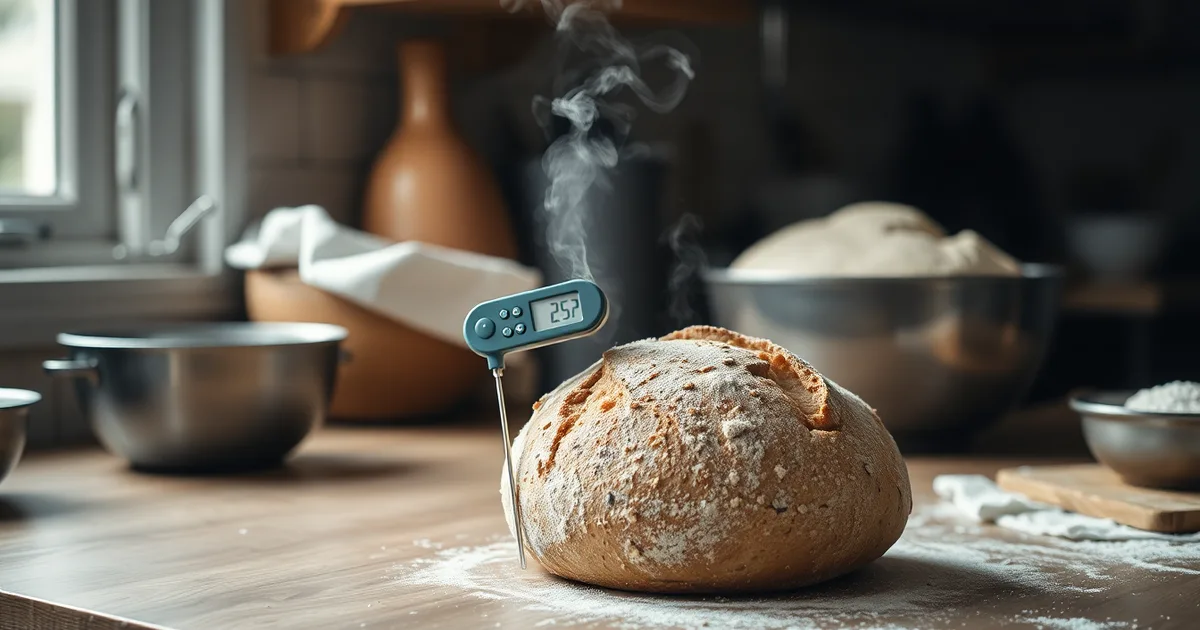
Then there is the bake. Lean dough needs to reach an internal temperature of at least 96°C (205°F) for the yeast to be fully deactivated and for the crumb to set; enriched dough with butter and sugar can finish slightly lower, around 93°C (200°F). Pull a loaf at 88°C (190°F) because the crust looks dark and you leave live yeast and unconverted intermediates in the center. A $25 instant-read thermometer in the middle of the loaf, checked through the base, settles the question in three seconds. If you have time for nothing else, fix this one first.
What is the ideal fermentation temperature for bread dough?
The target is 24–26°C (75–79°F), measured in the dough itself rather than the room. That is the range where Saccharomyces cerevisiae reproduces at a steady rate and produces ethanol and carbon dioxide cleanly, without the secondary alcohols that read as harsh or raw on the palate. A 500g batch of flour at that temperature finishes bulk fermentation in 2–3 hours, which is convenient but not the point. The point is the ratio of compounds the yeast leaves behind.
Below 20°C (68°F), the same yeast shifts its metabolism. A 2025 food science study found isoamyl alcohol, one of the fusel alcohols responsible for a solvent-like yeasty sting, increased by roughly 30% in dough fermented at 15°C (59°F) compared with 25°C (77°F). That is a big jump for a 10°C difference, and it explains a specific frustration: a baker follows a recipe to the gram, drops the dough in a 17°C kitchen in February, ferments it overnight, and gets bread that tastes like a brewery. Cold is not a neutral choice. It is a different flavour outcome. The exception is a deliberate cold retard at 4°C (39°F) for 12–24 hours, where the long, slow development of organic acids and esters is the whole objective. A fridge retard is fine. A lukewarm-room no-man's-land of 15–18°C is not.
Above 28°C (82°F), the problem inverts. Fermentation runs fast enough that the window between "ready" and "collapsed" can close in 20 minutes, and dough that has more than doubled and sinks when poked is over-proofed. Over-proofed dough has spent its sugars, leaving nothing for the oven spring, and the residual yeast flavour survives baking because the interior may not reach the temperature needed to drive it off. Use an instant-read thermometer on the dough, not the air. If your flour and water come out of a cold pantry, warm the water; if your kitchen runs hot in summer, use cooler water or refrigerate the flour. King Arthur Baking's guidance on dough temperature is the same principle: control the input, hit the range, and the yeast stops being the variable you fight.
Which brings up the thing most articles get wrong. Cutting yeast from 1% to 0.5% of flour weight does not fix a yeasty loaf if the dough still fermented cold or ran hot and over-proofed. Instant dry yeast, active dry yeast and fresh yeast all behave the same way in this respect. A tiny pitch of yeast at 15°C will taste harsher than a normal pitch at 25°C. Fix the temperature and the proof, and only then consider whether your yeast percentage is too high.
How to tell if your dough is under-proofed or over-proofed
The poke test takes about ten seconds and costs nothing, and it is the only proofing check that works on every dough you will ever mix. Use it at the end of bulk fermentation and again after shaping, right before the loaf goes into the oven. All you need is a lightly floured index finger and a dough that has been sitting still for at least fifteen minutes. If you just knocked it back or shaped it, wait. Freshly degassed dough springs back hard no matter how long it has proofed.
- Flour your finger, not the dough. A dry fingertip is what keeps the indentation readable. Dough stuck to your hand tells you nothing except that the surface is tacky, which it usually is. Dip the finger in bread flour or rice flour; rice flour does not absorb moisture and releases more cleanly.
- Press in about 1.5 cm (half an inch) at a point roughly a third of the way in from the edge. The centre of a round is the last part to proof, so testing there gives you a false "under-proofed" reading. Push straight down, hold for one second, then pull out.
- Watch the crater for five seconds. This is the whole diagnosis. Under-proofed dough springs back immediately and feels tight, almost rubbery, and the hole vanishes before you finish counting. Perfectly proofed dough springs back slowly and incompletely, leaving a shallow dimple that stays. Over-proofed dough does not spring back at all — the indent sits there, and if you press a little harder the whole surface deflates.
- Cross-check with volume and feel before you trust a single poke. Dough at 24–26°C (75–79°F) with 500g of flour normally needs 2–3 hours of bulk fermentation to reach 50–75% growth, not a doubling. A loaf that has more than doubled and collapses when poked has crossed the over-proofing threshold described in most 2026 baker training materials. Lift the bowl a few centimetres and let it drop: a hollow, jiggly thud means gas is trapped, a dense thump means it is not.
- Smell the dough. Under-proofed dough smells like raw flour and water. Properly proofed dough smells like fresh bread crust forming. Over-proofed dough smells alcoholic or sharply of acetone, and that is your cue that isoamyl alcohol — one of the compounds behind a raw yeast taste — has accumulated. A 2025 food science study found isoamyl alcohol production rises roughly 30% when dough ferments at 15°C (59°F) instead of 25°C (77°F), which is exactly why a slow, cold bulk ferment can produce a loaf that tastes more yeasty than a fast warm one.
- Adjust rather than abandon. Under-proofed at the end of bulk? Give it another 30–45 minutes at room temperature and re-poke. Over-proofed after shaping? Punch it down, reshape, and proof again — you will lose some oven spring but you will not lose the loaf.
- If you cannot get the temperature right, use a cold retard instead of guessing. Twelve to 24 hours at 4°C (39°F) after shaping is slow enough that the window between under- and over-proofed widens from about 20 minutes to a couple of hours. Bake straight from the fridge; the cold dough is easier to score and gains roughly five extra minutes in the oven.
Here is the step people botch: they poke the centre of the loaf or dough ball, press 3 cm deep, and then read the result as gospel. The centre is always the least proofed part, and a deep press tells you about the crumb structure rather than the gas. Press once, press shallow, press near the edge. If you poke three times in three places, you will have deflated the loaf and learned nothing.
The failure mode is subtler than a collapsed loaf. Dough that is only mildly under-proofed still rises in the oven, still comes out looking like bread, and tastes sharply of yeast because the interior never reached full fermentation or a full internal temperature. Aim for 96°C (205°F) in the centre of a lean loaf, 93°C (200°F) for enriched dough, checked with an instant-read thermometer. If the poke test says the dough is ready and the bread still tastes raw, the problem is not your proofing. It is that you pulled it out at 85°C.
The role of yeast quantity in bread flavor
Most bakers who complain about a yeasty loaf assume they should cut the yeast in half. That instinct is often right, but the number on the recipe card is rarely the real problem. In a 500g flour dough, instant dry yeast at 2% of flour weight is 10g, and at 24–26°C (75–79°F) that dose will push bulk fermentation to completion in roughly 60–75 minutes. The dough is ready before the flour has had time to develop flavor, and the isoamyl alcohol and acetaldehyde that Saccharomyces cerevisiae throws off in its first, most aggressive growth phase never get baked out or metabolised further.
The convention used by King Arthur Baking and by Peter Reinhart's formulation tables in The Bread Baker's Apprentice is 0.5–1% instant yeast for typical home dough, always expressed as a baker's percentage against flour weight. The table below holds everything else constant: 500g of strong white flour, 70% hydration, 2% salt, salt added after a 20-minute autolyse, mixed by hand to a moderate windowpane, then bulk fermented at 24–26°C until the poke test springs back slowly.
| Flour weight | Yeast type | Yeast % (baker's) | Yeast weight | Bulk fermentation at 24–26°C |
|---|---|---|---|---|
| 500g | Instant dry yeast | 0.5% | 2.5g | 3 hours 00 min |
| 500g | Instant dry yeast | 0.75% | 3.8g | 2 hours 30 min |
| 500g | Instant dry yeast | 1% | 5g | 2 hours 10 min |
| 500g | Instant dry yeast | 1.5% | 7.5g | 1 hour 25 min |
| 500g | Instant dry yeast | 2% | 10g | 60–75 min |
| 500g | Active dry yeast | 0.75% | 3.8g | 2 hours 40 min |
| 500g | Fresh yeast | 2% | 10g | 2 hours 20 min |
The 0.5–1% instant rows win for almost every home baker, and 1% is the safer starting point if your kitchen runs below 22°C in winter. At 0.5%, a dough left on the counter past the 3-hour mark will over-proof before you have shaped it, so that dose only pays off if you are willing to retard the shaped loaf in the fridge for 12–24 hours at 4°C (39°F) — which is itself the most reliable route to bread that tastes of wheat rather than of the packet. The case where higher yeast stops being a fault: enriched doughs above 20% butter and sugar, where fat and osmolarity slow fermentation enough that 1.5–2% instant yeast is genuinely needed to hit a 2-hour bulk window. Even there, bake to 93°C (200°F) internal, not 96°C, because the sugar in the crumb will brown long before a lean loaf would.
How baking temperature and time affect yeast flavor
Saccharomyces cerevisiae dies at 60°C (140°F). That number gets quoted constantly, and it misleads people into thinking a loaf is safe from yeast flavor the moment it passes 60°C in the middle. It isn't. Lethal temperature for the cell and finished bread are two different thresholds, separated by 36 degrees. A loaf pulled at 85°C (185°F) has dead yeast and a gummy, under-set crumb that reads as raw and yeasty on the tongue anyway, because ungelatinised starch and residual fermentation alcohols are still sitting in the centre.
The reliable doneness test is an instant-read thermometer pushed into the base of the loaf, not the top. For lean dough — flour, water, salt, yeast — you want 96–99°C (205–210°F). Enriched dough with butter, milk or egg sets a few degrees lower, around 93°C (200°F), because fat and sugar interfere with starch gelatinisation. Probe from underneath, angling toward the centre, and check two spots. A 700g boule baked at 230°C (445°F) typically needs 40–45 minutes to hit that range; the same dough in a loaf tin runs longer, closer to 50.
Under-baking is the most common cause of a yeasty loaf among bakers who have already fixed their fermentation temperatures. The crust looks dark, the tap test sounds hollow, and the interior is still 88°C (190°F). Colour develops faster than the crumb sets, which is why "it looks done" is not a doneness test. If your bread tastes of yeast and the crumb is slightly tacky or claggy near the centre, bake it another 8–10 minutes next time before you touch anything else in the recipe.
Why the thermometer matters more than the clock
Oven thermostats drift. A domestic oven set to 220°C (425°F) can run 15–20°C hot or cold depending on rack position and whether it has been recalibrated since manufacture. Recipe timings assume a calibrated oven you probably don't have. The thermometer removes that variable entirely, and it costs less than a bag of good flour. King Arthur Baking has recommended internal temperature as the primary doneness check for years, and it's the one piece of equipment advice from The Bread Baker's Apprentice era that has aged without revision.
One caveat: enriched doughs with a high sugar content can read 96°C (205°F) while still tasting slightly doughy, because sugar raises the temperature at which starch fully gelatinises. Push those to 98–99°C (208–210°F) and expect a slightly firmer crumb as the trade-off. Lean sourdough and yeasted country loaves are the reverse — pull at 96°C and they're done.
Fixes for a yeasty loaf: what to change next time
If your last loaf smelled like a brewery and tasted bitter at the back of the tongue, you are not dealing with a mystery. You are dealing with a process problem that has four or five handles, and you can turn all of them on the next bake without buying anything new. Work down this list in order. The first two items fix most loaves on their own.
- Cut the yeast back. Instant dry yeast at 0.5–1% of flour weight is plenty for a straight dough. For 500g of flour that is 2.5–5g, which is less than half a standard 7g sachet. Most recipes aimed at beginners overshoot this because it makes the dough rise fast and look impressive. Fast is not the goal. If you are converting from active dry yeast, multiply by 1.25 to account for the lower viable cell count; fresh yeast runs about 3x the instant figure. The Bread Baker's Apprentice and King Arthur Baking both publish tables for this, and they disagree by a few tenths of a percent, so treat the range as a range.
- Hit a dough temperature of 24–26°C (75–79°F) and hold it there. This is the single highest-leverage change. A 2025 food science study found that isoamyl alcohol, one of the compounds behind that raw, solvent-like yeast note, is produced roughly 30% faster when dough ferments at 15°C (59°F) instead of 25°C (77°F). Cold dough does not stop Saccharomyces cerevisiae from making flavour compounds; it slows the CO2 production you actually want, so the yeast sits around producing the ones you do not. Check with an instant-read thermometer stuck into the centre of the mass, not the surface. In a 20°C kitchen, use water at about 30–32°C to bring the mixed dough into range. In summer, use fridge-cold water.
- Give bulk fermentation 2 to 3 hours and let volume be your guide, not the clock. For 500g of flour at 24–26°C, that is the realistic window for a 50–75% rise. If your kitchen runs at 18°C, expect closer to 4 hours, and consider a turned-off oven with the light on to get there. A poolish or biga built the night before does some of this work for you and cuts the salt-free window in the final dough.
- Wait for a true doubling plus a pass on the poke test before shaping. Press two fingers about 2cm into the dough. If it springs back immediately and completely, it is under-proofed. If the indent stays put with a slow, partial rebound, it is ready. If it collapses or the dough sighs and deflates, you have gone past it, and over-proofed dough bakes into a flat, pale loaf with a sour, harsh edge that people often misread as too much yeast.
- Extend the cold retard to 12–24 hours at 4°C (39°F) if you want flavour without yeastiness. This is the trick that separates a supermarket-tasting loaf from one with actual wheat character. The cold slows yeast activity hard while enzymes keep breaking starch into sugars. Do not push past 36 hours; beyond that, proteolytic activity starts weakening the gluten and the loaf goes slack in the oven.
- Bake to an internal temperature of 96°C (205°F) for lean dough, 93°C (200°F) for enriched. This is not optional and it is not a refinement. Under-baked crumb holds live yeast and unfermented sugars, and both read as raw yeast on the palate. A 700g boule at 230°C typically needs 40–45 minutes to get there; a 900g loaf in a Dutch oven closer to 50. Probe the centre from the side, and re-probe if you are within 2°C of target. The crust colour you were told to look for is a lagging indicator.
- Cool completely before slicing, at least 2 hours. Cutting hot bread releases steam that recondenses inside the crumb, and the starch has not finished setting. A loaf sliced at 30 minutes tastes noticeably more raw and yeasty than the same loaf sliced at 3 hours. This one costs you nothing but patience.
The item bakers get wrong most often is the internal temperature, because it feels like fussing. You cannot see the middle of a loaf, and a dark crust at 35 minutes looks done to every sense except the one that matters. Buy a £15 instant-read thermometer and use it on every bake for a month. You will stop guessing, and the yeasty loaves will stop.
Does cold fermenting (retarding) make bread taste more yeasty?
Cold fermentation is the technique most often blamed for a yeasty loaf, and it is also the technique most often responsible for fixing one. The difference is duration. Put a dough in the fridge at 4°C (39°F) for 12–24 hours and Saccharomyces cerevisiae keeps working slowly, producing carbon dioxide along with the ethanol and organic acids that give bread its depth. Push past roughly 24 hours at that temperature and the balance tips: the yeast keeps generating isoamyl alcohol, a fusel alcohol that the tongue reads as raw, solvent-like yeastiness. A 2025 food science study measured isoamyl alcohol production rising by 30% in dough fermented at 15°C (59°F) rather than 25°C (77°F), which is the mechanism in plain numbers. Colder and longer is not automatically more flavour. Past a point it is just more yeast.
The practical sequence that avoids this is a cold retard followed by a warm final proof. Mix and bulk ferment at 24–26°C (75–79°F) for 2–3 hours on a 500g flour batch, shape, then move the dough to the fridge at 4°C for 12–24 hours. In the morning, take it out and let it finish proofing at room temperature, back in that 24–26°C band, until it passes the poke test and springs back slowly. That warm spell does two things: it lets the yeast finish its work in a range where it produces cleaner flavour compounds, and it takes the chill off the crumb so the loaf bakes evenly instead of dragging the centre temperature down. Skipping it is the mistake that produces bread that tastes like it was proofed in a fridge and baked straight from one.
Where cold retardation goes wrong
Two failure modes account for nearly every case. The first is leaving the dough in the fridge overnight and then well into the next day — 30 hours or more — because the schedule slipped. At that point even a 0.5–1% instant yeast dose (baker's percentage) has had time to exhaust the available sugars and push isoamyl alcohol past the threshold where it reads as a defect. The second is pulling the dough from the fridge cold and baking it directly, which stretches the bake time and leaves the interior below the 96°C (205°F) needed to deactivate yeast fully in lean dough. If you genuinely cannot wait for a warm final proof, allow extra baking time and check the centre with an instant-read thermometer rather than trusting the clock or the crust colour.
When to use a preferment (poolish or biga) to avoid yeastiness
A preferment is flour, water and a pinch of yeast left to ferment before the main mix, and it changes what the yeast is doing at the moment you bake. Instead of building all the dough's flavour in one 2–3 hour bulk at 24–26°C (75–79°F), you let a portion of the flour sit for 12–16 hours, during which Saccharomyces cerevisiae runs out of easy sugar and starts producing alcohols and esters rather than the sharp, sulphury notes we read as "raw yeast". A 2025 food science study measured isoamyl alcohol — one of the compounds behind that yeasty smell — rising roughly 30% when dough ferments at 15°C (59°F) instead of 25°C (77°F). A preferment sidesteps that trap: it ferments cool and slow on purpose, in a small mass that will later be diluted by fresh flour, so the aromatic compounds land as depth rather than as off-flavour.
Poolish and biga are the two you will meet in most recipes. Poolish is 100% hydration — equal weights of flour and water — so it looks like a loose batter and is ready when it is bubbly, domed and smells faintly of ripe pear. Biga sits at 50–60% hydration, giving a stiff, shaggy paste you tear apart rather than pour; it is the Italian default and suits firm, open-crumb breads. Both do the same job. Neither is "better yeast" — they simply shift a chunk of your fermentation out of the vulnerable window and into a long, cool one.
The dosage matters more than most recipes admit. Use 20–30% of the total flour weight in the preferment for a balanced result: noticeable savour in the crust and crumb, no lingering yeast bite. Below 20% you have spent the night waiting for a difference you cannot taste; above 35% and the ferment's acidity starts to dominate, which is fine if you want a tangy loaf and wrong if you wanted a clean one. At 500g of flour, that means 100–150g of flour in the preferment — about 100–150g water for a poolish, 50–90g for a biga. Build it the night before, leave it covered at room temperature for 12–16 hours, then mix it straight into your final dough.
Here is the trade-off people gloss over. A preferment buys you flavour at the cost of a second schedule: you now have to plan a loaf a day ahead, and if the kitchen runs warm overnight your poolish will over-ferment and smell like nail polish remover, which you will then bake into the bread. That is worse than the yeasty taste you started with. If you bake on impulse, skip the preferment and fix the actual problem instead — hold your dough at 24–26°C, use 0.5–1% instant yeast by flour weight, and bake to 96°C (205°F) internal for a lean dough or 93°C (200°F) for an enriched one. Preferments are for bakers who already control temperature and want more from a loaf, not a rescue for a dough that was fermented too cold or pulled from the oven too early.
Frequently Asked Questions
Why does my bread taste like yeast even though I followed the recipe?
Most recipes omit two numbers that decide yeast flavor: dough temperature and internal doneness. If your kitchen sits at 18°C (64°F), a 1-hour bulk that the recipe assumes happens at 25°C (77°F) will leave the dough under-proofed and the yeast still sharp. Under-baking compounds it: pull the loaf at 90°C (194°F) instead of 96°C (205°F) and raw crumb holds onto those volatile compounds.
Can I fix a yeasty tasting loaf after it's baked?
No. The compounds responsible, mainly acetaldehyde and fusel alcohols, are locked into the set crumb and no further baking, resting or wrapping removes them. Toasting slices at around 150-180°C volatilises a little of the surface, which is why day-old bread tastes milder, but the interior stays the same. Adjust your next bake: cooler dough, longer bulk, hotter finish.
How much yeast should I use for 500g of flour to avoid yeast taste?
For a straight dough bulk fermented 2-3 hours at 24-26°C (75-79°F), use 2.5-5g of instant yeast, which is 0.5-1% of flour weight. That is roughly half a 7g sachet to a full one for 500g. Commercial recipes often push 2% because their proofers are timed tightly; at home that dose races ahead and leaves the raw yeast note behind.
Does letting dough rise longer make it less yeasty?
Yes, within limits. A complete bulk fermentation plus final proof gives yeast time to consume available sugars and generate the alcohols and organic acids that read as bread rather than yeast. Push past full proof, though, and you trade one fault for another. Once dough has tripled at 25°C (77°F), roughly 3-4 hours for a lean 1% dough, ethanol dominates and the crumb collapses.
What internal temperature should bread be to avoid a yeasty taste?
Bake lean dough until the geometric centre hits 96°C (205°F) on a probe thermometer. Yeast itself is dead by about 60°C (140°F), so the target is not about killing it; it is about driving off acetaldehyde and setting the crumb. Enriched doughs with butter or milk need 88-93°C (190-200°F) instead, because fat and sugar keep more moisture in the interior.
Why does my bread smell like beer or alcohol?
You are smelling ethanol, plus traces of isoamyl and other fusel alcohols the yeast made during fermentation. That usually means over-proofing, or a cold, slow ferment where a small yeast dose worked for 12 hours or more at 4-8°C (39-46°F). Most of those alcohols bake off above 78°C, so if they survive into the loaf, the interior never got hot enough or the dough over-fermented before it went in.