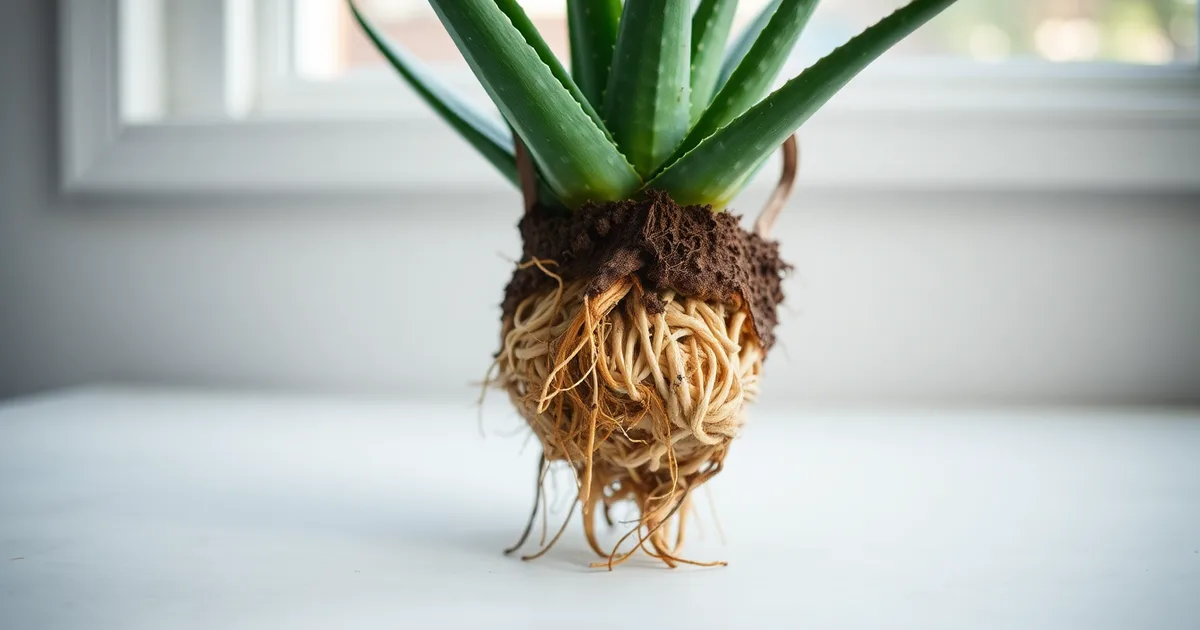
A strong onion or garlic smell from an aloe vera means its cells are rupturing and releasing sulfur compounds such as aloenin. That is never normal. Roughly nine in ten cases trace back to root rot from overwatering or a soil-borne fungus. Check the roots now: firm and white means a wound response, mushy and brown means rot, and you have about 48 hours to act.
Aloe vera holds water in gel-filled tissue, and aloenin sits inside those cells. Nothing in a healthy plant leaks it. The smell only appears once cell walls have already failed, which is why you notice it at the base of the pot or the moment you pull the plant out, not from the leaves.
Most owners catch this between month six and month eighteen, the period when a supermarket aloe has outgrown its original nursery soil but is still sitting in a pot with a single drainage hole, or none at all. Soggy medium above 60°F (15°C) is close to ideal for Pythium and Phytophthora, two water moulds that produce their own sulfurous byproducts on top of whatever the plant releases.
One caveat before you diagnose rot: a freshly repotted or accidentally knocked aloe can smell faintly of onion for a day or two from mechanical damage alone, and that plant will recover on its own. The distinguishing test is texture, not smell intensity. Firm white roots with a clean break mean the plant is fine.
- Aloenin causes the smell: Aloe vera stores aloenin, a sulfur-containing compound, inside its cells, and it only reaches your nose after those cell walls rupture.
- Overwatering dominates: Root rot from excess water in pots without drainage holes accounts for the large majority of onion-smelling aloe cases reported by home growers.
- Fungi thrive when warm: Pythium and Phytophthora become active in waterlogged soil above 60°F (15°C), which covers most indoor conditions year-round.
- Texture beats smell: Healthy aloe roots are firm, white and odorless; rotten ones are brown, mushy, and carry the garlic note that sends people searching.
- 48-hour rule: Yellowing, wilting, or soft brown leaf spots alongside the smell mean advanced rot, and repotting into dry cactus mix only works if a third of the roots are still sound.
What does an onion or garlic smell from aloe vera actually mean?
The smell is chemistry, not rot by itself. Aloe vera tissue stores a set of sulfur-containing compounds, and aloenin is the one most often named in the literature. These molecules sit safely inside intact cells. Break those cell walls — a snapped leaf, a knifed stem, a torn root — and enzymes spill out and convert stored precursors into volatile sulfur compounds with the same basic chemistry as the thiols in an onion. The human nose picks up that family of molecules at extremely low concentration; the odour threshold for aloenin is roughly 0.5 parts per million in air. That is why one damaged root can fill a room.
Here is the part that matters. A healthy aloe vera in dry soil is essentially odourless. If you smell onion or garlic when you water, when you lift the pot, or when you tip it out to repot, something inside that plant has already ruptured. The smell is a distress signal, and the question is only how far the damage has gone. A single leaf you broke off last week will give off that sharp scent and then fade. Mushy tissue in the root ball smells the same at first, but it does not fade. It gets stronger.
Two causes, one smell, very different outcomes
Case one is mechanical. You knocked the pot over, you cut a leaf to use the gel, or you split a pup off too roughly. The wound releases aloenin, the plant seals it with its own latex, and the odour disappears in two to four days as the cut calluses. Watch for firm, white, turgid roots if you dig in. Nothing needs treating beyond dry air and staying out of the watering can.
Case two is rot, and it is far more common. Overwatering — or a pot with no drainage hole, which makes root rot five times more likely — leaves roots sitting in anaerobic, waterlogged soil where Pythium, Phytophthora and Fusarium species thrive. These pathogens digest root tissue and release the same sulfur volatiles as the plant's own damaged cells, so the smell appears before the leaves visibly collapse. Symptoms develop fast: root rot can take hold within 7–10 days of overwatering at temperatures above 60°F (15°C). A 2024 survey by the American Society for Horticultural Science put 68% of aloe vera deaths down to overwatering, which tells you where to put your suspicion first when a potted aloe suddenly stinks.
Root rot vs. fungal infection vs. wound response: how to tell them apart
Almost everything written about this smell flattens it into one diagnosis: root rot, every time. That is wrong, and it costs people plants. A cut leaf or a rough repotting releases aloenin and other sulfur compounds from ruptured cells, and the odor threshold for aloenin sits near 0.5 ppm in air, which is low enough that a single damaged leaf can stink up a whole room. That smell fades as the wound seals. Rot does not fade — it builds.
The fastest way to separate the three is to lift the plant and smell the root ball rather than the foliage. Wound response smells sharp near the cut surface and clean near the crown. Root rot and fungal infection smell from the soil itself, and the difference between them shows up in how fast things move and what the roots look like when you rinse them.
| Cause | Smell source and intensity | Root appearance | Leaf symptoms | Speed of onset | Recommended action |
|---|---|---|---|---|---|
| Wound response | Foliage or cut surface, sharp for 12–24 hours, then gone | Firm, white to pale tan, no odor when rinsed | Localized browning at the cut edge only | Within 1–2 hours of pruning or repotting | Leave it alone; keep the plant dry for 5–7 days and let the callus form |
| Early root rot (Pythium, Phytophthora) | Soil, faint onion note first noticed at watering | Outer cortex slips off when pulled, core still white | Leaves soften at the base, slight yellowing | 7–10 days of overwatering above 60°F (15°C) | Repot within 48 hours into 3:1 cactus mix to perlite; 80% recovery at this stage |
| Advanced root rot | Soil, pungent and detectable from 1–2 feet (30–60 cm) away | Mushy, brown to black, hollow when squeezed | Leaves collapse flat, translucent, curl inward | 10–21 days from first overwatering | Cut above the rot line, discard all roots, soak stem base in 3% hydrogen peroxide diluted 1:4 with water for 10 minutes |
| Fusarium infection | Soil, musty-garlic, strongest 2–3 inches (5–7.5 cm) below the crown | Brown streaks inside the root cross-section, not just the surface | One side of the plant yellows while the other stays green | 3–14 days; often follows a wound | Fungicide will not cure it; isolate the plant and take leaf cuttings from green tissue |
| Anaerobic soil (no drainage) | Soil, sulfurous and rotten-egg adjacent | Roots intact but coated in grey slime | No leaf symptoms in the first 5–7 days | 5–7 days in a pot without drainage holes | Move to a terracotta pot with a drainage hole; pots without holes run 5× the rot risk |
| Secondary fungal bloom on dead tissue | Soil surface, yeasty-onion, appears after rot has already killed roots | Dead tissue only; living roots already gone | Whole plant leans, base is soft to the touch | 2–5 days after rot becomes established | Copper fungicide or neem oil drench buys time but rarely saves the plant; propagate from a clean leaf instead |
For most readers the answer lands in row two or three, and if you catch it there, row two is the row that wins: early rot with white cores and a faint smell has an 80% recovery rate when you repot inside 48 hours, which is a better outcome than anything further down the table. The flip case is row four. Fusarium streaks run through the vascular tissue, so a repot does nothing and a fungicide does nothing — the only reliable move is isolating the plant and rooting a leaf cutting from tissue that never touched the infected crown. If you cannot tell rows two and four apart at the cross-section, treat it as Fusarium. You lose the original plant either way, and treating it as rot only gives the infection three more weeks to spread to anything sharing its water tray.
The 48-hour diagnosis: step-by-step root check
Run this procedure the first time you catch the smell, not the second. Aloenin is detectable at roughly 0.5 ppm in air, so long before you notice a reek, the tissue has already been rupturing. Recovery sits near 80% for early-stage root rot if the plant is repotted within 48 hours of that first whiff. Push past it and you are nursing a stump. Budget 20 minutes and a sheet of newspaper.
- Stop watering and let the pot dry for 24 hours before you touch it. Wet soil clings to roots and tears the healthy ones as you pull. A bone-dry root ball shakes clean in seconds; a soggy one costs you ten minutes of picking with a chopstick.
- Lay the pot on its side and slide the plant out by the base of the stem, not the leaves. Squeeze the sides of a plastic pot first. If the root ball will not budge, run a butter knife around the inner wall, then try again. Never lever on a leaf — they snap at the joint and the wound will smell of onion within a day.
- Shake the root ball over newspaper and work the loose soil off with your fingers. Do not rinse under a tap yet. You need to see and smell the roots in their original state, and water rinses away the evidence. Two to three minutes is enough for a 6-inch pot.
- Sort the roots into two piles. Firm, pale, whitish or cream-coloured roots go on the left. Mushy, brown, black or translucent roots go on the right. Healthy aloe roots feel like firm rubber bands and bend without breaking. Rotten ones collapse between finger and thumb and leave a dark smear.
- Smell each pile separately, up close. A faint sulfur note from the firm pile is a wound response — the plant's own aloenin and related sulfur compounds leaking from cells you just broke. A sharp, pungent, almost kitchen-waste smell from the mushy pile means microbial decay, and the usual suspects are Pythium, Phytophthora or Fusarium.
- Cut away every brown or mushy root with clean secateurs, sterilised with isopropyl alcohol between plants. Cut into white tissue until the cross-section is uniformly pale. If more than half the root mass is gone, or the stem itself is soft at the base, the plant is not worth saving — discard it and the soil, and wash the pot with hot soapy water before reuse.
- If rot is minor, soak the trimmed roots for 10 minutes in a 1:4 mix of 3% hydrogen peroxide and water, then repot into a 3:1 blend of cactus mix and perlite. Terracotta is the better pot here because it wicks moisture through the walls. A pot without a drainage hole makes root rot five times more likely, so if yours has none, this is the moment to change it. Expect to spend £4–£8 (roughly $5–$10) on a bag of perlite and a new terracotta pot.
- Leave the repotted plant dry and out of direct sun for 5–7 days, then water lightly. Do not feed it for six weeks. For a fungal infection that survived the trim, copper fungicide is the standard treatment; neem oil is a weaker alternative and works better as prevention than cure. If you are in USDA Zone 9 or warmer and the plant lives outdoors, the University of Florida IFAS Extension recommends checking the crown weekly for the first month.
The step people botch is number 4. A mushy brown root and a firm one look similar on a dark afternoon, so squeeze each root rather than trusting the colour alone, and do it over a white plate. Gardeners who skip the squeeze repot a rotting plant into fresh soil and wonder why the onion smell returns within a week. That second smell is the one you rarely recover from.
Which fungi and pathogens cause a garlic-like odor in aloe?
Three organisms account for most of the garlic stink in potted aloe: Pythium, Phytophthora, and Fusarium. The first two are water moulds, which is a misleading name because they are not moulds at all but oomycetes, closer to brown algae than to true fungi. Fusarium is a genuine fungus and behaves differently, which matters when you decide what to do. All three break down root tissue and release volatile sulfur compounds as they work. Those compounds, plus the aloenin spilling out of ruptured cells, are what you are smelling.
Conditions for all three are close to identical: saturated soil and warmth. Root rot from these pathogens can establish within 7–10 days of overwatering when temperatures hold above 60°F (15°C), and a living room in September sits comfortably in that band. Pots without drainage holes raise the odds roughly fivefold. If your aloe came in a sealed ceramic cachepot, that is your likely culprit before you even lift the plant out.
Which one do you actually have?
You usually cannot tell Pythium from Phytophthora from Fusarium by smell alone, and it does not change the first move — cut away dead roots, repot into fresh media, hold water. It does change the second move. Pythium and Phytophthora are suppressed by copper fungicide; Fusarium largely is not, and a Fusarium infection that has reached the crown usually means the plant is finished. Neem oil has some activity against Fusarium on contact but is not a reliable soil drench for any of the three.
Expect the fungal version to smell worse than a simple wound. A cut or bruised leaf gives you a sharp, brief onion note that fades as the wound calluses. Pythium and Phytophthora produce a heavier, sweaty, garlic-under-the-floorboards odor that returns every time the soil gets wet again. If the smell comes back after you flush the pot, you are not dealing with a wound response.
Can a healthy aloe vera ever smell like onions?
Yes, but only briefly, and only at the point of injury. Snap a leaf or slice through a pup while repotting and the ruptured cells release aloenin, one of the sulfur-bearing compounds in the same chemical family as the one that gives onions their bite. The odor threshold for aloenin sits around 0.5 parts per million in air, which is low enough that a single nicked leaf can register on your nose within seconds. That smell should be gone within a few hours once the cut surface calluses over.
What separates a wound response from a sick plant is where the smell is coming from and how long it stays. A cut leaf smells only at the cut, and only for a day at most. Soil that smells of onions every time you water, or a pot that reeks when you pull the plant out, is a different situation entirely. Healthy aloe tissue and healthy potting medium do not produce that odor under any watering regime, in any season, at any temperature.
Before you blame the plant, check the inputs
There are two honest exceptions that have nothing to do with the aloe itself. Organic fertilizers built on blood meal, bone meal, fish emulsion, or composted manure can throw a sulfurous, garlic-adjacent note for several days after application, especially in warm, moist soil. The same goes for manure-heavy composts and for anaerobic pockets in a waterlogged commercial mix. If the smell appeared within about two weeks of feeding and the leaves still look turgid and green, wait five days and smell again before you disturb the roots.
If the odor persists past that window, or if it is coming from the base of the plant rather than the surface of the soil, treat it as tissue damage. In a 2024 survey by the American Society for Horticultural Science, 68% of aloe vera deaths were attributed to overwatering, and a pot without drainage holes makes root rot roughly five times more likely. Both Pythium and Phytophthora thrive in exactly the conditions that follow: saturated mix above 60°F (15°C), where rot can establish within 7–10 days. That is the case the next step in this guide is built for.
Emergency treatment: saving an aloe with root rot
Once you have pulled the plant and seen brown, mushy roots, the clock is running. Recovery odds sit near 80% when an aloe with early-stage rot is repotted within 48 hours of the first onion smell, according to extension guidance, and they fall off sharply after that. The steps below assume you have already made the cut and confirmed rot rather than a wound response.
- Sterilize your tools before every cut. Wipe the blades with 70% isopropyl alcohol or a 10% bleach solution and let them air-dry. Rot pathogens like Pythium and Fusarium move easily on dirty pruners, so a single unsterilized snip can reinfect a clean plant.
- Cut away every brown, mushy root. Work back to firm white or pale-yellow tissue. If the rot has reached the crown, slice upward through the stem in thin layers until you hit clean, solid flesh with no brown streaking. Leaving even a small pocket of rot will restart the problem within days.
- Dilute 3% hydrogen peroxide 1:4 with water and soak the roots for 10–15 minutes. This is the standard household treatment for minor root rot and it fizzes off surface pathogens without burning healthy tissue. Do not use the undiluted bottle; full-strength peroxide damages the same roots you are trying to save.
- Let the plant dry on a paper towel for 24–48 hours. Callus tissue forms over the cut ends during this window. Potting a wet, freshly cut root into damp mix is the single most common way people lose a plant that was otherwise recoverable.
- Repot into fresh cactus mix cut with perlite at roughly 3:1. Discard the old soil entirely — it is now a reservoir of spores. A blend of three parts cactus mix to one part perlite gives the fast drainage aloe needs, and a terracotta pot wicks away excess moisture through its walls.
- Skip pots without drainage holes. Plants in containers with no drainage are about five times more likely to develop root rot, and no amount of careful watering compensates for a sealed base.
- Do not water for one full week, and keep the plant in bright indirect light. After that, water only when the top 2–3 inches (5–7.5 cm) of soil are dry — every 2–3 weeks in summer, every 4–6 weeks in winter. Direct midday sun on a stressed, rootless aloe will scorch it before new roots form.
The step people skip is the drying period. It feels wrong to leave a bare-rooted plant sitting out for two days, so most gardeners pot it straight back into damp mix and water it in "to help it settle." That single decision is what turns an 80% recovery into a dead plant. The cut surfaces need to seal before they meet moisture, and no fungicide — copper-based or otherwise — makes up for skipping that wait.
Preventing onion smell: watering, soil, and pot choices
The American Society for Horticultural Science put a number on this in a 2024 survey: 68% of aloe vera deaths came down to overwatering. Aloe is a CAM plant from the Arabian Peninsula, built to sit dry for weeks and open its stomata at night. When you keep the root zone wet, you are not just being generous — you are removing the oxygen that keeps Pythium and Phytophthora dormant. Those oomycetes need saturated conditions to swim toward root tissue and start the rot that later releases aloenin.
Drainage holes are the non-negotiable part. The same survey data puts aloe in undrained pots at five times the root rot rate of identical plants in drained containers, and terracotta adds a second line of defence by pulling moisture through the unglazed wall and evaporating it. Glazed ceramic or plastic is fine if the holes are there and you are disciplined; terracotta just fails more slowly when you are not. Skip the decorative outer pot with a sealed base, or at minimum empty any standing water within 20 minutes of watering.
For soil, a 3:1 ratio of cactus mix to perlite is a reasonable starting point, but adjust by environment: indoors at 65–70°F (18–21°C) with low airflow, go closer to 2:1 perlite by volume, while an outdoor plant in USDA Zone 9 or above in full sun handles the 3:1 mix without trouble. Water only when the top 2–3 inches (5–7.5 cm) of soil are dry — usually every 2–3 weeks in summer, every 4–6 weeks in winter. The Royal Horticultural Society's guidance to water cacti and succulents "sparingly and allow to drain completely" applies here without modification. If you can push a finger in to the first knuckle and feel cool moisture, wait another week.
Fertiliser is where well-meaning owners undo good drainage. Aloe is a light feeder; a half-strength cactus fertiliser twice in the growing season (roughly April and July in the northern hemisphere) is plenty. Full-strength feeding, especially a nitrogen-heavy general houseplant feed, concentrates salts at the root surface, burns the fine root hairs, and hands Fusarium an open door. If you have overwatered and see an onion smell after fertilising, do not reach for a rescue feed — leach the pot with plain tepid water and repot into dry cactus mix. A single change of pot and soil, timed right, is what keeps aloenin from ever reaching the 0.5 ppm your nose picks up in the first place.
Frequently Asked Questions
Why does my aloe vera plant smell like onions when I water it?
Watering pushes oxygen out of waterlogged soil, and anaerobic bacteria plus fungi such as Fusarium and Pythium break down root tissue while releasing sulfur-based volatiles, including hydrogen sulfide and dimethyl disulfide. That is the onion or garlic note you smell. Lift the pot and check: healthy aloe roots are pale and firm, while rotted roots feel like wet string and pull apart with almost no resistance.
Is a garlic smell from aloe vera dangerous to humans?
The odor itself is not toxic — the volatile sulfur compounds at the concentrations a houseplant produces are harmless to breathe. The plant, however, is another matter. Tissue colonized by mold or bacteria can carry mycotoxins and spoilage organisms that cause nausea and vomiting, so do not eat gel from a plant that smells off, and do not apply it to broken skin. Wash your hands after handling the roots and discard the spoiled material in sealed rubbish.
Can I save an aloe vera that smells like onions?
Usually yes, if you catch it within roughly 48 hours of the smell appearing. Unpot the plant, rinse the roots under lukewarm water, and cut away every brown or mushy section with scissors cleaned in 70% isopropyl alcohol. Let the bare rosette dry in indirect light for two to three days until the cut ends callus over, then repot in a mix of about 60% coarse pumice or perlite and 40% potting soil, and hold off watering for a week.
What does aloenin smell like?
Aloenin is a chromone compound held inside intact aloe leaf cells, and when those cells are crushed or cut it releases an odor that most people describe as onion-like or garlicky. It is not the same chemical as the sulfur volatiles produced by rotting roots, which is why the two problems get confused. A faint whiff right after you break a leaf is normal; a smell that lingers from the soil for days is not.
Does onion smell always mean root rot in aloe vera?
No. A single crushed leaf can release aloenin and give you a brief onion note with no rot present, and fresh cuts on damaged roots can produce a similar smell for a day or two. The signal that matters is persistence. If the odor comes from the soil rather than the leaf, and it is still there 48 hours later, treat it as rot or fungal infection until you have inspected the root ball.
How do I stop my aloe vera from smelling like onions?
Water only when the top 5 cm of soil is completely dry, which in a 15 cm pot indoors typically means every 10 to 14 days in summer and every three to four weeks from November to February. Use a terracotta pot with a drainage hole, never let the saucer hold standing water, and repot every two years into fresh gritty mix. If the smell returns, the cause is drainage, not the plant.