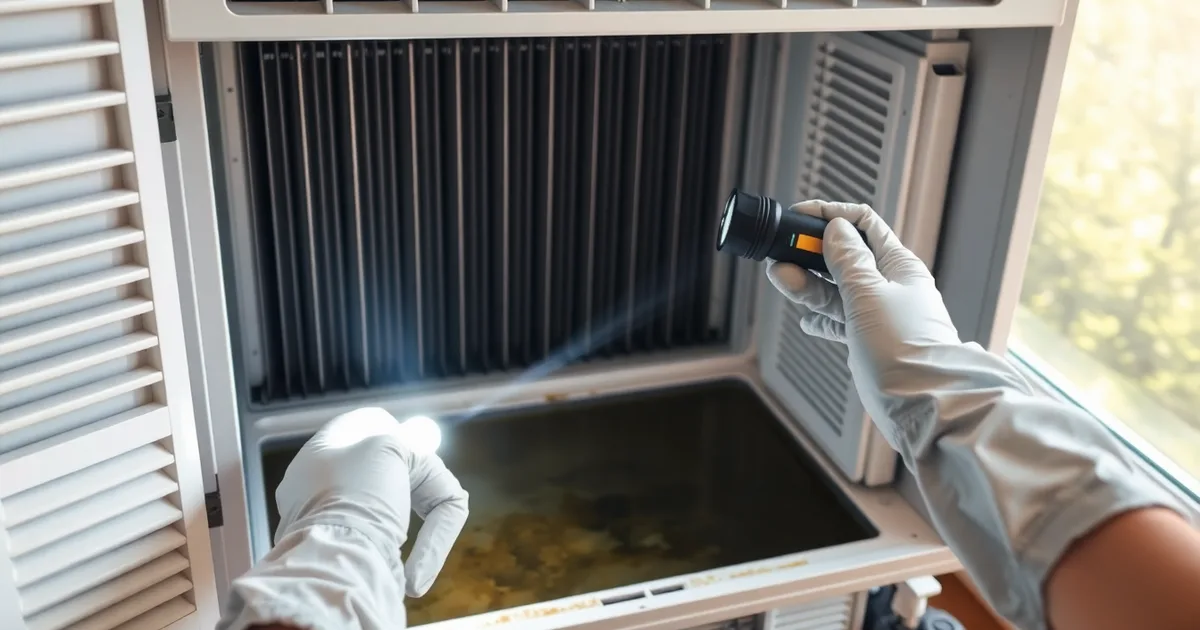
A wet-sock smell from an air conditioner means biofilm — mold and bacteria growing in standing condensate in the drain pan or on the wet evaporator coil, not on the filter. Run the pan tilt test: if water won't flow from the drain port when the unit is tilted back 2–3 cm, the pan is holding old water. Clean both with diluted bleach, then confirm drainage.
The coil sits at 5–10°C (40–50°F), well below the dew point of most room air, so it is condensing water the entire time the compressor runs. That water has to leave the unit within 24 hours. When it doesn't, a mixed community of mold and bacteria establishes itself and starts releasing microbial volatile organic compounds — MVOCs — which is the actual molecule your nose is detecting. Wet socks are a decent description of that smell, and the resemblance isn't a coincidence: the same class of compounds shows up in damp laundry.
Window and portable units are worse offenders than split systems, mostly because their pans are shallow and mounted at a slight angle from the factory, so a small amount of debris tipped the wrong way is enough to hold a puddle. A typical window AC pan holds 250–500 mL. If yours hasn't emptied within 30 minutes of shutdown, drainage is failing, and you are looking at a biofilm that has had days or weeks to thicken.
Filters get blamed because they are the only part most people can reach without tools. Wiping the grille and swapping the filter will not touch the smell if the source is downstream. A 2019 ASHRAE study put the cooling-capacity penalty from coil biofilm at up to 15%, which means the smell is usually the cheap symptom and the electricity bill is the expensive one.
- Pan tilt test: Unplug the unit, remove the grille, tilt it back 2–3 cm — if water doesn't run freely from the drain port, the pan is restricted.
- 24-hour rule: Condensate that stays in the pan longer than 24 hours supports mold growth; visible mold can begin within 24–48 hours of continuous moisture.
- Coil temperature: The evaporator runs at 5–10°C (40–50°F), below the dew point, so it produces water continuously while the compressor is on.
- Bleach dilution: Use 1:10 household bleach — about 1 cup per gallon of water — to kill biofilm, then rinse the coil with plain water to avoid corrosion.
- Performance cost: Biofilm on the coil can cut cooling capacity by up to 15%, per a 2019 ASHRAE study, while raising energy use.
Why does my AC smell like wet socks? (The biofilm answer)
A musty smell in a window air conditioner usually gets blamed on dust burning off the coil. That smell is dry: it shows up in the first 30 seconds of operation and fades. A wet-sock smell does the opposite. It gets stronger the longer the unit runs, and it comes back within a day of wiping the grille. That difference matters, because it tells you the source is alive. The odor is a mix of MVOCs (microbial volatile organic compounds), the gases mold, bacteria, and fungi release as they digest organic matter on wet surfaces.
Those organisms do not sit loose on the coil. They build biofilm: a slime layer that anchors them to metal and plastic, holds water against the surface, and shields the colony from airflow and from most spray-on cleaners. Once biofilm forms, wiping the front grille does nothing, because the grille was never the source. Biofilm can cut cooling efficiency by up to 15% (ASHRAE, 2019), partly by insulating the coil and partly by blocking the fins that air has to pass through. It also explains the timing. Mold can begin growing in 24-48 hours of continuous moisture, so a unit that runs nightly in humid weather can colonize a coil in under a week.
Two components stay wet long enough to host it. The evaporator coil runs at 5-10°C (40-50°F) during operation, and its fins hold a film of condensation the whole time the compressor is on. Below it, the condensate drain pan collects that water: typically 250-500 mL (8-17 oz) in a window unit, more in a portable air conditioner pulling moisture from a damp room. Both surfaces are dark, warm between cycles, and fed a steady supply of dust, skin cells, and pollen. That is a growth medium, not a cooling component.
Why the pan is the more common culprit
A coil colonizes slowly; a pan colonizes fast. If water sits in the drain pan for hours after shutdown instead of draining, you have essentially built an open bioreactor under your coil. A healthy window air conditioner should empty its pan within 30 minutes of the unit shutting off. Test it by tilting the unit slightly toward the drain outlet and watching whether water moves. Portable air conditioner models with self-evaporative systems still require manual draining every 8-12 hours in humid conditions once the pan fills, and LG, Frigidaire, and Midea units alike will start smelling sour within a season if that step gets skipped. If your pan passes the tilt test and drains clean, the coil is your next suspect, and it needs a coil-safe cleaner rather than a sponge.
The pan tilt test: is your AC draining or just recirculating old water?
Use this test when the smell appears within the first minute of startup and fades after the unit has run for a while. That pattern points to a pan holding stagnant condensate, not a dusty filter. You need no tools, about ten minutes, and a towel. A window unit is easier to test than a portable one, because the drain pan sits directly under the evaporator coil and you can usually reach it once the grille is off. On most LG, Frigidaire and Midea window models, the pan is a shallow molded trough, 250–500 mL (8–17 oz) at full, that collects water dripping off a coil running at 5–10°C (40–50°F).
- Unplug the unit. Not the remote, not the wall switch on a portable. Pull the plug. Water and electricity share the same chassis here, and you are about to tip the thing. Wait 5 minutes if it was running so the coil warms toward room temperature and stops shedding condensate onto your floor.
- Remove the front grille or the intake filter door. On most window units this is one or two screws plus a plastic tab; on portables it is usually the rear filter panel. Set the filter aside. You will not be cleaning it today.
- Locate the drain pan and the drain port. The pan runs the full width of the evaporator; the port is a small hole or spout at one end, often on the side that tilts slightly downward already. Look before you tilt. If you see standing water, a dark ring at the waterline, or grey-brown slime around the port, write that down. You have your answer, but finish the test anyway to see whether the drain is flowing or merely overflowing.
- Tilt the unit back 2–3 cm, measured at the front edge, and hold it there. Use a book, a folded towel, anything that keeps your hands free for 30 seconds.
- Watch the drain port. Water should trickle or run out within 30 seconds of the tilt. A slow drip that stops after a few drops is a partial clog. Nothing at all is a blocked port or drain line.
- If nothing flows, straighten a length of stiff wire or a zip tie and probe the port gently. Do not ram it. The pan is thin plastic and the drain passage on many Midea and Frigidaire units bends immediately behind the outlet. Five seconds of probing costs nothing and separates "clogged at the mouth" from "clogged downstream."
- Reassemble and plug back in only after the pan is dry or draining. If you found standing water and the tilt produced flow, note the water level in milliliters if you can catch it in a cup. More than roughly 200 mL sitting in a pan that should be near-empty after shutdown means the drain has been failing for days.
The step people botch is step 3. Everyone tilts first and looks second. If you tip the unit before you have seen the waterline, you will drain the evidence onto the floor and learn nothing about how long it had been sitting there.
Failure mode: the pan drains fine when tilted and the smell persists. That means the biofilm has moved upstream, onto the evaporator coil and into the blower housing, where the pan test cannot see it (covered in the cleaning sequence). A secondary failure mode is a "self-evaporative" portable that throws condensate onto the condenser and never needs draining in theory. In practice, at 80% relative humidity, those pans still fill every 8–12 hours. If your portable has a drain plug and you have never opened it, start there.
The reason the filter keeps getting blamed: a dirty filter is visible, cheap to fix, and vacuums clean in two minutes. Biofilm is none of those things. It grows in 24–48 hours of continuous moisture, feeds on dust and skin cells the filter missed, and produces the microbial volatile organic compounds (MVOCs) that your nose reads as wet socks, stale laundry, or a damp basement. Filter cleaning does not touch it. ASHRAE's 2019 data puts the efficiency cost of unchecked coil biofilm at up to 15%, which is why the smell usually arrives alongside a unit that no longer feels as cold as it did in June.
How to clean a smelly AC: 5-step sequence that actually works
Run this procedure if the pan tilt test showed standing water, or if the smell returns within a few days of a filter change. It applies to window units and to portable ACs with a removable drain pan; most LG, Midea and Frigidaire window models from the last decade come apart the same way, with two or four screws holding the outer shell. Reserve 60 to 90 minutes, a spray bottle, about 250 mL of household bleach (5.25% sodium hypochlorite), a stiff nylon brush, and nitrile gloves. Work outdoors or in a garage with the door open. Bleach fumes in a closed bedroom at 1:10 concentration are unpleasant at best.
The sequence targets both reservoirs of biofilm: the evaporator coil, where condensate films the fins at 5–10°C during operation, and the pan underneath it, which typically holds 250–500 mL and is where the smell actually lives.
- Unplug the unit and pull the filter. Not the wall switch, not the remote's off button. Pull the plug. Then remove the front grille and the filter, and vacuum loose dust, pet hair and lint off the coil fins using a brush attachment on low suction. Bent fins trap water and give biofilm somewhere to anchor, so work along the fin direction, not across it. Two minutes with a fin comb ($8–15) on crushed fins here saves you a repeat cleaning in six weeks.
- Mix 1 part bleach to 10 parts water — roughly 1 cup per gallon, or 100 mL bleach in 1 L of water. Decant into a spray bottle. Do not use splashless or scented bleach; both contain additives that leave a residue on the coil.
- Spray the coil and let it sit 10 minutes. Mist, don't drench. You want the fins visibly wet, not dripping into the blower housing. Set a timer and walk away. Ten minutes is the contact time that kills mould and breaks up the biofilm matrix; five is not enough, and thirty starts corroding aluminium fin stock.
- Rinse the coil with plain water. A pump sprayer on a fine mist is ideal. Keep the stream off the control board, the capacitor, the thermostat capillary and any exposed wiring — water in the electrical compartment is how a $15 cleaning turns into a $180 service call. If a coil cleaner foam was used instead of bleach, follow its dwell time and rinse twice.
- Remove the pan and scrub it. On most window units the pan slides out once the shell is off; on a portable, it's the reservoir behind the lower access panel. Scrub all surfaces with the bleach solution and the nylon brush, paying attention to the corners and the drain nipple, where slime accumulates as a grey-pink film. Rinse thoroughly. If the pan is fixed in place, sponge the solution in, scrub, then flush with a cup of clean water and wet-vac the residue out.
- Clear the drain line. Push a length of 3 mm trimmer line or a pipe cleaner through the drain channel and out the back of the unit. Flush with water until it runs freely. A partially blocked line is the single most common reason a cleaned unit starts smelling again within a fortnight.
- Reassemble and run fan-only for 15 minutes. Fan mode with the compressor off moves air across the coil and pan without adding new condensate. You should feel the coil surface dry to the touch at the end.
- Test drainage. Pour 250 mL of water into the pan and watch the back of the unit. Water should exit within 30 minutes of the unit shutting off. If it doesn't, the pan is tilted the wrong way or the line is still restricted — fix that before reassembling the shell, because a pan that holds water will grow mould again in 24–48 hours.
The step people botch is the rinse. Bleach left on an aluminium coil accelerates corrosion, and residue in the pan gets flung into the airstream on the next cooling cycle, which is why some people finish this job and report the smell is now "bleach plus socks." Rinse until the runoff runs clear and odourless. The other failure mode is skipping the drain line: you scrub the pan spotless, the line stays half-blocked, water backs up into the same corner, and by mid-October the unit smells exactly as it did in July. ASHRAE puts the cooling-efficiency penalty from biofilm at up to 15%, so this isn't only a smell problem.
Repeat the coil and pan clean every 3–6 months for a window unit in a humid climate, or at minimum before each cooling season. Portable units with self-evaporative systems still need the reservoir checked every 8–12 hours in humid weather; the "self-evaporative" label means the unit throws some condensate over the condenser coil, not that the pan stays dry. If the smell returns within a week of a correct clean, the problem is upstream — a blocked drain in the wall sleeve, a unit pitched toward the room instead of outdoors, or, in a rental, a shared condensate line — and no amount of bleach will fix it.
Drain pan vs. evaporator coil: which one is causing the smell?
Two surfaces grow the biofilm that produces wet-sock odor, and they behave differently enough that you can usually tell them apart before you take anything apart. The evaporator coil runs at 5–10°C (40–50°F) while the compressor is on, so it is wet the entire time the unit cools. The pan sits below it and is only supposed to hold water in transit. A window unit pan holds 250–500 mL (8–17 oz), and at 60% relative humidity a 5,000 BTU unit can condense close to 500 mL in an hour of steady running.
What matters is whether that water leaves. In a healthy unit, the pan drains within 30 minutes of the compressor shutting off. If your pan still has a visible puddle an hour later, the smell is coming from the pan or its drain line, not the coil — and the coil is a downstream problem you have not created yet. Mold needs 24–48 hours of continuous moisture to establish, which is why a pan that never fully empties grows a biofilm layer within a week or two of first use.
| Symptom | Likely source | Confirm with | Fix |
|---|---|---|---|
| Smell appears in the first 30–60 seconds after startup, then fades | Evaporator coil biofilm | Shine a light at the coil fins; look for grey or black film on the fin edges | Coil-safe foaming cleaner, rinsed with the unit tilted so runoff exits the back |
| Smell is constant the whole time the unit runs | Drain pan biofilm | Pan tilt test: pour 250 mL of water into the pan and time the drainage | Bleach soak at 1 part bleach to 10 parts water, 15–20 minutes, then flush |
| Water pooling on the sill or floor beneath the unit | Blocked drain line or a pan tilted the wrong way | Drain line: push a 30 cm length of soft wire through the outlet; expect a trickle within 5 seconds of pouring | Clear the line, then shim the unit so the pan slopes 3–5 mm toward the drain outlet |
| Pan is bone dry after 45 minutes of running in humid weather | Pan is fine; coil biofilm or a dirty blower wheel | Compare drain output volume against expected condensate for your BTU rating and humidity | Coil cleaning every 3–6 months, or at the start of each cooling season |
| Visible slime on the pan floor, none on the coil fins | Standing condensate in the pan | Wipe the pan floor with a white paper towel; a brown-grey streak confirms biofilm | Bleach soak, then manual draining schedule if the unit is a portable |
| Smell returns within 10–14 days of a full clean | Coil biofilm regrowth, usually with a partially blocked pan drain | Recheck drainage time after cleaning; anything over 30 minutes means the pan is still the source | Fix drainage first, then repeat coil clean; expect up to 15% cooling loss if left alone (ASHRAE, 2019) |
For most window units, the pan row wins: constant smell plus slow drainage points there, and the bleach soak fixes it in about 20 minutes of work. The exception is a portable unit with a self-evaporative system, where the pan can look dry because condensate is being flung onto the condenser and evaporated — in that case the coil is the source even though the pan test passes, and in humid conditions above roughly 70% relative humidity you should still expect to empty the reservoir manually every 8–12 hours.
What causes slime on the evaporator coil?
An evaporator coil runs at 5–10°C (40–50°F) while the compressor is on. Room air at 24°C with ordinary summer humidity has a dew point well above that surface temperature, so water condenses on the fins continuously, the same way it beads on a glass of iced tea. That film of water is not a defect. It is the coil doing its job, and it is also the reason the coil can never be cleaned by rinsing alone.
Everything airborne in the room lands on those wet fins. Dust, shed skin cells, pollen, cooking aerosol, pet dander, cigarette tar if anyone smokes indoors. On a dry surface this debris is inert. On a surface that stays wet for hours at a time, it is food. Bacteria and mold spores that were already circulating in the room settle into the fin gaps and start metabolising the organic fraction of that dust. A biofilm — a structured layer of microorganisms embedded in a self-produced matrix of polysaccharides — can establish itself in 24–48 hours of continuous moisture. Once that matrix forms, it adheres to the aluminium and to the gaps between fins, and the colony starts producing MVOCs (microbial volatile organic compounds). The wet-sock note is usually a mix of these: 1-octen-3-ol, geosmin, and various sulphur-bearing compounds that mold and bacteria release as metabolic byproducts.
Why a rinse makes it worse before it makes it better
This is the point most homeowners miss. A biofilm is not a coating sitting on top of the coil; it is a sticky film anchored into the surface, and the exopolysaccharide matrix holds onto it hard. Running water over the fins, or spraying a dilute vinegar solution and letting it drip, breaks off the loose outer layer and leaves the base layer intact. The visible grime washes into the drain pan, which is exactly where you do not want more organic load. Two or three days later the smell is back, often stronger, because you fed the colony in the pan. Killing a biofilm requires either a chemical that disrupts the matrix — a properly diluted bleach soak in the pan, or a foaming coil cleaner formulated for aluminium fins — or mechanical removal with a fin comb and soft brush. Plain rinsing does neither.
Filters slow this down without stopping it. Changing a window unit filter every 2 to 4 weeks in cooling season removes a meaningful share of the dust that would otherwise reach the wet fins, and it is the cheapest maintenance you can do. It does not touch biofilm that has already formed on the coil or in the pan, and a clean filter will not mask a smell that is coming from either. ASHRAE put the efficiency penalty for a fouled coil at up to 15% in a 2019 assessment, which on a 5,000 BTU window unit means you are paying for cooling you are not getting while the colony grows.
Why your portable AC smells worse than your window unit
A window unit pulls in outside air to cool the condenser, and dumps most of its condensate out the back of the chassis onto the ground or into a drip tray that sits in open air. A single-hose portable air conditioner does neither. It cools the condenser with the same room air it just cooled, then exhausts that warmed air through the hose and pulls replacement air in through every gap in your walls. Whatever evaporates off the drain pan goes back into the room, because the room is the condenser loop. That is the design working as intended, and it is also why the smell arrives within seconds of the compressor kicking on.
The pans are smaller, too. A typical window AC pan holds 250–500 mL (8–17 oz) and gravity does the rest. Portable units sit on the floor with the pan low in the cabinet and often no downhill path to anywhere, so water leaves by pump, by manual drain, or not at all. Midea, LG and Frigidaire all sell "self-evaporative" portables that splash condensate onto the condenser coil to help it evaporate. In a humid climate the coil cannot keep up, and the manual says what the marketing does not: drain every 8–12 hours. Skip that in an August heat wave and you have a permanent shallow bath sitting at 5–10°C (40–50°F) coil temperatures, which is close to ideal for biofilm. Mold can establish in 24–48 hours of continuous moisture.
What the off-season does to a portable unit
Self-evaporative models still leave a residual film. The pan does not dry to bare plastic; it dries to a skin of mineral scale, dust and dead microbial matter, and that film is the seed for next June. Window units escape this mostly because they are tilted, exposed and usually stored with the pan bone dry. If yours drains within 30 minutes of shutdown, the pan is fine. If water is still sitting there the next morning, you are not dealing with a filter problem at all.
The trade-off is real, though. A portable AC is the only option when your lease forbids window brackets or your window opens vertically through a crank. If that is you, plan on a full pan drain and a 1:10 bleach soak at the end of every season, not just a wipe-down. Biofilm left in place can cut cooling efficiency by up to 15% (ASHRAE, 2019), which on a portable unit already losing capacity to a single-hose setup is the difference between a room that cools and one that just smells cold.
When to call a professional (and when you can DIY)
If your unit still cools, you can reach the evaporator coil and pan without dismantling refrigerant lines, and the smell is confined to the unit itself, this is a job you can finish on a Saturday. That covers most window units older than a year whose coil fins are intact and whose drain pan still holds its shape. A portable air conditioner with a self-evaporative system qualifies too, even though those units still need manual draining every 8 to 12 hours in humid conditions once the pan fills. The deciding factor is access: if you can see the coil and physically tip the pan to test drainage, you can clean it.
The calculation changes the moment refrigerant enters the picture. Units charged with R-32, now common in newer Midea and LG window models, use a mildly flammable refrigerant classified A2L under ASHRAE Standard 34. Any work that risks puncturing the coil or loosening a flare fitting on an R-32 system is technician work, full stop. The same applies if you find mold spreading past the chassis onto the wall, sill, or surrounding drywall, because that means spores have been colonizing a surface you cannot reach with a bleach soak. Deep corrosion on the coil, usually visible as white or green powder between the fins, is the third stop sign. Cleaning a corroded coil tends to shear the fins off, and a coil with sheared fins leaks.
Warranty language matters more than most owners realize. LG and Frigidaire both exclude coil damage caused by unauthorized cleaning or non-approved chemicals, and Frigidaire's published guidance specifies a coil cleaner rather than household bleach for the fins themselves. Bleach at 1 part to 10 parts water is fine for the pan, which is typically plastic or coated steel, but it will attack the aluminum fins and the protective coating on some coils if left to sit. If your unit is under a parts-and-labor warranty and less than five years old, a service call is often cheaper than a voided coil claim.
The one case that always goes to a technician
If the smell returns within a week or two of a thorough clean, the biofilm is regrowing from somewhere you did not reach, most often the drain line or the blower housing. A pro has the tools to flush the line under pressure and pull the blower wheel. Biofilm in those locations can cut cooling efficiency by up to 15% (ASHRAE, 2019), and it will keep doing so until the whole moisture path is clean, not just the pan.
Preventing the wet-sock smell from coming back
Everything upstream of this point got the biofilm out. What keeps it from returning is making the evaporator coil and the condensate drain pan hostile to it for the other 20 hours of the day. Six habits do almost all the work.
- Run fan-only mode for 15–20 minutes after every cooling cycle. The coil sits at 5–10°C (40–50°F) while running, and when the compressor stops, that cold metal becomes a condensation magnet. Fan-only pushes room-temperature air across the fins and evaporates the residual film before mold can use it. Mold needs 24–48 hours of continuous moisture to establish; you are removing the moisture in under 30. On an LG or Midea window unit, this is the "Fan" or "Fan Only" position on the mode dial, or the fan icon on the remote.
- Clean or replace the filter every 2–4 weeks during heavy use. A clogged filter starves the coil of airflow, which lets the coil run colder and wetter than it should. That is the mechanism, not the smell itself. Washable filters get rinsed under lukewarm water and dried fully before they go back in — a damp filter reintroduces exactly what you just removed.
- Flush the drain line with distilled vinegar once a month. The pan drains through a 10–12 mm tube that clogs with a gelatinous mat of biofilm long before you notice water on the floor. Pour roughly 250 mL of distilled vinegar down the drain opening, let it sit 30 minutes, then chase it with water. Vinegar at 5% acetic acid will not kill established mold, but it holds the line clear between deeper cleans. Water should clear the pan within 30 minutes of shutdown; if it does not, the line is already failing.
- Clean the coil every 3–6 months, or at the start of each cooling season. Use a no-rinse or rinse-required coil cleaner rated for aluminium fins — not bleach, not dish soap. Spray from the downstream side where you can reach it, let it dwell per the label, and rinse into the pan so the loosened biofilm goes down the drain rather than into the room's air. A dirty coil costs you up to 15% of cooling efficiency (ASHRAE, 2019), which is the part you can measure on your electric bill.
- Check that the unit tilts slightly toward the drain. Window ACs should sit with the back edge roughly 5–10 mm lower than the front so gravity moves water out through the rear drain holes. If condensation pools on the indoor side of the pan, no amount of cleaning will keep the smell away for more than a few weeks.
- Drain or store portable units correctly at the end of the season. A portable AC with a self-evaporative system still needs manual draining every 8–12 hours in humid conditions once the pan fills — self-evaporation only handles a fraction of what a unit produces. Before storage, drain the pan completely, run the unit in fan-only for an hour to dry the coil, and store it upright. A portable unit sealed in a garage with residual water in the pan will smell worse next June than it did in August.
- Take a five-second sniff before you switch it on for the season. MVOCs — the microbial volatile organic compounds your nose reads as wet socks — show up before visible mold does. If the first 30 seconds of operation smell musty, you are catching it early, and a pan soak in 1 part bleach to 10 parts water (about 1 cup per gallon) plus a clean-water rinse is a 20-minute job rather than a Saturday.
The habit people skip is the fan-only run. It feels pointless because the room is already cool and the unit is just blowing air, and on a hot afternoon nobody wants 20 more minutes of a fan running when the compressor could be off entirely. Skip it for a week and the coil stays wet overnight, every night, and the biofilm is back on the schedule mold keeps — 24 to 48 hours from a wet surface to visible growth. The second-most-skipped habit is the vinegar flush, usually because the drain line looks fine from outside. It is not fine from inside.
Frequently Asked Questions
Can a dirty air filter cause a wet sock smell?
No. A clogged filter produces a dry, dusty mustiness, not the sour sock smell. Wet-sock odour means active biofilm (bacteria and mould) growing on the evaporator coil or in the drain pan. That said, a filter loaded past 200-300 grams of dust restricts airflow, so the coil stays wet longer between cycles and the biofilm gets worse.
Is the wet sock smell from my AC dangerous?
It can be. The smell comes from mould and bacteria releasing microbial volatile organic compounds (MVOCs) and spores into the supply air. For most healthy adults, short exposure is annoying rather than harmful, but prolonged exposure is linked to allergic rhinitis, asthma flare-ups and eye or throat irritation. Children, the elderly and anyone with existing respiratory disease face the highest risk.
How do I clean the drain pan without removing it?
Unplug the unit, then pour a 1:10 household bleach solution (roughly 250 ml bleach to 2.5 litres water) into the pan and let it sit for 10 minutes before flushing with clean water. If the pan feels slimy to the touch, no-touch cleaning only removes surface film. Removal and scrubbing with a brush is then the more reliable option.
Why does my AC smell only when it first turns on?
Startup is when the fan pushes its highest initial volume of air straight across the biofilm on the coil and pan, releasing a concentrated burst of MVOCs into the room. After a few minutes the smell seems to fade, but that is largely olfactory adaptation. The colony is still there, still wet, still producing.
Can I use vinegar instead of bleach to clean my AC coil?
Vinegar is a milder disinfectant and far less corrosive to aluminium fins, but it kills biofilm less effectively than bleach. If you use it, use full-strength white vinegar (5% acetic acid) and let it sit 30 minutes before rinsing. For heavy mould on the coil, a foaming coil cleaner or dilute bleach does a more complete job.
Why does my portable AC smell like urine or ammonia?
An ammonia-like smell usually points to something other than the standard biofilm. It can be a different microbial blend producing ammonia compounds, or a refrigerant leak. R-32 and R-410A leaks can smell sharp and chemical. Stop running the unit and call a technician, since refrigerant work requires certification and cannot be DIY.