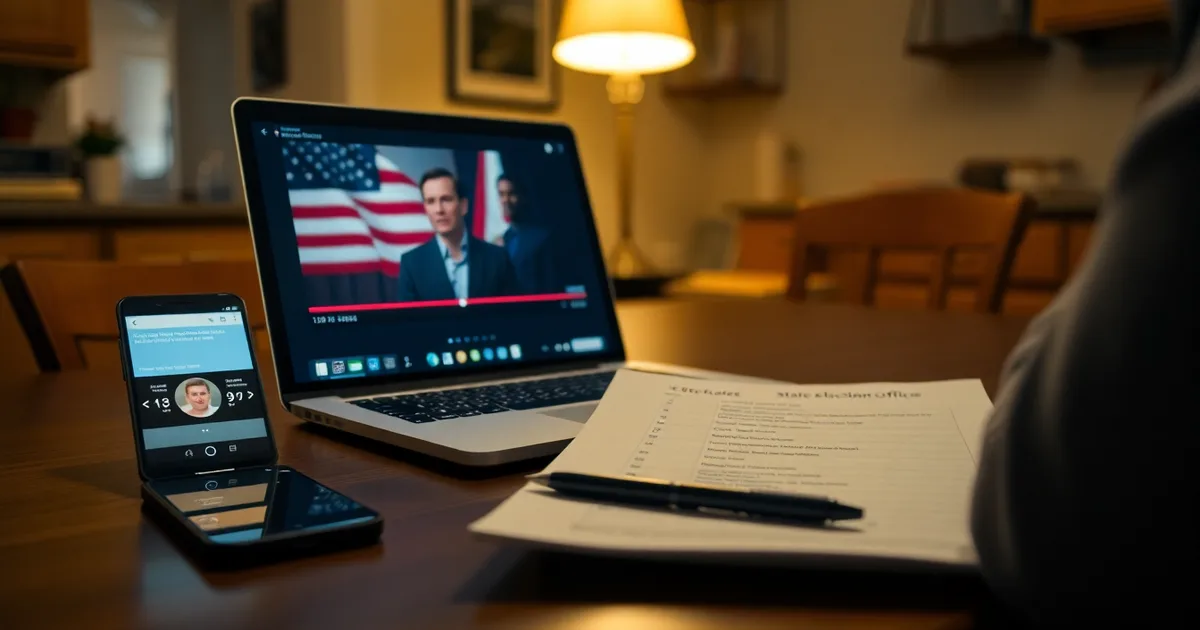
Report an AI deepfake political ad by capturing its URL, timestamp, and a screen recording, then filing with the hosting platform and your state or county election commission. The FEC regulates campaign finance, not ad content, so it is almost never the right office to call.
Twenty-two states now require disclosure when political ads use AI-generated audio or imagery. Only five attach criminal penalties to an undisclosed deepfake, which means the law in most places gives an election board something to investigate but not much to prosecute. Where you sit determines how fast anything happens.
The Federal Election Commission looked at a deepfake rulemaking in 2024 and declined to write one, leaving content complaints to state election boards and the platforms. The Election Assistance Commission keeps a state-by-state directory of election office contacts, refreshed ahead of the 2026 midterms, and that directory is the fastest way to find the right county clerk or secretary of state at 11pm.
Timing matters more than people expect. Platforms will not escalate a takedown request to their election integrity teams until you have gone through the in-app reporting flow, and a state commission typically wants the exact URL and the time you saw it alongside your own contact details. Missing either piece is the most common reason a complaint stalls.
- Platform first, always: Meta, TikTok, X and YouTube require the in-app reporting flow before a deepfake ad reaches their election integrity staff.
- FEC is the wrong door: the commission declined a deepfake-specific rule in 2024 and oversees campaign finance, not ad content.
- State law is uneven: 22 states mandate AI disclosure in political ads as of 2026, but only 5 impose criminal penalties for undisclosed deepfakes.
- Find the right office: the Election Assistance Commission's state-by-state directory, updated for the 2026 midterms, lists the authority with actual jurisdiction.
- Phone ads differ: the FCC confirmed in 2025 that AI-generated robocalls fall under the TCPA, so phone-based fakes go to federal regulators, not a state board.
How can you tell if a political ad is an AI deepfake?
You have maybe two hours before a synthetic ad gets 400,000 views and the original upload is quietly swapped for a corrected version. Identification has to happen fast, and it has to be defensible—a screengrab with your cursor hovering over the worst artifact is worth more to a state investigator than your gut feeling. Work through these checks in order.
- Watch the mouth, not the message. Generative lip sync in 2026 still drifts on plosives—p, b, m. Play the clip at 0.25x and watch the jaw between syllables. If the lips close a half-beat late on "bipartisan" or "poll," that is a synthesis artifact, not a bad upload.
- Count the blinks. Human adults blink roughly 15-20 times a minute. Early video models trained on short clips produce speakers who blink four times a minute, or blink in perfect synchrony with head turns. Both read as wrong within thirty seconds of watching.
- Check the shadows against the light source. Look at the rim of the face, the collar, and any wall behind the speaker. Diffused, directionless lighting on the face combined with hard shadows on the background is the single most common giveaway in the cheap tier of tools.
- Read the background text out loud. Signs, placards, campaign bumper stickers, and text printed on a candidate's polo shirt routinely come out as near-letters: "VOTE SMITH" rendered as "VOTE SMITFI." Text on clothing degrades first because it is small and usually moving.
- Check the hands and the ears. Fingers merge, knuckles multiply, and earlobes vanish into the jawline. AI-generated political ads almost never show a full-body shot for this reason, which is itself a tell—if a "candidate" is framed tight from the collarbone up for the entire 45 seconds, someone is hiding something.
- Run it through a detector, but treat the score as one input. Deepware Scanner accepts a video file or URL and returns a manipulation probability; Reality Defender is the tool most state AG offices and several Secretaries of State now use for triage. A 92% synthetic score is useful. A 55% score means nothing either way, and filing a complaint on a coin-flip detector result wastes an investigator's afternoon.
- Go to the candidate's official channels before you do anything else. Pull up their verified account on the same platform plus their campaign site. If the ad is not there, and their feed is actively posting other content, you have strong circumstantial evidence of a fake. If the campaign confirms the ad is theirs, stop—you may be looking at a clumsy but real production, and reporting it will not go anywhere.
The step people skip is the last one, and it is the one that sinks complaints. A voter sees an ugly, badly lit attack ad, assumes AI, and files with their Secretary of State—only to have the campaign confirm the ad is authentic and simply shot on a phone in a hotel ballroom. Verify the source first, then the artifacts. Note the exact timestamp, the platform handle that posted it, and the view count when you started watching. Washington State's Public Disclosure Commission and the California FPPC both ask for that triad on the intake form, and a complaint without it typically sits unassigned.
Which authority actually handles deepfake political ad complaints?
The Federal Election Commission regulates money, not messages. It enforces contribution limits, disclosure of donors, and the "paid for by" disclaimer under the Federal Election Campaign Act, but the FEC has no statutory authority over whether an ad's content is true, fake, or AI-generated. When the agency tried to write AI deepfake rules anyway, it deadlocked 3-3 in July 2024 and never issued them. A complaint sent to the FEC about a synthetic video will be closed, not investigated.
That leaves two bodies that can actually impose a penalty: the state election commission where the ad is distributed, and the FCC if the delivery mechanism is a robocall or text. Twenty-two states had AI political ad disclosure laws on the books as of 2026, per the National Conference of State Legislatures, and five of those carry criminal penalties for undisclosed deepfakes. Filing online with a state commission takes 15-30 minutes.
| Authority | What they handle | When to contact them | Typical response time |
|---|---|---|---|
| Federal Election Commission (FEC) | Campaign finance violations: undisclosed donors, excessive contributions, missing disclaimers | Only if the fake ad also hides who paid for it | 60+ days to even assign a case number |
| State election commission (e.g. California FPPC, Washington PDC) | Ad content and disclosure rules, including AI-generated audio and video | Within 24 hours of spotting the ad, if it targets a state or local race | 5-20 business days; fines up to $5,000 per violation in California |
| Platform (Meta, TikTok, YouTube, X) | Removal and evidence preservation: metadata, ad account ID, spend records | First, always, before you contact anyone else | 2-72 hours; keep the case number they give you |
| Federal Communications Commission (FCC) | AI-generated robocalls and texts under the Telephone Consumer Protection Act | If the deepfake reached you by phone call or SMS, not by feed | Weeks; fines up to $23,000 per illegal AI robocall under the 2025 TCPA ruling |
| Local district attorney | Criminal enforcement where the state law carries jail time or felony charges | After the state commission confirms a violation and the ad is still live | Weeks to months; often no public update at all |
For the reader who found the ad on a feed, the state election commission is the winning row: it is the only body that can fine or prosecute the creator for the fake content itself, and in the 22 states with disclosure laws it must act on a citizen complaint. The exception flips for robocalls. If a synthetic voice of a candidate called your phone, the FCC's TCPA authority is stronger than any state's, and the $23,000-per-call ceiling is the only penalty in this table large enough to matter to whoever paid for the operation.
What evidence do you need before filing a complaint?
The evidence window closes fast. Platforms deprioritise pull-down requests once an ad stops running, and campaigns often delete the post within a day of getting called out. If you saw it on X, TikTok, YouTube or Meta, start a screen recording that captures the ad playing end to end, then scroll up and down so the browser address bar, post URL and your device clock stay in frame. Timestamps in the recording should match the ad's stated run dates. On a phone, use the built-in recorder; on desktop, OBS or Windows Game Bar both write a file with a usable creation time.
Metadata is the part almost everyone skips, and it is the part state investigators ask for first. Download the video file rather than re-recording it where the platform allows — yt-dlp handles YouTube, X and most public TikTok posts, and the container's creation timestamp, encoder string and original resolution survive the download even after the post is gone. Save the sponsorship disclosure text verbatim, including the small grey "Paid for by" line most platforms render under political ads. Copy the account handle, the verified badge state, and the advertiser ID from the platform's ad library if one exists. Washington's Public Disclosure Commission and California's FPPC will accept platform ad-library screenshots as attachment evidence; an unsourced claim that "I saw it on Facebook" gets bounced.
Build the folder before you build the complaint
Screenshot the ad's landing page before it changes. Political landing pages frequently swap content or go dark within hours of a complaint being filed, and a screenshot dated after the ad disappeared carries little weight. Capture the full page, plus any donation or signup form that follows, plus whatever text sits alongside the ad in the feed. Rename each file with a date and a short descriptor — 20260913-x-post-0412-deepfake-senate-ad.mp4 — because you will be uploading these to a state portal that accepts roughly 25 MB per file and no more than about ten attachments.
Total time, done properly: 20 to 40 minutes. Filing the complaint itself runs 15 to 30 minutes on most state portals, so the evidence work is the bulk of it. Keep the originals. Uploading to a portal compresses and strips metadata in some systems, and if the case moves from a state election office to an attorney general's office — which happens when criminal penalties are in play in the five states that have them — you may be asked for the untouched files months later.
How do you file a complaint with a state election commission?
This procedure applies once you have the ad saved locally and you know which state's law covers its distribution, not where you live. If the ad ran on a candidate's Facebook page but was targeted only at Michigan voters, Michigan's authority handles it. You need three things before you start: the platform name and URL, a downloaded copy of the ad with its timestamp, and your own contact details, because most states reject anonymous complaints. Filing takes 15-30 minutes online and costs nothing.
- Find the right office through the Election Assistance Commission directory. Go to eac.gov and use its state election office lookup, not a search engine result. Google routinely returns county clerk pages and third-party "vote help" sites that cannot accept a complaint. The EAC directory lists the actual state agency, which is sometimes the secretary of state and sometimes a standalone commission.
- Confirm the agency has jurisdiction over the ad type. Campaign finance violations go to the state campaign finance regulator. False statements in campaign materials go to the election commission or secretary of state. In California that is the Fair Political Practices Commission; in Washington it is the Public Disclosure Commission. If the ad was a robocall, the FCC's 2025 TCPA ruling also applies, with fines up to $23,000 per illegal AI call, and you can file there in parallel.
- Locate the complaint link. Look for "file a complaint," "campaign finance complaint," or "enforcement" in the site's main navigation or footer. States bury this on purpose to cut frivolous filings. If you cannot find it in 90 seconds, call the agency's main line and ask for the enforcement division's intake address.
- Complete the form with specifics, not adjectives. This is the step people botch. "This ad is fake and misleading" gets closed. "This 30-second video posted 12 September 2026 at 14:20 ET on the candidate's official TikTok shows the opponent saying X; the opponent's campaign confirmed at 16:00 ET that he never said it" gets investigated. Include your legal name, mailing address, phone number, and email. Several states require a signed declaration under penalty of perjury, so read before you check the box.
- Upload the evidence as separate files. Most portals cap uploads at 10-25 MB per file and reject certain extensions. Convert video to MP4, screenshots to PNG or PDF, and keep the original file's metadata intact. If the portal will not accept large video, submit the screenshots and note that full video is available on request.
- Submit and record the complaint number. The confirmation screen usually shows a case number in the format YYYY-NNNNN or an agency-specific pattern. Screenshot it, save the confirmation email, and write down the date. If the portal gives you no number, email the agency the same day asking for written confirmation of receipt.
- Follow up if you hear nothing in five business days. Call the enforcement division, give the complaint number, and ask which investigator has it. Do not email again; the phone gets a status answer in under ten minutes in most states.
The failure mode is filing in the wrong state because you filed where you live. A complaint sent to a state with no jurisdiction is not forwarded; it is closed, and you rarely get told. If you are unsure which of two states applies, file in both. Duplicate filings cost you twenty extra minutes, and a dismissed complaint costs you the entire case.
What should you do if the ad is on a social media platform?
Report it in the app before you do anything else, because platform takedowns and legal complaints run on separate tracks and the platform track is the one that preserves a timestamped record. On Meta, tap the three dots on the ad, choose Report Ad, and select the reason closest to "political ad" or "misinformation." TikTok puts it under Share > Report > Misleading information; YouTube uses the flag icon and then "Misleading," with a free-text box worth filling properly. X's flow is Report post > Misleading > Political. Write the reason in plain terms: "AI-generated video of [candidate], not disclosed as synthetic, running as a paid ad since [date]."
Meta escalates political ad disputes through its ad review team rather than general content moderation, and the in-app form does not always route there. If the ad is actively spending money and the election is close, email the ad review team directly with the report ID in the subject line. Addresses change; the current one is posted on Meta's Transparency Center ad policies page, so check it rather than trusting a screenshot from another campaign. The same logic applies on TikTok, which has a separate commercial content reporting channel distinct from its community guidelines form.
What the platform will and will not do
Meta's 2024 election integrity operation reportedly ran around 40,000 people, but only a sliver of that headcount, on the order of 0.1%, was dedicated to deepfake detection specifically. That ratio tells you what to expect: removal is possible, enforcement is uneven, and a large fraction of reported ads stay up. Platforms also cannot fine anyone. Imposing a penalty, whether the $5,000-per-violation range the California Fair Political Practices Commission can levy or the criminal exposure that exists in the five states with penalties for undisclosed deepfakes as of 2026, is entirely the job of a state or local authority. Treat a platform removal as damage control, not as a remedy.
Save the report confirmation. Meta and TikTok both issue a report ID or case number, and some give you a status page. Screenshot it, note the date and time in your local timezone, and paste the ID into your state election commission filing, which typically takes 15-30 minutes online. Investigators at the Washington State Public Disclosure Commission and similar agencies ask for it because it establishes that you noticed the ad when you say you did. That matters if the advertiser later claims the content was posted and pulled before any complaint window opened. And on the FEC: it deadlocked 3-3 on AI deepfake rulemaking in July 2024 and has not claimed jurisdiction since, so sending a complaint there produces a form letter, not an investigation.
What happens after you file a complaint?
Most state commissions acknowledge receipt within a few business days and then do one of three things: open a formal investigation, send you a request for additional information, or dismiss the complaint with a written explanation. California's FPPC, which can fine up to $5,000 per violation for undisclosed AI ads, runs an intake triage rather than assigning an investigator to every filing. A requested follow-up is not a bad sign. Commissions often need the ad's exact impression window or a download of the creative file before they can match it against a registered advertiser's disclosure. If you get a request and sit on it for a week, the case usually closes by default.
Platform timelines move faster than government ones, which is the practical reason you report to Meta, TikTok, X or YouTube before anything else. Their election ad review queues typically resolve in 24 to 72 hours because the ad has already passed through their authorization process and carries an advertiser ID they can pull immediately. Meta's 2024 election integrity operation ran roughly 40,000 people, but only about 0.1% of that headcount touched deepfakes specifically — expect your ticket to land with a generalist reviewer, so include the exact timestamp and a screen recording rather than a still screenshot. A takedown is not a legal finding. It preserves the evidence and stops the spread, and that is all it does.
When the slow path is the wrong path
Robocalls are the exception to everything above. If the deepfake reached you as an AI-generated voice call, it falls under the Telephone Consumer Protection Act, and the FCC can act on its own authority — fines ran up to $23,000 per illegal AI robocall under the commission's 2025 TCPA ruling. File with the FCC the same day, alongside your state filing. Voice cloning campaigns typically blast thousands of numbers in a single evening, so the FCC's enforcement window is measured against the volume still in flight, not the individual complaint.
If your state commission has not acknowledged the complaint within two weeks, or has dismissed it on jurisdiction grounds, escalate to the state attorney general's consumer protection or public integrity division. Attorneys general in the five states with criminal penalties for undisclosed deepfakes have independent authority to prosecute, and several have opened cases referral-initiated from commission dismissals. Two weeks is the honest threshold — earlier escalation tends to get routed back to the commission you already filed with. Keep every acknowledgment email and case number; the AG's office will ask for them in the first reply.
Which states have the strongest deepfake political ad laws?
Jurisdiction depends on where the ad ran and who paid for it, not where you live. As of 2026, the National Conference of State Legislatures counts 22 states with AI political ad disclosure laws and 5 with criminal penalties for undisclosed deepfakes. The five below are the ones that produce actual enforcement, either because the statute is specific or because the agency has shown it will act. File with the state authority where the ad was distributed.
- California. The Fair Political Practices Commission requires disclosure when an ad uses AI to generate or substantially alter a candidate's appearance or voice, and the FPPC has treated synthetic media as a form of campaign material under the Political Reform Act. Fines for an undisclosed AI ad can reach $5,000 per violation, and each broadcast or separate post can be counted separately.
- Washington. The Public Disclosure Commission mandates labeling of synthetic media in political ads, with the disclosure required in the ad itself, not buried in a landing page or a bio. The PDC publishes its enforcement actions, which makes it one of the few state agencies where you can check whether a similar complaint led to a penalty.
- Texas. A 2023 law allows civil penalties for deepfakes published within 30 days of an election. The 30-day window is the part that matters. Outside it, the same ad may draw nothing from the state, so check the date the ad first ran before you cite this statute in a complaint.
- Minnesota. A 2024 law criminalizes deepfakes made to influence an election, which puts it in the small group of states where the exposure is criminal rather than administrative. Referrals go through county attorneys, so your complaint to the state elections office may be forwarded rather than resolved there.
- Alabama, Michigan, and Wisconsin sit in the second tier. Each has some form of synthetic media restriction, but the trigger language covers fewer ad types or the penalties are administrative warnings. Worth filing anyway, since a documented complaint builds the record even when no fine follows.
- States with no deepfake statute. If the ad ran in one of the roughly two dozen states without a specific law, your next move is the platform's political ad library and any general false-statement provision in that state's election code. A generic provision is weaker, but it is not nothing.
The item people get wrong is Texas. Campaign staffers read "civil penalties" and file as if the state will act immediately, then discover the 30-day window has already closed because the ad was seeded weeks before the election. The other frequent error is assuming a state law applies wherever the viewer lives. It applies where the ad was distributed, so a Minnesota resident seeing an ad targeted only at Ohio voters has to file in Ohio.
What if the deepfake is a robocall or phone ad?
Audio deepfakes sit outside election law almost entirely. The FCC's 2025 TCPA ruling confirmed that an AI-generated voice is a "prerecorded message" and an "artificial voice" under the Telephone Consumer Protection Act, which means one that calls your mobile without prior express consent is illegal on its face. There is no political-speech carve-out. In February 2024 the FCC made AI voices explicitly covered by the TCPA, and the fine schedule that followed runs up to $23,000 per illegal call. A robocall blast to 50,000 numbers is not a $23,000 problem.
File with the FCC at consumercomplaints.fcc.gov (the "Phone" form). Include the calling number, the exact date and time, whether it hit a landline or mobile, and a recording or transcript if you have one. The FCC does not adjudicate individual complaints the way a court does — it aggregates them into enforcement actions, which is why volume matters more than eloquence. A single complaint rarely produces a fine. Two thousand complaints about the same number almost always produce an inquiry. Save the voicemail file before it expires from your carrier's system, and if you are a campaign staffer, export it to local storage the same day.
The state track runs in parallel
The FCC is a federal regulator with civil tools. Your state attorney general has criminal ones. As of 2026, five states carry criminal penalties for undisclosed deepfakes, and robocall fraud statutes exist in all fifty — impersonating a candidate to deceive voters can be charged as election fraud, telecommunications fraud, or both. File with the AG's consumer protection division as well as the FCC. In 2024 the New Hampshire AG and the FCC both moved against the Biden robocall that went out before that state's primary, which is the model: parallel tracks, no waiting on either.
One thing that goes wrong here: people report audio deepfakes to their state election commission, which has no jurisdiction over phone calls and often no complaint intake for them. The commission will either bounce it or let it sit. Phone ads go to the FCC and the AG. If the robocall also ran as a paid radio spot or a text message with a link to a video, that fragment may fall under state political ad disclosure law — 22 states had AI disclosure statutes on the books as of the NCSL's 2026 count — and that piece does belong with the state election authority. Split the complaint by medium rather than filing one document everywhere.
Frequently Asked Questions
Can I report a deepfake political ad to the FEC?
No. The Federal Election Commission enforces campaign finance law, not ad content, so a fabricated video of a candidate is outside its remit unless the ad also breaks contribution, disclaimer or reporting rules. Route the complaint to your state election commission, which regulates electioneering communications in most states, and to the platform hosting the ad. In genuine campaign-finance cases you can file an FEC complaint at www.fec.gov; typical processing runs 60 days or more.
How long does a state election commission take to respond to a deepfake complaint?
Expect an acknowledgment within roughly 5-10 business days, and a full investigation to take several weeks. California's Fair Political Practices Commission, for instance, aims to notify complainants once a case is opened, but its enforcement division can take 30-90 days to reach a finding on a synthetic-media disclosure violation. In the run-up to a November general election, dockets swell and timelines stretch; if the ad airs within 14 days of the vote, say so in your filing to flag urgency.
What if the deepfake ad is from a foreign country?
Report it to the platform and to the FBI's Foreign Influence Task Force, which coordinates foreign election-interference cases. State election commissions generally lack jurisdiction over actors outside their borders, and the FEC has no authority over foreign-produced content that never touches U.S. campaign funds. The FBI accepts tips at tips.fbi.gov; note the ad's URL, hosting provider and any account handles. If a foreign government is behind it, the State Department's Global Engagement Center may also track the campaign.
Do I need a lawyer to file a deepfake political ad complaint?
No. You can file pro se with a state election commission or the FEC; commissions accept sworn complaints from any registered voter without counsel. Hire a lawyer only if you intend to seek damages, defamation remedies or injunctive relief against the ad's creator — a separate civil action from the regulatory complaint. For a plain disclosure violation, a written statement of facts, the ad URL and your evidence is sufficient.
Is it illegal to create a deepfake political ad?
Not universally. As of 2026, 22 states require AI-generated political ads to carry a disclosure label, and five — including California, Texas and Washington — attach criminal penalties for undisclosed deepfakes, ranging from misdemeanor fines to felony charges for intent to deceive voters. Federal law still has no standalone deepfake-election statute, though the FCC's AI robocall rules and the 2024 FEC AI advisory cover narrow cases. Creating one is lawful if disclosed.
What evidence is most important for a deepfake complaint?
A screen recording that captures the ad playing, the full URL and a visible timestamp is the single most persuasive item — it survives deletion and proves what aired when. Pair it with the ad's metadata (upload timestamp, account ID, platform transparency-report entry) and, where possible, a forensic report from a tool such as Hive or Deepware showing an AI-generation confidence score above 90%. Screenshots alone are weak; platforms and commissions routinely reject them as unverifiable.